

The Parrot Trick That Explains AI
60sThe relatable parrot analogy makes a complex AI concept instantly fun and shareable.
▶ Play Clip"Delivers exactly what the title promises — a clear intro to 10 AI terms — with an occasional sponsor detour."
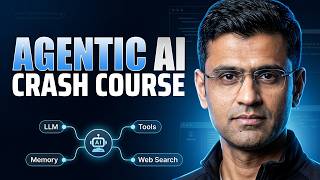
This video breaks down 10 essential AI jargon terms in a simple and fun way, using the analogy of a parrot named Buddy. It covers everything from basic AI and language models to advanced concepts like fine-tuning, RAG, AI agents, and MCP, helping viewers understand how AI tools actually work.
AI means giving computers the ability to do work that humans are good at, such as writing emails, recognizing images, driving cars, and writing code. AI is a broad umbrella term covering many technologies.
A language model is a computer program that predicts the next word in a sequence. It uses statistical probabilities learned from conversations, like Peter's parrot Buddy, and can auto-regressively generate full answers.
An LLM is a language model trained on massive amounts of internet data, Wikipedia, books, and news articles. Examples include GPT, Claude Opus, and Gemini. LLMs can write poems, answer questions, and solve complex math problems.
A prompt is a command given to an AI. Vague prompts lead to vague answers, while specific prompts produce expected answers. Prompting is a skill for effectively using AI tools.
Tokens are parts of a sentence, similar to words but often smaller. For example, 'unbelievable' is split into 'un', 'believe', and 'able'. Tokens determine cost and memory limits for LLMs.
Context window is like a desk that holds data AI can consider at once. A larger context window allows more text to be processed at the same time. Models like GPT and Gemini have specific context window limits.
Hallucination occurs when AI generates false or made-up information with high confidence. Users must verify AI outputs and not trust AI blindly.
Fine-tuning is customizing a pre-trained AI on additional data, like giving a company handbook to a new employee. It allows the model to answer questions on new information without retrieving external sources.
RAG combines a model with external references. The AI keeps a book as a reference and reads answers from it when asked, ensuring grounded, accurate answers. RAG is used in the majority of AI projects today.
An AI agent goes beyond question-answering by performing tasks using tools. For example, Amazon's Rufus can add items to a cart and place orders. An agent is 'AI with hands, not just a mouth.'
MCP standardizes how different tools and applications connect to LLMs, similar to a USB hub. It allows connecting calendar, email, Notion, Docs, Drive, Slack, etc., to AI tools like Claude.
By the end, you'll not only know the jargon but also understand the purpose behind each term — a solid foundation for anyone using AI tools in daily life or work.
What does AI stand for?
Artificial Intelligence.
00:16
What is a language model?
A computer program that predicts the next word in a sequence.
00:45
What makes a large language model (LLM) 'large'?
It is trained on massive internet data, including Wikipedia, books, and news articles.
03:06
Why does prompt specificity matter?
Vague prompts give vague answers; specific prompts yield expected answers.
03:51
What are tokens in AI?
Tokens are parts of a sentence, similar to words but often smaller pieces like 'un', 'believe', 'able'.
04:37
What is a context window?
The amount of text AI can consider at once, like the size of a desk.
05:17
What is AI hallucination?
When AI generates false or made-up information with high confidence.
06:00
What is fine-tuning?
Customizing an AI model on additional data, like training a new employee on company processes.
06:28
How does RAG differ from fine-tuning?
RAG references an external source to answer questions, while fine-tuning memorizes new information in the model.
07:21
What is an AI agent?
AI that can perform tasks using tools, not just answer questions.
08:14
What does MCP stand for and what does it do?
Model Context Protocol; it standardizes how tools and applications connect with LLMs, like a USB hub.
08:44
Language models predict the next word
The parrot analogy makes statistical next-word prediction intuitive.
00:45LLMs are trained on massive data
Scaling with internet data unlocks poem writing and complex math.
03:06Prompt specificity drives quality
A simple rule: vague prompt, vague answer; specific prompt, expected answer.
03:51Fine-tuning vs. RAG
Contrasts memorization with retrieval, a core distinction in AI system design.
06:28MCP standardizes tool integration
The USB hub analogy explains why MCP is a game-changer for connecting apps to AI.
08:44[00:01] in order to use AI, [music] but you need to know these 10 words to use AI effectively. In this video, we are going to go through these 10 AI jargons. We are going to keep it light and fun. Peter keeps on hearing this term AI
[00:16] everywhere, in news, social media, in office, etc. But what exactly is it? AI office, etc. But what exactly is it? AI stands for artificial intelligence. AI means giving computer the ability to do work which we the humans are generally
[00:30] good at. For example, writing emails, recognizing images, driving a car, writing code, etc. AI is a big umbrella. Everything falls under it. Now, let's understand how AI understands the language. That's where the next term
[00:45] comes in play. Assume Peter has this intelligent parrot called Buddy. Buddy is good in its mimicking abilities and it has a sharp memory. So, he's
[00:57] listening to all the conversations which are going on in Peter's home. Whenever Peter says something like feeling hungry, I would like to have some, Buddy will say biryani. Buddy will not say things like camera or chair, etc.
[01:13] Because he has been hearing these conversations for a long, long time. And he has noticed that anytime if a person is hungry, they will either say food, is hungry, they will either say food, biryani, pizza, and so on. So, Buddy has
[01:28] developed this uh statistical probability model in his brain such that would like to have some, he would usually say biryani, cherries, or food. And the probability of him saying this is much higher than the probability of
[01:43] him saying bicycle or a book. He will not say, "I would like to have some not say, "I would like to have some bicycle for eating." This is called a language model. A language model is a computer program which will complete the
[01:56] next word. And once it completes the next word, it can again complete the next word, next word, and so on. And it can go into this auto regressive generation to give you the full answer. I want to take a moment to thank today's
[02:10] sponsor, Open Router. If you're building anything with AI today, you know the problem. You want to use cloud for reasoning, GPT for general task, Gemini for long context. But that means three different API keys, three different
[02:24] billing accounts, three different SDKs. Open Router solves this problem by giving you a single API that gives you access of more than 300 models from every single major provider. One key, one bill, one integration. The best part
[02:40] is you can switch models by changing one line of code. [music] No rewrites, no line of code. [music] No rewrites, no new SDK, no migration headaches. For our team at Codebasics, this means we can pick the right model for each job
[02:52] without locking into one provider. If a better model launches tomorrow, we can Router using the link in the video description below, which is openrouter.ai. All right, back to our video now. Now
[03:06] assume Buddy got some divine magical powers, and now, instead of listening to a conversation in one home, he's now flying across cities, he's
[03:18] listening to all kind of conversations, he's reading book, and he has all the world's knowledge. So, instead of being a language model, Buddy has now become a large language model. Large language models are trained on a massive amount
[03:34] of internet data, Wikipedia, books, all the news articles, and so on. The examples of large language models are GPT, Claude Opus, Gemini, etc. With this new ability, Buddy can now write poem, it can answer questions, it can solve a
[03:51] complex math problem. The next word is prompt. Prompt is also a command. When Peter says sing a song to Buddy, Buddy can sing a song, but that may not be as per the expectations of Peter. So, sing a song is nothing but a prompt or a
[04:07] command that Peter is giving to Buddy. And if Peter wants to be specific, he'll say sing the famous dance song from RRR. And in that response, Buddy will say Naatu Naatu. So, here the prompt has to be specific, and then LLM will generate
[04:25] generate. So, vague prompt, vague answer. Specific prompt, the expected answer. Prompting is a skill when it comes to using AI tools. The next one is
[04:37] tokens. Let's say there is this word unbelievable things happen. But the way Buddy hears these words is he will hear them into component, into pieces. And these pieces may look something like
[04:50] this. These are similar to words, but you can see that for word unbelievable, you can see that for word unbelievable, you have un and believe and able. These are called tokens. Tokens are the parts of the sentence. They are similar to
[05:05] words, but even a smaller portion of the word can even a smaller portion of the word can be a token. And LLMs understands this language of tokens. Tokens matter because they determine the cost and
[05:17] memory limits. The next one is context window. Think about context window as a window. Think about context window as a desk that you have on which how much data you can put. A small desk can have only two or three paper open. But if you
[05:31] want to have lot of papers open where Buddy can read the paper and give you the answer, you need to have a bigger desk. So, this size of the desk is essentially context window. Context window means how much text AI can
[05:46] window means how much text AI can consider at once? All these models, GPT consider at once? All these models, GPT 5.3, Gemini, Opus 4.6, 4.7, they have a specific context window limit. The next one is AI hallucination. Sometimes AI
[06:00] produces an answer with a lot of confidence which sounds correct, but in reality, the answer will be wrong. Hallucination means when AI generates false and made-up information with a lot
[06:14] of confidence, but it doesn't have reality. That is basically hallucination. While using AI, you need to do some kind of verification. You can't trust AI blindly. The next one is fine-tuning. Fine-tuning is a process of
[06:28] fine-tuning. Fine-tuning is a process of customizing AI on some additional data. Let's say Buddy knows a lot of things about the world. He's generally trained. about the world. He's generally trained. Now, he's joining a company, and in that
[06:41] company he is given the company's handbook. So, using the handbook, he's training himself. He's learning about the rules, the culture, and so on. And then tomorrow, if somebody asks him a question without referring to company's
[06:54] handbook, he'll be able to answer those. So, Buddy is an entity which is already trained on some knowledge. Now, you're giving it some additional small knowledge, and you can train it so that it answers the
[07:08] questions on that new set of information as well. To summarize, it is like training a new employee on your company's processes. The next word you'll often hear in AI discussions is retrieval-augmented generation, also
[07:21] known as rag. So, in rag, what Buddy will do is he will have the book with him. He doesn't need to train himself. He can keep the book with him as a
[07:33] reference, and when somebody asks the question, he will open the book and give the answer. This way, he's not pulling the answer from his memory, but he is referring to a book and reading the answer. So, the answers are always right
[07:47] and they are grounded in some kind of source knowledge. Whereas in fine-tuning, Buddy is training his brain. He's memorizing things and answering the questions. Rag is a technique that majority of the AI
[07:59] projects uses nowadays. The next word, which is very popular nowadays, AI agent which is very popular nowadays, AI agent or agentic AI. So far, Buddy was only answering the questions. But what if you give it an ability to perform tasks? For
[08:14] example, it can go and do things. It can pick vegetables for you. It can cook food for you. That's an AI agent. AI agent is not just a question and answer agent is not just a question and answer chatbot, but it is given access of tools
[08:29] so that it can perform tasks for you. Amazon's Rufus AI chatbot is an example of an agent. So, that chatbot can not only answer your questions, but you can say, "Okay, add this item to my card,
[08:44] place an order." It can do all of that. To summarize, agent is an AI with hands, not just a mouth. And the last one, model context protocol, also known as model context protocol, also known as MCP. Think about USB hub. Previously, if
[08:57] different devices, keyboard, mouse, monitors, etc., you had to plug these 10 different wires directly into your laptop. But now, with the USB docking
[09:09] laptop. But now, with the USB docking station, you can have single USB-C going into your computer and remaining devices can just go directly into your USB hub. can just go directly into your USB hub. Basically, it is standardizing the way
[09:22] devices connects with the laptop. Similarly, model context protocol is standardizing how different tools and applications connect with LLM. You want to connect your calendar, email, Notion, Docs, Drive, Slack, etc. with your AI
[09:37] tool. For example, you can connect all these different tools with your Claude and you can perform tasks. And the way it will do it is using model context protocol. All right, so that's your 10 words in your AI vocabulary. You are now
[09:52] already ahead of so many people who are using AI because you not only use AI, you actually understand all these different jargons and their purpose. for watching. If you have any question, post in the comment box below.

⚡ Saved you 0h 10m reading this? Transcribe any YouTube video for free — no signup needed.