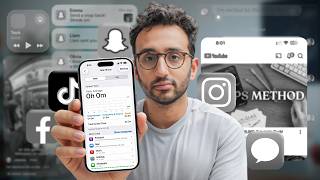

The 5-Minute Rule to Fix Focus
45sA simple, actionable productivity hack that promises immediate relief from distraction, highly relatable and easy to test.
▶ Play Clip"The title accurately promises 17 micro habits, and the video delivers exactly that with clear, actionable advice."
This video presents 17 micro habits designed to improve attention span and focus, emphasizing practical strategies to combat modern distractions like smartphones and short-form content. The speaker, Ali Abdaal, draws on personal experience and research to offer actionable tips for training the brain to concentrate for longer periods.
The first 5 minutes of any task are the hardest; telling yourself to do it for just 5 minutes helps overcome initial resistance and makes it easier to continue.
Reading books, listening to audiobooks, or watching movies trains the attention span better than short-form content like TikTok or Instagram Reels.
Charging your phone outside the bedroom prevents nighttime scrolling, which harms sleep, mood, and focus.
Use system-based blocks rather than willpower to limit access to distracting apps after a certain time.
Avoid multitasking with your phone while watching TV or movies to train sustained attention.
Forcing yourself to follow a show without subtitles improves focus and attention span.
Working in busy coffee shops or different libraries trains you to focus in various settings, enhancing adaptability.
Use built-in phone limits (e.g., 10-15 minutes per app) to reduce overall screen time and improve attention.
Ideally in another room; otherwise, use Do Not Disturb and place it face down to reduce temptation.
80% of distractions come from internal emotional states like boredom or anxiety, not external notifications. Recognize and sit with the feeling instead of escaping it.
Use tools like Whisper Flow to speak ideas instead of typing, reducing friction and helping you get into the zone.
Tracking word count or other metrics provides a sense of progress, which is motivating and helps maintain focus.
Avoid stimulating breaks (email, social media); instead, do activities that genuinely recharge energy.
Working in environments where others are focused (libraries, coffee shops) naturally encourages focus.
Sleep, nutrition, exercise, and socialization are foundational for attention span; address these before blaming software issues.
Mute all non-essential notifications to reduce distractions.
Making tasks even 10% more enjoyable reduces boredom and improves focus, a core idea from the book 'Feel-Good Productivity'.
By consistently applying these micro habits, you can train your attention span to be more resilient against modern distractions. The key is to build systems that reduce reliance on willpower and to address both internal triggers and environmental factors.
What is the 5-minute rule for focus?
Tell yourself you'll do the task for just 5 minutes; after that, it becomes easier to continue.
What percentage of distractions are triggered by internal emotional states?
Around 80%.
07:45
Name two internal triggers for distraction mentioned in the video.
Boredom and anxiety (also fear, insecurity, perfectionism).
07:45
What is the 'gold standard' for phone placement during focus?
Having the phone in a different room altogether.
07:00
What tool does Ali recommend for speaking ideas instead of typing?
Whisper Flow.
09:30
What are the 'hardware problems' that affect attention span?
Sleep, nutrition, exercise, and socialization.
13:30
What is the core thesis of 'Feel-Good Productivity'?
Enjoyment is the secret to focus and productivity.
14:45
The 5-Minute Rule
A simple, actionable technique that leverages the natural difficulty of starting a task.
Internal Triggers for Distraction
Reveals that most distractions are emotional, not external, shifting the focus to self-awareness.
07:45Hardware vs. Software Problems
Emphasizes that basic health habits are foundational for focus, often overlooked.
13:30Making Tasks Fun
Introduces a counterintuitive approach: enjoyment boosts focus and productivity.
14:45[00:00] Ladies and gentlemen, welcome back to the channel. In this video, we're going to talk through 17 micro habits that you can incorporate into your life to try and fix your attention span before it's too late and the robots come for us all. The first 5 minutes of any task are the ones where we are the most prone to getting distracted. There's an absolute peak of this just before we start doing the task and then usually you
[00:18] find that about 5 minutes into the task, it's like it's actually a lot easier to stay focused than you were at the start. What that leads to is something really popular in the productivity space, the 5minut rule. If you are struggling with staying focused on anything at all, just tell yourself you're going to do it for 5 minutes. Or if you're in the middle of a focus session and you're finding yourself getting distracted, tell yourself, "I'm
[00:36] just going to do it for another 5 minutes." If you can sit through the discomfort of just doing it for 5 minutes, you'll usually find that it's a lot easier to stay focused and for your attention span to stay on task with that particular thing. Consume more long- form stuff. I'm not saying you have to cut out all forms of entertainment. But in general, the more you're consuming things that are longer form like books or audio
[00:54] books or movies rather than Tik Toks and Instagram reels and YouTube shorts, the more you are able to train your attention span to focus on stuff for a little bit longer. Get your phone away from the bedroom. One of the biggest time syncs in the world is when we are scrolling on our phone for no reason at nighttime. This is just terrible for our attention span. It's terrible for our focus, and it's also really terrible for
[01:13] our sleep and for our mood and for all of the things in life. So, ideally, you'd be charging your phone not in your bedroom, and so you can say good night to your phone before you go to bed. But if your phone absolutely has to be in your bedroom, it's worth setting up the charger across the bed so that you're not tempted to reach for it if you can't get to sleep. Set your phone to automatically
[01:31] block offending apps after a certain time at night. I'm a big believer of building a system rather than requiring your own willpower to do sensible things like training up your attention span or training your ability to focus. If you are watching a TV show or a movie, do it without reaching for your phone. This is another example of being able to consume long- form content, which is still entertainment in various ways, without having to do something
[01:49] else at the same time. If you're watching a TV show or movie, try watching it without the subtitles on. I know sometimes it's difficult to follow what's being said, and sometimes it is genuinely difficult to follow the plot to figure out like, wait, who is that character again? What do they actually want? But by forcing yourself to watch stuff without the subtitles, you're actually training your attention span, which means you can get entertained and also be
[02:07] running this training program at the same time. Change up the environment in which you work. Yes, it's all well and good having a nice productivity desk setup where you've got everything like arranged as you like it, but there's also something about being able to take your laptop into a very crowded, very busy coffee shop and training yourself to be able to focus in that particular environment. When I was at university, I found that in my first
[02:25] year of med school, I was only really able to focus when I was in my own room, but then that would get kind of lonely. And so from my second year onwards, I found that going to different libraries and different coffee shops, a was way more enjoyable, which meant I just had a better time. But B, what it did was that it forced me to train my attention span and my focus so that I actually could
[02:43] focus in those coffee shops. And especially if you're using stuff like noise cancelling headphones, this is really not as hard as it can sometimes appear. And the benefit of this is that it means you can then train yourself to focus in almost any environment. Oh, by the way, if you're interested, we actually have a completely free 7-day focus crash course, which is a free email course. You just enter your email and then basically every day for
[03:01] 7 days, you get some very detailed emails with some amazing strategies on how to improve your focus. That'll be linked down below if you want to check it out. Set screen time limits on your phone. To be honest, a lot of the tips in this video are about the damn phone because the damn phone tends to be the thing that is stealing our attention span more so than anything else. And so, all modern phones these days
[03:20] have built-in screen time limits. Like, limit yourself to Instagram for 10 minutes, 15 minutes. And if you can do that, I can guarantee that your attention span is going to be way better compared to someone who's like got 8 hours of screen time on Instagram or on Tik Tok. While you are trying to focus on something, get the phone away from you. Ideally, you would have it in a different room altogether. That would be the gold
[03:38] standard. Silver standard would be that it's in the same room, but it's in some kind of do not disturb focus mode and it's like away from your desk. And like bronze standard, which admittedly is the one that I do, is that you have it on some kind of do not disturb focus mode, so you don't get any notifications. And you also have it turned face down so you're not like tempted to look at the phone. Get
[03:56] good at understanding your internal triggers for distraction. There is a wonderful book by my friend Near Eel called Indistractible, which is basically about how to take control of your attention span. And the research that he summarizes in that book. What it basically suggests is that in around 80% of cases, the key trigger for our distraction is not actually something like an external notification, but it's actually some kind of internal emotional state that we are seeking to
[04:14] escape. Something like boredom or something like anxiety or fear or insecurity or perfectionism. And so we have those kind of feelings, those internal bodily sensations that come up as a result of us trying to I don't know do some work that might be tricky. And instead of recognizing the feeling and sitting with the feeling and just sort of like experiencing the feeling, we feel so uncomfortable with what is just ultimately an internal bodily sensation that's not
[04:32] really going to harm us that we have to reach for the phone to try and distract us from that internal experience. So if you recognize this and you actually want to train your attention span, one thing that's useful to do is when you feel that internal trigger, it's helpful to take a step back and to try and name what emotion you're feeling. Is it fear? Is it uncertainty? Is it doubt? Is it anxiety? Is it perfectionism?
[04:50] Is it I'm afraid of what other people will think? Like what's the thing? And secondly, in that moment, if you close your eyes and you try and just really fully feel the feeling. So rather than trying to escape the feeling of discomfort, actually what does it feel like if you just lean into that feeling of discomfort? And usually you find if you do that that the feeling has not actually killed you, it's actually not harmed you
[05:09] in any way at all. And then the more practice you have of doing this thing where you recognize the emotion and allow yourself to fully feel it, the more it trains your brain and your body to not try and run away from what might seem to be unpleasant emotions on the surface. The more you can do that, the less likely you are to get distracted by stuff. And therefore, you have just trained your attention span to
[05:27] be able to focus for longer. Now, another way to increase your attention span is to minimize friction when you are doing deep work. Now, just like you, a lot of my work is done on the computer. And one of my favorite ways of getting in the zone is to speak out my ideas instead of typing them. So, there's an app that I've been using pretty much every day lately, and that is Whisper Flow, who are very
[05:45] kindly sponsoring this video. Whisper Flow is amazing. You install it on your Mac and then you hit a keyboard shortcut and then you just speak whatever you want and it will do an amazing job of transcribing the stuff that you've said and putting it into wherever you've got your cursor and it also adapts the tone and the formatting based on where you're writing. So whatever I say then becomes either a casual message or a properly formatted
[06:03] email or a structured document depending on the context. So for example, over the weekend I was working on some changes to the lifestyle business academy curriculum which is this online business school that we're working on. But at the end of the day, I was like, "Ah, I need to type out all of these different changes I've made so I can communicate them to the team and to our students." And so instead of having to like painstakingly
[06:21] type out everything and sort of format it and structure it appropriately, I just spoke out a spiel into Whisper Flow and it did an amazing job of formatting things exactly how I wanted. So in my case, all of my work is actually downstream of writing. So ideas and courses and newsletters and YouTube videos and books and so having my thoughts recorded and accurately transcribed when I'm using my computer is a massive, massive unlock for me. So
[06:39] if you're still manually typing things out, you might like to give Whisper Flow a go. Head over to whisperflow.ai/ Ali and use the code Ali to get one month completely for free. And that link will also be down in the video description. So, thank you again to Flo for sponsoring this video. And let's get back into it. Track your progress with whatever task you're doing. Writers figured this out ages ago. Almost every writer who writes for
[06:57] a living will find some kind of way of tracking their word count. This is the principle that video game designers tap into as well. Like whenever you're like killing the monsters in World of Warcraft or whatever, you can see your experience bar going up and you can see yourself leveling up. And this is often what would make what what is otherwise an a grindy unenjoyable activity into something that feels genuinely good. Because we as humans are
[07:16] hardwired to seek progress when we can experience and feel ourselves making progress in whatever the thing is. Even if it's something arbitrary like killing a number of bears in World of Warcraft or if you're a salesperson like putting beads into a jar for every sales call you make. That feeling of progress is profoundly motivating to encourage us to continue doing the thing. And therefore, as a result, by tracking your progress, you're actually improving your ability to
[07:34] focus on that task for longer. Take recharging rather than stimulating breaks. A lot of the time what I see in people who are working on starting businesses for example is that you know they'll work on the thing for I don't know 45 minutes, 50 minutes or an hour and then they'll take a break. But in that break they will do something that is generating even more stimulation. They will check their email. They'll check their Slack messages.
[07:52] They will look at social media and see what notifications came in. Now what that does is that it doesn't relax us. It does not recharge us. But what it does is it just adds more stuff to our mental to-do list. And this has the opposite effect of actually recharging us during a break. So wherever possible during the breaks that you are taking away from focusing actually focus on things that genuinely recharge your energy rather than creating
[08:10] more open loops in your mind. Try to surround yourself with other people who are also trying to focus. This is the incredible power of working in libraries or working in coffee shops where everyone's got their MacBooks out and everyone seems to be working. When you are in an environment where other people are working, it just naturally nudges you away from doing distracting things and actually towards working. And the more you're able to do that, again, the
[08:28] more you're training your indistractibility, the more you're training your attention span, the more you're training your ability to focus. Diagnose and fix problems with your hardware. Now, a lot of the times something like attention span or focus, that's sort of like a software problem. It's sort of like, you know, or or at least we can conceptualize it as an issue with our brain, our brain's ability to focus. But one thing that has a remarkable impact on
[08:46] your brain's ability to focus is what are the stats of the rest of your body? Have you slept appropriately well? Have you eaten healthy food? Have you exercised recently? It's the boring stuff like that, the hardware problems that often end up fixing the software problems. So, if you're finding that you're having an issue with your attention span, honestly, the first thing to look at is how's your sleep? How's your nutrition? How is your exercise? Are you
[09:04] getting some basic level of socialization? Because we as humans need connection with other people. And if you haven't ticked any of those boxes, you are leaving a lot of focus points on the table. Turn off all of your notifications other than the ones from friends and family. We are constantly getting pinged by all of these apps that are just stealing our attention span. And so what I find helpful is that anytime I see a notification from
[09:23] an app that is not immediately actionable or that's kind of annoying, I will just long press and I will mute all notifications from the app. With whatever you're doing, ask yourself the question, what would this look like if it were fun? Generally, we struggle with our attention span and we struggle with our focus on things that we find boring. But if you can find a way to make the task even just 10% more enjoyable, you're a
[09:41] lot less likely to be distracted and you're also going to be more productive, more creative, and you'll have more energy to give to the other important areas of your life. This is the exact thesis behind my New York Times bestselling book, Feelgood Productivity. If you haven't yet checked it out, or maybe if you have and you need some revision, there is a video over here that we've put together which is the introduction to that book that
[09:59] explains the core fundamental thesis. It explains the science behind why enjoyment is actually the secret to focus and productivity. And there's a bunch of really cool animations in that video which is based on the first chapter of the audio book that you can check out in that video right over there. So, you should definitely check that out. Thank you so much for watching and I will see you



⚡ Saved you 0h 10m reading this? Transcribe any YouTube video for free — no signup needed.