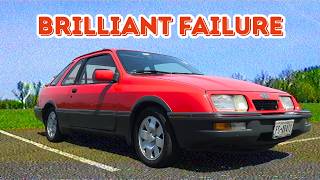

Selling the Merkur XR4Ti: A Masterclass
40sThe satirical sales pitch for a weird car is both hilarious and educational, perfect for car enthusiasts and comedy lovers.
▶ Play Clip"The title accurately reflects the video's content: a review of the 1987 Merkur XR4Ti with the signature Regular Car Reviews style."
The video reviews the 1987 Merkur XR4Ti, a unique collaboration between Ford and its European division, sold in Lincoln-Mercury dealerships. It explores the car's quirky design, turbocharged performance, and the reasons behind its commercial failure, while also reflecting on its cult status and driving experience.
The video humorously describes how to sell the XR4Ti, targeting sophisticated drivers unfazed by terms like 'foreign,' 'turbocharged,' and 'rear-wheel drive.' It lists potential buyers including a doctor, a man with espresso, and Michael Jackson.
The video is sponsored by Lasfit, which offers custom-fit floor mats. The host demonstrates cleaning the mats with GP cleaner and a stiff brush, highlighting their durability and ease of maintenance.
The XR4Ti's angular, retro-futuristic design is described as looking 'illegally parked' anywhere. The video explains that Ford's financial struggles in the early '80s forced them to take risks, leading to the creation of this car.
Ford executives developed a plan to create an American version of the European Ford Sierra XR4i, spearheaded by Bob Lutz. Lutz wanted to sell it through specialty import dealers, but his superiors overruled him, opting for Lincoln-Mercury dealerships.
Sales topped 25,000 units in the first two years but plummeted to under 3,000 in the third year due to a weaker US dollar and price increases. Ford discontinued the XR4Ti in 1989 as the Taurus revived the company.
The host praises the car's torque-heavy turbocharged engine, grippy handling, and responsive steering. The example car features modifications like an LA3E ECU, cold air intake, lightweight flywheel, and Rapido intercooler, enhancing performance.
The cabin is described as spacious yet slightly cramped, with a well-aged interior that feels modern in its simplicity. The layout is uncluttered and tactile, with buttons and switches that are easy to use.
The video attributes the XR4Ti's failure to being sold in the wrong dealerships, a lack of brand recognition, and challenging styling. The Merkur name was seen as pretentious, and the car's alphanumeric designation was unfamiliar to buyers.
The car was too antithetical to American tastes in the 1980s, which favored large, soft, floaty cars. The XR4Ti's firm ride and driver-focused nature were out of place in Lincoln-Mercury showrooms.
The host reflects on the German concept of Weltschmerz (world pain) in relation to the XR4Ti's failure. Despite its commercial flop, the car remains a beloved oddity that offers a unique driving experience.
The 1987 Merkur XR4Ti was a bold but mismanaged experiment that failed due to poor marketing and cultural misalignment, yet it remains a cherished driver's car with a cult following.
What was the original European model that the Merkur XR4Ti was based on?
The Ford Sierra XR4i.
05:32
Who was the auto executive behind the idea to bring the Sierra to the US as the Merkur XR4Ti?
Bob Lutz.
05:32
What does 'Merkur' mean in German?
Mercury.
06:33
How many units did the XR4Ti sell in its first two years?
Over 25,000 units each year.
07:28
What was the factory horsepower and torque of the 2.3L turbocharged engine?
175 horsepower and 200 lb-ft of torque.
09:49
What modifications were made to the example car in the video?
LA3E ECU from a Thunderbird Turbo Coupe, true cold air intake, lightweight flywheel, and Rapido intercooler.
10:02
Why did Ford discontinue the XR4Ti in 1989?
Because the Taurus had revived the company, and they no longer needed to take risks.
07:55
What is the German term 'Weltschmerz' used to describe?
Melancholy caused by the discrepancy between the bleakness of the real world and an idealized version of how the world should be.
18:58
Unique Design
The car's angular, retro-futuristic design is described as looking 'illegally parked' anywhere, highlighting its distinctive appearance.
04:10Ford's Financial Struggles
Ford's financial crisis in the early '80s forced them to take risks, leading to the creation of the XR4Ti.
05:06Sales Decline
Sales plummeted from 25,000 to under 3,000 units in the third year due to a weaker dollar and price increases.
07:28Driving Experience
The host praises the car's torque-heavy turbocharged engine and responsive handling, calling it a joy to drive.
08:22Reasons for Failure
The car failed due to being sold in the wrong dealerships, lack of brand recognition, and challenging styling.
13:33[00:05] How to sell the 1987 Merkur XR4Ti in your Lincoln Mercury dealership, where it may or may not belong. Representing the Ford Motor Company's unshakable confidence in the American buying public, the 1987 Merkur XR4Ti
[00:23] is an [music] exciting entry into the luxury sport market for sophisticated drivers unfazed by such terms as foreign, [music] turbocharged, rear-wheel drive,
[00:38] and polyamory. You can expect a diverse range of refined drivers to be among the customers for this boutique European Toilette? >> Buyers will include, but are not limited
[00:54] to, doctor, man with espresso, newly married bank manager, newly divorced architect, three Bavarian children in a trench coat,
[01:08] Major League baseball player, Soviet intelligence operative, Michael Jackson. The avant-garde exterior represents a challenging aesthetic to consumers distrustful of math.
[01:24] If a customer asks why their Merkur has two rear spoilers, gently reassure them that shut up. If a customer expresses worry that the turbocharged engine is
[01:36] more aggressive than the standard Lincoln Mercury vehicle, redirect them reconditioning. If struggling to close the deal, remember this simple acronym: confidence helps all our sales.
[01:53] Confidence can put even the most doubtful cheeks in the driver's seat of a Mir core. So, establish dominance through gentle negative reinforcement. You clearly enjoy less complex [music] vehicles. I hear the Mercedes dealership
[02:08] vehicles. I hear the Mercedes dealership down the street still has 190s in stock. gearbox. May I ask if you've ever been tested for [music] power steering dependency? With your marketing savvy, the Mir core
[02:22] brand is sure to be around for decades to come. Today's episode of Regular Car Reviews is sponsored by Lasfit. And this is a is sponsored by Lasfit. And this is a Mustang Mach-E. Lasfit are laser scanned
[02:35] custom fitted floor mats that offer more protection than stock floor mats, and they fit perfectly into your foot wells. Now, most of the time when you see floor mats like these, they're clean, fresh out of the box, and going in. But these
[02:48] out of the box, and going in. But these are dirty, nasty. They did their job. And this Mustang saw winter, saw the beach, saw construction sites, and now to clean. They pop out of the stock floor carpet anchors. You bend them and
[03:04] back in the car. And now I'm spraying them off with GP cleaner. GP cleaner just means general purpose cleaner. Now I agitate the floor mats with a stiff bristled brush. Once I get it all foamy, I spray it off with plain water. Then
[03:19] you put them out in the sun, let them dry, dab them off, and in they go back in. No spending a lot of time there with the vacuum, getting stuff up, and it doesn't come clean. Nah, these things clean up easy. And they're free of all
[03:32] stain. And they use premium TPE material, free of harmful substances and odors. They're neither too rigid like plastic nor too soft like rubber. And they won't turn yellow, brittle, or get hard over time. You can also see as I'm
[03:45] putting them all clean inside that they go up under your pedals, your brake pedal, your accelerator. That way all the stuff that comes of your boots gets caught by the Lasfit floor mats. So, just click the link in the description
[03:57] and use code RCR to save money on the Lasfit website. Once again, click the link in the description and use code RCR to save money on the Lasfit website. to save money on the Lasfit website. Thank you. The 1987 Merkur XR4Ti is a
[04:10] car that looks illegally parked no matter where it's parked. Why does it look like this? And why do I feel such a deep kinship with it? This angular retro-futuristic wind tunnel carved recumbent upvote
[04:24] button could only have existed at a time when Ford was open to being weird as a matter of necessity because there is no greater recession indicator than Ford actually trying. But in the early '80s, they didn't really have a choice but to
[04:38] do something different because their money was in the toilet. They were dealing with the two-piece combo of a recession and competition from foreign imports and it went hand in hand with the mashed potatoes of high production
[04:51] costs, the dry biscuit of poorly received styling, and the watered-down soft drink of high gas prices, all creating a meal that didn't agree with corporate digestion, which is just a needlessly complicated way of saying
[05:06] that Ford needed to change if they didn't want to spend the decade sitting on the can crapping out what was left of their production capital. So, executives sat there in the Dearborn delusion silo known as the Ford
[05:19] corporate headquarters and developed a plan with the over-correctional energy of a child who keeps adding to an already implausible lie. And it included the decision to create an American version of Ford Europe's
[05:32] performance-focused Sierra XR4i. And look, the idea wasn't bad. Hell, it came from Bob Lutz, an actual genius among auto executives at the time and even now, you know, because his
[05:48] influence is seen virtually everywhere. I mean, he's influenced the development of such cars as the Dodge Viper, the Ford Explorer, and the BMW 3 Series, which is relevant here because Lutz felt that the Sierra could be a luxury sport
[06:04] rival to the 3 Series in the US. So, Ford ditched the Sierra name to avoid any unfortunate associations with GM or Oldsmobile. And then they added a T to designation so people knew this was turbocharged.
[06:19] Then they outsourced assembly to the Germans and slapped a price tag on this Germans and slapped a price tag on this equivalent to 51,000 modern American And then to tie it all together, the decision was made to sell it under the
[06:33] decision was made to sell it under the new luxury Merkur brand, with Merkur meaning Mercury in German. It sounds exotic, yeah, but not so exotic that people won't instantly make the connection with the Mercury brand
[06:47] and thereby Ford, right? And to further drive home the connection, they made the choice to then place these XR4Tis in Lincoln-Mercury dealerships throughout the United States rather than
[07:00] selling them through independent import dealers, which is what Bob Lutz wanted them to do. He was fighting for them to sell this through specialty import dealers, but his superiors didn't listen. Corporate egos are as fragile as
[07:15] tested faith, and a prerequisite for promotion in the auto industry is thinking you know better than the car guy. So, Lutz was overruled and history would eventually recognize this decision as one of those mistakes that could only
[07:28] come from overconfidence or some kind of humiliation kink. Because while sales did top 25,000 units in each of the first 2 years of the XR4Ti, the third
[07:40] year saw them struggling to sell even 3,000 of these things as the US dollar had gotten weaker than Canadian A1 steak sauce. So, they had to jack up the price sauce. So, they had to jack up the price as a result. By 1989, Ford couldn't
[07:55] justify keeping this around since the Taurus had now put the company back on the upswing. So, they didn't really need to be weird anymore. Ford was the high school quarterback who briefly lost his standing because he
[08:08] I don't know. He chat himself in home room or something. So, he spent a semester lunching with the robotics team. But then he scored a game-winning touchdown and now he's back to being popular again. Peace out, virgins. See
[08:22] real estate. Which finally brings me to the actual review part of this video because put simply, I love this car. It's one of the
[08:34] great tragedies of American car culture in the 1980s that this was allowed to fail even as I wonder what chance this ever had to succeed. It's a torque-heavy, turbocharged congregant at the church of European
[08:50] idolatry. An American car assembled by Germans and marketed with the confidence of a man lying about the dyno numbers on his Silverado with a cold air intake he got off of eBay. There's absolutely no
[09:05] reason any of this package should work as well as it does and yet it's grippy and responsive with the focused, locked-in energy of a guy's first day in the gym post breakup. Except the power delivery here is more aggressive and
[09:22] more consistent, weirdly enough. Maybe if I would have pushed this harder, I would have felt some turbo lag. But even if I had, I'm not sure it would have hurt the experience for me because it's just so fun to roll around in this
[09:35] thing. And while the gearbox takes some time to get comfortable with, it's notchy and satisfying to move through the gears. Every road surface feels like a track in this thing. Now, part of that is because the engine
[09:49] Now, part of that is because the engine here is the 2.3 L turbocharged inline here is the 2.3 L turbocharged inline four, factory rated at 175 horsepower and 200 lb ft of torque, although modifications likely bump those numbers
[10:02] up a fair bit. I'm talking stuff like an LA3E from a Thunderbird Turbo Coupe, a true cold air intake ducted into the fender, a lightweight flywheel, and a Rapido intercooler to help with all that pesky
[10:19] heat soak. The transmission is the stock BorgWarner T9 five-speed manual, and it pairs well with the engine here. There were some janky moments that I think were largely my fault. No,
[10:32] no, I know they were my fault, just because I'm I'm a bit too tentative while I'm getting to know a manual transmission. Moments of stuttering at speed and when coming out of idle, but even if they weren't my fault, those
[10:45] even if they weren't my fault, those problems largely got overruled by the fun I had just mashing on this zippy little turbo that was whizzing and singing the song of reckless endangerment. It's an analog experience
[10:58] in the truest sense of that term, because everything feeds off of your input. And yeah, cars should feed off of your input, but what I mean is that it's just so responsive, sometimes to its detriment because it can kind of feel
[11:14] overcooked as low throttle input can give you more power than you were realistically asking for. But for the most part, it reminded me just how fun it can be to learn a new car, learn where it grabs, how much throttle it
[11:28] wants off idle. I only had about two hours to experience this car inside and needed to know about it within the first 2 minutes of punchy power delivery. And
[11:40] I understand that my love for this car's operation likely has a lot to do with my wonderful volunteer Frankie here and all the things that he's done to either increase power or maintain the car so that it remains in great working order.
[11:57] example of an XR4Ti than this, even as it's not necessarily stock, really. Although I would argue, and I think Frankie also
[12:09] made this point to me, which is that the goal of the modifications were to preserve the general feeling of analog performance that it offered when it was factory new. And to that end, I would think he succeeded here. I will say
[12:23] the cabin had more space than I was anticipating, it can still feel a little cramped. But that's a fairly minor complaint when you consider that for the most part, this is a well-aged interior.
[12:36] In fact, the entire cosmetic appearance of this car holds up in my eyes. I wouldn't call it modern by any stretch of the imagination, but I think if you were to put, say, a younger driver into this car, someone who's only experienced
[12:51] cars from the last 15 years or so, they wouldn't necessarily feel wildly out of place in this cabin, even though it looks way different from anything they might be used to, because the simplicity of the layout is the most modern thing
[13:06] about it. It's uncluttered and minimalist without looking bare. It minimalist without looking bare. It remains tactile and magnificently so. remains tactile and magnificently so. Buttons, switches, compartments, uh
[13:19] the It's such an instantly legible car. It's the automotive equivalent of a draftsman's handwriting. And if you want to see photos that actually do it justice, Frankie got this off Cars and Bids a few years ago, and the listing is
[13:33] actually still up. Obviously, the bidding is closed, but either way, I've linked it in the description, and what a [clears throat] diamond, really. And yet, I completely understand why it failed. Ford expected their existing
[13:49] customer base to meet them in the middle here, but gave no real indication of why they should. They didn't know the Merkur brand. At best, Merkur came across like a BMW cover band. And when is the cover band ever been better than the genuine
[14:04] article? In theory, creating a new foreign-inspired luxury brand separate from the more domestic sensibilities of Lincoln made sense. But, the problem was
[14:16] that it was almost too distinct from the other brands under the Ford umbrella. If this had been a Ford or a Lincoln or even a Mercury, maybe it would have done better. Who knows? But, the Merkur name was exotic at best and pretentious at
[14:32] worst. And the XR4Ti model designation was alphanumeric at a time when people were used to names like Voyager, the Escort, Cavalier, Accord.
[14:44] Sure, you had your MR2s and your M3s and your CRXs and your RX-7s, but those were all from brands that were largely established and had a comfortable, well-defined identity for the most part. They had a cultural presence, and that
[15:00] presence created familiarity, which in turn created the trust necessary for in the first place. Merkur didn't have that. And this is
[15:12] before even getting to the challenging styling cues. Because while I love how this looks, I might not have been as receptive if all I'd known up to that point were muscle cars, boxy sedans, minivans, land barges, and the
[15:28] occasional European sports car. Ford had to make alterations to the Sierra to bring it in line with American safety standards, and that meant adding more weight, which in turn made it even more bizarrely proportioned.
[15:44] They needed a taller hood to make room for the engine. The floor pan layout had to be changed to accommodate the catalytic converters, and impact standards meant the bumpers had to be stretched. In virtually any USDM
[15:59] showroom, this was going to look out of place, but in Lincoln-Mercury dealerships, it might as well have been a weaboo at a sixth-grade dance recital. Americans were already struggling to adjust to future-adjacent concepts like
[16:13] the C4 Corvette and the Fox body Mustang, but at least those were evolutions of established names. But no matter how much you tried to explain that the biplane rear spoiler was for highway stability or rear end lift or
[16:29] downforce or just general aerodynamics, people were still going to see something that looks broken, like it's missing a piece somewhere. The spoiler was one of the best parts about this radical '80s design, but if
[16:44] you put this in a showroom next to a Lincoln Continental or a Town Car or a Grand Marquis, all the buttoned-up clientele is going to see is something they don't want in their neighborhood, like dope or melanated skin.
[16:58] These were simply put in the wrong dealerships entirely. Lincoln-Mercury dealers didn't know how to make a German hot hatch appealing to non-enthusiast customers because, again, why go with a German outsourced American car when you
[17:15] could get the same turbocharged rear-wheel drive experience straight from the cow's Bavarian teat. And the end result is a car that was And the end result is a car that was easy to love, but impossible to sell.
[17:28] I actually think this could have been a hit for Ford in the '90s, you know, ride that early wave of tuner culture, but it was just too antithetical to what Americans wanted in the 1980s. They wanted these big, soft, floaty cars that
[17:42] didn't make demands on a driver's skill level. But Ford gave them a German hatchback with the firm grip of a liar's handshake. This was espresso in the land of Dunkin' Donuts medium roast, and let me tell you there is no brand with
[17:59] greater inconsistency than Dunkin' Donuts. You order an iced coffee and it's either the fountain of youth or pissed up river water with no middle ground. And by the same token, Ford displayed the same inconsistency between
[18:14] their own model lines and brands, you know, Ford and Lincoln and Mercury were know, Ford and Lincoln and Mercury were all operating to different levels of they were given a lot of indication that Merkur was going to be any different.
[18:30] And hey, I love this car. I love how it looks, how it handles, just the vibes. But I'm not going to pretend like it was this can't miss first-round draft pick that somehow flopped. Maybe Ford had those
[18:44] expectations for it, but that doesn't mean it was ever positioned to succeed. Not really. The Germans have a term known as The Germans have a term known as Weltschmerz, which means world pain.
[18:58] It describes melancholy caused by the discrepancy between the bleakness of the current world and our own idealized version of how the world should be. Now, depending on whom you ask, Weltschmerz is characterized by a sort
[19:13] of grim resignation to the disproportionate cruelty of the world, whereas other definitions I've read suggest that for as miserable as it sounds, Weltschmerz is rooted in idealism, fueled by the hope that things
[19:27] can be better, or else we wouldn't yearn for that idealized world at all." And I feel a sort of world pain, I guess, for the timeline where the XR4Ti
[19:39] could have succeeded. Where Ford was rewarded for this risk. But even though we don't live in that idealized world, we're still in a world where this exists at all.
[19:53] And I exist in a world where I got to drive it. drive it. And I take my wins where I can get them.
[20:06] think you know where. As much as I enjoyed the Lexus SC400, I got a different kind of enjoyment from this. A package that prioritized driver engagement over the bells and whistles of luxury sport presentation. It's
[20:21] really engaging, and for that reason, it is the new number one car in my top five, meaning we now have to say goodbye to the 2018 Volkswagen GTI Autobahn. The
[20:34] bottom five remains completely untouched for now, of course, but that might not be the case for much longer considering some of the cars I have in the pipeline this summer. But regardless, I would like to thank Frankie and his girlfriend
[20:47] or wife, I'm sorry, I can't remember. I apologize. I'd like to thank you both for a terrific shooting day. It was an absolute delight to be in their company. They even kept me hydrated when I forgot my water back at my car. Just wonderful
[21:01] folks. Now, if you think you have a car that can win the race to the bottom, or you have a car you think Brian might want to drive for RCR and you're willing to come to us in Southeastern Pennsylvania, email me at
[21:14] Pennsylvania, email me at [email protected]. the bottom, or either. Like, comment, share, subscribe, tap the bell icon, or
[21:30] keep the show going by supporting us on Patreon for just a dollar. Merch are also in the description if you want to rep the brand in public. But either way, your [snorts] viewership is more than enough. I just want you to know that.
[21:45] Thank you so much for watching and have an outstanding rest of your week.

⚡ Saved you 0h 21m reading this? Transcribe any YouTube video for free — no signup needed.