
Save Thousands with S Corp Election
45sHigh-value tax savings strategy explained simply, appealing to self-employed viewers and small business owners.
▶ Play Clip"The title promises tax-saving strategies and the video delivers a comprehensive list of actionable tips, though some strategies require deeper study."
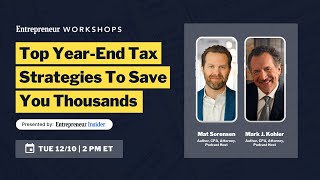
In this year-end tax planning webinar, attorneys Mark J. Kohler and Matt Sorensen share 20 actionable strategies to help entrepreneurs and small business owners reduce their tax burden before December 31st. They cover entity structuring, retirement accounts, family payroll, health care deductions, and more, emphasizing that proactive planning now can save thousands of dollars.
Dan Bova introduces the webinar, emphasizing that tax planning before December 31st is crucial for maximizing refunds and minimizing taxes owed.
Mark explains that S corporations can save on self-employment tax. For those with net income over $40-50K, a retroactive S election (Form 2553) can be made before year-end, potentially saving $10,000 annually.
Matt advises that reasonable compensation should be 25-50% of net income. They have never had a client audited for taking too low a salary, so aggressive positions are low risk.
Putting a spouse on payroll allows them to contribute to a solo 401k (up to $69,000), but only if the goal is retirement savings, not Social Security benefits.
Paying children under 18 for legitimate work provides a tax deduction for the business, while the child pays no tax due to the standard deduction. No W-2 or 1099 is required for kids under 18.
Self-employed individuals can contribute up to $69,000 to a solo 401k. For S corp owners, the deadline to set up the plan is December 15th due to IRS system maintenance.
Ensure you receive the full employer match by year-end. High earners can use the mega backdoor Roth to contribute after-tax dollars up to the $69,000 limit and convert to Roth.
Hold a board meeting with family members before year-end to deduct travel, lodging, and meals. This also strengthens asset protection for the entity.
Due to a court ruling, the Beneficial Ownership Information (BOI) report is not required for now. Monitor the appeal, but it is not a year-end priority.
Pay children for business work, then contribute that income to a Roth IRA for them. This provides a tax deduction now and tax-free growth for the child's future.
High-income earners can contribute to a traditional IRA (non-deductible) and convert to Roth. This allows $7,000 per year into a Roth IRA regardless of income limits.
Compare actual expenses vs. mileage. For business owners with low mileage, actual expenses (including bonus depreciation) can yield a large deduction. Consider purchasing a vehicle before year-end.
Buy needed equipment before December 31st to deduct the full cost using Section 179 or bonus depreciation. Use credit cards to accelerate the deduction even if paid later.
Enroll in a high-deductible health plan during open enrollment to qualify for an HSA. Contributions are tax-deductible, grow tax-free, and withdrawals for medical expenses are tax-free.
Business owners can set up an HRA to deduct out-of-pocket medical expenses. This is especially useful if you have over $5,000 in medical costs.
For S corp owners, having the company pay health insurance premiums and HSA contributions on your W-2 reduces FICA taxes while maintaining reasonable compensation.
Donate to charity by December 31st to itemize deductions. Consider gifting appreciated assets to avoid capital gains tax and receive a charitable deduction.
Rent your home to your business for up to 14 days per year. The business deducts the rent, and you receive the income tax-free. Use fair market value and document the meeting.
Individuals aged 73 or older must take RMDs from traditional IRAs and 401ks by year-end to avoid a 50% penalty. Roth accounts are exempt.
Convert traditional IRA or 401k funds to Roth before year-end to benefit from tax-free growth. This is especially advantageous if you expect higher tax rates in the future.
Year-end tax planning is critical for entrepreneurs. By implementing even a few of these strategies—such as S corp elections, family payroll, retirement contributions, and health care deductions—you can significantly reduce your tax bill and build long-term wealth.
What is the deadline for setting up a solo 401k for an S corp owner?
December 15th, due to IRS system maintenance.
14:00
How much can a self-employed individual contribute to a solo 401k in 2024?
Up to $69,000.
14:00
What is the Augusta rule?
You can rent your home to your business for up to 14 days per year; the business deducts the rent and you receive the income tax-free.
47:00
At what age must you start taking Required Minimum Distributions (RMDs) from traditional IRAs?
73.
49:00
What is the penalty for failing to take an RMD?
50% of the amount that should have been distributed.
49:00
What is the backdoor Roth IRA?
A strategy where high-income earners contribute to a traditional IRA (non-deductible) and then convert it to a Roth IRA.
30:00
What is the maximum employee contribution to a 401k in 2024?
$23,000.
18:00
What is the benefit of paying your children under 18 for work in your business?
You get a tax deduction, and the child pays no tax due to the standard deduction.
10:00
What is the triple tax advantage of an HSA?
Contributions are tax-deductible, growth is tax-free, and withdrawals for qualified medical expenses are tax-free.
37:00
What is the recommended reasonable compensation range for an S corp owner?
25-50% of net income.
06:00
S Corp Saves Self-Employment Tax
This is a foundational strategy that can save business owners thousands annually.
02:30Solo 401k Contribution Limits
The $69,000 limit is significantly higher than IRAs, making it a powerful retirement savings tool.
14:00HSA Triple Tax Advantage
The HSA is one of the most tax-efficient accounts available, yet many overlook it.
37:00Augusta Rule for Tax-Free Rent
This little-known rule allows business owners to generate tax-free income from their home.
47:00RMD Penalty Warning
The 50% penalty for missing RMDs is severe, making this a critical compliance item for older taxpayers.
49:00[00:00] Hello, hello, hello. Welcome, everyone. Thanks so much for joining us. I'm Dan Bova from entrepreneur.com, and we are here to talk about tax deductions, what you need to book before December 31st. Look, there's still time to take advantage of tax-saving strategies that can make a big difference in the size of your refund or the amount that you owe. So here to guide us through those strategies is our returning dynamic duo of self-described tax nerds. Mark J.
[00:24] Kohler is the attorney CPA, author, founder of the Main Street Tax Pro Certification Program and co-host of Main Street Business Podcast. And Matt Sorensen, attorney, founder and CEO of Directed IRA and Directed Trust Company, senior partner at KKOS Lawyers and co-host of the Main Street Business Podcast and the Directed IRA Podcast. Welcome guys. You're ready to save us some money? This is going to be the most fun you've ever had with a year-end tax planning webinar.
[00:48] I mean, buckle up people. Saving money is fun. And it matters now. This is like go time right now in December. Yeah. We're going to be, we want to thank you, Dan, for that wonderful introduction. We're just so grateful for the entrepreneur team. It's such an honor to be on the team and it's just a wonderful opportunity to be with you, the entrepreneurs that are really desperate and starving for tax advice and it's hard to sometimes
[01:12] get it from a professional. So we're excited for this time with you. Yeah, I want to make sure everybody understands April 15th is your tax filing deadline. And that is when you kind of like calculate the score. But how you win the game is what you're doing right now before December 31st. There's a lot to take in here. Mark and I have got a list of 20 marks in 20. I'm close to 20. And by the
[01:36] way, I love that analogy. This is like this is the tax planning deadline. This is right. Yeah, then it's your points right now. Score the score points. Okay. And on that note, so much to say here quickly, the chat is alive and well, we can see it right here. If you have a question, you've got to put it in chat. We're going to be dropping some links in there to be give you some additional resources throughout.
[02:00] You need to get a pencil and paper, pen and paper, whatever, an iPad that you can take notes. Because you're going to walk away with some strategies today. If we don't save you, I'm going to be as bold as enough to say five or 10 grand in tax strategies that you could easily implement before your end. But then this is a fail. There is something here for everyone. Yeah, there really is. And if you're a small
[02:24] business owner, an entrepreneur, there's a lot here. Okay. You got a lot here. Whether you're investing in real estate, you own a business, main hustle, side hustle, I don't care what it is. There's a lot of strategies here. Now we're not gonna be able to hit everything you should be thinking about. So we're going to hit kind of the top 20 list. It turns out here. We'll see if we can get through all 20. But these
[02:48] are really critical ones that are year end and we want to make sure you're focusing on we're seeing our clients save a lot of money in these. And I want to say the last thing on this is tax planning is not about doing one thing. There is not one easy button you get a hit on your tax return and say, Charge me the lesser tax, you know, okay. It's a lot of things you do that add
[03:12] up that can be hundreds of thousands of dollars depending on your situation. So it might be, it might be five things you do here out of 20 and 15 of them don't matter, but those five could be tens of thousands of dollars staying in your pocket instead of going to the IRS. I'd love it. And this was, I like your football analogy. I mean, you, They say defense wins games, but you may have to score a
[03:36] point. And so you need a good offense, a good defense, a good special teams. You've got to be working every angle you can to win the game. And it's just not one thing and game over. So, okay, let's jump into it. Now, I'd like what Matt just said to you. Let's set an expectation here. If you are simply a corporate employee, W-2, your list of choice options to implement are going to be much, much less, but
[03:59] you're still got stuff. We got still stuff, but you're, you're here because you follow entrepreneurs. So there's some entrepreneur, you know, bone inside of you and 50 plus million Americans have a side hustle, a side gig. It is a, a, a legitimate issue for a lot of people that didn't realize they have a small business. When you get a 10 99, that's a small business right there. Yeah. That's a, it's a gateway drug. It's a gateway
[04:23] drug. And the, what you get addicted to is the tax savings. So let's dive into it here and talk about the number one business entity and strategy for small business owners. I'll give them the strategy, but bring them up to speed. Why is that? Okay. We got to talk about the S corporation. Super important. You want to set the table and then I'll tell them the year end strategy that's critical. Yeah. So if you are self-employed,
[04:47] when you make income, you pay income tax on the income you're making is you're self-employed. You get your 1099, you're selling goods or services. I don't care what it is, but you also have to pay into Medicare and social security. A lot of people are out there. It's like, we'll set up an LLC to save taxes. LLCs don't save taxes. But an S corporation can save you taxes or an S election on an LLC and you're
[05:11] saving on self-employment tax. Mark's book, The Tax and Legal Playbook, breaks this down. It's an entrepreneur's published that book. We've got a lot of content on the S corporation strategy. But I just want to say, if you're like, I'm doing at least 40 or 50K this year, Using an S corporation is a structure that will save you taxes. Yep, and you can't just wish it so in April So here's the year and again so much there
[05:35] if you're not familiar with the S corp strategy and For many of you tax advisors out there that are listening and we've got a message several messages for you today But the first one is get over it on reasonable comp. So Too many accountants are afraid of taking an aggressive salary position on the S corp and it is not high risk in 25 years We have never had a client audited for taking too low of salary
[05:59] So we're gonna give you some parameters here that will save you money Okay so first you're gonna go learn about the S corp if you made more than and I like what you said about 40 or 50 grand net this year and you had an LLC and Fine, but that doesn't get you across the finish line. You have to make a retroactive S election. It's a special form 2553. You're going to get that done in an
[06:23] 8832 entity selection form. It's super expensive. Buckle up. Our office charges $250. I know it's highway robbery, but guys, this is not hard. It's not expensive, but you have to do this before you're in. And I'll set the stage for you here, Matt, because as soon as you make your, make your retroactive S election, the second tip here is for all of you that do have an S corp, all of you have to designate your payroll
[06:47] and that payroll dollar amount has to be issued on your 941, which is in the first week of the year. Now you don't have to give yourself a W-2, but this whole process has got to happen now. And you've got to have a conversation with your tax advisor in the next two to three weeks to either pull off the retro or nail your payroll. It's a big conversation. Yeah. Let me make sure you understand this. If
[07:11] you're making $100,000 a year, let's say it's in an LLC, sole proprietorship, that hits Schedule C on your tax term, you're paying about $15,300 in self-employment tax. If you do this S-corporation strategy and you run it properly, you could maybe pay like $4,000 to $5,000 in self-employment tax. We're talking about like a $10,000 savings that you could get every year. This is a common strategy. A lot of new business owners or people that have an LLC
[07:35] are like, what the hell? I've never heard of this one. This is, this is a big one. I use an S corporation. Mark's using an S corporation. And do not let your accountant go, oh, it's high risk. The IRS is auditing an S corp more. They're not, or, well, I don't make enough money due to the S corp and you, you've gotta take reasonable comp. It's not worth your time. People, you've got the wrong tax advisor.
[07:59] We'll give you a link to you find a tax advisor that speaks this language. Okay. Now right on the heels, we're going to move faster because we've got a lot to cover. So what we're hoping to do is for any of you, for all of you here, you're going to make a little note. Okay. I got to look into that. Others are like, nah, not for me. So like Matt said, just start writing down the ones
[08:23] that make sense to you. We're going to move on. The next one close on the heels of this is spouse payroll. We're going to get to kids payroll. Let me mention spouse. Maybe you mentioned kids. Now, We're going to talk a bit about the 401k here in a minute. And that's the only time we recommend you put your spouse on payroll is if you want to fund his or her 401k, typically a solo 401k for you
[08:47] solopreneurs out there. Don't just put your spouse on payroll because you think he or she is going to get more social security or retirement from the government. No, not a good deal. I've got a whole chapter of this in my book. Social Security benefits there's called a spousal a spousal benefit whether you take salary or not and a lot of times you can save so much Rather than hoping the government's gonna give you more later. It
[09:11] never pencils out. So that's a little Cautionary point we may want to put your spouse on payroll in the next three weeks because we want he or she to put in 23,000 or 30,000 in a solo 401k. Bam. That's pretty badass but Don't just do it to think, oh, they're going to get social security when they turn 65 or whatever. Not the right reason. Kids, many business owners have kids and that's a no brainer. Yeah. And
[09:35] we want to put kids on payroll. And when we say payroll, I'm putting that in air quotes, by the way. I like that. Yeah. All right. So we want to pay kids. Let's get your kids involved in your business. We love that from just teaching your kids about money and what you do, getting them involved in your business. But there's a tax strategy in that. You know, if you pay your kids, maybe let's say $5,000 for
[09:59] the year, they're working in the business with you. This could be a rental property. This could be their shredding paper. They're helping with your marketing. Some of my kids would come to my events. They'd sell my books. They'd help with my QuickBooks. They'd have what my social media, they do photography. You know, there's lots of things. And I, I would pay my kids for that. Why would I do that? Well, I could pay them, let's say
[10:23] $5,000. And let's just throw that number out there. There's different variations. If I can pay them five grand, I get a $5,000 tax deduction. If you're in a 37% federal and 10% state tax bracket, that's saving me almost $2,500 in taxes because I'm taking a deduction. Well, my kid picks that up as income. They don't pay taxes on it. Right? They can file the standard deduction. They're, they don't even, it's not even taxable income that, but
[10:47] they need to be truly working in the business and there's some process to it as well. Okay. So here's your takeaway point. Cause we've had full one hour podcasts on this. It was when entrepreneur introduced us, they mentioned the main street business podcast. Please get over there and we have over 500 episodes millions of downloads and there are several podcasts on paying your kids go learn about it So here's your takeaway if you have kids under
[11:10] age 18 and have a side hustle or any sort of small business You've got to look at moving some money from your tax return to theirs for the work they provide in the business and if you have kids that are 18 or older and Maybe they spend money like they're under age 18, but if they're 18 or older, we have a different methodology. There might be a W-2. There might be a 1099. For kids under age
[11:34] 18, rarely are we going to ever, ever, ever issue a W-2 or 1099, and you're not required to. So go learn on this. This is an important step you have to take before you're in. You can't say, I pay my kid. You've got to launder the money. Oh, I wasn't going to say that word today. Okay, no, we don't launder money. We pay the kids and let them claim the income for valid services in your business.
[11:58] Learn about it. Okay, so now look what we just knocked out a retroactive S corp for those that have an S corp nailing your proper payroll level It's usually gonna hover between 25 to 50 percent of your take-home third You might put your spouse on payroll to fund a 401k. We'll come back to that and fourth We want to get your kids on the books for outside labor Subcontracting or employee services depending on the situation study
[12:22] up on it. There's four strategies right there. Let's hit a few questions. So G1 Wheeling says, "If self-employed with a W-2 and utilizing, can I use the Solo 401k for deferrals? What is available to the self-employed people with an LLC and 100% self-employment?" Let's hit that strategy right now. Yeah, the same strategy. You can have a Solo 401k and be an entrepreneur and have a 401k at work as well. You can have both. And that's whether
[12:46] you're an LLC or a non-LLC taxpayer. If you're on Schedule C as Charlie, you can go do this. So let's go there, the Solo 401k. That'll be strategy number five. Yeah, let's hit the Solo 401k. We love this one at year end. is if you're self-employed, you can set up a 401k for yourself. And it's called a solo 401k. Now, this is great for you solopreneurs, those of you that don't have employees. You can have maybe
[13:10] some family in your business or business partners, and that's okay. 1099, part-time employees, that's okay. But this really meant for self-employed people with no other employees. A lot of people out there, it's gonna be your side hustle. You can put up to $69,000 a year into a solo 401k. Like you can do $7,000 in an IRA. We're going to come to some of these other retirement accounts, but a solo 401k for the self-employed people, you entrepreneurs,
[13:34] $69,000 a year. If your spouse is in the business and we decide to add them to payroll, coming back to Mark's earlier point, they can also do $69,000. That's a huge amount of money you can get in. If you're looking for year-end tax deductions, that's a $69,000 tax deduction. Now it depends on your income on how you do that. And we may be able to break that down here in a second, but that's the general thing
[13:58] of the solo 401k. You've gotta be self-employed, no employees up to 69K a year. Yeah. And we just recorded a full length podcast on this year end solo 401k strategy at Main Street Business Podcast. We both have articles and our books are full of this. So if here's the takeaway, If you want to put more in a 401k other than the match at work, come to that in a little bit, if you want to put away
[14:22] additional money in a 401k, you have to take action. And our deadline internally to help clients do this is December 15th. And if you go to any reputable firm, they're going to say, if you have an S corporation, we got to get on this. Because if you don't get the EIN for that 401k before the IRS shuts down their computer system for year-end maintenance, you're out in the cold. No pun intended. So get that. If you
[14:46] have an S corp, we're going to put a link here in chat to get over to the law firm for nine 95. We set up a 401k, a solo 401k that you can self direct. You can get that started immediately. Fill out the form, get the application going. Your appointment to meet with the attorney will be after the 15th, but we can get the 401k application going. Now that's just an aside. Keep learning on that. Yeah.
[15:10] So for a JC one wheeling, I just, You can do the solo 401k if you've got a W2 day job, okay? And you're putting in money at your kind of day job, corporate job. We always say match and get out, especially if you have a side hustle. Put in as enough money as you can get the match at your day job because that's free money. Most 401ks that an employer have a match. But then for the
[15:34] rest of the money, let's go put it into your solo 401k because you can have more control of it. You can do traditional or Roth in the solo 401k. We want to get more money into the solo 401k for those who are self-employed that might have a side hustle. Now, if you're just 100% self-employed, no 401k at a company, we're just dropping all into the solo 401k until we hit that 69k. And so, but now this
[15:58] goes off of your W-2 for you S-corp owners. So it depends on what your W-2 is. So if I can give a quick example. Okay. Okay. I'm going to go fast. Okay. So I want to, we've got so many great questions here too. Go. Let's say you have a $50,000 W2 out of your S-Corp. Maybe you made 150K that year and you said, I'm going to take a $50,000 W2. The other a hundred K comes through
[16:22] as dividend profit. On that $50,000 W-2, I can put in $23,000 as an employee contribution. The rule is that for every dollar you make as an employee, you can put into the solo 401k up to 23k. Okay, well, I made 50. I can do 23k and max out the employee. Plus, you get to do an employer contribution of 25% of whatever the W-2 is. 25 of 50k is 12 500. so right there i'm at what that
[16:46] 35 500 that i get to put in the solo cap a fifty thousand dollar w-2 crazy yeah it's amazing and um That goes over one of the last questions that just flew in is how much can you contribute into a solo 401k if I'm not that profitable yet? Is a percentage of profit or gross before cost? Neither. It's based on your self-employment income. Meaning what's the salary for your W-2? Or if you're an S corp or
[17:10] if you're a sole proprietor LLC, what is your net income? You have to have FICA wages up to the level of your deferral. The company match is not based on that or requires profit in the business, but you've got to be taking income out before you can put money into the solo 401k. When you do the console on that, we'll walk you through all the options and steps and get to the podcast on that. Now let's
[17:34] pivot here. While we're on this S corp topic, Don says, can you cover again what the salary should be for an S corp owner, please? Well, Devon, we have a whole payroll matrix and a whole podcast on that topic. I will just tell you it's a percentage of how much you take home, and it can range at the extreme end, maybe 20%. of your take home to, it could be 80%. Your income level is gonna matter.
[17:58] There's an art to it. Google Kohler payroll matrix. We've done a podcast right here with, webinars right here with entrepreneur on this very topic. So Don, just do a little research on our names. You're gonna find the topic answered quickly. Let me pose the next question for you. This is from Image Form Studio. He bundles it up into three questions, but here's the gist of it. I've got multiple streams of income, Do I really need a
[18:22] separate LLC for every stream and have it funnel all into one S-corp? Is that necessary? It's not necessary. You could, but it's not necessary for tax purposes. It's not going to save you any more taxes. There might be business reasons to do that. For example, maybe you have separate employees in those businesses. Maybe there could be more liability in one business or another. Maybe the The web business is very low risk, but the screen printing business
[18:45] is actual production and manufacturing and someone could get hurt. But you could have one S corporation. That's your umbrella you're talking about. You could. And have all this income flowing into it. And you just have DBAs or trade names for these different businesses so you can market them differently. And all those DBAs or trade names are owned by that 1S corporation. And that would be the simple, more cost-effective way, particularly if these are businesses you're making
[19:09] tens of thousands of dollars on. Now, if these are real businesses, you're making hundreds of thousands, millions of dollars in these separate lines of business, I would have one S corp that has 100% owns an LLC, and I'd have that separate business in that LLC, I want to be breaking down those financials anyway, separately tracking it different. And I want to have probably some separate asset protection. So if something happens in that business, it doesn't affect
[19:33] all the others. And image form studio, everybody pay attention. This was a great question from this attendee. Because All of us sometimes need to clean house a little bit and this is a perfect time of year to say, okay, I've got too many entities or I don't have enough. Should it be flowing differently next year? So please make an appointment with the lawyer or business lawyer you trust. This is not something you knock out on LegalZoom,
[19:57] but give us a call. We're affordable. We've got 14 lawyers on the phones every day helping clients around the country get restructured affordably. Get a consult. Maybe the answer is do nothing, but at least you know. Alright now I want to go back to a strategy Matt said that's gonna be our number six He referred to it for a moment all of you that are participating in a 401k at work They've got a match because that's
[20:21] how 401ks work But you need to know what that match is and it's free money in the sense that you put that money in they're gonna match a hundred percent of that up to a certain dollar amount and If you don't do it by the end of the year, there's no match. So that is a critical year-end strategy to kind of hold your HR department right now and say, have I deferred enough or any? What's my
[20:45] look like? And find out what that deferral could be. Can I go with the next one on top of that? Yeah, damn straight. So this is for those of you that have the 401k at a corporate employer. is we want to get the match at least, but you might say, hey, I'm high income. I'm making a few hundred grand at this job and I want to get more money in savings. I want you to think about
[21:09] the mega backdoor Roth. Okay. Mega backdoor Roth sounds pretty exciting, right? But that's a way, let's say I put in $20,000 into my 401k at work and I got some match out of it the company maybe threw in 10 So I got 30 in there Let's say I got 20k of employee contributions 10k of match and the company's like we're not putting any more money in Matt This is all we're gonna match. It's all on you
[21:33] to put the rest in well I've got 30k in total I can have 69,000 in a 401k in general. So I got another 39,000 I can put in well, how do I do that? Well I've only got $3,000 left I can do as an employee contribution to get to the $23,000 employee. How do I get $39,000 in? You do an after-tax employee contribution, which is step one to a mega backdoor Roth. That can then be rolled
[21:57] out to a Roth IRA. Okay. This is called the mega backdoor Roth. It's basically a way to get up to the maximum $69,000 into your 401k. You can do it at a day job 401k and you got to work through your employer's 401k provider, but you also got to get that contribution in before you're in. Now, One last thing I want to add on this 401k conversation and deferring retirement money, then we're going to give you
[22:21] something that doesn't deal with retirement. This is not a retirement freaking webinar. It's just one of the great ways to get write-offs and or defer tax-free income through a Roth. You can have Roth 401k, Roth IRAs, whatever. Here's the point. If you want to put more money away, you've got your match at work and you have a small business and There's an art. There's a sweet spot. You might want to put more away one year versus
[22:45] another year. How much is your payroll? How much can it be or have to be? How much should I pay my spouse? Are they going to participate? This little equation is something we do every day in a year-end consult with our tax law team. So have that meeting with your trusted advisor and we'll give you some resources if you don't have one because finding that sweet spot is magic because it can save you taxes on this
[23:09] year's tax return and build that bucket of wealth for the future but it just again is not a conversation you want to have in april because then they'll go well this year we could do this well what about last year That was the December conversation and we're having it right now. Freaking eight. Okay. Yeah. And I would say if you invest in this time now, I know it's a lot of stuff's going on at your end.
[23:33] Remember a lot of these strategies you're going to do and figure out that work for you. You're going to do next year and next year you're going to rinse and repeat. Once you get this figured out and architected for your situation, you're You might add some stuff in the next couple years, depends on what's happening. You got things shifting, you're paying attention to laws and opportunities. But the nice thing about this is these are tax savings
[23:57] you're going to start replicating every year. Okay, so a couple of people said, what do you guys do? You're pretty handsome guys. We were wondering, you know, where are you hanging out this weekend? Well, I appreciate that. Mel model? Yeah, I don't think that's what they asked. Drew Lander? No? No? This is gonna be for those that dropped in a little late the most fun you're gonna have in year-end tax planning in a webinar Ever we're
[24:21] trying to do our best. We try to keep this palatable simple and actionable So we're gonna have some fun here. My name is Mark Kohler. This is Matt Sorensen We're senior tax lawyers at the law firm KQS lawyers. We also have the directed trust company I trained CPAs and advisors around the country and Main Street tax pros. We were both authors the bottom line is We love saving taxes. We're small business owners and we are investors.
[24:45] We own real estate. We own crypto. We do what we freaking teach and we hate big freaking law firms. We love boutique law services helping the little guy. We have a great relationships with entrepreneur and we love you. Now I'm going to summarize the, well, let's do three more. So we come up with our top 10 and I'll repeat the top 10 tax strategies. When we get to 10, we are at number seven. I'm going to
[25:09] throw out number eight. you should have a family office A family office is not just for the billionaires. If you're an entrepreneur, you've got a family, either it's a brother, sister, mom, dad, a best friend, family is a big definition. And whoever you're hanging out with at Christmas should be on your board of advisors, if you're an LLC, or board of directors, if you're an Inc. And when you have that board meeting, the travel to get
[25:33] there to and from, the hotel, the Airbnb, the food, that is all a tax write-off because you're having that annual board meeting. You may even use the Augusta rule, which I mentioned is another strategy here in a moment, but you're going to maybe even pay yourself some deductible rent that's tax-free income to have that meeting at your home. So there's a lot of options here to take advantage of that year-end conference, that year-end board meeting. And
[25:57] people think, "Oh, I got an LLC or corporation. It's a pain in the butt to have a board meeting." No, it's a freaking opportunity for a great tax write-off, and it gives you better asset protection for your entity. all of you should have that board meeting before your end and at least write off fricking dinner. I mean, it's a no brainer. Yeah. And when we set up an LLC with our clients, we do a board of
[26:20] advisors, like a, which you can have in an LLC and their advisory capacity corporations have boards of directors. So when you're setting up your LLC and structuring this, let's get a fricking board of advisors. If you don't have one, get one added. It's simply doing a set of minutes and adopting that. Talk to the people, let your family members know what's going on. You know, you're already probably talking to your spouse about what's going on in
[26:44] your business and taking their advice and getting their temperature on things. And what do they think? Let's deduct some of this stuff and let's call those board of advisor meetings. And so these are real family businesses and a lot of you have your real family involved. So let's take advantage of some of these tax deductions and opportunities that are staring you in the face and you're not even using. Yes. And I want to say this to
[27:08] all of you. I'm a small business owner. I grew up on a farm in Washington state as a, as a young kid with my parents as entrepreneurs. And I know that it's, it's penny pitching at the times of Christmas and it's a tough economy out there with a lot of hope for next year. But let me just say this, this is not an infomercial to call our law firm right now. This is go get a little
[27:32] bit of study going on this evening put on a christmas movie and then take a break here and there and go to our podcast go to our blog articles go to our youtube channels every topic we're hitting right here we talk about it in depth and to help you understand what you're getting into then call the trusted advisor and say let's do x y and z explain more and we're here for you and anytime you pay
[27:56] us money we freaking better be saving you five times out of taxes or better protection or more wealth building all right all right should we give up the legal update and then maybe talk about some christmas shopping at december to remember wow okay i was gonna go here you tell you go where you want to go The not strategy? You want to do the not hearing? Let me tell you about what you don't need to do
[28:20] by year end. Many of you that have an LLC or corporation have heard about this BOI, Business Owner Information Report. You're supposed to file the FinCEN, part of the Corporate Transparency Act. We filed thousands of these for our clients and their entities. Just this year? Just this year alone, because you had to. Well, there's a court ruling out of Texas, a federal district court judge who ruled the BOI filing requirement unconstitutional and placed an order against
[28:44] FinCEN from requiring any business owner in the US to have to comply with this right now. and so you do not need to file your boi by year end i know many of us have gotten hit up about that i can get hooked with about it from outside places let alone our own companies that you need to do so don't stress about that now it's not on your year-end list monitor this the government's appealing this we'll
[29:08] see what happens with the new trump administration they may drop it who knows but this boi requirement we have heard for real estate corporation was struck down as unconstitutional ongoing litigation and And but take that off your list. Let's worry about saving some taxes before you're in. Yeah. And I mean, I was trying to fix my collar here and just, I mean, this was like out of control. I was like, look at the size of that
[29:32] collar, the 1970s. I know. It's like Travolta's like arrived, you know, got a little Andy Gibbs, Saturday night live. Yeah. I got to tuck that in. I was getting out of control. Okay. I want to go to strategy number 10 and that is the kid Roth, not kid rock. We love him. This is the kid Roth. Now hear me out. If you're going to start paying the kids, which you should because they're in a lower or
[29:56] no tax bracket for helping you in the business, Thought number two is, what am I going to be doing for college savings? Where can I put money tax-deferred, tax-free, and I can pull that money out for college with no penalty or tax and let the growth continue to snowball? Or maybe not to pull it off for college, but help my kids build a future income learning about retirement. So if you want your kids to have a
[30:20] Roth IRA, we've got to think about it right now. But some of you might go, "Whoa, whoa, whoa, Mark. You can fund the kids' Roth IRA by April 15th for this last year." Yeah, you can, but if you don't pay them, you can't. So this is highly connected to having a board meeting where your kids are participating, which is an opportunity to compensate them for attending the board meeting, thinking of all the duties they performed throughout
[30:44] the year, paying them on paper, taking a tax write-off off your tax bill, and then them claiming the income with zero tax oftentimes, 90% of the time, and then plugging that money into a Roth IRA for either college savings or the future. Head drop. I mean, that's like magic. Yeah, and I think that's, again, this is, I think, for those that are business owners with family and kids, let's get the kids involved in the business. Let's
[31:08] also teach them how to invest. Now, when you're looking at the order of things, I want you to fund your own retirement accounts first, Before you get to this strategy, okay, I want you to think about this kid's Roth, and we love paying the kids to get the tax deduction, but let's fund your Roth IRA first. Let's make sure you're maxing out your retirement accounts. Oh, but if you want to take it to the hoop and
[31:32] go to the next level, we love the kid's Roth. Oh, did you say fund your Roth first? We're going to come to that on a little strategy before you're in, but I want to hit TL's question. Doesn't the S corporation election have to take place before now or at an earlier date? TL, that's if you're talking to an accountant that's operating in 1985. Freaking A, you can do an S-selection right now retroactive to 1-1-24. It's under
[31:56] a special rep proc that you put at the top of the 2553 and include a letter with it. Again, we charge 250 bucks to just do the process. So if your accountant isn't talking to you about this and any of you have an LLC with at least $50,000 or more of net income, you are a perfect candidate for this retroactive S election. It could save you three or four grand easy. Now let's summarize our 10 strategies
[32:20] so far for those that missed these. and this is where you just make a note and say oh that might apply to me i'm going to go check out more the s corporation retroactive election your s corporation payroll making sure it's not too high and saving on fika number three paying the kids number four paying the spouse but only to fund a 401k which brings us to number five the solo 401k which you've got to have
[32:44] filed by december 15th at our office because irs shuts down for maintenance you will not make the cutoff And that's if you're an S-Corp. If you're a sole proprietor, don't stress. But if you're going to make that S-Corp election, you've got to do the solo 401k now. Sole props have until next year. Number six, you're going to come up with our number 11 here. I'd love you to talk about Roth chunking. Number six. I feel like
[33:08] we got to hit some other non-retirement account strategies. I know. I know. Okay. We can do that. Number six is if you have a day job, W2401K, make sure you get your match done before the money falls off the table. Number seven, the mega backdoor Roth. Number eight, having your board meeting as a family for your small business and taking a tax write-off for travel and dining at the least. Number Number nine is do not do
[33:31] your BOI report. Don't stress about it until the Supreme Court rules on this. And number 10, making sure you pay your kids so they can do the kids Roth. What's a good number 11? What do you like? Well, I like the backdoor Roth IRA. I think we're going to do a non-retirement one. Well, we're there. So we're going to hit it. Yeah, let's, let's, let's, let me hit. I like it. Let me hit, cause I want
[33:55] to hit the two, two other Roth topics in one. I'm going to try to do two for here. here. Okay. Okay. So a lot of you have heard you make too much money to do a Roth IRA. And this isn't a year end thing because you get until April 15th to do your Roth IRA contributions. Now, remember the Roth for kids, you got to do get their payroll in. You got to pay them by the end
[34:19] of the year. That's why we're talking about that as you're at, but there's another strategy, the backdoor Roth IRA, where if you're high income, And you don't qualify to make Roth contributions, which is $7,000 a year. You can do this, what's called a backdoor Roth IRA, where you put money in a traditional IRA, you claim it as a non-deductible contribution on your tax return, and you can convert it to Roth. It's a two-step process that allows
[34:43] you to still get $7,000 into your Roth IRA every year. It's how I funded my Roth IRA every year. And I know some people are like, well, $7,000, that's not that much, Matt. OK, it's $7,000 now. And you know what? On January 1st, 2025, you can do a 2025 contribution plus your 2024 contribution. I can put $14,000 in that could be Roth dollars starting to grow and build tax-free because the Roth account, you do not save
[35:07] taxes now. It is not going to save you taxes now. But if I can build wealth in that account, it's a tax-free vehicle to grow and build wealth for the long haul. I don't pay taxes as I'm earning money and building and investing it. And... it comes out tax-free at retirement now some people might be thinking but matt i don't love wall street that's all i can buy with an ira no okay that's our company directed
[35:31] ira and this you can use what's called a self-directed ira you could invest your roth ira in crypto in real estate in private equity you could buy a rental you could private money lend it okay all these investments you can make In general, you can also do in an IRA. It takes a self-directed IRA, and that's what we do at our company, Directed IRA. Whether you're doing a solo K, the kids Roth IRA, I just want
[35:55] you to think about growing and investing that money in a tax-free manner using the Roth, and that's what we do at Directed IRA. Okay. Now... we've got several comments we're coming to it we're going to do auto next a few thoughts here um on our comments thank you so much for these questions in the chat i know this is being broadcast on multiple platforms and some some of you are not able to pose a question that
[36:19] we're going to see real time so let me just throw this out i'm calling an audible we do a podcast every wednesday and we do an open forum about every three weeks. I think when you do open forum year-end tax tips tomorrow. Love it. And if you want to pose a question for that forum, please get over to MainStreetBusinessPodcast.com and you'll be able to get in there and put in a question and we'll cover it tomorrow
[36:43] in our podcast. It'll post 24 hours later. I will also be going live on YouTube on Thursday. I know you go live every week. So get over to YouTube, find our channels, subscribe and hit the bell icon. When we go live, we're going to be answering questions for you. We're not going anywhere. We want to be a support for you in this process. Finally, we'll give you some links to find an accountant that speaks Mark and
[37:07] Matt. A couple other questions, Image Form Studio and researching a vendor. Recently, I discovered their LLC is in Nevada. They're making money in California. What do they hope to benefit from? Nothing. They're gonna try to get around $800. Yeah, they're just signing up from a terrible audit with the state of California at some point and they're wasting money in Nevada. Now, we love setting up entities in other states, but you've got to pay tax where you
[37:31] earn the money. Yeah, can I give a quick example on that? Mark Wahlberg, okay, Mark Wahlberg moved from Hollywood, California to Las Vegas, Nevada and And he moved his studio to Nevada. So if you want to get out of California state income tax, you got to move your butt out of California. Okay. And you can't earn income in California. So if Wahlberg's back there making a movie, shooting a movie and he gets paid in California, he's
[37:55] paying California income tax. But what he's doing in Nevada now with his Nevada business, he's a resident of Nevada. Now you've got to do those two things. If you want to avoid state income tax, you got to live in the state that has no state income tax. while we're in Nevada and earn the money. He moved his own studio there and now he's getting out of it for that piece of these. I love it. We've got
[38:19] another Facebook question from Marky Mark, you know, Oh, you got to bring in Marky Mark, the funky bunch. Okay. Now we're going to come to another question here from Chris White in a moment. Let's get auto on the table. Any of you, now this is where we don't want to let the tax tail wag the dog or otherwise stated go after a tax deduction and spend money we shouldn't have spent. We want to be wise with
[38:43] our spending. So when it comes to the auto deduction, you can do actual or mileage. But if you're going to go actual, meaning right out of the actual car with depreciation and gas and repairs and maintenance, which can be a great strategy, you have to compare it against the mileage strategy. Now, if you're looking at a new vehicle in the next 60 days, I would recommend you pull the trigger before year-end And if you go with
[39:07] the actual deduction, then you're going to get a huge write-off before your end. Even with bonus depreciation at 60%, 80%, and between now and next year, lots of changes there. We're expecting some great things with the new administration on bonus depreciation. But the actual deduction for auto can be really powerful. Now, you have to analyze this. Go in with your eyes wide open. Quick example. If I'm a realtor putting on a bunch of miles, I'm not
[39:31] going to go with actual. If I'm... a small business owner with a storefront and run a lot of errands and move things around and may need a truck or an SUV and I'm not going to put on a ton of miles. I'm going to go with actual and write the crap off of that vehicle. So you have to look at your usage, the cost of the vehicle, the type of vehicle. We've again got podcasts on this
[39:55] and articles. Do your homework. But I think the auto is a great deduction. Yeah, I mean, that's one of the big ticket ones, you know, you buy an auto for 60 grand, let's say, and you get 60% bonus depreciation on that. I mean, that's a 30,000 plus deduction you could be taking in year one, even if you don't pay for it, you got a loan to finance the purchase. So that could be a huge deduction on
[40:19] your return. Again, reducing your taxable income, keeping more money in your pocket. I don't know that you're scoring there. I think it's preventing the IRS from scoring on you though. Yeah, and let's go before we go to health care. There's a bunch here on health care. Let's stay with equipment if we could on purchases. If any of you are looking at buying equipment, computers, laptops, cell phones, supplies, anything that we... Cameras. Cameras, studios. Now everybody has
[40:43] a YouTube studio now. You might want to get something that you plan on purchasing in January, put it on credit card in December with the ability to pay it off in January. But any purchase you put on your credit card for equipment in your business is a write-off this year. So it's a great time to look for holiday deals get a write-off and We don't know all of your income and your type of business and that's
[41:06] gonna could play into it on the 179 deduction versus bonus But typically you're gonna see a great deduction pine equipment before you're in yeah and there's a great strategy and what mark was breaking down there just with kind of like a planning expenses and income here in the next 30 days because as we're hitting up here against December 31st I want to load expenses and before the end of the year and delay income into January right
[41:30] so I'll be as aggressive as collecting revenue or grabbing that new deal until January 1st let's get then a 2025 tax year but but man i want to make sure all my expenses are paid people i owe money in my business if it's tax deductible i want to make sure they're paid before year end because i want to take that right off in 2024 and also if there are the equipment or items you're going to be
[41:54] needing anyways let's get them in december instead of getting them in freaking january and waiting for a whole year to write it off all right now before we're not trying to build some big anticipation to drop our contact info at the end let's get it out there now some people are already talking about it so if our team will help with this let me first say this if you kind of like your accountant, want a second
[42:18] opinion, you're not sure what you need, and you want to do a year-end tax planning consultation, start with our law firm. We have tax lawyers that are very affordable. They're going to build you a trifecta, a game plan for next year, and our goal is to save you. Far more than you pay us. And we have a very, very high satisfaction rating. It's incredible. And we're built for the main street small business owner. Our website is
[42:42] KKOS Lawyers. Maybe you could guys throw in the phone number and our KKOS Lawyers site. You can schedule an appointment. You will pay for that appointment. We do not do free consultations. And I would recommend a comprehensive year in tax console. It could be $1,500 or more, but holy crap, we want to save you five, 10 grand more with that planning. So make an appointment. Number two, if you're like, well, I'd like to do that, but
[43:06] I also just need a good accountant anyway. I need a good tax advisor. What we did is we walked away from our accounting firm and trying to prepare tax returns and started building the Main Street Tax Pro certification. Kind of my baby. Matt's running the directed IRA team. I'm running the Main Street team. But if you get over to MarkJCohler.com, and the services and go to the network, our TaxPro network. We've got hundreds of accountants around
[43:30] the country that speak Mark and Matt. They're trained on 12 different modules, close to 75 different strategies. They have to pass an exam of a thousand questions and continue training with us. In order to be a tax pro network member so get over there You can interview a tax advisor in your state or across the country. It does not matter young or old male or female Do they know crypto do they know real estate you can
[43:54] toggle the search there? Make an appointment with one of them before the end of the year as well There's so much money on the table here people. It's easier to save money than make money. So Next strategy do you want to talk about the user elusive which should we turn to health care for a minute? Okay? Yeah. Yeah, let's go to the Health care expenses. Okay, I say this in general with health care is this is
[44:18] one of the items that if you just don't follow the right procedure You don't get a write-off your health care So health care can be deductible and I can a tax deduction for but the way you do it matters is Basically, a lot of people think, well, I can itemize that on my tax return. I'm doing itemized deduction. I'm tracking my medical. 99% of people that do that don't get to write it off because it's got
[44:42] to exceed like 8% or 7.5% of your adjusted gross income. It's like if you're making $100,000, you've got to have more than $7,500 of of health care expenses for any of it to be deductible. So there are strategies. If you have a flexible spending account at work, this is your FSA. Use it or lose it. Okay, so this is number... This is one. Yeah, but this is one of four strategies when it comes to health care.
[45:06] So this is going to be strategy number 14, the flexible spending account. Pray tell, Mr. Swanson. Okay, if you have an FSA at work, we don't usually recommend those for business owners in your own business, but maybe your spouse works and you have an FSA available. This is use it or lose it, and it's lose it time right now. So make sure you're using it before your end to cover any of your medical expenses because you
[45:30] do get those. Those are tax-deductible dollars going into the FSA coming out for medical. Yeah, you've got to turn in your receipt or you don't get it. It's kind of like the match of the 401K. Your company is offering this to you. It's free money again. Go find a receipt for eyes, dental, dentistry. massage therapy for physical therapy, anything. And if you want to know where to go, go to publication seven. Oh my gosh. Now it's
[45:54] five something. Five. Oh two. Oh my gosh. I always quote it and I just forgot it at the moment. It's the healthcare publication. Now, Next, that's the flexible spending account. The health savings account, I think it's the best kept secret in tax planning. Amazing. I don't need any healthcare expenses because I drink one Rockstar a day and this keeps the doctor away. I highly recommend it. did rockstar get that they're going to get because someday they're
[46:18] going to sponsor me they've sent me one case of rock stars but i i need to hear from you yeah i've got your back okay it's publication 502 um and by the way publication 502 does not list rock stars being a tax deduction but we can say it does improve your productivity it does i'm like i'm fired not tax deductible well you know one rock star a day be productive okay now the health savings account Yes,
[46:42] you get to fund it up until April 15th. But if you have the wrong type of health insurance, you don't get to fund it. Well, guess what it is right now? Healthcare enrollment. So for any of you that are a small business owner, you've gotten used to picking out your own health insurance, which is pretty cool. And you can go and look at the different metal plans and platinum and gold and silver and la la la.
[47:06] But what you're looking for is a high deductible plan. And you want to get the high deductible plan to open the door to the health savings account. And this is the time to do it. So you may not get the write-off for 2024, but if you don't get the write-insurance policy now as a year-end strategy, you're not going to get the write-off next year. And that's a big deal. There's no income limits. Any age, you can,
[47:30] well, I shouldn't say that. At age 65, you do phase out of the new contributions. But you can be building this account at any age, any income, front page of your tax return. The HSA deduction is huge. But make sure you're choosing the right health insurance right now during healthcare enrollment. Can I just say on the HSA, I want to make sure I'm saying this, there's the triple threat of the HSA. Tax deduction when I put
[47:54] it in, no matter what your income level is, you never phase out of it, you get an automatic deduction for that, whether you're single or doing family on the HSA. It grows and you don't pay taxes as you're investing in growing that and it comes out for qualifying medical later. So it's an awesome strategy. It's one I use. A lot of our clients use it because we all have medical and we all have the ability to
[48:17] save in a tax-free manner. Okay, the HRA is called the Health Reimbursement Arrangement. Now that's exclusive to you as business owners, but it's something you can still do before year-end. So if you're a solopreneur, husband, wife, single, kids or no kids, if you have medical expenses, Over and above your health insurance. Now again, this is co-pays for prescription drug, eyes, dental, whatever. Go to publication 502. So the HRA is something you can implement. Talk to your
[48:41] accountant again. I would say this. If you had more than $5,000 in out-of-pocket medical expenses this year, maybe you had a knee surgery, something bad happened, whatever, broken arm, went to the emergency room, blah, blah, blah. the HRA could work for you. It's called the HRA 105 plan. Bring it up with your tax advisor, either with our team or whoever you meet with before year end, because if you don't do it before year end, you don't
[49:05] get a write off for that medical and it's a big deal. So that's strategy number 15. Can I stay with medical one more? Okay. Please. I'll just throw it out and you can ad lib or riff on it. Okay. Health insurance premiums are 100% tax deductible by a business owner. Huge opportunity. Well, for those of you that are doing the S corporation strategy, that has to be listed on your W-2. And you want your company to
[49:29] pay that premium, even if it's a personal plan, let the company pay for it. Also, you can put in an HSA contribution on your W-2. Now, this is technical, but what you're allowed to do is reduce the amount of FICA on your W-2 while still maintaining reasonable comp. So if you had $12,000 in medical insurance premiums, let's say $1,000 a month, and then you did $8,000 in an HSA this year, that's $20,000 that's still considered comp,
[49:53] but it's not subject to FICA. So we just saved another $3,500. Is that crazy? That's pretty awesome. A $50,000 W-2 turns into a $20,000 W-2. Yeah, $30,000. $50,000 minus the $20,000. Oh, yeah. You're the CPA here. Someone's got to do the math. And then you throw the 401k in there, and you wipe out another $25,000. It's insane. So you get the reasonable comp with 401k, HSA, and the insurance. Oh, it's cool. all right all right let's
[50:17] talk about charity let's talk about being charitable i mean it is that time of year right season of giving right now so charitable deductions if you want to take that this is if you're going to be itemizing on your deduct on your tax return um you can take the charitable deduction maybe you're giving to your church or the non-profit you love remember you got to do this by 4 december 31st in order to take that charitable
[50:41] deduction also i want to there's a couple strategies that go with that gifting of appreciated assets or property You can get a step up in basis of that. We always have clients, maybe they sold a business, a big real estate deal, and they might want to use some of these charitable strategies to benefit a nonprofit and also to defer or avoid some taxes. And so there's a lot more complex strategies planning there, but I'm just saying
[51:05] that there are some tax strategies where you can also avoid gains by gifting assets to charity on appreciated assets and make a charitable impact and get a charitable deduction. Oh my gosh. And you know what's funny, guys? We've got a whole list of high-end strategies we're not even going to. Charitable remainder trust, oil and gas, solar, donor advised funds. We've got a laundry list of strategies for the higher income network of people too. But I like
[51:29] this question down here. Someone was saying, well, Don't make a ton of money. Um, is it too little to work with you or something like that guys? We love just the brand new small business owner realtor someone that's just even selling online or a brand new influencer with a 1099 from who knows where and this could even be the athletes that are now having NIL income and they're like I don't even know what to do with
[51:53] it Yeah, so we're helping them to if you bought your first rental property term or long term. It's so important So don't feel like you're we're above that by any means and Let's go political here for a minute before we give you a couple last strategies. Chris White, we're going to both take just 20 seconds. Matt Sorensen, what is the likelihood that our new leadership will change rules regarding retirement accounts? What is the likelihood? There's very
[52:17] little likelihood that there will be changes. Which is what we want. If there is changes, they're going to be in our favor. Let me tell you a couple of things. Depending on how the election went, I don't mean to be political here, but on this question and topic, there could have been some change. There could have been some restrictions on Roth IRAs, backdoor Roth IRAs, the mega backdoor Roth we talked about. Current administration didn't love it.
[52:41] They weren't able to change it already. But we've got a change in leadership that loves that type of strategy because it helps keep more money in people's pockets that are hardworking Americans earning money. And we want to save and have people be able to have some independence on their own savings and money they're putting aside for retirement. the other thing i'll say is there's a lot of legislation from the current administration republicans about letting you put
[53:05] more money in to these tax advantage and tax preferred accounts doubling up how much you can put in your hsa for example is a bill that has some likelihood of seeing it so we think that's good because a lot of these retirement account strategies we hit these are a craft of federal legislation right they write the rules on how much you can put into that And the contribution limits are just really inadequate for a lot of
[53:29] people, particularly for people that have been behind and didn't get money in in their 20s and 30s. Okay, we got about five minutes left here, six minutes. We'll give you some additional resources and contact information here shortly at the end. I've got two more strategies. It's going to put us at 19. I had 20, but I think we doubled up the Roth chunking with the backdoor Roth. Yeah. But... I want to give you a quick one
[53:53] and then Matt, would you be prepared to talk RMDs? Big one. The one I want to just hit is it's out there in the airwaves. It's all over TikTok and that is called the Augusta rule. It is legitimate. So I do want to cover it, but it can get abused quickly. What this rule is, and it originated with in Augusta, Georgia, where during the masters, people would rent their homes for a couple of weeks. And it
[54:17] got to be such a debacle with the IRS. IRS said, okay, if you rent your house out for less than 15 days during the year, legitimately, We don't even want to hear about it. Keep the money. It's cool. It was part of the paper reduction act back in the 1990s. So, okay, cool. So now I can rent my home to my business for a legitimate meeting or meetings where I keep good records of what the hell
[54:41] happened for a fair market value, go to Airbnb and find a fair market rental value for your house for that day. And now you can write a check from your business, write it off as rent, 100% write off, and it's zero taxable income to you. It's called the August rule. So if you're gonna hold your board meeting during the holidays again, you could rent the home to your family for a couple days for that meeting. Now
[55:05] don't abuse it, don't go overboard. But now you can think, Ooh, next year I've got some ideas. I might hold some workshops from home, some mastermind groups. I might have more corporate meetings in my house and take advantage of a wonderful strategy, but don't get too aggressive. Matt, RMDs, what do you think? Yeah, RMDs, this is kind of one you need to do so you don't get penalized by the IRS. This is... But required minimum distributions
[55:29] for any of you 73 or older, you need to start taking these from your IRA. And these could be traditional IRA. Roth accounts are exempt from that. This could be your traditional 401k. You have to take a certain amount out. So let's say you had $100,000 in your traditional IRA, you're 73. You might have to take 4% of that out a year right now, which is $4,000 as a IRA. as a distribution to yourself. So if
[55:52] you're in your thirties, forties, fifties, sixties, don't even worry about this. This is something for any of you that are 73 is the critical year end thing. There's a 50% penalty for failure to do that. So that's why we're always making sure everybody knows about it. RMDs only for traditional, IRAs and 401ks. Roth accounts are exempt. And you know who misses this is the grandma or grandpa or mom and dad that just turned 73 and didn't
[56:16] even see this coming. So seriously, if you've got a parent or aunt or uncle that's just turned over age 70, they might be Not seeing this train coming down the track reach out to him and say hey Are you on top of your RMDs you may be doing them a huge favor because it costs a lot another question was a TLC circling back to self-directed IRAs signed up with a company probably not ours that said I
[56:40] can open a business account anywhere with my IRA and keep a ledger and this that and another TL your question is huge I want to recommend you get over to directed.com IRA or well the directed IRA podcast Listen to the first 20 episodes we recorded those gosh four years ago Sequentially to help you learn the basics of self directing all of your answers and questions You don't even know to ask will be answered there You will
[57:04] love it so any of you that want to self-direct a Roth or a 401k or a health savings account and don't know where to get started The directed IRA comm website is incredible. Can we put that in the chat somewhere? directed IRA comm And Matt's book, I got to plug it for him or I'm going to get in trouble. It is the best book on self-directed IRAs. It's sold 60,000 copies. The National Association of the Industry
[57:28] uses it for certification. Government regulators buy my book even to learn what the hell this stuff is. So yeah, get over it. That's the Self-Directed IRA Handbook. And Teal, I'm a little worried about that question and that company that gave you that advice. I would kind of stop, drop and roll on that advice. Maybe they're talking about a solo 401k there where you can be your own trustee, but not an IRA. But just know we've got
[57:52] a ton of resources on that that we just dropped there. And our team here, if you want to talk about an account with us, you can jump on a phone with some experienced team members at Directed IRA too. Okay, now I'm going to give you strategy number 20. And this is in our last two minutes. And I wish I would have seen this coming earlier. I think I've confirmed it was in my traditional 401k. I pulled
[58:16] this off. So I bought some XRP about six weeks ago. Now, any of you that are doing crypto trading, you've seen that. What? It is insane. So it's almost 5X from just six weeks ago. That's XRP. Now, if I would have bought that in my Roth IRA, not my traditional 401k or traditional IRA, That 5x would have exploded for whatever dollar amount. You put in 10 grand, it's now 50. Whatever you put in 50 grand, it's
[58:40] now 250. Whatever. It will never get taxed. Ever, ever, ever in a Roth structure. Now why I bring this up is if you want Roth money, you either have to put it in a Roth or use that backdoor method Matt talked about on Strategy 11. but you have to do Roth chunking and that's where you convert to a Roth IRA. So if any of you have a traditional IRA or traditional 401k at work, you have approximately
[59:04] 15 days, well 30 days, to do your Roth conversion. If you miss the window, you missed that for this year. So you want to get that Roth conversion done before year-end and start building that Roth account. And so it's a whole separate strategy that's about tax savings for the future. Even though it won't save you tax in 24, it's going to cost you tax maybe, depending on the basis of your retirement account. So you want to
[59:28] get that analysis done again with your year-end consult. Yeah, all right. Well we man I'm surprised we got that all in here mark and I are attorneys We build by the hours for decades, you know, we can we can make anything take forever. Yeah, I'm just kidding Of course Yeah, we want to get hard and fast strategies out to you just stuff to think about before you're in areas and opportunities We can save taxes some of
[59:52] the critical things you need to do by year-end Remember your traditional IRAs Roth IRAs and stuff even your health savings account contribution you really have until April 15th to pull some of that off and If you add the spouse to payroll for the solo, okay, you're adding your kid to payroll that for, for the kids Roth strategy, that's your end. You want to buy some equipment. We want to maybe push some income into the, into next
[1:00:16] year. You know, let's all this stuff is so critical at year end. So we want to get those strategies out for you right now. And Image Forum Studio, thank you for saying that, that there's a lot of education here with just a little spattering of marketing. And really this wasn't not intended to be a marketing opportunity. We just want to give you resources too. And you should be asking these questions of your advisors. And if they
[1:00:40] look like deer in headlights, you got the wrong people. You wanted to say. Yeah, I was going to say, use your advisor, the places you know and trust. We want you to feel confident on our team. And we do do this. We're in the business of this. That's why we are actually experts. experts at it. But we're really here just trying to help you and that's why we give away a lot of free information and content.
[1:01:04] I mean, Mark trains CPAs, lawyers, financial advisors, okay? He just had a conference with hundreds of them there learning how do you orchestrate all this and really help clients save on taxes and protect their wealth, build their assets. We're doing this every day. for our clients here. So please make sure you're following us. We've got the podcast, we've got the resources. Thanks so much to Entrepreneur, of course, for hosting us. - Yep, and so KKOS Lawyers
[1:01:28] could be a great place to have your initial year-end counsel. Also get to the TaxPro network over at martijkohler.com. If you're thinking of doing any sort of retirement, conversions or setting up new accounts check out directed IRA comm and the podcasts are full of so much information to unpack this so that you make the right decision going into your end and Gosh, Merry Christmas. Thank you so much and thank heavens for a 12-team playoff in the
[1:01:52] NCAA football program finally you know what the best thing about that is more good football games it is more good football games the best teams in the country so it's going to be great college football season i'll finally start paying attention now there you go yeah well thanks everybody thank you to entrepreneur and we'll see you in january for another webinar please subscribe to everything we got out there we'll never let you down and keep you
[1:02:16] informed on all these topics thanks so much



⚡ Saved you 1h 02m reading this? Transcribe any YouTube video for free — no signup needed.