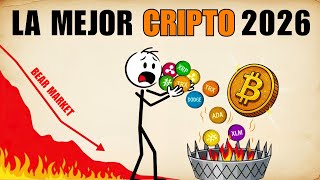

2026: The Most Expensive Year for Crypto Mistakes
42sOpens with a strong, urgent warning that a bad decision could set you back 5-10 years, creating immediate fear of missing out and high engagement.
▶ Play Clip"Title accurately warns about 2026 being a dangerous year for crypto, but slightly exaggerates the 'most expensive' claim."
The video warns that 2026 will be a bear market year in crypto, punishing those in wrong positions. It emphasizes avoiding the trap of buying cheap altcoins based on unit price, and instead focusing on market capitalization and capital flows. The core strategy recommended is consistent Bitcoin accumulation (DCA) to survive and prepare for future gains.
The market will punish those in wrong positions; 2026 is not for improvisation or copying social media strategies.
The market moves in 4-year cycles: accumulation, euphoria, all-time highs, then bear market. 2026 is expected to be a bear year.
Beginners buy cheap coins (pennies) thinking they can become rich, but price per unit is irrelevant; market cap and supply matter.
XRP, TRX, Dogecoin, Cardano, Stellar have huge supplies; they need billions of new capital to move significantly.
Market cap = price × circulating supply. It shows actual size and how much new money is needed to move the price.
Bitcoin has max supply of 21 million, almost all in circulation, creating scarcity and efficient capital absorption.
Low market cap assets can rise fast but crash harder (70-95% in bear markets) due to lack of liquidity and institutional backing.
Thousands of tokens became illiquid or delisted in the last bear market. Bitcoin always comes back; most altcoins don't.
Bitcoin is the least volatile, most liquid, and most adopted asset. Altcoins only outperform in rare, short periods.
Consistent Bitcoin accumulation (DCA) reduces stress and risk. Bear markets are preparation, not profit time.
2026 is a bear market year; the smart strategy is consistent Bitcoin accumulation (DCA) to survive and position for future gains. Avoid chasing cheap altcoins and focus on market cap and capital flows.
What is the number one trap for beginners in crypto?
Unit bias: buying cheap coins because they cost pennies, ignoring market cap and supply.
02:21
How is market capitalization calculated?
Market cap = current price × number of coins in circulation.
04:29
What is Bitcoin's maximum supply?
21 million coins.
04:56
Why is Bitcoin more efficient at absorbing capital than altcoins?
Because of its scarcity (limited supply of 21 million) and high liquidity, making each new dollar have a greater impact on price.
04:56
What percentage do altcoins typically fall in bear markets?
Between 70% and 95%.
07:25
What is the core strategy recommended for 2026?
Consistent Bitcoin accumulation (DCA - Dollar Cost Averaging).
10:56
Why do small market cap assets crash harder in bear markets?
Because they lack liquidity, safe haven status, and institutional backing; capital flows out quickly when fear sets in.
07:11
What is the total supply of XRP?
100 billion units, with over 60 billion in circulation.
05:08
Does Dogecoin have a maximum issuance limit?
No, it has no maximum limit; new coins are constantly created.
05:50
What is the difference between investing and gambling according to the video?
Investing involves understanding market cap, supply, and capital flows; gambling is buying cheap coins without analysis.
06:45
Unit Bias Trap
Explains a common psychological fallacy that leads beginners to buy worthless altcoins.
02:21Market Cap as Key Metric
Teaches a fundamental concept for evaluating any crypto asset.
04:29Bitcoin's Scarcity Advantage
Highlights why Bitcoin is fundamentally different from most altcoins.
04:56Most Altcoins Don't Survive
Historical pattern that altcoins often become illiquid or die in bear markets.
08:04DCA Bitcoin for 2026
Core actionable strategy for the predicted bear market.
10:56[00:02] in 2026, this will be the most expensive one. Because while most people will be looking for the next cheap coin, the one that still costs pennies, the market will do the exact opposite. He will punish without mercy anyone who is in the wrong
[00:16] position. And let me be very clear from the start, 2026 will not be a year for improvisation, it will not be a year for trying your luck, and much less will it be a year for copying what you saw on Twitter or TikTok. It will be a year where a bad
[00:30] decision can set you back 5 or 10 years financially. In this video I'm not going to sell you promises. I'm going to explain how to think about 2026, how to avoid the mistake that will destroy thousands of portfolios, and why at the end of this analysis only one
[00:44] strategy makes real sense. But first, I have an important announcement for claim to be from money. This could be a scam. Subscribe to the channel, study, and forge your
[00:59] own path, because in this crypto world, any mistake is irreversible. 2026 is not a normal year, and if you don't understand this from now on, everything else you do in crypto is going to be poorly planned. The crypto market doesn't move
[01:11] randomly, it moves in cycles and those cycles are deeply linked to the Bitcoin halving that occurs every 4 years. Historically the pattern is very clear. After each halving, the market enters an expansion phase.
[01:24] First accumulation, then euphoria, then all-time highs. And I've already explained this here in other videos. I won't go into too much detail now, you just have to watch the Bitcoin Cycle Explained in 13 minutes video. But what you
[01:38] need to know now is this. [music] Whoever survives a bear market is the one who Whoever survives a bear market is the one who then has a real chance. Those who don't survive are left out of the game, and everything points to 2026 being a
[01:51] full year of downward pressure, an uncomfortable year, a slow year, a year where the everyone's conviction. It won't be the year of great stories, it will be the year of defensive decisions. And this is where most fail, because instead
[02:07] of adapting to the context, they try to force speculative strategies into an environment that does not forgive them. If you understand this, you're already ahead of 90% of the market, because 2026 doesn't reward the most optimistic, it rewards those who understand the
[02:21] moment and act accordingly. Now let 's get to the number one trap that catches almost all beginners. The phrase is always the same. This coin costs cents. If it happens, I'll become rich. It sounds logical, but it's a
[02:35] well-known psychological illusion in the markets. Unit Vias. Your brain prefers to buy many units because it feels better to say, "I have 10,000 coins," than to say I have 0.03 of Bitcoin. The problem is that the market doesn't reward what
[02:50] price per unit is the least important thing. What matters is the actual asset size, how much money is already in it, how many coins exist, and how much new money would have to come in for it to really go up. You see a coin worth 0.20
[03:05] or 0.30 and you think, "Easy, it can do it 10 times." But if that project has tens of billions of coins, to grow significantly it needs an absurd amount of new capital. Look at XRP. Many see it as cheap [music], but it
[03:19] has a gigantic selection. Its all-time high was around $3.84 in 2018. Reaching and staying above those levels is not easy, because the asset is already very large. TRX is another case. It costs pennies, yes, but it has
[03:34] billions of units. Thinking it's going to $10 isn't a plan, it's a fantasy. Dodgecoin is even more extreme, with a huge supply and no fixed limit. In euphoria it rises, but in the beer market liquidity disappears and the narrative falls short
[03:48] . Cardano Stellar, Etena. The pattern repeats itself. [music] A cheap coin can be heavier and harder to move than an expensive coin, because the market doesn't move by the number on the screen, it moves by capitalization and
[04:01] money flow. And the final mistake is comparing them to the Bitcoin of the past. Bitcoin was a historical anomaly, the first, the scarcest, with only 21 million. Today the market is mature, competitive, and saturated. Thinking that a
[04:15] penny will repeat that is not optimism, it's not understanding the game. And in 2026 that mistake could cost you a whole cycle. To truly understand which asset has potential and which does not, you need to erase price from your mind
[04:29] market capitalization. Market capitalization is very simple, it's the current price multiplied by the number of coins in circulation, nothing more. That number represents the actual asset size, how much
[04:43] money is already in it, and how difficult it is to move it. Now let's look at this with real examples, because this is where everything becomes clear. Bitcoin has a unique feature. Their maximum supply is 21 million coins, no more, no less, and
[04:56] almost all of them are already in circulation. That creates scarcity, that limits dilution, and that makes every new dollar that comes in have a much greater impact on the price. That's why Bitcoin, even though it's large, is still efficient at
[05:08] absorbing capital. Now let's compare that with other assets that people call cheap. XRP has a total supply of 100 billion units with over 60 billion already in circulation. This means that although the price per
[05:21] unit may seem affordable, the actual active size is already enormous. For XRP to significantly increase in price, it does n't need millions, it needs tens or hundreds of billions of new dollars. TRX has
[05:35] around 95 billion coins in circulation. Low price again, giant size. Dodcoin is even more extreme, it has more than 150 billion coins and worse still, it has no maximum issuance limit.
[05:50] New coins are constantly being created. That means that even if money comes in, some of the growth is diluted over time. It's like trying to fill a bucket with a hole in the bottom. An asset can be cheap and already be gigantic. When you
[06:04] see a coin at $0.01 and think, "This can go up to one," you're unknowingly saying , "This asset needs to multiply its size by 100." And if it 's already an asset worth tens of billions, that would imply a market cap
[06:18] of trillions of dollars. That's not realistic. That's not how the market works. For an asset to go from $ 10 billion to $20 billion, $ 10 billion of new capital has to come in. Not likes, not comments, not hype, just money.
[06:33] And the larger the asset, the harder it is to move. That's why, when someone tells you, "This coin is cheap, it has a lot of potential," the only question you should ask is, "What's its market capitalization? How many coins
[06:45] are there? And how much money would have to come in for that to happen?" If you can't answer that, you're not investing, you're gambling. And in a year like 2026, gambling is exactly what the market punishes. Smaller assets do have
[06:58] more potential to rise. Fast. That's true, but that's only half the story. The other half is risk. And in crypto, potential and risk always grow together. The lower a project's market capitalization, the easier it
[07:11] is to move with little money, but precisely for that reason, it crashes much faster when the market turns. This isn't theory, it's statistics. In bear markets, when Bitcoin falls between 60 and 80%, altcoins typically
[07:25] fall between 70 and 95%. Not because the market is unfair, but because these projects lack liquidity, safe haven, and institutional backing. When fear sets in, capital doesn't stay to see if the project
[07:38] has potential. It flows out, and that's where the risks that no one mentions in bull markets appear. Projects that are abandoned because the team runs out of money. Tokens without real adoption that only existed while there was hype, hacks and
[07:51] exploits that destroy trust overnight. Trendy narratives that fizzle out in the downturn, and in many cases, something worse. The project simply disappears. Volume, no buyers, no way out. This has happened
[08:04] before. In the last bear market, thousands of tokens became illiquid or were delisted. Bitcoin always comes back; most altcoins don't. And this pattern repeats itself time and time again. Periods where altcoins consistently outperform
[08:18] Bitcoin are rare, short, and concentrated. Most of the time, we're in Bitcoin season. This means that even if some altcoins rise in dollar terms, they lose value relative to Bitcoin. When Bitcoin rises,
[08:30] altcoins tend to rise less. When Bitcoin falls, altcoins are destroyed. That's why Bitcoin is the least volatile asset in the entire crypto market. It has the largest market capitalization, the highest liquidity, and the highest adoption rate. And then
[08:43] the question is inevitable. If Bitcoin performs better most of the time, if it protects better when it rises, and if it defends better when it falls, why take on more risk at the worst possible moment in the cycle? That's the difference between
[08:56] investing and gambling. Now for an important clarification, because everything you've heard so far doesn't mean that Saying altcoins aren't for anyone means they're not for everyone, and certainly not at any given time. Everything
[09:08] in crypto depends on one thing: your risk profile. If you're a conservative investor, if your priority is preserving capital, sleeping soundly, and avoiding emotional decisions during a market crash, then Bitcoin alone
[09:20] solves the problem. For this profile, Bitcoin acts as the core of the portfolio. It's the most liquid asset, the most widely adopted, and the one with institutional backing. In volatile cycles, Bitcoin fulfills the role that gold does
[09:33] in the traditional system: protecting relative value. Now, if your profile is more aggressive, the conversation changes. If you already have a more solid portfolio, if you understand volatility, and if your goal is to try to outperform Bitcoin,
[09:46] then yes, going beyond Bitcoin can make sense, but with one very clear condition: preparation. Outperforming Bitcoin isn't a matter of luck. It requires fundamental analysis, an understanding of tokenomics, an assessment of actual adoption,
[10:00] and above all, accurate cycle timing. Highs exist, but they're short-lived, and those who aren't prepared are left behind. That's why investing in altcoins... It's about betting on the next big thing, it's about navigating risk consciously. Understanding that difference is
[10:15] what separates those who build wealth from those who just chase the next opportunity. 2026 is not the time to invent trends. It's not the year to try exotic strategies. It's not the year to chase the next
[10:28] narrative, and it's definitely not the year to take unnecessary risks. Everything indicates that the cycle that began with the 2024 halving peaked in 2025. And if the market behaves as it has
[10:42] historically, 2026 will be a year dominated by corrections, pressure, and psychological strain. In that context, the right decision isn't complex; it's uncomfortable, yes, but it's simple. The core strategy for 2026 is a
[10:56] single one: consistent Bitcoin accumulation. Buy Bitcoin gradually, month by month, with a clear logic. That's what's known as DCA (Decline and Accumulation). And there's another point that almost no one mentions: stress. Investing in
[11:09] altcoins during a be market increases financial risk and mental stress. The drops are more violent, the uncertainty is greater, and emotional decisions multiply. That's why doing nothing differently in 2026 isn't
[11:23] passivity; it's an active decision. And here comes the most important conclusion of this entire video. Most people see bear markets as a threat. Investors who understand the cycle see them as
[11:35] preparation. 2026 isn't the year that makes you rich; it's the year that determines whether you'll have the opportunity to become rich later. If you want to know exactly how to structure that Bitcoin accumulation step by step in 2026 with clear
[11:49] improvising amidst volatility, I've already uploaded another video here on the channel where I explain the complete DCA strategy. Watch it now, because in bear markets, the right information at the right time makes
[12:02] right information at the right time makes all the difference.
⚡ Saved you 0h 12m reading this? Transcribe any YouTube video for free — no signup needed.