
AI Summary
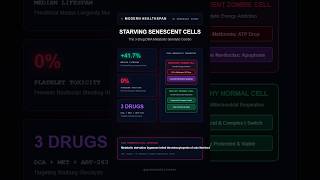
This video reports on a new metabolic senolytic cocktail developed by researchers at UC Berkeley. The combination of metformin, DCA, and a low dose of navitoclax targets senescent 'zombie' cells by exploiting their metabolic vulnerabilities. In preclinical mouse studies, this approach extended average lifespan by 41.7% without the platelet toxicity associated with existing senolytics.
Chapters
Senescent cells accumulate with age and release toxic inflammatory signals that drive biological aging.
Existing senolytics like navitoclax cause serious bleeding side effects at high doses.
UC Berkeley researchers combined metformin, DCA, and ultra-low-dose navitoclax to target senescent cells' defective mitochondria and glycolysis dependence.
The combination deprives senescent and cancer cells of energy while healthy cells adapt.
In mice, the cocktail increased average lifespan by 41.7% without toxic platelet damage.
Because the drugs are already approved and repurposed, translation to human trials could be faster.
Mentioned in this Video
Study Flashcards (5)
What are zombie cells and why are they harmful?
easy
Click to reveal answer
What are zombie cells and why are they harmful?
Senescent (zombie) cells accumulate with age and release toxic inflammatory signals that drive biological aging.
00:03
What is a major side effect of navitoclax?
easy
Click to reveal answer
What is a major side effect of navitoclax?
Navitoclax, a senolytic drug, can cause serious bleeding side effects at high doses.
00:17
What three drugs make up the metabolic senolytic cocktail?
medium
Click to reveal answer
What three drugs make up the metabolic senolytic cocktail?
Metformin, DCA, and a very low dose of navitoclax.
00:17
How does the combination target senescent cells specifically?
medium
Click to reveal answer
How does the combination target senescent cells specifically?
It exploits the metabolic weaknesses of senescent and cancer cells—defective mitochondria and over-reliance on glycolysis—depriving them of energy while healthy cells adapt.
00:33
What was the average lifespan increase in preclinical mouse studies?
medium
Click to reveal answer
What was the average lifespan increase in preclinical mouse studies?
41.7% in mice, without toxic platelet damage.
00:46
💡 Key Takeaways
Zombie cells drive aging
Establishes the biological mechanism (senescent cells and toxic inflammation) that the treatment targets.
00:03Metabolic senolytic strategy
Explains the novel approach of combining repurposed drugs to exploit cancer/senescent cell metabolism, avoiding side effects.
00:1741.7% lifespan extension in mice
Provides the key quantitative result and notes the absence of platelet toxicity, a major advantage over existing senolytics.
00:46Full Transcript
[00:03] который убивает клетки-зомби, лишая их энергии. С возрастом в организме накапливаются стареющие клетки, которые выделяют токсичные воспалительные сигналы, запускающие процесс биологического старения. Однако существующие сенолитические препараты, такие как
[00:17] навитоклакс, при высоких дозах часто вызывают серьезные побочные эффекты в виде кровотечений. Исследователи из Калифорнийского университета в Беркли решили эту проблему, объединив метформин, DCA и сверхнизкую дозу навитоклакса. Эта комбинация использует метаболические
[00:33] недостатки стареющих и раковых клеток, дефектные митохондрии и чрезмерную зависимость от гликолиза, лишая их доступной энергии, в то время как здоровые клетки адаптируются. В доклинических исследованиях на мышах этот
[00:46] метаболический коктейль увеличил среднюю продолжительность жизни на 41,7% без токсического повреждения тромбоцитов. Поскольку это соединения, используемые повторно, процесс перевода на человеческий язык может произойти гораздо быстрее.
[00:59] Would you test metabolic senolytics? Subscribe for more updates.