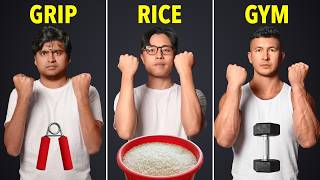
Weak Forearms Are Killing Your Gains
45sOpens with a relatable problem (weak forearms) and shocking claims about life expectancy and hiring odds, hooking viewers immediately.
▶ Play Clip
[00:00] Over the next 30 days, I'm turning this
[00:02] forearm into a powerhouse. Because after
[00:05] over 10 years of training, I always
[00:07] assumed my forearms would get jacked
[00:09] from normal lifting. But they didn't.
[00:11] And my forearms are now the second
[00:12] smallest part of my body. Even worse,
[00:14] people started noticing. And weak
[00:16] forearms don't just affect how you look.
[00:18] They can hold you back in the gym, are
[00:20] linked to shorter life expecties, and
[00:22] have even been shown to decrease your
[00:24] odds of being hired. So, I'm training my
[00:27] left forearm every single day using
[00:30] sciencebacked exercises, but I've also
[00:32] recruited two friends to test the most
[00:34] popular forearm protocols on the
[00:36] internet. So, by the end of the 30 days,
[00:38] we'll know which method and what
[00:40] exercises actually build the biggest,
[00:42] strongest forearms and wrists. But
[00:44] first, we need to get our baselines.
[00:46] Because all of us are right-handed,
[00:47] we're going to be training our left arms
[00:49] for the experiment with our right arm
[00:50] serving as a control. We're taking
[00:52] measurements across our lower, middle,
[00:54] and upper forearms to see if our
[00:56] different training programs grow some
[00:58] areas more than others.
[00:59] >> This is the smallest one I've ever
[01:01] measured.
[01:01] >> Shut up.
[01:02] >> And while for this experiment, size
[01:04] matters, what matters even more is who
[01:06] can last the longest.
[01:09] >> Does it count? What the
[01:12] >> This simple test measures your support
[01:14] grip, which is essential for rock
[01:16] climbing, deadlifting, and even bringing
[01:18] in your groceries. And for this one hang
[01:20] test, most beginners should be able to
[01:22] hang for 10 to 20 seconds with 90 plus
[01:24] seconds being elite.
[01:27] >> No, man. This is so hard.
[01:31] >> Keep going. Keep going.
[01:34] >> And with Robin holding on for a max of
[01:36] 12 seconds,
[01:37] >> 12 seconds.
[01:38] >> It's not.
[01:39] >> It was my turn. And while I'm hanging, I
[01:42] should probably explain this is just the
[01:43] first of multiple tests we'll be using
[01:45] to assess our grip strength, which can
[01:47] actually be broken down into three
[01:49] different types. And while I am feeling
[01:50] pretty good about my support grip,
[01:53] >> okay, 115.
[01:55] >> When it came to our next test, the
[01:57] results were a bit more humbling.
[02:02] >> Normal 121.4
[02:04] normal. I'm about to break this. This
[02:07] second test measures our crush grip.
[02:09] Think if you're trying to crush an apple
[02:10] with your bare hand. I felt your
[02:12] handshake. It's like a little girl.
[02:16] >> Oh, that was pretty high.
[02:18] >> 99.
[02:21] >> I still cannot hit three digits.
[02:24] >> That's as hard as he goes.
[02:27] To make Dennis feel better, multiple
[02:29] studies have found the average person's
[02:30] grip strength today is far weaker than
[02:33] it was even just 20 years ago. Which is
[02:35] problematic since grip strength is one
[02:37] of the best predictors of your overall
[02:39] strength and activity level, which
[02:41] explains why researchers found a strong
[02:43] correlation between weak grip and early
[02:45] death.
[02:48] >> Robin, don't pass out.
[02:50] >> Okay.
[02:51] >> 108.2. And for our final test, we're
[02:54] measuring finger and wrist strength by
[02:56] testing our pinch grip by attempted to
[02:58] hold three 10 lb plates between our
[03:00] fingers and thumb.
[03:09] >> Wow.
[03:10] >> And after struggling in our first two
[03:11] tests, this time Dennis just couldn't
[03:13] get it up.
[03:15] >> What the This is so embarrassing. I'm a
[03:18] fitness guy.
[03:20] >> Saturate. Saturate. Sentry, centrate,
[03:29] >> zero.
[03:30] >> But then it was Robin who put both
[03:32] myself and Dennis to shame.
[03:38] >> No way. My my foot will go your foot.
[03:43] >> That was pretty good. 6 seconds.
[03:45] >> Now for our training.
[03:47] >> Right.
[03:47] >> Oh, okay. This is going to be yours.
[03:50] You're going to be training your
[03:51] forearms just through grip gripping.
[03:54] >> There we go.
[03:55] >> Robin will be sticking to 100 reps every
[03:57] single day with a hand gripper as his
[03:59] only training. Meanwhile, Dennis will
[04:01] also be training daily, but he'll be
[04:03] using my leftover rice.
[04:06] >> Yes,
[04:07] >> Dennis is trying the rice bowl approach
[04:08] that I've seen everywhere online with
[04:10] people documenting some pretty crazy
[04:13] results. Robin and Dennis will be trying
[04:14] to compete against my science-based gym
[04:17] routine that I've designed to maximize
[04:19] growth. But in order to design the best
[04:21] workout possible, we need to understand
[04:23] the three main areas that make up your
[04:25] forearm. Starting with the most beefy
[04:27] part of your forearms, the flexors. To
[04:29] train them, it's pretty simple. Wrist
[04:31] curls. I'm going to try these with
[04:32] dumbbells, but also some cable
[04:34] variations to see what works best. But
[04:36] if you lift weights, your flexors are
[04:38] already trained indirectly. So, you're
[04:40] probably lacking a bit more in the next
[04:42] area, the extensors. These muscles sit
[04:44] on top of your forearm, creating some
[04:46] pretty crazy striations when you develop
[04:49] them, and may also help with elbow pain.
[04:51] Now, to train these, you just got to
[04:52] extend your wrist, which I'll be trying
[04:54] out with dumbbells, as well as this
[04:56] cable version. Last but not least is
[04:58] this big chunk of muscle that sits right
[05:00] around your elbow crease, which is, in
[05:02] my opinion, the most noticeable
[05:03] impressive forearm muscle. It's called
[05:05] the brachio radiialis. Now, unlike the
[05:08] two other muscle groups, this muscle
[05:10] doesn't cross over the wrist and won't
[05:12] be trained through wrist movements. It
[05:14] instead helps bend your elbows during
[05:15] curls, but so do your biceps. So, to
[05:18] target this muscle more, you want to
[05:20] first rotate your arm into a neutral
[05:22] hammer grip. If you do just this during
[05:24] regular curls, you'll already feel the
[05:26] difference, but you can take it a step
[05:28] further. So, I've been paying close
[05:29] attention to some really cool bicep
[05:31] studies, and it seems like placing your
[05:33] arm on an incline bench or preacher curl
[05:36] puts your biceps at a disadvantage and
[05:38] forces your break your radiialis to work
[05:40] harder and experience more growth. So,
[05:42] I'll be doing one exercise that applies
[05:44] that as well as reverse grip curls,
[05:46] which also seem to target this muscle
[05:48] well. I'm going to give all these
[05:50] exercises a shot, training each area of
[05:52] the forearm with three sets to failure
[05:54] every single day. And after 30 days of
[05:56] experimenting, I'm going to share what I
[05:58] think is the number one exercise for
[06:00] each area, plus give you a fully
[06:02] optimized forearm workout based on my
[06:04] findings. But by the time I had finished
[06:06] just my second workout on my new plan, I
[06:09] was already wondering if my forearms
[06:10] were even going to make it the full 30
[06:12] days. My forearms have never been this
[06:14] sore before. Clearly, I don't train
[06:16] them. I don't know if I'm going to be
[06:17] able to do this for 30 days.
[06:23] So, it's like hurting here and around
[06:25] the fingers. It's hurting a lot.
[06:27] >> First exercise, grab rice
[06:31] for two.
[06:33] >> And while Dennis doesn't have 100 reps
[06:35] to worry about like Robin,
[06:36] >> hey, no, no.
[06:38] >> He'll be following a popular rice
[06:39] training plan that we found online. Now,
[06:41] I always thought training a muscle every
[06:43] single day just wouldn't allow it to
[06:45] recover and grow bigger and stronger.
[06:47] But some new research is making me
[06:49] rethink that because in a recent study,
[06:51] strong, well-trained lifters bench
[06:53] pressed every single day for 34
[06:56] consecutive days. They did one set where
[06:58] they tried to lift as much as possible
[07:00] for one rep, and then afterwards, they
[07:02] did five lighter sets for volume. Now,
[07:04] you would expect training like this
[07:05] every single day would burn most lifters
[07:07] out. But by the end of the study, the
[07:09] lifters made insane strength gains,
[07:11] adding an average of 40 lbs to their one
[07:14] rep max, which for well-trained lifters
[07:16] would normally take easily over a year
[07:18] to accomplish. Now, while the study
[07:20] focused on bench press may not be the
[07:22] perfect model for how to grow your
[07:23] forearms, my hypothesis is that short
[07:26] daily training shouldn't be anything to
[07:28] worry about and if anything may end up
[07:30] getting me the fastest gains of my life.
[07:32] But by day three, I was already feeling
[07:34] a lot of discomfort.
[07:36] Not just through my forearm muscles, but
[07:38] in my actual wrist joint.
[07:41] Oh, that hurts. That's so uncomfortable.
[07:44] >> And when I checked in with Robin, he was
[07:46] having a similar struggle trying to hit
[07:48] 100 reps every day. In fact, the only
[07:50] person who wasn't struggling so far
[07:52] seemed to be Dennis.
[07:53] >> Feels kind of nice.
[07:55] >> Today I'm doing legs, so I'm doing
[07:58] Bulgarian split squats. Usually I wear
[08:00] wrist wraps on both. I'm only going to
[08:02] wear a wrist strap on the right side. If
[08:05] I'm being honest, I actually think
[08:06] relying too much on lifting straps is a
[08:08] major reason why my forearms have become
[08:10] underdeveloped. Because ever since I
[08:12] found out about a study that showed
[08:13] lifting straps instantly increase
[08:15] people's deadlifts by around 40 lbs, I
[08:17] started adding straps not just to my
[08:19] deadlifts, but to all my back and biceps
[08:21] exercises. And so my forearms just
[08:23] simply stopped getting challenged. So
[08:25] now I'm trying to make up for all that
[08:27] missing activation.
[08:29] But because a common issue beginners
[08:31] have is their forearms and grip giving
[08:33] out before their other muscles like
[08:34] biceps and back. I'm curious if Dennis,
[08:37] even with his rice training, will
[08:39] experience some benefit in his exercises
[08:41] where he typically gets forearm cramps.
[08:42] Which is why on day one, I also had
[08:45] Dennis, Robin, and myself, test our
[08:48] personal best on the incline biceps
[08:50] curl. And on day 30, we're going to
[08:52] retest to see if the forearm training of
[08:54] our left arm actually leads to better
[08:56] curling strength compared to our right.
[08:58] And since Dennis and I are already
[09:00] tracking our workouts through our Built
[09:01] with Science Plus app, we'll be able to
[09:03] see if there are any other strength
[09:04] jumps that happen as a result of this
[09:06] improved grip. Robin, on the other hand,
[09:08] he doesn't have a current workout plan,
[09:10] but he does have his own motivations.
[09:11] >> When I play piano, uh I'm not good with
[09:14] the left hand. I always play
[09:19] right hand more. I'm really excited also
[09:22] how this exercise will going to impact
[09:26] me playing with left hand.
[09:28] >> And while we'll have to wait to see if
[09:29] Robin's playing improves, his progress
[09:31] with his grip training is already
[09:32] improving. He's already smashed 100 reps
[09:35] on the lowest difficulty, which means he
[09:37] can start upping the resistance, which
[09:39] meant I was the only one who was
[09:41] continuing to struggle with the daily
[09:42] workouts. Okay. So, one thing I've
[09:44] noticed about a lot of forearm
[09:45] exercises, specifically for this guy
[09:47] right here, the brachioraiialis, I found
[09:50] that dumbbells, it's really hard to get
[09:53] the form down without aggravating the
[09:55] wrist and elbows. So, I'm going to
[09:57] experiment with cables. Keep my palm
[09:59] facing down.
[10:02] There we go. Way better than dumbbells.
[10:05] With some exercise swaps, my joint pain
[10:07] was no longer an issue. And I'd even
[10:09] found some home friendly exercises I
[10:11] could swap in when I didn't have a
[10:12] dumbbell. But the craziest improvement
[10:14] by far was the visual change I was
[10:17] already noticing.
[10:18] >> It actually feels like new beginnings
[10:20] again. Feels like I'm a beginner. Just
[10:22] like my muscles are growing super
[10:24] quickly, which is really motivating cuz
[10:27] I haven't had that since I started
[10:30] lifting. Even my wife seems shocked by
[10:32] my progress, asking me the one question
[10:34] every guy wants to hear. Why is it so
[10:37] big?
[10:38] >> What do you mean?
[10:39] >> Like, is your other one miniature now?
[10:41] Let me see your other one.
[10:43] >> But it feels pretty like it feels
[10:45] bigger.
[10:46] >> Well, it looks like it.
[10:49] >> But it feels pretty jacked though,
[10:50] right?
[10:50] >> Feeling. Yeah.
[10:51] >> But size doesn't mean much without
[10:53] functional strength. So, after 15 days
[10:55] of training, I wanted to see if each of
[10:57] us could pass a simple grip test. Today,
[10:59] we're going to do a general fitness
[11:01] test. Usually you take 100% of your body
[11:03] weight
[11:04] >> and you have to do a farmer carry for at
[11:06] least 30 seconds. But since we're only
[11:08] training one arm, we're going to divide
[11:09] that weight in half and we're going to
[11:11] do that for 30 seconds.
[11:12] >> 3 2 1.
[11:15] >> All right, walk. Oh, easy.
[11:19] >> Come on, Robin. This 30 second challenge
[11:22] is a pretty reliable benchmark for
[11:24] assessing your grip strength. If you can
[11:25] make it the full 30 seconds, your grip
[11:28] strength is performing as it should be.
[11:30] You pass. But if you fail,
[11:31] >> keep walking. Keep walking. Robin's
[11:33] down. Robin is down.
[11:35] >> You've got some serious work to do.
[11:38] >> No.
[11:40] >> You passed. Good job.
[11:42] >> Robin,
[11:43] >> he doesn't get a high bar. He didn't
[11:44] pass.
[11:44] >> He has a low pass.
[11:47] >> You have two weeks to pass this. Okay.
[11:49] >> And while Dennis and I did manage to
[11:51] complete a farmer's carries, Dennis's
[11:53] forearm has gotten so strong that
[11:55] regular rice is no longer challenging.
[11:57] Oh, I got these to increase the
[12:01] resistance. These are like metal bowls.
[12:03] So, I'm going to add them to the rice.
[12:05] Hopefully, when I do my workout, make it
[12:07] a little bit harder.
[12:08] >> We also got him a wooden spoon to make
[12:10] it more difficult.
[12:11] >> It's a lot heavier for sure. Ooh, I
[12:15] would say like five times more difficult
[12:18] to do.
[12:19] >> As for my own training, everything was
[12:20] going good until week three. I am
[12:23] frustrated. My lifts this week have been
[12:26] horrible. like my forearm strength has
[12:28] tanked. I'm a little worried because my
[12:30] forearms feel exhausted. I don't think
[12:32] they're recovering well, but I'm hopeful
[12:34] that in the final two weeks that my
[12:36] strength really starts to pick up.
[12:38] Fingers crossed. Seeing my strength
[12:40] start to dip was definitely concerning.
[12:42] But when I look closer at the data on
[12:43] the daily bench press study we talked
[12:45] about earlier, some days the people got
[12:47] stronger, some days they got weaker, and
[12:49] for many days it stayed the exact same.
[12:52] But by the end of the 34 days, all of
[12:54] them got significantly stronger than
[12:56] when they started. So, I'm hoping if I
[12:58] just stay the course, I should be able
[13:00] to break through this plateau before we
[13:03] get to the final tests.
[13:06] >> Every single day, I can see the
[13:09] progress. Basically, I'm able to
[13:11] comfortably do the exercise. Now, uh
[13:13] this exercise definitely helped me to
[13:15] basically learn this
[13:21] And after 30 days, Robin was getting
[13:24] stronger and stronger with his hand
[13:25] gripping, and he'd even made it to the
[13:27] hardest setting. Oh, I'm not sure the
[13:30] parking lot was the best place to do
[13:32] this. Meanwhile, Dennis couldn't wait to
[13:34] stop carrying his rice bucket everywhere
[13:36] he went.
[13:36] >> Even if I'm on vacation, my arms not
[13:39] going to be on vacation.
[13:41] >> As for me, I realized how much my arms
[13:43] benefit from direct forearm work. It
[13:45] took under 10 minutes a day and I could
[13:47] easily fit it in between sets. Plus, I
[13:50] started relying on straps less and my
[13:52] grip more. But here's what I didn't
[13:54] expect. After experimenting with dozens
[13:56] of exercises, there were only a few that
[13:58] didn't hurt my joints. So, I narrowed it
[14:00] down to my top three for growth and the
[14:03] exact workout I'm going to stick with
[14:05] after this. I'm going to show you all of
[14:06] that in a second. But first, let's see
[14:08] how my strength results compared to
[14:10] Dennis and Robert. And what they don't
[14:12] know is I've also prepared a bonus test.
[14:14] what Reddit claims is the world's
[14:16] hardest jar to open. But we'll save that
[14:18] for later. Up first is our crush grip.
[14:27] >> Oh my god.
[14:29] >> 13.
[14:30] >> 137.2.
[14:31] I can feel that, too.
[14:33] >> But for Dennis's rice training, show the
[14:36] camera. Show the camera. Okay, it
[14:39] doesn't count. It doesn't count.
[14:40] >> 86. One more time. One more chance. ONE
[14:42] MORE TIME.
[14:46] I THOUGHT he was going to break
[14:47] >> 6.4.
[14:49] >> What?
[14:50] >> Were you eating?
[14:54] >> I'm predicting that this is going to be
[14:55] the biggest strength increase for Robin
[14:58] because this is what he trained.
[15:02] >> No, wait. No,
[15:03] >> before
[15:05] was 108.
[15:07] >> No, no, no.
[15:09] One second.
[15:10] >> You got it. You got it. 1111.4.
[15:14] >> Yeah, but
[15:15] >> last time you were
[15:16] >> which meant round one is going to my
[15:18] science back gym plan. As for the dead
[15:20] hang
[15:25] 112.
[15:26] >> My time came in almost exactly the same
[15:29] as my day one time, which isn't the
[15:30] progress I was hoping for. And it means
[15:32] either Dennis or Robin have the chance
[15:34] to take the win.
[15:37] >> Let's go, Robin. Easy way.
[15:42] What the? Wait, wait, wait, wait. What
[15:44] is 6 seconds?
[15:46] >> 5.59.
[15:48] >> What was his last time?
[15:50] >> 12 seconds.
[15:51] >> Yeah.
[15:51] >> What happened?
[15:53] >> So, hand gripper does not help with your
[15:56] dead hang time.
[15:57] >> Which means it's down to just Dennis.
[15:59] And even though Dennis claims his rice
[16:01] bucket was barely a full workout, his
[16:03] single arm dead hang was already well
[16:05] past his day one time of just 5 seconds.
[16:10] Holding my breath, too.
[16:11] >> 14 seconds. What have you been doing?
[16:13] >> Holding my breath helped. Also, I'm
[16:15] sick, so I think that helped.
[16:17] >> What I think also helped Dennis is the
[16:18] fact that his rice workouts mainly
[16:20] challenged his grip endurance, building
[16:22] up to longer and longer sets of stirring
[16:24] the rice, plus the fact that he was
[16:26] regularly lifting weights throughout
[16:27] this process. But what really surprised
[16:29] me was what happened when we retested
[16:32] our biceps curl strength. Our rep
[16:34] performance on our left side increased
[16:36] more than our right sides did. something
[16:38] I was not expecting, especially for a
[16:39] well-trained lifter like myself,
[16:41] suggesting that stronger forearms may in
[16:44] fact lead to strength boost in other
[16:46] lifts as well. However, when we tested
[16:48] Robin, who doesn't lift any weights at
[16:50] all, his results hadn't changed. But
[16:52] when we got to the pinch test
[16:56] >> Oh,
[16:58] >> 20 seconds.
[16:59] >> Wow.
[17:00] >> Holy
[17:01] >> Let's go. Holy. And even though I did
[17:03] improve slightly from day one, compared
[17:05] to Robin, my extra second just doesn't
[17:07] feel very impressive.
[17:10] >> Six seconds.
[17:13] >> Yo, how'd you do that? 20 seconds.
[17:17] >> So, across the three tests we ran, it
[17:19] seems like each method of training did a
[17:21] better job at improving different areas
[17:23] of grip strength. However, when it came
[17:25] to our bonus test
[17:30] >> Oh no. Again.
[17:30] >> Oh my god. again. Same expression.
[17:34] >> I swear it's the
[17:36] >> You can't do none of this funny stuff.
[17:39] God,
[17:41] look at it. It's so painful.
[17:43] >> Now, it won't be this painful if you're
[17:45] following the right workout plan using
[17:46] our Build with Science Plus app. With
[17:48] it, you're going to get a completely
[17:50] customized workout routine based on your
[17:52] body. And not just for your forearms,
[17:54] but for every single muscle. That way,
[17:56] you're not going to be embarrassed the
[17:57] next time you try to open a lid or even
[17:59] take your shirt off at the beach.
[18:01] I had high hopes for you.
[18:08] >> Really? You can't hold it? You're not
[18:09] joking?
[18:11] >> It also guides you with your diet and
[18:13] lets you track your nutrition with a
[18:15] snap of a picture. You can try it for 2
[18:17] weeks free over at billwithcience.com or
[18:19] by scanning this QR code right here.
[18:21] Right.
[18:22] >> Yeah. Yo, I'm nervous. I don't know if I
[18:24] can publish this video if
[18:28] >> what?
[18:31] >> Oh wow, look at this.
[18:33] >> You guys want some jab?
[18:35] >> But now let's talk about growth. So when
[18:37] we measured the average growth across
[18:39] all three measurement points, third
[18:41] place went to Dennis's rice training,
[18:44] leading to modest growth through his
[18:45] upper forearm, but no growth through his
[18:47] middle and lower forearm, followed in
[18:49] second place by me. While my forearms
[18:52] experienced a ton of growth through the
[18:53] upper and middle of my forearm, the
[18:55] lower part around my wrist stayed
[18:57] exactly the same. Robin, on the other
[18:59] hand, he had barely changed his upper
[19:00] forearm, but the highest growth around
[19:02] his middle and lower forearm. However,
[19:05] because of his training experience, he
[19:07] probably experienced the biggest newbie
[19:09] gains out of all of us.
[19:10] >> First time in my life I did any
[19:13] exercise.
[19:14] >> This is the first time in your whole
[19:15] life you've done exercise.
[19:17] >> Yeah. Hopefully, these gains convince
[19:18] Robin to commit to something more than
[19:20] just gripping. But based on my data and
[19:22] my own 30-day experience, here are my
[19:25] picks for the top three forearm
[19:27] exercises. And I've even added all of
[19:29] these forearm exercises to our Build
[19:30] with Science Plus app. I will say
[19:32] farmer's carries as a bonus at the end
[19:34] of your workouts is a great idea,
[19:36] especially for beginners. And as we saw
[19:38] with Robin, simply getting a hand
[19:40] gripper is an easy, low barrier to entry
[19:42] way to get started and might even grow
[19:44] the lower forearm a little bit more. And
[19:46] here is the workout I'm personally going
[19:48] to be sticking with going forward, doing
[19:50] it twice a week on my leg days or rest
[19:52] days. And if you want to pair your
[19:54] forearm training with a full body
[19:56] workout plan that hits every single
[19:58] muscle, then check out this video next.
[19:59] Thank you so much for watching and I'll
[20:01] see you next
⚡ Saved you time reading this? Transcribe any YouTube video for free — no signup needed.