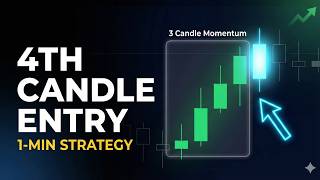

3 Candle Rule for 1-Min Trades
45sThe core strategy is explained concisely, offering a quick, actionable trading rule that viewers can immediately understand and try.
▶ Play Clip"The title accurately describes the strategy, but the video includes a lengthy intro and a promotional segment for a PDF guide, which dilutes the core content."
This video presents a simple 1-minute Pocket Option trading strategy based on candle momentum, called the 'fourth candle continuation strategy.' The core idea is to enter a trade when three consecutive candles of the same color appear, anticipating that momentum will continue into the fourth candle. The strategy emphasizes discipline, filtering, and risk management over blind execution.
The video introduces a simple 1-minute Pocket Option continuation strategy based on candle momentum, with no complicated indicators or over-optimization.
The strategy is called the 'fourth candle continuation strategy.' When three consecutive candles appear in the same direction, it signals strong short-term momentum, which often continues into the fourth candle.
Trading involves financial risk. The strategy is for educational purposes only, with no guarantee of profit. Viewers are advised to practice on a demo account and never trade with money they cannot afford to lose.
The first rule is to see three consecutive candles of the same color. Three bullish candles prepare for a buy continuation; three bearish candles prepare for a sell continuation. The trade direction follows the previous three candles.
Candles should be normal and balanced in size. Avoid extremely large spike candles (which may indicate exhaustion) and very small candles (which show weak momentum). Steady, healthy momentum is preferred.
Avoid taking trades near strong support or resistance levels, as even strong momentum can reverse at key zones. Market location is important.
Avoid trading during major news events, as high-impact news can create unpredictable volatility. The setup works best in stable market conditions.
Once the third candle closes and all conditions are met, enter a 1-minute trade in the same direction as the three candles. The strategy is about taking only clean setups, not every setup.
A free PDF guide is available via the link in the description, explaining the setup, confirmation rules, and do's and don'ts step-by-step.
A chart example shows three strong bullish candles approaching resistance. Despite the resistance, the momentum is strong, and the fourth candle breaks through, resulting in a profitable trade.
A chart example shows three consecutive bearish candles with solid bodies and clear selling pressure. The fourth candle continues downward, and the trade closes in profit.
A chart example shows three bullish candles, but the fourth candle fails to continue upward due to a minor resistance area and overall bearish market context. The trade closes in a loss, highlighting that trading is about probabilities, not guarantees.
Trading is not about winning every trade. It's about following rules, managing risk, and staying disciplined over time. Focus on process, not outcome.
The fourth candle continuation strategy is a simple, rule-based approach for 1-minute trading, but it requires discipline and risk management. The video emphasizes that losses are normal and that long-term consistency comes from following a structured process, not from chasing every trade.
What is the core concept of the fourth candle continuation strategy?
When three consecutive candles appear in the same direction, the momentum often continues into the fourth candle, so you enter a trade in that direction.
00:14
What are the four rules for a valid setup?
1. Three consecutive candles of the same color. 2. Candles should be normal and balanced in size. 3. Avoid trading near strong support/resistance. 4. Avoid trading during major news events.
01:20
Why should you avoid extremely large spike candles?
They may indicate exhaustion, which could lead to a reversal.
01:34
What is the recommended expiry for the trade?
1 minute.
02:17
What is the key lesson from the losing trade example?
Even when three bullish candles appear, if the overall market context is bearish or the move is just a pullback, continuation may fail. Trading is about probabilities, not guarantees.
06:41
Core Concept
Defines the entire strategy in one sentence: three candles in a row often lead to a fourth.
00:14Rule-Based Approach
Emphasizes discipline and filtering, which is the foundation of professional trading.
01:20Resistance is Not a Wall
Highlights that strong momentum can break resistance, challenging a common misconception.
04:18Probabilities, Not Guarantees
Reinforces that losses are normal and that consistency comes from following rules, not from winning every trade.
06:41[00:01] Trading Strategies. In today's video, I'm going to show you a simple and practical 1-minute Pocket Option continuation strategy based purely on candle momentum. There are no complicated indicators here
[00:14] and no over optimization. This strategy focuses on understanding short-term price continuation using basic price action logic. It's called the fourth candle continuation strategy. The concept is straightforward. When the
[00:27] market prints three consecutive candles in the same direction, it often shows strong short-term momentum. If buyers are clearly in control, we see three bullish candles. If sellers are dominating, we see three
[00:40] bearish candles. In many cases, that momentum continues into the fourth candle. However, we do not blindly enter every time we see three candles. Discipline and filtering are essential.
[00:53] Before we go deeper, I want to clearly state that trading involves financial risk. This strategy is shared strictly for educational purposes. There is no guarantee of profit and you should never trade with money you cannot afford to
[01:06] management and practice on a demo account before trading with real funds. Now, let me explain the rules clearly. First, you must see three consecutive candles of the same color. If there are three bullish candles, we prepare for a
[01:20] buy continuation trade. If there are three bearish candles, we prepare for a sell continuation trade. The trade direction always follows the previous three candles. Second, the candles should be normal and balanced in size.
[01:34] Avoid extremely large spike candles as they may indicate exhaustion. Also, avoid very small candles as they show weak momentum. We want steady, healthy momentum. Third, avoid taking this trade near strong support or resistance
[01:48] levels. Even strong momentum can reverse at key zones. Market location is very important. Fourth, avoid trading during major news events. High impact news can create unpredictable volatility and this setup works best in stable market
[02:02] conditions. Now for execution. Once the third candle closes and all conditions of the fourth candle in the same direction with a 1-minute expiry. That's it. But remember, this strategy is not about taking every setup. It is about
[02:17] taking only clean setups that respect all the rules. Professional trading is built on patience and structure, not excitement. To help you understand this strategy in more depth, I've created a complete free PDF guide explaining the
[02:30] setup, confirmation rules, and important do's and don'ts step-by-step. You can download it using the link in the description. I recommend studying it carefully before applying this strategy in live markets. If you value
[02:43] structured, rule-based trading education without hype or unrealistic promises, make sure you like this video and subscribe to Sam Trading Strategies. Turn on notifications so you don't miss upcoming strategy content. Now, let's
[02:57] how this setup works in real market conditions. At this point on the chart, we can clearly see three strong bullish candles forming one after another. These are not weak candles. They are clean-bodied candles with solid upward
[03:11] movement showing that buyers are in control. Now, here's something important. Yes, price is approaching a resistance level. Normally, many traders buying completely. But trading is not
[03:24] about blindly reacting to levels. It's about understanding momentum strength. Look carefully at the structure. The candles are not slowing down. There is no doji. There is no rejection wick showing selling pressure. Instead,
[03:37] buyers are pushing price aggressively upward. This tells us that resistance is being tested with strength, not weakness. After the third bullish candle closes and all our rules are satisfied, no doji, healthy candle size, no major
[03:51] news, we enter a 1-minute buy trade at the opening of the fourth candle. Now, as the fourth candle starts forming, pay attention to what happens. Instead of immediate rejection from resistance, price continues pushing higher.
[04:05] The body of the candle expands upward, and we can see that buyers are still active in the market. This is a very important lesson. Strong momentum can break resistance levels when pressure is high. Resistance is not a wall, it is an
[04:18] area. And when buyers attack that area with strong volume and continuation candles, breakouts become possible. As the expiry approaches, price remains above the entry level, and the trade closes in profit. Let's move to the next
[04:31] chart example. At this point on the chart, we can see clear bearish momentum. The market was already moving downward, and after a small bullish strongly. Then we get three consecutive bearish
[04:45] candles with solid bodies and clear selling pressure. There is no doji between them, and the candle sizes look healthy, not too large and not too small. This tells us that sellers are still in
[04:57] Since all the rules are satisfied and there is no immediate strong support blocking the move, we enter a 1-minute sell trade at the opening of the fourth candle. As the fourth candle forms, price does not show strong bullish
[05:09] rejection. Even though there may be small wicks, the structure remains bearish. There is no bullish engulfing candle and no sudden buying pressure. The market continues respecting the downward momentum during the trade
[05:22] duration. This is important. Continuation trades don't always move aggressively. What matters is that the structure stays intact. As expiry entry level, and the trade closes in profit. Now, let's move to the next
[05:36] example. At this point on the chart, we can see three consecutive bullish candles forming after a small bounce from the recent low. The candles are reasonably healthy in size and show short-term buying pressure. There is no
[05:48] doji between them and momentum appears to be shifting upward after the previous bearish move. Based on our fourth candle continuation strategy rules, this qualifies as a potential buy setup. So, after the third bullish candle closes,
[06:01] we enter a 1-minute buy trade at the opening of the fourth candle. Now, watch Initially, the fourth candle pushes slightly upward, suggesting buyers are still active. However, notice something important. The upward move is not very
[06:14] strong. The candle starts showing hesitation near a minor resistance area created by previous candles. Instead of strong continuation, we begin to see rejection pressure. The bullish momentum weakens and sellers step in faster than
[06:27] expected. This is a key lesson. Even when three bullish candles appear, if the overall market context is still bearish or if the move is just a temporary pullback, continuation may fail. Momentum shifts quickly in
[06:41] short-term trading. As expiry approaches, price drops below our entry level and the trade closes in a loss. And this is completely normal. Trading is about probabilities, not guarantees. The setup met the rules, but the broader
[06:55] bearish pressure in the market was still dominant. This means the three bullish candles were likely a pullback, not a true reversal or continuation shift. The important part here is not the loss itself. The important part is that we
[07:08] followed the rules, we controlled risk, and we did not break discipline. Before we close this video, remember one important thing. Trading is not about winning every single trade. It's about following your rules, managing risk, and
[07:22] staying disciplined over time. Today, you saw both a winning trade and a losing trade, and that's real trading. No strategy guarantees profit. What creates consistency is structure and emotional control. Do not chase the
[07:35] market. Do not break your rules after one loss. Focus on process, not outcome. probabilities, you build a long-term edge. Always remember, trading involves
[07:47] financial risk. Practice properly, use risk management, and never trade money you cannot afford to lose. If you value honest, rule-based trading education video and subscribe to Sam Trading Strategies. I'll see you in the next
[08:01] Strategies. I'll see you in the next breakdown. Stay disciplined.




⚡ Saved you 0h 08m reading this? Transcribe any YouTube video for free — no signup needed.