
GEO Secret: Use Sales Calls for AI Prompts
45sReveals a counterintuitive strategy of using sales transcripts to find AI prompts, offering a fresh, actionable insight for SEOs.
▶ Play Clip"Title promises GEO advice from five experts and delivers exactly that with actionable tactics."
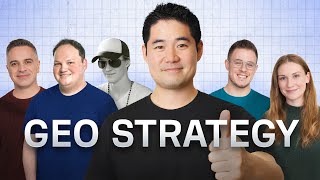
This video features insights from five SEO experts on how to rank in AI search (GEO). They share tactics like analyzing sales conversations for prompts, focusing on YouTube visibility, creating niche comparison pages, and building a trustworthy brand. The core message is that long-term success in AI search requires building a better business.
No one agrees on how GEO works. The video aims to cut through the noise by asking five active SEOs for their best advice.
Analyze sales call transcripts with an LLM to find unique topics and understand customer fears, doubts, and desires. Prompts are 5x longer than keywords.
YouTube mentions and impressions are the strongest correlating factors with AI visibility. YouTube is a major input (training data) and output (most cited domain in AI overviews).
Create comparison pages (e.g., 'QuickBooks alternative for graphic designers') to get brand mentions in AI. Use sponsored links to piggyback on competitor mentions.
Ensure your website is a great resource. Monitor Reddit for opportunities and use tools like Brand Radar to find topics where competitors are mentioned but you are not.
The core of any GEO strategy is building a trustworthy brand, product, and content. Tactics are secondary to this principle.
The video concludes that while tactics like analyzing conversations, YouTube visibility, and niche comparisons are valuable, the most important factor for long-term GEO success is building a better business that people can trust.
How much longer are prompts compared to traditional keywords?
Prompts are on average five times longer than keywords.
00:15
What is the strongest correlating factor with AI visibility according to Louis's study?
YouTube mentions, followed by YouTube mention impressions.
01:30
What type of content does Steve recommend for getting brand mentions in AI?
Niche comparison pages, e.g., 'QuickBooks alternative for graphic designers'.
02:30
What is Glenn's first question to ask before pursuing GEO?
Do you deserve to show up? Is your website a great resource?
04:00
What is the core principle of GEO according to the final expert?
Build a better business.
05:30
Prompts Are Longer Than Keywords
Highlights a fundamental difference between traditional SEO and GEO.
00:15YouTube Dominates AI Citations
Provides data-backed insight on the importance of YouTube for AI visibility.
01:30Niche Comparisons for Brand Mentions
Offers a specific, actionable tactic for new brands to compete.
02:30Build a Better Business
Emphasizes that long-term GEO success depends on fundamental business quality.
05:30[00:00] I'm on a mission to build a GEO strategy that can help you consistently rank in AI search. But there's a huge problem. No one seems to agree on how it actually works. So to cut through the noise, I asked five SEOs who are actively testing tactics and strategies one question. What's your best piece of GEO advice? Right now, we're still in the stage where we try to understand what people want, but classic search keywords are not
[00:27] hitting the context that people are looking for. And so my number one tip is about how do you bridge that disconnect? How do you actually figure out what people might be prompting? And my way to approach that is to look for conversations that actually happen between your target audience and the company. My favorite are sales conversations. I use transcripts from these conversations. I will upload them to an LLM and then ask these traditional marketing and product
[00:54] questions. What does a customer care about? What are their fears, uncertainties, doubts, etc. All these traditional questions you would ask for market research. You can now with the help of AI find these unique topics that you probably wouldn't have found with classic keyword research, >> right? So, how do we get our brand mentioned in those AI overviews? >> For AI overviews, AI mode, etc. Being present organic search, I think, is a critical step. And then from
[01:22] there, it's the classic spiel of web mentions across publishers, social networks, review sites, the content that you create. But at the most basic level, it depends on how the web talks about you. Again, publishers and UGC platforms like Reddit and the content that you create to have some sort of answer that LMS can lean on. >> How important do you think it is to get mentioned in listicles? >> Right now, it's very important. There's lots of
[01:49] room for spam. does room for simple tactics and the hard reality is it works. Will it work forever? No. How long? No idea. >> Kevin, I appreciate your time. >> Yeah, my pleasure, man. So, the first takeaway, you can't just think in keywords. Prompts are on average five times longer than keywords in traditional SEO because searchers are asking questions and explaining their situation in way more detail. So Kevin's advice, start pulling insights from conversations like Zoom
[02:16] calls, Reddit or support emails, and live chat conversations. Noted. All right, Louise, what is your best piece of GEO advice? >> I would say my best piece of GEO advice is focusing on YouTube visibility. I'm just about to publish a new study where we looked at the relationship between branded search factors and AI visibility and found that YouTube mentions are the strongest correlating factor followed by YouTube mention impressions. YouTube is a large part of the input
[02:43] and the output for AI. So when I'm talking about input, Open AI has trained on over a million hours of YouTube transcripts. YouTube is a huge repository of natural language content. So it makes sense. And then also in terms of the output looking at brand radar, we see that YouTube is the most cited domain in AI mode and AI overviews. So my advice would be really start taking a look at your YouTube visibility and how you
[03:10] show up, who you're sponsoring, what kind of content collaborations you're doing, that kind of thing. From like a tactical actionable standpoint, what should a new website be doing to get more mentions in AI search? >> Making sure you're creating recent content and updating your content regularly. Ryan Lord did a study where he studied 17 million AI citations and found that AI content is 26% fresher, I think it was, than content ranking in the SERs. So, I
[03:38] would say making sure you're publishing and refreshing your content will definitely help your case. Trying to actively build your mentions on third party sites would be a big piece of advice. And now, now that could extend to YouTube mentions as well. >> Is there anyone else that you know that I should speak to to learn more about GEO and and how I can rank in AI search? I saw Steve Tooff on LinkedIn the other day saying
[04:05] that he's specifically creating YouTube videos for AEO. But yeah, he's he was always putting out really good tactical practical advice. So >> Louis's research shows that the frequency of mentions in videos and the number of views to those videos correlate strongest with mentions in AI. So my second takeaway is to get your brand mentioned in YouTube videos. HS HS. >> All right, Steve, I need your help. Can you give me your best piece of geo advice?
[04:32] >> Sure. Right now, the main thing that we're doing that is getting the best results is around SAS comparisons. So, traditionally, your comparison pages would have things like company A versus company B. Let's say FreshBooks versus QuickBooks. Those pages are great and they get a lot of visibility already in LLM. But what we're noticing is that each of our chat GBT, our Gemini instances, they all know who we are as as users. And creating content around
[04:59] comparisons that speak to a certain type of user are a great way to leverage what the LLM knows about that person and support its reasoning journey in generating an answer. >> Okay. So, is that to get like mentions of your brand in there or to get citations or what are these comparison pages good for? >> Both. So let's say for example a graphic designer is searching for a QuickBooks alternative, right? If we have an article that
[05:26] is QuickBooks alternative for graphic designers, it can get our brand if we're featured in that listicle, similar to the great research that Glenn over at Hrefs did around listical visibility. This gets our brand mentioned. And what we can also do is leverage the strengths of our brand, right? So if we for example have an ICP that we know that our client is really strong with uh we can talk about the ways in which they are superior
[05:54] even in terms of the type of information that we want to get across. So, if we know that FreshBooks is a great invoice software for graphic designers and that graphic designers value an easy to use intuitive interface and that's something that FreshBooks does very well, then that's a great thing to include in a listical like QuickBooks alternative. Okay. So, if I'm if I'm starting a new website, a new company, and I want to start getting mentioned
[06:21] in AI Search, how do I compete with these other accounting softwares that have bottomless budgets compared to someone like me? So, one of the things that you could do is obviously like include yourself on as many listicles as possible, but maybe you want to piggy back off the comparison of two giants and then create a three-way listicle where your brand is also mentioned in there, right? So that's an option. You could use Href's sponsored link in
[06:48] there in the backlink. So you could look at which of your competitors sponsor certain links and go and purchase links on those same sponsored links so that you get your brand in the same conversation as them. I think that you also have to be realistic in terms of like if you're a new player, it's going to be a long game, but understanding that your goal is to associate your brand with those other known brands and entities
[07:15] in the same space over time throughout all of your properties. >> Awesome. Thanks so much, Steve. >> Listicles and niche comparisons. And what a brilliant way to get mentioned on these with a sponsored links filter in site explorer. I'm super pumped to try this. I then gave Glenn Alop, our head of marketing strategy and research, a call. >> Yeah. So, I need your help. What is your best piece of GEO advice? One question I have for
[07:42] you is, do you think you deserve to show up? Do you have a website that's, you know, a great resource people would actually want to find? Would it be odd if they saw it cited as a source in GEO? And then from there, it is, do you have anything that you are adding to the conversation in your industry? So, if someone were to search for the best CRM and they don't see brands like HubSpot and so
[08:10] on showing up in the results, that's a bit strange. And then I like to think that responses and the likes of Chad GBT and AI overviews are just kind of a representation of what is happening in the world. You know, there are tactics to kind of game your way in and spam yourself on tons of best lists and things like that. >> Yeah. So, basically, if you're selling anything, then you want your brand to get mentioned
[08:37] there. So like how would you go about doing that? >> One thing I like to do is monitor Reddit queries for things that are relevant to the normal keywords I would care about in search. So I like to look at organic search results. What Reddit threads are ranking? Is there an opportunity to be involved in a natural way? And then one of the great use cases I think for brand radar especially is that you can find
[09:04] topics that your competitors are being mentioned on that you're just not really being associated with. Going back to the CRM space, are other brands being mentioned a ton on those topics and you are not at all? Maybe that's an opportunity for you for more content and things like that so you can get in those answers as well. >> All right, thanks Ken. That's super helpful. >> This whole time I just been focusing on tactics, but niching
[09:31] down and asking myself tough questions like, does it even make sense for my brand to actually appear in AI for certain questions or queries? It's not even something I consider. But even with all of this advice, it still felt like something was missing. So, in a final attempt, I called one of the most technical SEO pros I know, hoping for some advanced tactical advice. But what he said completely caught me off guard. What's your best piece
[09:58] of GEO advice? >> People are going to hate me, but it's build a better business. >> That's it. This needs to be at the core of your GEO strategy. The tactics and strategies that were shared by everyone else are centered around that one obvious principle. Build a better business. Long-term GEO rewards the same thing that you and I have always wanted. Brands, products, and content that we can trust and rely on.
⚡ Saved you 0h 10m reading this? Transcribe any YouTube video for free — no signup needed.