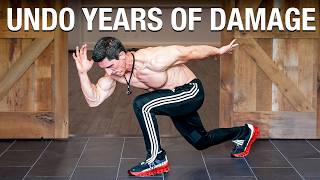
The One Squat That Fixes Everything
45sChallenges the common myth about shins not passing toes, making it controversial and educational.
▶ Play Clip"The title promises body-fixing moves, and the video delivers seven targeted exercises, though 'guaranteed' is a stretch."
This video presents seven fundamental movement patterns essential for maintaining physical function and mobility as we age. The host demonstrates each exercise, emphasizing proper form and the importance of incorporating these movements into a regular routine to prevent common age-related declines.
The video introduces seven primitive movement patterns that are crucial for human function but often neglected, leading to age-related decline.
A sumo squat variation that shifts weight to one side, stretching adductors and promoting deep hip flexion. The tibia must move past the toe for proper depth.
A wide stance forces hip hinge, preventing waist bending. Sweep hands along floor, reach overhead, squeeze glutes at top. Maintain natural spine curvature.
Stand with feet together, lunge forward with one leg while raising opposite arm. Focus on hip stability and knee alignment over toe.
Pivot off back foot, sweep arms past knee, reach high and low. Maintains torso rotation, reducing fall risk.
From kneeling, slide foot forward into lunge, stretching hamstrings and adductors. Hands on ground for stability.
A push-up variation where one cheek touches ground, opposite knee drives up. Incorporates lower body mobility and shoulder depth.
Lying on back, elbows in, open arms like Superman to lift back off ground. Engages rotator cuff and external shoulder rotation.
These seven exercises target essential movement patterns to maintain function and prevent age-related decline. Consistent practice can improve mobility, stability, and overall physical health.
What is the first primitive movement pattern demonstrated?
Chimp squat (sumo squat variation).
00:15
How many reps per side for the chimp squat?
5 reps each side.
01:11
What is the key to a deep squat according to the video?
Tibia must move into ankle dorsiflexion (shin past toe).
00:58
What does the wide stance hinge pattern primarily target?
Hip hinge and hamstring/adductor stretch.
01:38
How many total reps for the wide stance hinge?
10 reps.
03:10
What is the purpose of the gait pattern exercise?
Reinforce opposite arm and leg movement and hip stability.
03:24
What is the solar twist exercise designed to prevent?
Falls by maintaining torso rotation ability.
04:54
How many reps for the solar twist?
10 reps.
06:06
What is the tracker push-up variation?
A push-up where one cheek touches ground and opposite knee drives up.
08:07
What muscle group does the Clark tents exercise target?
Rotator cuff and external shoulder rotation.
10:08
Shin Past Toe Myth
Corrects common misconception that shin should not pass toe; explains biomechanical necessity for deep squat.
00:58Torso Rigidity and Falls
Identifies loss of torso rotation as primary cause of falls in elderly.
04:54Push vs Pull Balance
Emphasizes need to pull more than push to maintain upper back strength.
09:41[00:01] requirements for human function? And the catch, most of us can't even do them as we continue to age because we stop doing the things that test them. Today, I'm train each one of those movement patterns that you can do in just a
[00:15] are going to keep you functioning at a high level from now until many, many, hopefully years from now. The first pattern is a basic squat pattern. And something called the chimp squat. So, you want to get into a wider than
[00:29] you're going to do is basically perform a sumo squat, which we know is good for stretching out the adductors and also, of course, getting into a deep flexion at the hip. When we're down here though, I want you to be able to shift over,
[00:42] hands make contact with the ground, and lean into that lead foot. Okay? You come you squat back out like you're doing the sumo squat again. Down into the sumo, slide, and then push. Now, a lot of people talk about not wanting the shin
[00:58] to go past the toe or in the direction of the toe. That's actually incorrect. Biomechanically, in order to get a deep squat, you need to have the tibia move ankle into dorsif flexion because when you lose that, that's when the real
[01:11] trouble starts. So, being able to get into that lead foot is a great uh thing to work on. At the same time, you're working on that adductor stretching. flexion. And with just this one move, you want to go five to each side, five
[01:25] to the right, and then five to the left. Each time, trying to get deeper and deeper. Pattern number two is the hinge. And we're talking once again about the hips. And if there's one that is lost more than anything else, it's our
[01:38] ability to actually hinge directly from the hips. This is going to do it for you because you want to take a very wide stance. What this does is it forces you when you move your hips backwards to actually create the hinge right at the
[01:52] hip. When we have a narrow stance and we try to lean ourself backwards, what happens is we usually just bend from the waist. But when we take up a lot of that mobility from below now with the wide stance, moving the hips backwards is
[02:05] just going to cause that direct hinge that we're looking for. So the activity that we're looking to do is just to sort of sweep the floor. All right, we're going to take our hands down, sweep along the floor if we can with our
[02:17] fingers. Reach through as far as you possibly can. Come up and reach overhead. Head follows the hands. At this point, I really want to squeeze my glutes. Engage the glutes at the top. Squeeze your hips forward to try to open
[02:30] this up and stretch it out. Back down. Lead with the hinge. Come down and sweep. Each time I do it and when you do it, what you want to try to focus on is maintaining as much of a little natural curvature in your spine at the bottom.
[02:44] you don't want to be folding and allowing this to just sort of cave in. Instead, you want to be able to keep the the little arch in your back so that the hinge is actually reinforced. So every time you come down, you'll start to feel
[02:57] more of that stretch in the hamstrings and adductors, allowing you to get deeper and deeper more naturally. Again, reach up to the top. Head follows the hands. Really try to get as far back as you can and engage the glutes on each
[03:10] portion of the rep. How many repetitions here? 10 total. Fingers touch. Come all the way at the top 10 times. The third primitive movement we need to maintain is our ability to move on the surface, right? To walk gate. And to do this, we
[03:24] where the opposite arm and leg move together. And we can do that with this want you to do is just stand with your feet rather close together. Get all of for me, it's going to be my left side. And I'm going to have my left hand up
[03:39] position. The other one's going to go back behind me just a little bit. In do is I focus on the movement of the right leg. This is going to be my forward lunging or static lunging leg. So, I'm going to drop the leg back and
[03:54] move the arm up. So, it looks like that, right? This arm obviously will naturally drive backwards. Come back up again and come down. Now, what you want to do to do this right is reinforce hip stability in this position and reach the arms out
[04:09] as far as you can to really try to challenge your core stability. So, what I do is I come back down, reach, reach, and really try to maintain a stable knee position over that toe. Right? A lot of times people will start to see this
[04:22] hips. You come up and you perform this one really slow. Down. Stable. Reach. Get down into the hip as far as you can. Drive out of it. Nice and slow. Back to the top. In position. Reach back here. Arm up here as far as you can. Stable at
[04:39] the knee. Come back. Of course, you'd go the other side here. The same way. Five and five. The idea is, can you do this slow with stability? Get deep. Maintain the hip. If you can do all those things,
[04:54] you can maintain that function well into old age. This next movement pattern loss is actually probably responsible for more falls as we age than any other. And it's rigidity of the torso. People lose the ability to rotate, to have the
[05:08] ability to twist. If you want to be able to have balance and maintain balance and function, you need to be able to twist. So the exercise we do here is one that a solar twist. The arms are going to be dissociated from the hips. We want
[05:23] So, basically, we're going to swing down, pivot off the back foot, sweep past the knee. So, I'm behind the knee here. And I'm going to try to reach as Back towards the floor with my other hand. Come out of it. Arms go up. Open
[05:40] up as much as you can. Twist. Rotate. Go back down again in that position. This reaches far. This reaches down for the ground. When you do this in one move, it actually starts to feel really good. Reach as high as you can. Come back
[05:54] Up and down. Up. Reach. Over and down. You're just pivoting off of this back foot to put you in position. You never
[06:06] have to lift your feet up off the ground. You do 10 repetitions here. Again, reinforcing, maintaining the ability to twist and rotate so that you have more three-dimensional stability and that fall wrist goes way down. We've
[06:20] hinged, we've squatted, we also have to lunge. So, now what we do is something want you to do is get down on the floor for this one. And you're going to You're on your toe. If you can get your foot flat here, that's even better, but
[06:34] it requires a lot of ankle mobility. But here, I'm up on my toe. And this other leg is out in front of me straight if you can for as much as you can stretch there. Now my hands are in contact with
[06:46] the ground. All I'm going to do is put this foot down here. Let my hand slide this foot down here. Let my hand slide and let this sweep right in with me as I stretching this hamstring out. And I have my position on this leg. Again,
[07:00] heels off the ground a little bit. Toes here. I'm gonna slide and let my hand follow the toe back down to the ground. Sweep it back over. And then let that follow that foot again. Follows the foot. Sweep and down. And each time
[07:16] foot. Sweep and down. And each time really slide over, get down, slide into it, and get down. So we're getting that into that lunge side to side position into that lunge side to side position here. Like this. Again, works great on
[07:29] introducing that deep hip flexion, stretching out those adductors that get too too tight, that yank on your pelvis, and again, getting our body grounded in space, and stabilizing with the hands on the floor to make this something that
[07:42] even people that are starting out can do. They don't have to go so far. If that's fine. again is having the hands in contact with the ground that gives you the stability to be able to work on that and still have the safety built
[07:55] it right, but you can't get around moving and lunging. You have to maintain the ability to do so. So, we've hit a lot of the basic primitive patterns, but one we haven't covered yet is just a basic upper body push, right? Grouping
[08:07] the chest, shoulders, and triceps together into an activity that that's how they prefer to move. You can do it with this exercise. It's a push-up variation called a tracker. And what we do here is incorporate some lower body
[08:19] mobility into the exercise and we reinforce the depth of the push-up to shoulder mobility, too. So, what we do is we come down to the ground. Again, if you just drop down to your knees and you do it from here. But, you come down to
[08:33] cheek make contact with the ground into this sort of tracking position, the hunter, right? And then the lower body is going to participate too by basically driving your knee up at the same time. Now, the nice thing about this is you
[08:47] get a reprieve at the bottom because it is a mobility reinforcing exercise, too. So, you can actually lower and briefly make contact and rest. So, the knee is in contact, the opposite leg is in contact with the ground. I'm getting
[08:59] into this good deep mobility of my shoulder. From here, slide your knee shoulder. From here, slide your knee back and then back up to the toe. So, as you push up, it looks like this. Slide and push. Come down again. Everything
[09:12] slides up. cheek down, little reprieve, slide it back and push up. Now again, if you're doing this from your knees, you simply drop from here, come down, slide, make contact, push, and come back up to the
[09:28] top. It doesn't matter what your pushing maintaining the ability to push while having those mobility requirements reinforced. That's going to keep you feeling a lot better. Do 10 of these,
[09:41] get exactly what I want you to from this exercise. If you push, then you must you should pull a hell of a lot more than you are right now, and even more than you push to maintain the balance and the weak muscles of the upper back.
[09:54] option here if we expanded these if you struggle to do pull-ups or if you just want to do more of them, I actually over at athletex.com/ourpull-ups just for watching this video. If you
[10:08] can go grab that for free. 22 days, more pull-ups than you're doing right now. As you're doing right now. However, for this video, what I want you to do is always, and do something called the Clark. It's a great exercise for
[10:21] reinforcing not only pulling strength, but also rotator cuff strength. So, what we do is we get in this position here, and the elbows are going to come in hands are going to be across your chest. And what I want you to do is pretend
[10:36] like you're opening the shirt like Superman would. Open the shirt up. When you do that, your elbows should create enough lift of your back off the ground. can lift off the ground. You do not have to worry about lifting your pelvis at
[10:51] all. That stays in contact. So I lift here. My head's down. I lift until my back is off the ground. And then from here, while holding it, you open your hands as far as you can. This is the rotator cuff. Engaging that external
[11:04] shoulder rotation. See if you can get your hands in contact with the floor. Hold it. And then reverse. Let yourself back down. That's one repetition. Again, 10 repetitions here. Pull the hands across. We call these Clark tents.
[11:17] You're opening up that chest until the back is completely off the ground. You'll feel your tailbone in the back of your head, but nothing else. At that Rotate them. Don't move your elbows. Get them in contact with the ground here. It
[11:30] amazing. At the same time, it should feel challenging because you're challenging muscles that are often times very weak. They've lost the ability to work in concert with each other. We want to make sure that you know how to pull
[11:43] and pull as one unit. And with those seven moves and just this little amount of space on the floor, you have now a game plan for maximizing and maintaining Guys, if you're looking for programs built by a physical therapist, cuz I
[11:55] know how important function and their maintenance of function matters as you aphanx.com. If you want another video here, check this one out. It's a perfect stretches. Guys, if you haven't done so, make sure you click subscribe, turn your
[12:07] when we put one out. All right, guys. See you soon.
⚡ Saved you 0h 12m reading this? Transcribe any YouTube video for free — no signup needed.