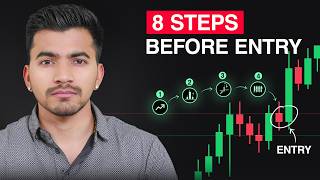

The 1st Step You MUST Take Before Any Trade
51sKicks off a practical 8-step framework that instantly makes viewers feel they're getting insider knowledge.
▶ Play Clip"Delivers exactly what the title promises with a full step-by-step breakdown and live example, though repeated subscribe requests add minor fluff."
This video presents an eight-step checklist that traders should follow before entering any trade, demonstrated through a live Nifty chart example. The steps guide viewers from understanding the bigger market picture through trade planning, risk management, and post-trade journaling, with the goal of eliminating emotional decisions.
Start by analyzing daily and 1-hour charts to identify the prevailing trend. In the example, Nifty shows bullish momentum in the short term despite an overall downtrend, which informs the trading bias.
Identify and mark key support and resistance zones on your trading timeframe. This includes previous swing highs and structural levels that help decide where to enter and place stops.
Align your trade with the trend. In an uptrend, look for buying opportunities near support rather than predicting reversals, because predictions often lead to unnecessary losses.
Use price action and indicators to confirm the setup. A doji candle at support and price holding above the 9 & 20 EMA provide additional confirmation before entering.
Ensure the trade offers at least a 1:2 risk-reward ratio (e.g., risk ₹1000 to make ₹2000). If the ratio is lower, skip the trade because the potential reward doesn't justify the risk.
Before entering, note the exact entry price, stop loss, and target (e.g., entry 24,000, SL 23,970, target 24,066). This prevents mid-trade confusion and impulsive decisions.
After entering, follow your written plan instead of reacting to every market move. Emotional reactions to short-term fluctuations lead to self-doubt and poor decisions.
Record whether you executed the trade exactly as planned. Reviewing your journal at the end of the month helps identify the biggest recurring mistake that causes losses.
The entire 8-step process is designed to remove emotions from trading. Most losses come from random, emotional decisions like moving stop losses or adding quantity arbitrarily.
A systematic approach—understand the picture, mark levels, find setup, confirm, plan risk, write the plan, maintain mindset, and journal—ensures survival and profitability in the market.
Following this eight-step checklist—from reading the bigger picture to journaling every trade—builds a disciplined, emotion-free trading system that minimizes losses and improves consistency. The key is to replace random reactions with a written, repeatable process.
What is the first step before taking any trade?
Understanding the bigger picture by analyzing higher time frames like daily and 1-hour charts.
01:31
What minimum risk-reward ratio should a trade offer according to the video?
At least 1:2, so if risking ₹1000, the potential profit should be ₹2000.
11:37
Which two EMAs are used for additional confirmation in the video?
9 and 20 EMA.
09:09
What candle pattern at support was used as a price-action confirmation?
A doji candle.
08:26
Why is it important to write down the trade plan before entering?
To avoid confusion and prevent changing decisions based on market fluctuations during the trade.
14:43
What should you do after the trade is closed to improve your trading?
Journal the trade to check if you followed your plan and to identify repeated mistakes.
19:08
What time frames does the trader use for execution and for reading the bigger picture?
5 and 15 minutes for execution; daily and 1 hour for the bigger picture.
02:09
According to the video, what causes the biggest losses in trading?
Trading against the market trend and making emotional decisions, such as moving stop losses or increasing quantity arbitrarily.
07:05
What is the purpose of the 9/20 EMA in the strategy?
It acts as additional confirmation to define the strategy, not as a standalone strategy.
09:21
What is the eighth step in the trading checklist?
Trade journaling—recording execution details to analyze and correct mistakes.
19:08
Multi-Timeframe Analysis
The trader checks daily and 1-hour charts to understand the bigger picture before trading on 5/15-minute charts, a core principle of top-down analysis.
02:09Risk-Reward Rule
A minimum 1:2 risk-reward ratio is mandatory; otherwise, the trade is not worth taking. This simple filter prevents many unnecessary losses.
11:37Trade Plan as a Shield
Writing down entry, stop loss, and target prevents emotional decisions mid-trade, addressing the most common cause of trading failure.
14:43Journaling Reveals Root Mistakes
Monthly trade review shows that most big losses come from repeatedly not following the trade plan, making journaling essential for improvement.
20:19Emotions Are the Real Enemy
The biggest losses on trading are emotional mistakes; controlling emotions makes profit easier, which is the video's ultimate message.
22:57[00:05] video, we're going to talk about eight steps before punching any trade. Yes, you heard it right. There are eight steps that anyone might have told you this but today I am telling you through this video. If
[00:20] subscribe to the channel. Press the bell notification button you do not miss out on any upcoming video. Because today's video is so important, if you watch today's [music] sure that whatever mistakes you have been making in trading till date, after today's video, all those
[00:36] mistakes of yours will be eliminated to the maximum. So watch this video carefully because [music] if someone had taught me this earlier, I probably wouldn't have made such huge losses in my trading journey. But today through this video I am going to
[00:48] tell you the things that you have to [MUSIC] Right? And for this I will give you an example on a chart as to how you have to follow those eight steps on the chart and how to plan the trade [music].
[01:03] How to follow the proper process in the market. And yes, do share this video with your friends who trade in the market Because it is very important to tell them that no trading or
[01:17] any trade is a random plan. For that, eight steps are followed. And what are these eight steps? Today I am going to teach you through this video. understand these eight steps [music]. Let's talk about the first step. The
[01:31] first step is understanding the bigger picture. For example, I have a chart on my screen and here I am showing you the chart of Nifty. There is a broad index. buy or sell recommendation here. No one is giving any guarantee or anything. I am just
[01:43] sharing a process that I follow which you should follow before punching any trade. And I am telling you this in replay mode. So that I can give you an example here. Right? Now look here I have a Nifty chart.
[01:55] ? My first step should be understanding the bigger picture. Now what do I need to do to understand the bigger picture market ? I trade in 5 minutes. I I have a trade time decided. You probably do it in five. I do it in 15
[02:09] in 5 minutes in the Indian market. And I also told you why he does that? Because there is a 6 hour window here. Now first of all I have to see the bigger picture of the market. So brother what is the market doing in daily time frame. Now when we talk about the daily time
[02:22] see that there was a downward fall in the market. After the fall, the market is giving a channel type formation here. Right? As you can see, think I have seen a breakout here. Then I mark the second level
[02:37] something from here. Something like this has a gap pending in the middle. Right? And if you look at the structure of this market, then after taking a support in the middle, a support zone was marked here. And after this, the market took support at this point
[02:51] and broke a resistance zone which was around this area. After breaking out, the market is going to test the next resistance zone. Right? Now if you breakout has occurred. After the breakout, the market gapped up and the
[03:05] price is revolving around a resistance. So if you look at the past three candles formed here is of green color, behind it is a red candle and before that is a green candle, so from the market bottom, from this area which I am marking, it has given a one way
[03:18] momentum. However, this means that the market is in range. Here you will see that it is such that if I have to trade currently, then for the last four-five days the market is giving me a one way i.e. bullish momentum.
[03:30] Although the overall trend is downwards, but what is visible in the bigger picture is that for the last three-four days the market is going straight [music] strong buying in the market for the last three-four days [music]. What has happened in the last 10 days
[03:44] ? It doesn't make any difference to me since last 15 days. I have to work in five and 15 minutes. So I will take the data of last two or three or four days only here. Ok? So I understood the direction of the market. Now what should I do to understand this further
[03:56] ? I have seen this in One Day so far. Now I come to one hour Now I have also come to One Hour. So even in one hour, if I look at the market structure, I draw a path here. The market rose from the support, went up, then
[04:09] came down, then went up, then came down, then went up and then reached the resistance here, then came down, then went up. So if you comment and tell me which structure is this? This higher high higher low higher high higher low higher high higher low is
[04:23] Stopping around the resistance. What is the bigger picture that I am seeing even in the one hour time frame ? Up trend. That means if the market opens, the market opens then I have to look for buying opportunity until and unless there is no breakout of the structure
[04:37] or breakdown of the structure or trend change. Ok? So I understood the first step that I have to see the bigger picture inside the market here. Now let's talk about the second step [music]. Step number two is that
[04:51] you have to mark out the important levels. That means mark the important levels. Mark the support and resistance. How will you mark it now? As I have already been doing this, How will you mark it now? As I have already been doing this,
[05:03] I'll mark it further. For example, in the one-hour time frame, this is a zone where the market has taken support and then moved up. Then you will see a marked it here because I have to keep the important levels marked.
[05:17] Then if you see, the area from where the market came down is also acting as a resistance for me. came down is also acting as a resistance for me. Then if you look, there's another one here somewhere where the market held. So this is also a level for me. So
[05:29] important support here inside the chart. Ok? This is very important. Why? Because I have to execute the trade. So I have to work in 15 minutes. So I will see you reacting very strongly to 1 hour of support
[05:43] and rest. Now I come to the 15 minute if I want to trade in the 15 minute time frame then I will have to look at some levels in that also. Now this is the 15 minute time frame. You will see here that support is marked from below.
[05:56] Meaning, the resistance that was there has become support. Price came up. After rising, the takes support from here upwards. Here the support takes over. Here the support takes On the resistance zone. And above we also have a resistance. Which one? The previous
[06:10] swing high that I have shown you here. Right? Now my important support Now let's come to step number three. Step number three is finding the right trade I see the market in an uptrend , moving into a higher high formation,
[06:25] what could be the right trade setup here ? Obviously, the market should appear to me at a place where I get buying opportunities. This would be the right trade setup for me. I don't know when I will get a selling opportunity because the market trend looks bullish to me. If I do any
[06:38] selling here, which is what everyone usually does. We start thinking that the market can or will fall from here. Predictions do not work within the prediction market.
[06:52] and make a logical trade plan based on the same. If I go into predictions, I will think that it should fall from here, it can fall, it has gone too high, the market has risen too much, then brother, I will sit with stop loss and unnecessary losses
[07:05] biggest losses happen when you are sitting against the market and your premium becomes zero. So if you do not want to make such a mistake then you have to look inside the market to see when the right setup will be formed for me? When will the right setup be formed? When I
[07:20] formed for me? When will the right setup be formed? When I again give the same directional confirmation. Since the market is moving bullish, I need directional confirmation. If I get bullish confirmation somewhere
[07:32] near the support area, then I will plan a buy trade to the next target. Which one? Any one resistance level. Ok? This is my step number three. So I understood the three steps that I have to wait for the setup to form inside the market. Right?
[07:45] wait for the market opening here. I played it here in replay mode just to explain it to you. The market opens and the market opens here. Right? If you look as soon as it opens, you will see that a bearish candle has appeared here. Now the bearish
[07:58] candle is here. So where does the bearish candle come in? If you look, there is a support zone. What was I waiting for? I need a right setup. Where? Market an uptrend going on in the market. So where do I have to buy? Will
[08:12] Where will I buy it? Available at market discounted prices. That means the market is found at some support zone. Now the market is at the support zone. So Now What I Have to Look For? I have to look for a confirmation which is our main strategy. Meaning, in which
[08:26] setup. I have to look around the support and plan my trade around here. Now before making the trade plan, comes my fourth step which is the fourth step. What is the fourth step? Look for confirmation. That means, the trade
[08:42] setup that is being formed here is that I have to buy at the support. Exactly, the A doji candle formed. Now let me mark the high and low of this dozing candle. I can mark anything. There is a setup. What do I do now ? From here I will install two indicators.
[08:55] I need a different kind of confirmation. So I told you step number four need multiple confirmations here. My setup is being created. What is the setup? That when there is bullish momentum in the market, I have to wait for the market to reach support and
[09:09] after reaching support, I get confirmation. A Doji candle has been found at support. What is the end price? I have placed 9 & 20 EMA in 5 minute time frame which acts as an additional confirmation for me. If you are thinking that 9 & 20
[09:21] EMA is just a strategy. No, this is a tool. These indicators are tools that further define my strategy and [MUSIC] So I put in the 920 EMA. The market is holding at the 920 EMA. Right? It was still on
[09:35] top of him. It didn't come down to that. The crossover came to nothing. Holding at 920. So I got an additional confirmation. That means I waited for the trade setup. If I get support I will buy. Now before entering the trade
[09:47] I am looking for additional confirmation whether the price is above the 920 EMA as the my step number four. Now it's step number four. So now I have to wait for the trade. I'll hit play here and let's see what that does. Right?
[10:00] Stopped here. And here I come, an additional [music] confirmation. Confirmation has come here in 15 minute time frame. And now what? Now I have to see what my risk reward is. However, I could have bought here even before this as soon as the high of a doji candle is reached. That means if
[10:13] I have to plan a trade here. What I have to do? I have to plan a long trade from here. Because I have a setup for a long trade only. candle. I can plan a long trade here. [MUSIC] And I can
[10:27] place a stop loss below this swing low. Now one thing I have to look at [music] is where my risk reward is going to be. If I buy the doji here. Below this, a Doji is formed near me, however, here my 1:2 is being formed till our next resistance,
[10:41] 1:2. But if I buy here on a big candle, then my risk reward may not be that good because the nearest if you see, I am not getting that good risk reward. 1 getting 1.5.
[10:55] if the price goes above the Doji candle then I have to buy and place a stop loss below it. Right? Bullish market is visible. I also took confirmation here. After confirmation, I planned my entry. And I want to
[11:08] see risk planning. That is, the risk I am taking. This is most important. This is our fifth step. Plan your risk. Risk means the trade I am I see support here. A doji candle was found at support. I know that as soon as the
[11:22] I made a buying trade here as soon as the high was reached. And then I have to see high was reached. And then I have to see ? Below the swing low of the last candle and I want to make a high pay entry here.
[11:37] What should be the risk reward? Minimum 1:2 so if I am risking ₹1000 here then I should make ₹2000. But if I think I take it here my risk reward matching? Found around 1:1.4. It is
[11:51] not matching. This is the biggest mistake. When we trade, our setup is being formed , confirmation is coming, then we have to see our risk reward, whether my risk reward is in favor here or not. If I go from here to around this next
[12:05] resistance area, I am getting at least 1:2 upside. This risk reward is favorable when I am planning to trade the high of this doji candle. Right? Because my setup is telling me this. I have
[12:19] I have to plan my entry here. So this seems to be my risk reward more favor. in one trade. At least 2000 should be made. There should be room for 2000 to be made. If there is no space to make 2000. I take it here. I don't have the space to become 2000.
[12:33] So I don't have to plan that trade. This is why we get trapped in unnecessary trading. That's why we take We can see the trade setup. But we do not know whether there is any scope for profit after that trade setup is executed or what
[12:49] returns I am going to get from it. Is my odds against risk 1:2? Isn't it? If you are only getting 1:1 against your risk , then why risk your money by taking that trade ? You have to try that my risk plan should be like this.
[13:01] At least if I am taking a risk of ₹1000 in a trade then that trade should have the potential to give me ₹2000 and that should be visible to you on the chart. Here I see that the price can go up to this high. The
[13:13] my stop loss should be below this swing low. If it goes down, the trade will fail. Right? So I have completed my step number five here. It so happened that I planned my risk that yes, I am taking this much risk of ₹1000. I will
[13:28] take a target of ₹2000. Now let's come to step number six which is very important. Now the most important point is that when you take the trade, you get confused that should I book this trade now, this will turn, this will rotate. The
[13:40] best way to solve this is to write down the trade plan. What is a trade plan? I am buying at the plan. What is a trade plan? I am buying at the level of 24,000. Right? This is the level of 24,000. It turned out to be high. I made a purchase here. My stop loss is being
[13:53] formed around 23,000 968 or 900 70. Ok? This is becoming my stop loss. My target will be 24000 066 according to 1:2, that is, My target will be 24000 066 according to 1:2, that is,
[14:13] note this down. Grab a pen and a notebook. When you are entering the trade or you find the entry zone above. I will enter above this. Write it down. 24,000 is my entry plan. My stop loss became 23,970. The
[14:29] 23,970. The target is 24, 70 or you can say 67 whatever it is. You have planned it here. Why is this important? Because if I do not act according to my trade plan , then whatever happens in the meantime
[14:43] after the straight check is executed will change my decisions. I will get confused there. Right? What should I do here, friend? But if before entering the trade I have written that my entry price is this, SL price is this, target
[14:57] price is this and I have to take it till this point, then no second thought will come to my mind because I will wait till the target to execute the trade. Now let's let this trade run and wait for the end target. Will you achieve your target
[15:09] in direction? Right? So, most probably it has almost hit our target. And [music] This is going to favor our target. Right? And here our Right? And here our target has been hit which was 1:2. Ok?
[15:21] It hit the target of 1:2. Now comes the most important step number seven which comes the most important step number seven which is mindset for which no one is prepared. What does mindset mean ? What mindset means is that
[15:34] when I entered this trade, I wrote down the entry price. I had written the stop loss location in it. I wrote the target location in it. What was the target? How much was the risk reward written? 1:2 means if I am taking a risk of ₹1000 then
[15:46] I should make ₹2. I would go for 2000. Otherwise there is no point in me taking a risk of ₹1000. Entry price is my ₹24,000. My stop loss price is ₹24,000. My stop loss price is ₹23,970, my target price is around ₹24,70.
[15:58] I have written this. Now what is mindset? The mindset is whether I have to follow what I have written or I have to react as per the market or as per the market's behaviour. I will take the decision on his behalf.
[16:12] If you think that brother, my decision making should be as per the market trend. After Punching the Trade You Are in the Wrong Mindset. Your trading mindset is wrong. Because after entering the trade, if I have entered here then it is
[16:26] if I have entered here then it is When will it go in my direction? After how much time will it go? After how much time will it go? How many candles will it take to not in my control. Because if I keep on thinking that
[16:40] deciding anything according to the market. In the middle, I'm going to start changing multiple times here. I will start In the middle, I'm going to start changing multiple times here. I will start , will rotate, if even one negative candle comes in between then I will start having self-doubt.
[16:52] So what makes it better? If you want to improve your mindset. What do you have to do? You have to plan the trade and write down what your planning is will my SL be? Where will my target be ? Note it down.
[17:06] How to build up the Now Mindset that I will stick to what I have written. Whatever the market does, it does n't have to react according to the market. I have to react according to my trade plan. There is a I have to react according to my trade plan. There is a
[17:19] is my entry price. This is what I am following. This means I have the right trading mindset. I left the trade plan that I had written for this. I mindset is still not developed. You have to work on your trading mindset. And
[17:34] in the market, then because if you think that the market will react as it will, I will adapt to the way the market goes, then the market will do the same to you, so you will have to
[17:48] build up your trading mindset that whatever rules I have written for this trade, am I following them or not, if you follow them only then a good actual trader's mindset will be built up, but if you do not follow that written rule. You do
[18:03] n't even focus on it. You just sit and trade, relying on the market. Now the target should come, friend. If it is not coming then it is okay, friend, I have any loss. I hope this does n't happen. I hope that doesn't happen. Hey friend, you want to
[18:16] travel, I will reduce the stop loss. Hey man, this is going up. Now I will increase the quantity a little. It might burst now. Anything can happen. If you have these thoughts about all the things I mentioned, do you know when they come? When you are
[18:29] not following your trading plan. Now Whatever the market reacts to, if you take action against it, it save yourself from the traps of the market,
[18:42] where you want to enter this trade? Where to place SL? Where to aim market is doing, what the market is showing you. If you start
[18:55] mindset will get spoiled. Ok? So this is what you have to plan. What you have to do after punching a trade. Ok? Now let's come to step number eight which is very important. Step number 8: You executed the trade. Your execution has taken place.
[19:08] Which was your execution entry plan. Your target has come, your stop loss has come. Stop loss could have also come here. Ok? Target came, stop loss came. Now the final step, what is that? Trade journaling is something that no one does,
[19:24] no one knows how to do, that brother, when I made a trade plan, did I execute plan, did I execute plan as per my plan or did I change it according to the market,
[19:37] which I told you in the beginning, that is, if you price, this is my stop loss, this is my target, I should take this, the risk reward is 1:2, I am investing this much capital, this much risk is there, this much reward is there [Music] if you are taking this
[19:51] means your mindset is good. This means you have to write there that yes, I executed my trade according to my trade plan. If your trade plan has changed. Leaving aside the plan you had made, the entry stop loss target you had
[20:06] entry stop loss target you had written, you changed your trade plan appropriately according to what happened in the market. This means you did not follow your trade plan. And if you are not following your trade plan,
[20:19] write it down because it is possible that you might be incurring maximum losses due to not following the trade plan and if you generalize it, write it down and at the end of the month, monitor all the trades and analyze them, then you will come to know that
[20:34] my biggest mistake or the reason for my biggest losses is that I do not follow the trade plan that I write. And if you find your biggest mistake that is causing your biggest losses and once you correct that biggest mistake,
[20:49] your profitability or your mistakes will start decreasing. Your big losses will profitability will start coming. Because most people go into losses control ourselves from big losses only. And behind big losses there is a common
[21:04] mistake which we repeat again and again. And whenever we make small mistakes. That's why we have to journal about how I followed the trade [music]? Did I follow with the plan or did I follow without the plan?
[21:19] What did I do? I trailed the stop loss or I left it there. Did I take the entire target or did I cut it in half out of fear. If you control your trade based on the market reaction instead of a trade plan, then
[21:35] brother, let's take this. Come on, the target is coming here. Let's add on a little more. you took action as per the market indication. This means you will become emotionally involved in the market. And once your emotional trading comes in the way, then no matter how good a
[21:49] follow. How well you follow the market bias , follow the direction, place and remove such good support and resistance. By getting carried away by emotions, you will again make the same mistake that every beginner trader makes. So what is our job ? At the end, what does this whole process mean
[22:03] ? The eight steps of this entire process that I told you from one to eight, the meaning of all these processes is that brother, I want to make myself an emotionless trader. I do n't want to become an emotional trader. And when will I become an emotional trader? When
[22:18] take random trades. I will make random decisions and invest random capital based on the random results the market gives me. I will put in random quantities and will chase the market with all my might to make profits. At the end there will be
[22:31] no profit, it will become zero. But if I want to do systematic trading then I will have to follow these eight different steps before punching in the trade. So that my trade execution can be better and I do
[22:44] not get emotional. Our first goal, the first target of a trader is to not let emotions enter inside us. I am telling you this today. Perhaps you will not be able to understand this today. But
[22:57] after some time, when you analyze your losses, then you will understand one thing that friend, all the losses I have incurred were my emotional mistakes. This has happened due to emotional trading. And once you start controlling emotional trading. Then you
[23:09] will realise [music] that brother, profit is made so easily in the market. Only emotions have to be controlled. If you follow a proper trading system. This means that
[23:23] a system will have to be created before punching up any trade. As I have explained in today's video what your system should be. The first is Understanding the Bigger Picture. Understand the big picture within the market. Second, identifying key levels. Now that the big
[23:35] what are the important levels? Mark them out. Third, you have to find out a good trade setup. Isn't it? After finding out the trade setup you have to add multiple confirmations. Are there more confirmations coming in the trade setup I am getting or am I
[23:50] working on a single confirmation? If multiple confirmations are coming then your confidence level will be boosted. Ok? Fifth, you have to plan your risk properly where you get risk confirmation. Now I have to take the risk. Risk is my 1:2.
[24:04] is less than 1:2. If it is less than 1:2 then there is no point in taking the risk. You should see the potential of making ₹2000 by investing ₹1000. Sixth comes write down the trade plan. Before entering the trade, where to enter,
[24:18] I take the target or till where will I take the target. What is the risk reward? How much will the loss be, how much will the profit be? Note this down. Right? This is your sixth step. Seventh is the prepared mindset that do I have to follow? Do
[24:31] I have to move according to the market or according to my trade plan? If I follow the trade plan, I will be safe. If I act according to the market, inside the market. Because no one knows what the market will do. If the market placed a stop loss below,
[24:45] you immediately entered a recovery trade. The market gave the target. So you decide yourself whether to act according to the trade plan or according to the market. If you go according to the market, you will end up
[24:58] in losses. Your most important eighth step is to execute the trade and generalize the results obtained after the execution of the trade. So that whatever
[25:10] So that whatever You will improve the mistakes the next day. Only then will you be able to catch your small mistakes and cut down the big mistakes in the long term.
[25:26] start getting cut down, then profitability gradually starts coming. Ok? So these were the eight steps that you have to follow before punching in and after closing any trade. Meaning before making a trade. [sound of clearing throat]
[25:40] Okay? So I hope you understand how trades are planned and how we have to take a systematic approach to the market before like it, subscribe to the channel and yes, do share this video
[25:53] with your friends so that they can understand what approach we have to take before planning a trade. If you work in the market with the right approach, there will be stability in your market. That means
[26:06] you will survive in the market. You work with the wrong approach , do random trading, no matter how good a strategy you follow, you will never be able to survive in the market, nor will you be able to become like the video, please like the video and subscribe to the channel. For the rest, whoever wants to trade
[26:19] market, I have given the links for both in the description box. You can start your trading journey by opening your account. See you in the next video. Till then by-b see you. Jai Hind.

⚡ Saved you 0h 26m reading this? Transcribe any YouTube video for free — no signup needed.