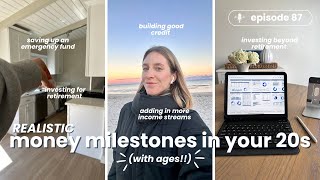
Why Financial Milestones Trigger People
45sAddresses the controversy of age-based financial goals, making viewers feel seen and sparking debate.
▶ Play Clip
[00:00] [Music]
[00:01] Don't Depend on Daddy is an unfiltered
[00:03] safe space empowering young
[00:04] professionals to build independence in
[00:06] their 20s and beyond. Whether it be
[00:08] personal, professional, or financial.
[00:10] Regardless of your age, relationship
[00:12] status, or job title, the most
[00:14] consistent person in your life is you.
[00:15] So, join me and let's build our
[00:17] independence together. Enjoy.
[00:20] Hello and welcome back to Don't Depend
[00:24] on Daddy the podcast. My name is
[00:26] Michaela. I am your host. And today we
[00:29] are going to be talking about financial
[00:31] foundations and personal finance
[00:33] milestones to reach throughout your 20s.
[00:36] I'm super excited about it. I think this
[00:38] is going to be a really great just like
[00:40] reference point episode to come back to
[00:42] year overyear. And as we get to the end
[00:45] of the year, a lot of these episodes are
[00:46] going to be more like retrospective and
[00:49] reflective on how to manage your money
[00:51] at the end of the year going into a
[00:52] fresh year where we have a little bit of
[00:54] a fresh start. Before we get into this
[00:57] episode, I'm going to run through the
[00:59] housekeeping quickly. First things
[01:01] first, as always, you can get $10 off
[01:03] the personal finance dashboard when you
[01:05] use the code podcast 1. The Black Friday
[01:08] sale for the PFD has officially ended.
[01:11] But if you are new here and this is the
[01:12] first episode you're listening to, you
[01:14] can always use the code podcast 1 for
[01:16] $10 off the PFD. The PFD is my, you
[01:19] know, signature money management
[01:21] financial planning tool. It's a tool
[01:23] that I've used to save my first 100K and
[01:25] now I've grown my net worth to almost a
[01:27] million using this tool. So, it works
[01:30] and it just will help you feel more
[01:32] confident in your overall financial
[01:35] picture. So, you can get $10 off with
[01:37] the code podcast 1. I am going to be
[01:39] running another sale, not a Black Friday
[01:41] sale obviously, but um as we get to the
[01:43] end of the year and we're thinking about
[01:44] 2025 planning and everyone is sort of
[01:47] auditing and thinking about their
[01:48] financial goals, I'll be running another
[01:50] sale. So, if you want to wait and get
[01:52] $15 off instead of 10, feel free. But if
[01:54] you don't want to wait, use the code
[01:55] podcast one. The other quick thing for
[01:58] updates is own your career and own your
[02:01] money. Um, so if you are someone who is
[02:03] looking for a gift for either a recent
[02:06] grad or a young professional or someone
[02:08] in your life who is looking to overhaul
[02:10] their finances and take their
[02:12] professional power back, I highly
[02:14] recommend you check out Own Your Money
[02:16] and Own Your Career. Those are both of
[02:17] my books. They're available hard
[02:19] coverver. You can get them on Amazon or
[02:21] like Barnes & Noble, Books a Million.
[02:23] You can also get the ebook version if
[02:25] you have a Kindle or a Nook. I believe
[02:27] the Nook is the version of the Barnes &
[02:29] Noble Kindle. I use a Kindle. Or you can
[02:31] get the audio version, the audiobook
[02:33] version. So, also if you have Spotify
[02:36] premium, you can listen to Own Your
[02:37] Money for free with your Spotify premium
[02:40] membership. So, those books are really
[02:42] amazing gifts. If you are going to give
[02:44] someone a book, you might as well give
[02:46] them something that they can learn from.
[02:48] Um, I'm a little biased, but I think
[02:50] they're fantastic. So, those are the two
[02:52] quick housekeeping things that I'm
[02:54] running through. As a quick update, as
[02:56] you can see, if you're watching on
[02:58] YouTube, um, I'm still at my parents
[03:00] house on Cape Cod. I will be here
[03:01] through the end of the year. I
[03:02] apologize, the lighting is like a little
[03:04] bit funky. Um, the sun is like directly
[03:06] in my face, so I have the shade down.
[03:08] There's a little bit of a shadow. Sorry.
[03:10] Can't do anything about it. Um, but
[03:12] hopefully the, you know, talking in this
[03:15] video makes up for the strange lighting
[03:17] going on. Anyways, let's get into the
[03:20] juice here because I'm really excited
[03:22] about this episode in particular just
[03:26] because I think it's very tactical and
[03:28] it's really helpful. Something that I
[03:30] have found to be really challenging I
[03:32] think just in the era of being online is
[03:36] sharing any hard tangible milestones to
[03:40] reach at certain points throughout your
[03:42] 20s just because people are so sensitive
[03:45] about it. So before we get into these
[03:49] financial milestones that I personally,
[03:52] so this is my experience, my
[03:54] perspective, um you know, take that with
[03:57] a grain of salt that I think 20somes
[04:00] should aim for at different periods. I
[04:02] want to be super super super clear that
[04:06] this is a guideline. Okay. So, I am
[04:09] going to be sharing ages for the sake of
[04:11] keeping this sort of structure and just
[04:14] making it easier to set tactical goals
[04:16] again because I'm finding that that
[04:18] information is hard to find and I think
[04:21] it's helpful um to have these tactical
[04:23] goals to have the age ranges and to use
[04:26] that as a guideline or a guiding post. I
[04:30] think it's helpful, but they are not
[04:32] meant to be rigid and they are not meant
[04:34] to make you feel badly about yourself if
[04:36] you don't match up to them exactly. So,
[04:38] if hearing milestones and hearing ages
[04:41] is going to trigger you or make you feel
[04:45] upset, then I don't think this is a good
[04:48] episode for you to continue listening
[04:49] to. So, just keep that in mind. Um, and
[04:52] with that, for those of you who are
[04:55] interested in this, let's get into it,
[04:57] cuz I think this is I I think it's
[04:58] helpful. And I say all of that again to
[05:00] not be like, you know, I I just want to
[05:03] be very clear upfront. Um because I know
[05:05] there are people out there who hearing
[05:08] things like this can feel upsetting.
[05:10] Anyways, we're going to go through the
[05:12] five milestones and I have some notes up
[05:14] on my laptop that I'm going to be
[05:16] looking at and let's just get right into
[05:18] it. So milestone number one is saving up
[05:20] an emergency fund. And the ideal age
[05:23] range for doing this is ages like 22 to
[05:26] 24. So this is really like that first
[05:29] financial goal that you are focused on
[05:31] when you graduate college. This is in my
[05:34] opinion the most important financial
[05:36] priority even before like paying off
[05:38] credit card debt or anything of that
[05:40] sort. And the focus is in your early
[05:42] 20s. So by age 24 25ish your goal should
[05:47] be to have 3 to six months of living
[05:50] expenses saved in a high yield savings
[05:52] account. So I use Ally Bank as my high
[05:54] yield savings account of choice. This is
[05:56] not sponsored. I have just used Ally for
[05:58] years and years and years. And the
[06:00] reason why I like Ally is because they
[06:03] have savings buckets, which I think some
[06:06] other high yield savings accounts have
[06:07] savings buckets, but again, I've been
[06:09] using Ally, so like I'm not going to
[06:11] switch to a different account
[06:12] unnecessarily, but the savings buckets
[06:14] make it really easy for you to segment
[06:17] your various savings goals. So within my
[06:20] Ally savings account, I have an
[06:22] emergency fund and that has a little
[06:25] less than 6 months of my monthly
[06:28] expenses and I would say 6 months is a
[06:31] threshold to aim for if you feel
[06:35] uncertain in your job or you know you
[06:37] want to pursue entrepreneurship as your
[06:39] career path. If you feel comfortable and
[06:42] confident in your job, 3 months is a
[06:45] totally perfect goal. Um, I have six
[06:47] months just, you know, because I work
[06:49] for myself. So, if I, God forbid, you
[06:52] know, my business were to go down the
[06:54] drain or something were to happen or I
[06:56] got hurt or whatever and I couldn't
[06:58] work, I'd have money to sustain me to
[07:00] hopefully bridge that gap before either
[07:02] finding a job or getting back to work.
[07:04] So, 3 months is a really great target if
[07:07] you have a regular job. And then after 3
[07:09] months, you can start balancing either
[07:12] adding to your emergency fund with other
[07:15] goals or move on to something else. To
[07:18] figure out how much you need to save for
[07:20] your emergency fund, you need to
[07:22] identify your monthly spend. So, what
[07:23] are you spending on your essentials and
[07:25] your non-essentials on a monthly basis?
[07:28] So, think about like rent, utility,
[07:30] grocery, transportation, going out to
[07:32] eat, going to the gym, all those kinds
[07:35] of things. what's an estimate of what
[07:37] that monthly outflow is. If you use a
[07:39] tool like the personal finance dashboard
[07:41] to track your expenses, this is a really
[07:43] easy number to land on. If you don't
[07:45] have a tool and you're feeling a little
[07:47] bit lost, I recommend you get one. Um, I
[07:50] also do want to say, I didn't say this
[07:51] at the beginning, I do have a resource
[07:53] library on my website that has both free
[07:56] and paid resources, spreadsheets, and
[08:00] budgeting apps, money management tools,
[08:02] etc. of all varying degrees that I have
[08:04] tried and tested and approved. So, if
[08:07] you are looking for a tool, maybe you
[08:08] don't want to use a spreadsheet, you
[08:10] want to use something a little bit more
[08:11] auto automated or digitized or whatever
[08:13] that's connected to your accounts, go to
[08:16] the resources linked in the show notes
[08:17] here, and you can go through all the
[08:19] ones that I, you know, again, personally
[08:21] like. But to be able to find that
[08:23] target, you need to know your monthly
[08:24] outflow. And let's say you spend $5,000
[08:27] per month, then your baseline emergency
[08:30] fund should be $15,000. That number can
[08:33] feel really overwhelming and really
[08:34] cumbersome. I understand. Take it day by
[08:37] day, week by week, month by month. Um,
[08:40] again, the goal here is to have this
[08:41] done by like 25. So, it's not going to
[08:44] happen in the first 6 months. Hopefully,
[08:47] it does. For some people, it will
[08:48] depending on what you do for work and if
[08:50] you're able to live at home and what
[08:51] your situation looks like. But don't be
[08:54] discouraged if it takes you, you know, a
[08:56] couple of years to save up that amount
[08:57] of money. That's normal for it to take
[08:59] some time. Um, so aim to save $500
[09:02] first, then reach $1,000. I think $1,000
[09:05] should be that like bare minimum
[09:07] baseline. $1,000 isn't really enough to
[09:09] cover like big major emergencies or to
[09:12] bridge the gap if you were to lose your
[09:13] job or something, but it's a really
[09:15] great first target to reach. And then
[09:17] work your way up to that final goal. And
[09:20] make sure again you're putting this
[09:22] money in a high yield savings account. I
[09:24] just want you to think about your
[09:27] um emergency fund as like a financial
[09:30] fire extinguisher. Okay? So I know that
[09:32] this is not like a sexy financial goal.
[09:34] I know it probably is hard to think
[09:36] about prioritizing it when there are
[09:39] likely other things that you want to be
[09:41] doing, but think about it as the
[09:43] financial fire extinguisher that is
[09:46] going to help you put out a poor
[09:48] situation should you find yourself in
[09:51] one. Emergencies happen. Um, but it's
[09:53] really designed to help again bridge the
[09:55] gap if you lose your job or if you
[09:57] happen to get into like a car accident
[09:59] or your dog dies or your dog has to go
[10:01] to the vet or something like these are
[10:03] real emergencies that can be very, very,
[10:05] very expensive. And if you don't have
[10:07] the money set aside, it just puts you in
[10:09] a little bit more of a precarious
[10:11] position. So, this money that you put
[10:14] aside in your emergency fund is not for
[10:16] like a spontaneous weekend trip. It's
[10:19] not to buy yourself a new phone. it's
[10:21] for real emergencies. So again, keep
[10:24] that in mind. And if it helps to list
[10:26] out like what would constitute an
[10:28] emergency just as a reminder like I
[10:31] would go through that exercise because
[10:33] emergency is subjective. So it's going
[10:36] to feel a little bit different for
[10:37] everyone. So again, milestone number one
[10:40] is saving up that emergency fund and the
[10:41] goal is to do this by the time you turn
[10:43] 25. Milestone number two is to start
[10:47] thinking about your retirement savings.
[10:49] So retirement does feel like a lifetime
[10:52] away. I do also think a lot of younger
[10:54] people um and I hate to do like the Gen
[10:56] Z thing, but I do think a lot of Jenz
[10:59] feels like they're never going to
[11:00] retire. Retirement is impossible or
[11:02] they're going to die before they retire.
[11:03] The world is going to end before they
[11:05] retire. And I totally get that. But that
[11:08] also could not happen, right? like you
[11:10] could very much so reached age 65 and
[11:12] everything's perfectly fine and the
[11:14] world just keep going to the world will
[11:16] have kept spinning and you could have no
[11:18] money because you didn't think about
[11:20] retirement at all. Um so you know you
[11:22] want to think about that because your
[11:24] biggest wealthb buildinging asset is
[11:27] time. So the age range to start thinking
[11:30] about retirement again we're balancing
[11:32] some of these goals here would be 22 to
[11:35] 26 27ish. By 26, 27, you kind of want to
[11:39] have a good cadence with your retirement
[11:41] savings. Ideally, you would do that
[11:43] earlier, but by 27, you know, having a
[11:46] percentage of your money going towards
[11:48] your retirement, really being able to
[11:50] think about not necessarily maxing out
[11:52] your retirement accounts, but increasing
[11:54] your contributions year-over-year.
[11:55] That's a really great target. So, at 22,
[11:58] like when you're first starting a job
[12:00] or, you know, whatever age you start
[12:01] your job, maybe you went to grad school,
[12:03] so you're starting at 24 or 25. Again,
[12:05] totally fine. But at your first job, you
[12:08] want to be contributing, I would say 1
[12:10] to 2% from day one towards your
[12:14] retirement account, regardless of if
[12:15] your company matches. If your company
[12:18] matches, then you want to aim to at
[12:20] least get the full company match, no
[12:22] matter what. So, let's say that your
[12:24] company will match your retirement
[12:26] contributions up to 3%. Then you want to
[12:28] make sure you're contributing at least
[12:30] 3% towards your retirement the first day
[12:33] you start working. Whether you start
[12:34] working at 22, 23, 24, 25, 26 does not
[12:38] matter because that is free money in
[12:40] your pocket. If you can't do the full
[12:42] amount of the match, then you know 1 to
[12:44] 2% or half of the match good target. But
[12:48] if you can get there and it's not
[12:50] inhibiting your ability to eat, then I
[12:53] recommend you start with that free
[12:54] match. By age 26, if you started working
[12:58] at 22 and you see a little bit of like
[13:00] that linear job progression, which
[13:02] people see that 10% 11% is a great goal
[13:07] to get to. When I was in my corporate
[13:10] job, every year I would increase my 401k
[13:12] by 1%. It was a very, very minimal
[13:15] change in my take-home pay. I didn't
[13:16] even really feel it or notice it. But
[13:19] obviously long-term that small increase
[13:21] when it's in the market and it's moving
[13:24] over time can make a really big
[13:26] difference significantly more than just
[13:27] 1% of a difference. So really think
[13:30] about how you are going to be increasing
[13:32] your retirement contribution throughout
[13:34] your 20s and into your 30s. Obviously, a
[13:36] great goal as you get older and start
[13:39] earning more is to meet those annual
[13:42] maximums on your 401k or your IRA or
[13:46] both if you can afford to. But
[13:48] increasing it year-over-year 1% 2% 3% if
[13:52] you're feeling good is great. And really
[13:54] having these targets of like by age 26 I
[13:58] want to hit 10% or by age 28 I want to
[14:00] hit 10%. Again, these are, you know, put
[14:02] them in the context of your own
[14:04] situation, but having those targets is
[14:07] really, really helpful to just make
[14:09] those year-over-year adjustments.
[14:12] Moving into milestone number three, this
[14:15] is where you're thinking about your
[14:17] credit score and building your credit
[14:19] foundation. And this is something to
[14:21] start thinking about in like your
[14:23] mid20s, so like 25 to 27. Those few
[14:26] years after college is really focused on
[14:28] the basics and just getting things set
[14:29] up. obviously would love to have a
[14:31] credit card again in college right when
[14:33] you graduate college, but pick and
[14:35] choose your battles. So, if that feels
[14:37] overwhelming to you, then I wouldn't
[14:39] worry about your credit until maybe a
[14:41] little bit later because there are other
[14:42] ways that you can build credit without
[14:44] using credit cards. But the goal is to
[14:47] start thinking about your credit score
[14:50] because your credit score is like your
[14:52] adult GPA. So, the age range that I have
[14:55] tagged on here is 25 to 27 because
[14:57] again, early 20s, you're focused on
[14:59] building up that emergency fund and
[15:01] making sure you're hitting those very
[15:03] minimum retirement contributions so you
[15:05] can get your money working in the
[15:07] market. By your mid20s, hopefully you're
[15:09] feeling a little more grounded with
[15:10] those first two milestones and you can
[15:12] pivot to optimizing a little bit and
[15:14] that's where this credit conversation
[15:16] starts to come into play. It really does
[15:18] matter what your credit score is,
[15:20] especially if you want to get approved
[15:22] for an apartment on your own. Um, get
[15:24] approved for a mortgage if you ever want
[15:26] to buy a home. Get any type of loan like
[15:28] a car loan. Sometimes even job
[15:30] background checks will check it. If
[15:32] you're getting approved for apartment um
[15:34] for an apartment, they will check your
[15:36] credit. They will do a background check
[15:38] on you. So, those are really important
[15:40] things to keep in mind if you want to be
[15:42] like a functioning independent adult in
[15:45] society without needing to have a
[15:47] guarantor or a co-signer on things,
[15:49] which there's nothing wrong with those
[15:50] things, but not everybody has that. So,
[15:52] it's important to make sure you're
[15:54] taking these steps to mitigate any
[15:56] issues that could come up in the future.
[15:58] So, the goal is by 27 to have what's
[16:01] considered good credit. So, good credit
[16:03] would be a score of 700 or above. So,
[16:07] how can you do this? And there are three
[16:09] key strategies that you can implement.
[16:11] First would be ensuring from the get-go
[16:13] you are always paying your bills on time
[16:15] because paying your bills on time like
[16:17] utility bills and your rent and
[16:19] everything and making like student loan
[16:20] payments those all impact your credit
[16:23] score even if you're not using a credit
[16:25] card. Obviously if you have a credit
[16:27] card and you're putting money on it and
[16:28] you're paying that off on time every
[16:30] month that is going to help improve your
[16:32] credit score and show like a long credit
[16:34] history. But if you don't have a credit
[16:37] card, you can still build credit either
[16:39] through like showing proof of payment
[16:41] for your utility bills. You can open up
[16:43] a secured card to make those payments.
[16:46] There are tons of online resources where
[16:48] you know you can build your credit in a
[16:50] more secure way. But overarchingly, you
[16:54] want to make sure you're paying all of
[16:55] your bills on time so that nothing is
[16:57] going to collections because that again
[16:59] will impact your credit score if you put
[17:01] anything on your credit card. So now
[17:03] we're going to talk about like smart
[17:04] credit habits. If you're using a credit
[17:06] card and you're putting anything on that
[17:07] card, you want to make sure you're
[17:09] paying it off in full and you're never
[17:11] ever ever carrying a balance. And that
[17:14] is I think like the most important thing
[17:16] to think about when you are building
[17:19] credit or opening a credit card. Never
[17:21] use those buy now pay laters. Um I don't
[17:24] think you need to use a CLA or anything
[17:26] of that sort. If you don't have the
[17:28] money to buy something in full at that
[17:30] time, just don't buy it. save up for it
[17:32] and then put it on your card when you
[17:34] have the cash and then pay the card off
[17:35] right away. But paying your bills on
[17:37] time is obviously going to really help
[17:39] get that score up. The other two things
[17:41] are keeping your credit utilization
[17:43] under 30%. So this is the percentage of
[17:46] your credit line that you use and 30% is
[17:49] really the top of what you should be
[17:51] using on a month-to-month basis. So, you
[17:55] can check your credit line with your
[17:56] card issuer or with a tool like Credit
[17:58] Karma that will pull all of your
[18:00] different cards in. Credit Karma,
[18:02] Experian, both great resources. They'll
[18:05] pull all of your cards in. You can see
[18:06] your full credit line if you have more
[18:08] than one credit card. Um, but for
[18:10] example, let's say you have a credit
[18:12] line that's $5,000. 30% of that would be
[18:15] $1,500. So, on average, you wouldn't
[18:17] want to be putting more than $1,500 on
[18:19] your credit card per month. And then the
[18:22] last tip here is to make sure you're not
[18:24] opening too many lines of credit at once
[18:26] or getting too many hard inquiries at
[18:28] the same time. Each credit card that you
[18:30] open up is a hard inquiry on your credit
[18:32] and this can temporarily reduce your
[18:34] score. So if you are opening a lot of
[18:36] credit cards, you're getting a lot of
[18:38] inquiries on your credit report. That is
[18:41] going to like be a warning sign to
[18:44] issuers or um lenders that you know
[18:47] you're opening up a lot of cards. it
[18:48] could be a red flag that you need access
[18:50] to quick cash and you know then in the
[18:53] future that could impact your credit
[18:54] score may not be possible for you to get
[18:57] loans and all that kind of stuff. So be
[18:59] aware of that. Um you know one maybe two
[19:03] credit cards a year is like kind of the
[19:04] most. All that to say your credit is
[19:07] really important. The focus for your
[19:09] credit to really boost your score above
[19:11] 700 is in your mid20s. These are all
[19:14] things you can also be doing
[19:16] simultaneously just as like a cognizant
[19:20] person in your early 20s if you're just
[19:22] practicing good credit spending um
[19:23] credit card spending habits and you're
[19:25] paying your bills on time like you're
[19:26] building and boosting your credit before
[19:29] this mid20s point anyways. So by the
[19:31] time you reach 25 26 27 like your credit
[19:34] score is probably already going to be
[19:36] fine. Um, but if you're focused on other
[19:38] things in your early 20s, then this is
[19:39] something to pay attention to when you
[19:41] reach that mid20s point. Moving on to
[19:44] milestone number four. This is where
[19:46] things start to get a little less like
[19:48] foundational and a little bit more fun.
[19:50] These last two are more about investing
[19:53] and growing your wealth beyond just
[19:55] these basics like um beyond the basics
[19:58] of just retirement, 401k stuff, and then
[20:01] saving up an emergency fund. So
[20:03] milestone four is establishing more than
[20:07] one stream of income. And this is more
[20:09] of a later 20s milestone. So think like
[20:12] 27, 28, 29. At this point in your 20s,
[20:16] again, if everything was linear, which I
[20:18] know is not how everybody's life is. If
[20:21] everything was linear by that point in
[20:23] time, maybe you've been in your
[20:25] corporate job for a couple of years and
[20:27] you're feeling good about your
[20:28] retirement and you're approved for your
[20:30] apartment. Maybe you own a home, I don't
[20:32] know. Um, you could be thinking about
[20:34] getting married or maybe you're not
[20:36] getting married at all. I'm not at this
[20:37] point. So, you know, it just really
[20:39] depends on your life situation. But
[20:41] later on in your 20s, a lot of people
[20:43] tend to feel a little bit more
[20:45] established in their lives. And so, this
[20:47] is when you have the brain capacity and
[20:48] space to start thinking about more than
[20:50] one income stream. So, that could be a
[20:52] part-time job or a side hustle in
[20:54] addition to your corporate job. It could
[20:55] be thinking about entrepreneurship.
[20:57] Like, there's so many paths here. But
[20:59] diversifying your income makes it
[21:02] possible for you to not only continue to
[21:04] build just like general wealth and build
[21:07] up that financial foundation, but it can
[21:09] allow you to add more and more savings
[21:11] and investments to your broader
[21:13] portfolio and just expand your reach and
[21:15] expand the opportunities that become
[21:18] available to you. So having a day job is
[21:20] great, but I think we've seen too over
[21:23] the last year that the job market is
[21:24] fairly unsteady. And even jobs that have
[21:26] traditionally been considered not even
[21:29] recession proof, but just like reliable
[21:32] are no longer that. And people are
[21:33] getting laid off with no warning. They
[21:35] have no idea it's coming. I've seen lots
[21:37] of my friends get laid off. I've seen
[21:38] people in my family get laid off. I've
[21:40] seen emergencies happen. And so it's
[21:44] important I think to keep in mind that a
[21:47] job like a nineto-ive job that was
[21:49] traditionally considered reliable and
[21:52] like a real job is not that anymore
[21:55] unfortunately. So it's unfortunate that
[21:58] having an additional income is becoming
[22:01] a little bit more of a requirement as
[22:03] opposed to a choice. But rather than
[22:05] looking at it as a chore or something
[22:07] that you have to do, I think it's a
[22:09] really great thing to look at as an
[22:11] opportunity um because not only is
[22:14] additional income something that can
[22:15] help you build your financial foundation
[22:16] like I mentioned, but it's also an
[22:18] opportunity to learn and develop new
[22:20] skills and potentially explore an
[22:22] additional career path. And so I'll use
[22:23] myself as the example here, but Break
[22:25] Your Budget has totally changed my life.
[22:27] Not only in the sense of it's allowed me
[22:29] to grow my wealth and create the sense
[22:32] of control and freedom over my life, but
[22:34] I've learned actually so much from doing
[22:36] this. And if I were to return to a
[22:39] corporate setting, which my mind is
[22:40] open, I may do that. I hope to not, but
[22:42] it's something that who knows what my
[22:44] life holds for me, right? Like I don't
[22:46] know. If I were to return to a corporate
[22:48] setting, I would probably pursue a
[22:51] different type of job than what I did
[22:54] before I quit my job a couple of years
[22:56] ago, just because I've learned a totally
[22:58] new set of skills. And so, I've just
[23:02] discovered this part of me that I didn't
[23:04] know existed through my side hustle
[23:07] that's created extra income for me. It's
[23:08] allowed me to develop different skills.
[23:10] It's opened my eyes to different career
[23:12] paths, and I've just learned so much. So
[23:14] I would have never been able to reach
[23:16] that point if I never did this. So think
[23:19] of a side hustle as an opportunity for
[23:21] you to like lean into a passion or
[23:24] explore an area of interest. So for
[23:26] example, my side hustle that I'm, you
[23:28] know, planting seeds for, thinking about
[23:30] when I move to Chicago is to potentially
[23:33] get a job working at a coffee shop like
[23:35] as a barista because I really want to
[23:37] learn the coffee business because it's
[23:39] something that I potentially want to
[23:40] pursue in the future. But I've never
[23:42] worked a job like that. I don't know how
[23:43] coffee shops run. I don't know the back
[23:45] end. I don't know the business. I don't
[23:46] know the profits. Like, it's something
[23:48] that I need to learn about. And so,
[23:49] instead of looking at getting like a
[23:51] little part-time job as a chore or as
[23:54] something that's like annoying, I'm
[23:56] looking at it as this is a cool
[23:57] opportunity for me to learn something.
[23:59] And if it ends up being not what I want,
[24:02] like that's totally fine. There's no
[24:03] pressure there. And that's the beauty of
[24:05] additional income streams is they at the
[24:07] beginning at least are low stakes, low
[24:09] pressure. Um, so and usually when you
[24:12] put not a lot of pressure on it, that's
[24:14] when you're able to actually evaluate a
[24:18] opportunity or a situation for what it
[24:19] is as opposed to it being like this
[24:21] really stressful thing. So think about
[24:24] what a potential additional income
[24:26] stream could be for you. And a few
[24:29] examples would be like a freelancing job
[24:31] or a part-time job. I have a friend who
[24:33] she has a full-time job and she also
[24:35] works part-time at Free People as like a
[24:37] sales associate and she has a little
[24:38] community there and she's met tons of
[24:40] girls and she gets a discount on the
[24:42] clothes and it's a couple hours a week
[24:43] and it's totally great, right? Like I
[24:45] don't think there's any shame in that
[24:47] and I as much as I hate to see the
[24:51] corporate world be so greedy and like
[24:54] you know ruin people's lives honestly by
[24:56] laying them off in the middle of the
[24:57] night with no warning and no severance.
[25:00] What I am finding to be the silver
[25:02] lining about this is it's normalizing
[25:04] different job opportunities in different
[25:06] career paths where I think that's really
[25:08] valuable. I think it's so valuable to be
[25:11] able to pursue other things without
[25:13] judgment, without shame, just because
[25:14] you're interested in it. So, I don't
[25:17] know. I think there's a silver lining
[25:18] there. And I think changing the way that
[25:20] you view part-time work or side hustles
[25:23] or freelance work will do a lot of
[25:25] wonders for exploring those
[25:28] opportunities and finding new ideas. So
[25:32] to reiterate, the goal isn't just extra
[25:34] cash. It's building financial resilience
[25:36] and it's providing you the opportunity
[25:38] to explore some of your passions which
[25:40] again is so so valuable especially in
[25:43] your 20s. Moving on to the last
[25:45] milestone here, milestone number five.
[25:47] This is again later 20s, so like 27, 28,
[25:51] 29, and then getting into your 30s would
[25:53] be investing beyond retirement in making
[25:56] different investments that aren't just
[25:58] in a 401k or an IRA because I feel like
[26:02] at least in the personal finance online
[26:04] space, we see a lot of conversation
[26:07] around IRA and retirement accounts,
[26:09] which is very important. Um, but
[26:11] brokerage accounts and other types of
[26:13] investments totally get demonized
[26:15] because they're not tax advantaged. But
[26:17] when you have all of your money in tax
[26:20] advantaged accounts, you can't access
[26:22] those accounts without penalties or
[26:23] without fees until you retire. So there
[26:26] is a lot of value in having
[26:28] non-retirement investments for those
[26:30] either shorter or mid to longterm goals.
[26:33] I know that was like short, mid, and
[26:34] long goals, you know, but it's different
[26:37] different reasons why you would invest,
[26:40] I guess, beyond retirement. So, like for
[26:43] example, I have money in a brokerage
[26:44] account that I don't necessarily plan
[26:47] anytime soon to use. But if I were in
[26:51] the next couple of years to buy a home,
[26:53] I may draw down from those accounts
[26:55] depending on, you know, what my other
[26:57] accounts are looking like, my financial
[26:58] situation, what the market's looking
[27:00] like. But that's money that I can access
[27:03] for different purchases or different
[27:05] events in my life. Whereas, if that
[27:07] money was in a retirement account, I
[27:08] wouldn't be able to use it for a
[27:10] purchase of that sort. So graduating
[27:12] from retirement accounts to broader
[27:14] investments is something that I
[27:16] recommend you do when you're ready and
[27:19] like the element for being ready is
[27:21] you've got your retirement accounts on
[27:23] lock. You're able to actively contribute
[27:25] to those. You have an emergency fund,
[27:27] you're feeling comfortable at work. At
[27:29] that point, you don't have any debt or
[27:30] credit card debt. Student loan debt,
[27:32] that's a little bit different or like
[27:33] maybe a car loan or something, but you
[27:34] don't have any credit card debt or super
[27:36] high interest debt. At that point, it's
[27:39] a great time to start thinking about,
[27:40] okay, maybe I have some additional
[27:42] income or some discretionary income that
[27:44] I'd like to put towards different types
[27:47] of investments. This is where the
[27:49] brokerage account and non-retirement
[27:51] investing goals come into play. And the
[27:53] reason why I place these at your late
[27:55] 20s is because usually it takes you all
[27:57] of your 20s to, you know, pay off credit
[27:59] card debt if you had it, to start
[28:01] actively contributing to those
[28:02] retirement accounts, to get your
[28:04] spending underway, to start paying down
[28:06] student loans or a car loan or something
[28:08] and like really get your finances in
[28:10] order. I think a lot of people don't
[28:13] reach a point where they're comfortable
[28:14] to invest beyond that until they're 28,
[28:17] 29, and even into your 30s. Maybe you're
[28:20] not even there yet. And that's normal.
[28:22] And part of again why I wanted to add
[28:24] age ranges on here is because I think
[28:26] it's important to talk about how
[28:30] you can do things for your finances
[28:32] later in life. Like you don't have to do
[28:34] everything by the time you turn 25,
[28:36] which is not something that we see a lot
[28:39] on social media. And I mean I've
[28:41] definitely contributed to it because I
[28:43] use that hook of I saved 100K by the
[28:45] time I was 25. That's marketing. It's
[28:46] true, but it's marketing. And I think
[28:48] it's important to remember that that
[28:50] these big numbers are attention
[28:53] grabbers, okay? And it's not normal for
[28:56] everyone. And generally, myself
[28:57] included, which I've discussed, there
[28:59] are some extenduating circumstances to
[29:00] being able to reach those points. For
[29:02] me, I lived at home for kind of about a
[29:05] year during CO and that obviously made a
[29:07] big difference in my ability to save up.
[29:09] I did reach that milestone before um
[29:12] like before co like I moved and
[29:14] everything but you know there are again
[29:16] things that help bolster that number um
[29:19] for me and for pretty much everyone else
[29:21] who has said it because a lot of the
[29:22] people who do claim that like I have
[29:24] relationships with and I've spoken to
[29:25] and you know it's I my point is it's
[29:28] important to remember that when you see
[29:31] these big milestones there's always more
[29:33] to the story and they're outlier
[29:35] situations. So reaching the ability to
[29:38] invest beyond your retirement account at
[29:40] a later date is normal like it takes
[29:43] time. So the benefit of investing beyond
[29:47] retirement accounts is that you know you
[29:49] have some more accessible assets with
[29:51] fewer restrictions. So that goes back to
[29:53] that point about retirement accounts
[29:55] being tax advantaged. When they're tax
[29:58] advantaged there are restrictions around
[29:59] what you can access and when. Um, but it
[30:02] also allows you to diversify your wealth
[30:04] across different types of investments.
[30:06] So these different types of investments
[30:08] could be individual stocks, emerging
[30:10] markets, real estate if that's something
[30:12] that you're interested in. And they can
[30:14] help you achieve those medium to longer
[30:17] term goals. So like I mentioned earlier
[30:19] too, buying a home, maybe starting a
[30:21] business, funding any type of major life
[30:23] purchase. Again, that's going to vary
[30:25] person to person, timeline to timeline.
[30:27] Everything is going to look a little bit
[30:28] different for each individual person.
[30:31] And that's totally fine. But the primary
[30:33] goal of investing beyond retirement
[30:35] accounts is to create that broader
[30:37] financial portfolio that provides
[30:39] opportunities beyond just the
[30:41] traditional retirement planning that we
[30:43] are force-fed, which is super important
[30:46] but not the only thing to think about
[30:48] because you can only access funds in
[30:50] your retirement account at retirement
[30:52] age. And again, it demonizes brokerage
[30:54] accounts and other investment
[30:56] opportunities because those aren't tax
[30:59] advantage. So, I like to think of the
[31:00] difference between retirement accounts
[31:02] and like brokerage accounts as with
[31:04] retirement accounts, whether you're in a
[31:05] Roth or a traditional, you're either
[31:07] taxed on the way in and can withdraw
[31:09] tax-free on the way out, or you
[31:12] contribute taxree on the way in and then
[31:14] you pay taxes on the withdrawals on the
[31:16] way out. With brokerage accounts, you
[31:19] are contributing taxed income because
[31:22] it's income that you receive after you
[31:23] pay taxes on it. And then when you
[31:26] withdraw that money, you're also paying
[31:28] capital gains tax. So you're taxed on
[31:30] the way in technically and you're also
[31:31] taxed on the way out. So it's just
[31:33] important to remember that those are the
[31:35] key differences, but the benefit is the
[31:37] flexibility and the ability to access
[31:40] funds. And also there aren't limits on
[31:41] how much you can put into a brokerage
[31:43] account. So you know with retirement
[31:45] accounts, 401ks, you have contribution
[31:47] limits. And maybe you're having a really
[31:49] good year or you've had a really good
[31:50] couple of years and you've maxed those
[31:52] accounts out and you still have money to
[31:53] invest. like you want to get that money
[31:55] moving in the market depending on your
[31:57] goals. So there is definitely a place
[32:00] for brokerage investing and other types
[32:02] of investing in your financial strategy.
[32:05] It just doesn't have to be something
[32:06] that you prioritize in your early to
[32:08] mid20s. It could be something that you
[32:10] think about in your later 20s. And
[32:11] again, that's okay. You still have
[32:13] plenty of time at 28, 29, and 30 to put
[32:16] money into different types of accounts.
[32:18] So, the key with investing beyond
[32:21] retirement and but really investing at
[32:23] any point in time is just consistency.
[32:25] You want to be consistent. It's okay if
[32:26] it's only $50 or $20 or $100 or
[32:29] whatever. You want to build the habit of
[32:32] investing and making those investments.
[32:34] And you'll learn by doing and there are
[32:36] lots of resources online. I also have a
[32:38] free investing guide which I'll make
[32:39] sure is linked in the show notes. And I
[32:41] also talk about this a lot inside Own
[32:43] Your Money. There's a whole chapter on
[32:45] investing and scenarios and investment
[32:47] types and an investment glossery and
[32:49] like lots of information on this. So,
[32:51] leverage those resources and make
[32:53] empowered decisions. Um, because again,
[32:57] as you go throughout your 20s, the goal
[32:59] is for your wealth to grow long term.
[33:01] And you do that by diversifying your
[33:03] accounts, diversifying your positions,
[33:05] and really thinking strategically about
[33:07] what those goals are. Anyways, I hope
[33:10] this was helpful. I'll do a quick
[33:11] summary here. So milestone number one,
[33:13] saving up an emergency fund. The goal is
[33:15] to do this like 22 to 25ish. Milestone
[33:18] two would be thinking about retirement
[33:20] account. That's going to be the same
[33:22] early 20s age, like 22 20 to 25, 26. Um,
[33:26] moving on to milestone number three is
[33:28] building up your credit score and really
[33:30] hitting that good credit, which is a
[33:33] score of 700 and above. And that's
[33:34] something to focus on throughout your
[33:36] 20s. But, you know, 25 to 27 is a good
[33:40] target. by 27, you want to have good
[33:42] credit. By moving on, moving on to
[33:44] milestone number four. This is where
[33:46] you're thinking about diversifying your
[33:48] income and hopefully adding in an
[33:50] additional income stream. This is
[33:52] something to think about in your like
[33:54] mid to late 20s. So, 26, 27, 28, getting
[33:58] into your late 20s. And then my also
[34:00] number five is investing beyond
[34:01] retirement. Great place to do this or to
[34:03] start thinking about it is in your late
[34:05] 20s. But obviously for all of these, the
[34:07] earlier the better. Anyways, just keep
[34:10] in mind these milestones are not a
[34:13] strict checklist. They're guidelines and
[34:15] everyone's financial journey is going to
[34:17] look a little bit different. But the
[34:19] most important thing you can do is to
[34:20] just start now at whatever age you're at
[34:23] listening to this episode. So, I hope
[34:25] this was helpful. Um, if you have
[34:27] questions about anything, obviously, let
[34:29] me know. Remember, personal finance is
[34:31] very personal. Your path is unique. And
[34:35] yeah, I'll catch you next week in the
[34:37] next
⚡ Saved you time reading this? Transcribe any YouTube video for free — no signup needed.