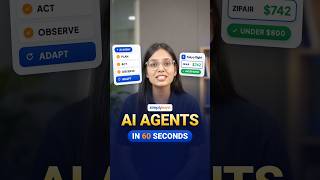

AI That Does Tasks For You?
43sThe concept of AI agents acting beyond chatbots is a hot topic, and the clear contrast with a concrete example (booking a flight) makes it highly shareable.
▶ Play Clip"Delivers exactly what the title promises — a clear, concise 60-second explanation of AI agents with no fluff."
This video provides a concise, 60-second explanation of AI agents, contrasting them with regular chatbots and outlining their core components and capabilities. It emphasizes the shift from AI that merely answers questions to AI that can plan, act, and complete tasks autonomously.
An AI agent goes beyond answering questions; it can plan, take action, and complete tasks for you, unlike a regular chatbot that only provides answers.
AI agents follow a four-step process: plan what needs to be done, act using tools like search engines and APIs, observe the results, and adapt their strategy if needed.
Example given: 'Find me a flight to Tokyo under $800' — the agent plans, uses tools, checks results, and changes strategy if necessary.
The three key components behind AI agents are: an LLM for reasoning, tools for taking action, and memory for tracking progress.
AI agents can write code, research information, automate workflows, and handle customer support. The trend is moving from AI that talks to AI that acts.
AI agents represent a significant evolution in artificial intelligence, shifting from passive conversational tools to active task-executing systems. Understanding their core components and workflow is essential for leveraging their potential in various applications.
AI Agent vs. Chatbot
Clearly distinguishes AI agents from chatbots, a fundamental concept for understanding the technology.
00:15Four-Step Agent Workflow
Provides a simple, memorable framework (plan, act, observe, adapt) for how agents operate.
00:29Core Components of AI Agents
Identifies the essential building blocks (LLM, tools, memory) that enable agent functionality.
00:42Shift from Talking AI to Acting AI
Highlights the broader industry trend toward autonomous AI systems.
00:56[00:02] Let's go. What if AI could do more than just answer questions? What if it could actually plan, [music] take action, and complete tasks for you? That's exactly what an [music] AI agent does. A regular chatbot gives you an
[00:15] answer. An AI agent takes a goal, creates a plan, uses tools, [music] checks the results, and adjusts its approach until the task is completed. [music] For example, you say, "Find me a flight to Tokyo under $800." The agent
[00:29] follows four [music] steps: plan, act, observe, and adapt. It plans what needs [music] to be done, uses tools like search engines and APIs, checks the results, [music] and changes its strategy if needed. Behind this are
[00:42] three key components: an LLM for reasoning, tools for taking action, and [music] memory for tracking progress. Today, AI agents can write code, research information, automate workflows, [music] and handle customer
[00:56] support. AI is moving from AI that talks to AI that [music] acts. Subscribe to Simplilearn for more tech concepts explained simply.




⚡ Saved you 0h 01m reading this? Transcribe any YouTube video for free — no signup needed.