
Amazon's Controversial 3rd-Party Seller Move
55sReveals the surprising internal controversy when Amazon opened to third-party sellers, sparking curiosity about Amazon's risky business decisions.
▶ Play Clip"Title accurately reflects the interview's focus on Amazon seller tools and strategies, though it's more of a conversation than a pure 'how-to' guide."
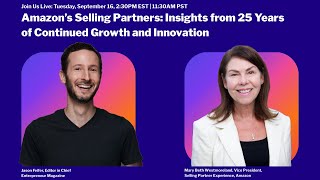
In this interview at Amazon Accelerate 2024, Jason Feifer, Editor-in-Chief of Entrepreneur Magazine, speaks with Mary Beth Westmoreland, Amazon's VP of Global Seller Experience. They discuss Amazon's 25-year journey with third-party sellers, new AI-powered tools for sellers, and strategies for creating effective product listings that resonate with buyers.
Amazon opened its marketplace to third-party sellers in 2000, a controversial move at the time, but now seen as one of its best decisions, enabling vast selection for customers.
In 2006, Amazon opened its fulfillment network to third-party sellers, allowing them to leverage Amazon's logistics for delivery.
Amazon's generative AI tool helps sellers create detailed product listings from a photo, a few sentences, or a DTC site link, making listings more appealing and discoverable.
Key attributes include a great title, dimensions, product description, proper branding, and high-quality images. Lifestyle images help customers understand product use.
Amazon offers tools to turn static images into lifestyle images and even generate videos from a single image, enhancing the shopping experience.
Amazon provides sellers with data on products customers are looking for but are not yet available, helping sellers identify market opportunities.
Amazon listens to sellers through events, visits, support contacts, and product usage data. The Seller Assistant AI tool also gathers insights from seller queries.
A generative AI conversational assistant that personalizes advice for sellers based on their products, inventory, and brand, helping them grow their business.
Amazon has reimagined Seller Central into a unified, easier-to-navigate experience for sellers to manage their business.
Amazon's culture involves trying to disprove assumptions about tools by testing with sellers and iterating based on feedback.
Amazon continues to invest in AI and data-driven tools to help sellers create compelling listings and grow their businesses. Sellers are encouraged to leverage these tools and engage with Amazon's support to maximize their success on the platform.
In what year did Amazon open its marketplace to third-party sellers?
2000
What is the name of Amazon's generative AI tool that helps create product listings?
Generative AI Listings Tool (or Seller Assistant AI for conversational help)
02:30
What key attributes should a product listing include according to Mary Beth Westmoreland?
Great title, dimensions, product description, proper branding, and high-quality images.
04:00
How does Amazon gather feedback from sellers?
Through events, visits, support contacts, product usage data, and the Seller Assistant AI tool.
08:30
What is the purpose of the Seller Assistant AI tool?
To provide personalized advice to sellers based on their products, inventory, and brand, helping them grow their business.
10:00
What is Amazon's approach to product development regarding seller tools?
They try to disprove their assumptions by testing with sellers and iterating based on feedback.
12:30
25-Year Seller Partnership
Highlights a pivotal decision that shaped Amazon's marketplace dominance.
Generative AI for Listings
Demonstrates Amazon's use of cutting-edge AI to simplify seller tasks.
02:30Visual Storytelling Tools
Emphasizes the importance of visuals in e-commerce and Amazon's tools to create them.
05:30Seller Feedback Loop
Illustrates Amazon's systematic approach to listening and iterating based on seller input.
08:30Seller Assistant AI
Shows how AI personalizes seller support, saving time and improving outcomes.
10:00[00:00] You, I'm going to guess, are either a seller, an entrepreneur who is selling your products on Amazon, or you are thinking about it because you understand how incredibly powerful Amazon is for sellers. And maybe you want to understand how to do it better, how to increase those sales on Amazon, how to understand the power of Amazon and how to use it to your advantage well. This is exactly the place to do it. I've come to the
[00:25] place. We are here at Amazon Accelerate, the annual conference in Seattle that Amazon hosts for sellers. And I am here with Mary Beth Westmoreland, who understands this better than anybody because you are... I lead our global seller experience team. Which means? Which means that my teams, our mission is solely focused on making sure that our selling partners love selling on Amazon, like you said. Yeah, we want them to grow and thrive on Amazon and we want
[00:49] them to just be happy. Yeah, yeah. And to succeed. And that is what I want to because I'm the editor in chief of Entrepreneur Magazine. My name is Jason Pfeiffer. I love supporting entrepreneurs. I want you to see them succeed. Today we're going to have a conversation about how Amazon is helping them do exactly that. And this is a big year, isn't it? Every year is exciting here. We were together last year and that was great.
[01:14] But this year is the 25th anniversary of Amazon opening its partnership up to exactly everybody. Yeah to all of our third-party sellers. Which Jason you probably know that was probably pretty controversial at the time. Yeah, it seems kind of crazy, but I can't even remember why it seemed crazy. Exactly. Well at the time, I mean this was you know, Amazon was a thriving retail business, growing retail business and in 2000 We had the idea that we
[01:39] wanted to open our doors up to third-party sellers as well. So you can imagine that the retail business was a little worried. Like, hey, that sounds kind of competitive and how is that going to work? But looking back on it now, we know, first of all, it was one of the best decisions we ever made because what we were able to do together, the retail business as well as the third-party business, is offer buybacks. buyers just
[02:03] amazing selection from some of those small businesses that you just mentioned, right? Like, you know, all the small businesses who have a passion for an idea, create a product. Now we're able to deliver that to customers just as seamlessly as we were, as we are retail. And that experience for the sellers has really evolved over the past. It probably doesn't feel anything like it did 25 years ago. Yeah, well, I wasn't around, you know, at Amazon
[02:28] 25 years ago. But yeah, I mean, I certainly was a buyer back then. And it has evolved a lot. You know, the thing is, like, even in 2000, I think 2006, we actually offered our fulfillment network. So this was all of the operations that took our retail products and delivered them to the homes of our of our shoppers, and open that up to our third party sellers as well, which is a big deal. So yeah, it's
[02:53] definitely evolved in Yeah, and I know there are big announcements coming here at Amazon Accelerate. So that is news that you're going to want to be watching, but it hasn't happened yet, so we can't reveal anything. But can you review some of the more recent announcements, some of the big things that have rolled out recently that people should really understand? Yeah. Well, we're again laser focused on our seller experience and the success of our selling partners.
[03:18] And you know that we've talked a little bit about technology in the past, so you know that at the heart of what we do is really taking technology and innovating to make selling on Amazon just an awesome experience. Lots of announcements coming this week, but some of the most recent ones that I'm super excited about because our selling partners are finding great value from are things like our generative AI listings, which is when you come to
[03:42] Amazon, you have a great product, you want to list it, you have to put a lot of information in in order to make sure that your product is discoverable to shoppers like us. So we wanted to make that really easy, but also the most appealing to buyers, to shoppers. So, we're leveraging GenAI, you can just come to Amazon and give us a picture of your product or just write a few sentences about what it is or
[04:07] even just point me to your DTC site and we'll create these amazing listings out of the gate for you that buyers love too. Yeah, right. Because, and I think people who are just new to selling on Amazon don't fully appreciate this, so it might be worth just trying to unpack some of the basics here about what all of that copy is that you're now making easier for people to produce with generative ai but What you're trying
[04:32] to do there as a seller, and you know this better than me, so let me just tee you up, but what you're trying to do there is not just explain to buyers what you have to offer and why it's great, but you're also thinking a lot about how buyers are searching. You want to understand what their search behavior is and then build that language back into the descriptions that you're writing because then it can do a
[04:56] better job of capturing their searches and driving them to you. Yeah, and we want to make sure that the products are descriptive. So like when you walk into a store, you want to read the label. You want to know what's going on. You want to see it. You want to touch it. You want to feel it. So we want to make sure that that experience comes forth in the Amazon store as well. But yeah, it's a
[05:21] really good point. The context is have great product. We want to make sure that we create that detailed page that buyers just really resonate with. Yeah. What are some of the things that you always advise sellers to be thinking about when they're building that page? Yeah, we provide context to selling partners about, hey, make sure that these are required attributes. Like you need a great product title. You need to make sure that you have dimensions. You
[05:46] need to tell us about a product description. You need to tell us what this product is. So those are things that are really, really important. You want to make sure that if it's a branded product, that it's branded properly. You want the images to be beautiful, right? We do a lot. Again, like we have some really amazing tools that we've created that can take a product image and then make it like a lifestyle a like like
[06:10] Like create an image that is like a lifestyle image that, you know, if it's a cushion as an example that we show it on the outside patio or inside of the sofa, like really make it resonate with customers well. Yeah. Yeah. You know, and that's not just resonating with customers, but that is visually doing something that is so important that I think entrepreneurs often forget about, which is, and this feels weird if you're a seller, if
[06:35] you're an entrepreneur who's created something, it feels weird to have to do this, which is to just tell your customer when and how to use your product. People often don't think to do that because they think, well, I understand it. I made it. I understand exactly what it's for. But customers don't always know. That's a really good point. And so you have to show them. That's a really good point. I remember, Mary Beth, this takes us
[07:00] a little away, but I'll bring it back, which is I remember once I had a lot of entrepreneurs who come and ask me for advice. And there was this one entrepreneur who created this totally weird new snack type that was, not to go into detail. What was it? It was... It was a peanut butter. It was like the Ben and Jerry's of peanut butter. So it was like peanut butter, but it was also full of stuff,
[07:25] you know, like chocolate or pretzels or whatever. It actually sounds delicious. It's totally delicious. It was totally delicious. He sent me a bunch and it was delicious. But what I told him was, I don't know when to eat this. When am I supposed to eat this? Is this a dessert that I eat like Ben and Jerry's, like in a bowl? Is this something that I put on a spread? Tell me how to eat it. When do
[07:49] I eat this? And that's something that entrepreneurs often forget because they create a thing and they have, it's what I call, I have a term for it, which is, Assumption of shared understanding that you have an assumption that your consumer understands this exactly the way that you do and that's not true and one of the ways to solve for that in a really simple clear way on Amazon is with the visuals. Visuals, yeah, it tells you
[08:14] everything and it's just easy to grok from a buyer's perspective, right? Like I would rather look at a picture and really, like to me that just brings it to life, like the value prop to it. So can I just ask? Please. What did they say you should eat that peanut butter? peanut butter with what did they say you should do it for dessert or was it like on a sandwich with jam okay like what was the
[08:39] answer well so the answer was the wrong answer because the answer was whenever you want like that's what he was like he was like it could be whatever you want it could be a snack it could be dessert it's for adults it's for kids it's whatever for whatever and that's great in a way like of course any creator of a product wants people to use it however they want and all that stuff. But the problem is
[09:03] that if you don't give people that guidance, then they just don't know what to do. They can't connect the dots. Like for you, you're like, okay, now I have to figure it out. Right. It's like work now. Right. And so, and then, and then I just kept thinking about the experience of it. Like, I know how much ice cream to put in a bowl for a regular dessert for myself or for my kids. I don't know
[09:28] how much of this peanut butter stuff I'm supposed to put in a bowl. And then I kind of can't imagine like spooning peanut butter into my mouth like that. So he needed some-- - Not more than once anyway. - Not more, no, that's all it could be. So he needed some really clear, specific guidelines. And I don't know, actually, if that person is selling on Amazon, but if they are, it would be fascinating to see the
[09:53] evolution of the listing that they have, because I think as you watch, and everybody on Amazon should be doing this, which is looking at other listings and saying, what is this person doing? really well and how is this properly communicating what this product is and who it's for and when it's for yeah that example that you gave is actually a really good one and it kind of illustrates the the power of some of the tools that
[10:17] we talked about. You can go look at other listings that like as a buyer resonate to you. But also we're trying to take a lot of that guesswork out with the tools that we're building. Like that listings tool I mentioned. There are others like we talked about the power of visuals and creating that lifestyle imagery. That's a big part. We have video generator that takes a static image and actually turns it into a video. That's a
[10:42] big deal too. And then like even things like providing context to a selling partner about like what buyers love. Like for example we have a tool that will provide any selling partner with some data about, "Hey, here are some products that customers are looking for that are gaps today." So it really helps them to understand what the shopping behaviors are, like through the power of how we help them create great listings, but also just through data.
[11:07] Right. Which is so important if you're trying to understand a buyer on Amazon because that's different than a buyer at a physical retail store where someone might be wandering through aisles and see stuff. In this case, you really have to understand the intent of buyers. What are they actually searching for? What is the language that they use to find things? because the better you understand the consumer you're trying to reach the problems they're trying to solve
[11:32] and the words that they're using to try to find solutions to their products the better you can make sure that your product gets in front of them yeah i think that's a really good point i also think though that we want to create a really rich browsing experience for a shopper who may be shopping on Amazon in somewhat similar fashion as maybe walking through a store and like something catches your eye. And it's because of what
[11:56] you said, it's because we know the shopper well. Like I go to amazon.com, I know that I'm gonna be presented with products that I might not be searching for in the moment, but that I know I probably are very interested in buying. So yeah, there's a bit of both there. So something I know you think a lot about at your team is creating a great feedback loop for seller feedback. You want to listen to what sellers
[12:21] are experiencing, what they want, where their pain points are, and then building them into the products that you're using. Tell me a little bit more about how you're listening to sell, how you're getting that feedback and what you actually do. I mean, I'm imagining a seller right now who's watching this, who's saying, I got an idea. I want to tell Amazon. What are they supposed to do? How are you listening? We have tons of ways. We're
[12:46] here this week with thousands of our selling partners and we're going to be spending most of that time sharing some pretty exciting information, but also listening to them, talking with them, understanding what their challenges are. It helps to inform our roadmaps. But we have a lot of other mechanisms that we use. We use that word mechanisms, which I know you're familiar with. We bring sellers in to talk with our teams. We go out and visit sellers.
[13:10] And sometimes, Jason, we don't just go out there and ask them a bunch of questions. We just watch. We watch what they do. Where are they spending their time? how do they run their business what's most important to them yeah we also do things like leverage support contacts i mean our selling partners when they need help they call us they reach out to us so that's like really really important and useful information for us to take
[13:35] and then inform the priorities of how we're going to build for them but then one other thing i just want to mention this yeah like one other major thing that's so important is listening through our product experiences. Like are our selling partners using the tools that we build? And if they do, do they love them? Do they come back and use them again? You know, we have this tool called Seller Assistant. It's our generative AI conversational
[14:00] assistant. It's kind of like an assistant that's with you through your selling journey at Amazon. And selling partners will interact with that. We'll ask questions like, how do I grow? Or what were my sales last week? Or I'm having this problem. Can you help me? And like that is so telling to understand more and more about what a selling partner cares about just by listening. Oh, because so let me let me take that tool and understand
[14:24] it from two different sides. So side number one is. instead of what used to happen before, which is that you had to know where all the information was through our cell, etc. Which is very complicated for especially people who are new. Now you're saying you don't need to figure that out anymore because there is one centralized little tool here that talks to you like a human being and you can just ask it a question and it
[14:49] will answer it. So you don't have to go hunting around for the information, which is so useful. But then you're saying that also from the Amazon side, Everything that's being asked of these little tools across all the sellers is giving you a lot of insight into what sellers are needing and what they're confused about or what they need more of. And that's helping you then build out the products that can solve that. - That's a great
[15:14] way to think about it. The only thing is I'll push your thinking a little bit on that seller assistant. Because it's not just about like, you don't know where to navigate to go find something. And that's a part of it. You're absolutely right about that. But it deeply understands who you are as a seller, knows your products, knows your inventory, understands like, your brand deeply. And so it's able to personalize an experience based on what you
[15:39] should go do to grow your business as an example. So it was not just about solving for the NAV issues. The other thing is we want sellers to love using our tools. We do. And so we've done things like reinvent, reimagine all of these tools that we have into like cohesive, unified experiences. We've basically reinvented what we call Seller Central, by the way, all of those tools, that collective experience we call Seller Central. We've really reimagined
[16:03] that and made it a lot easier for selling partners to use, find, navigate, like really run their business on Amazon too. So we're doing both. That's great. I love that. Just to stay on the feedback loop for a moment longer, because you're so thoughtful about this. When people ask me, Mary Beth, what I think the number one overlooked thing in entrepreneurship is, like what does an entrepreneur forget to do the most? My answer is hear from
[16:28] their customers. - Spend time with your customers. - Yeah, spend time with their customers. - Spend time with your customers. - And I think the problem, especially at a small level with an entrepreneur, is that they think, well, I'm a small business. I'm hearing from customers every day. I know my customer. I am my customer. But you forget how much of a delta there could be between the person who's making something and the people who's consuming
[16:53] it. And you need to be talking to them. So I'd love to hear some advice from you. You're doing this at a global scale. How are you, inside of your teams, systematizing things? using that information and making sure that you're really hearing. Well, first of all, you're so right. I just have to say, you are so right. Like in your worst day, don't you want like because everybody has a bad day yeah don't you want to
[17:17] just go spend time with your customers totally like because that to me just brings the passion back of like why we do what we do and for us of course that's selling partners like spending time with our selling partners even when they're having a bad day to me is inspiring so and it really helps to inform everything but the mechanization um it's through the anecdotes like through the feedback qualitatively that we get like spending time with
[17:42] your selling partners but it's through things like getting them to use the product We try to disprove things too, Jason. Like Amazon has a peculiar culture. And one of the things I really love about it is that we don't go into something and say, you know, I want to prove them right. I built this great tool. Selling partners, of course, are going to love it. We go in trying to disprove ourselves. Like what did we get
[18:07] wrong about it? it. Like did we really kind of pushed something hard and maybe we got it wrong and we're going to just like really let our selling partners, our customers help us figure that out. So that's another thing we mechanize is that we bring them in, we roll things out and we test and we learn and then we get it right and we tweak and we iterate. So it's part of our, the way that we
[18:31] build. the way we do product development is all about like iterate and learn based on customer feedback. I love that. We've only got a few minutes left. And so just to remind everybody who's maybe joined a little late, I'm Jason Feigler, I'm the editor-in-chief of Entrepreneur Magazine. I'm here with Mary Beth Westmoreland, who again, give me your awesome title. Global Seller Experience VP. Global seller. Yes, which basically means that she is making sure that sellers have
[18:56] a great experience on Amazon. That is the single sentence. And we're here in Seattle at Amazon Accelerate, the event for Amazon sellers. There are going to be a lot of announcements coming out about new things. I don't even know them. She does, but she's not telling me. And that are coming out that are going to be here to help sellers grow. So what you can't give it away what's coming, but what should sellers maybe be thinking
[19:21] about the most that you don't think that they are? That either new sellers or existing sellers, what are the products that we haven't covered already, the services that you already have that you think just need to be top of mind for sellers? - Well, your example earlier actually hit on what I think entrepreneurs really want and that is tools to help them create amazing products that really just shine a light on the value prop like really
[19:46] just make sure that their products are seen in the light that they're intended which is like the value that comes across all the work that we're doing the insights that we provide to our selling partners yes there are a lot of really cool things that we're going to touch on this week here at accelerate But there's also a lot of things that we're already doing. And that's the entrepreneurs especially should know that we're doing a lot
[20:10] for them to actually make that happen really easy, saving them lots of time. Right. So so it is get get inside. Seller Central. Use our tools. Yeah, use our tools to create great listings. Use our tools to understand what buyer behaviors are telling you. Try things. Use our folks. Our support team is there to help them every step of the way if they need it. Yeah, entrepreneurs are the vast majority of selling partners on Amazon. We
[20:35] care a lot, a lot about the amazing value that they bring. So thank you. That's amazing. And if you happen to make crazy new kinds of peanut butter, just send it her. Yeah, I'm going to look at that, by the way. I'm kind of curious about it. about it um all right well keep keep watching stay tuned because there is going to be tons of news coming out here and if you are a seller on amazon
[21:00] or if you are launching something and you're going to be selling on amazon you are going to want to know about the news that is coming out in seattle here mary beth it is always an absolute pleasure it's great thank you so much for having me jason i love hanging out with you thank you you too all right everybody thanks so much have a great day




⚡ Saved you 0h 21m reading this? Transcribe any YouTube video for free — no signup needed.