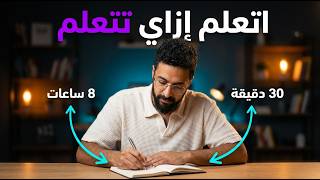

Why 99% of People Can't Learn Anything
42sOpens with a relatable pain point about wasted education, immediately hooking viewers who feel they've learned nothing.
▶ Play Clip"Delivers on the promise of learning how to learn with practical steps, though some parts are padded with personal anecdotes."
The video addresses the common frustration of feeling that years of education and reading have yielded little benefit. The speaker, Al-Saluki, shares his personal transformation from a disengaged student to a successful entrepreneur and content creator, attributing his success to mastering the skill of learning how to learn. He emphasizes that in the age of AI, the ability to learn quickly is more valuable than any static skill.
Many people spend years in education and read many books but feel they gain nothing. This is a problem faced by 99% of people. The difference between them and successful learners is knowing how to learn.
The speaker was once a poor student who hated reading, but he changed his approach and now runs multiple companies and has a large library. He attributes this to learning how to learn effectively.
Skills become obsolete quickly, especially with AI. The most valuable talent is the ability to learn new things quickly and better than others.
You don't need to absorb every piece of information. If you read a book and remember just one life-changing idea, that's enough. Even a course that doesn't fully benefit you may contain one small thing that changes your life.
A study at an American university found that students learn better when the curriculum is made more difficult for them. The brain benefits from challenging situations.
The more effort you put into acquiring information, the more it sticks. In the age of instant gratification, we ask for information instead of searching for it, which reduces learning.
80% of results come from 20% of effort. Focus on the 20% of a book or course that gives you 80% of the value. Use the index to select relevant chapters and skip the rest.
Consuming information (reading, watching) is not learning. Learning requires active engagement. Three techniques: timing (90-minute focus sessions), testing (self-testing immediately), and applying (using the knowledge in real situations).
Three ways to test knowledge: slow burning (re-watching and focusing on details), immersion (applying in real situations like performing on stage), and teaching others (explaining to friends or on a channel).
After learning, the brain needs time to consolidate information. This happens through exercise (walking), meditation (or prayer), and sleep.
Don't rush, don't compare yourself to others, and stop judging yourself. Focus your energy on self-improvement.
The video concludes that learning is a skill that can be developed. By focusing on the most valuable 20% of information, actively testing and applying knowledge, and allowing time for consolidation, anyone can learn faster and more effectively than others.
What is the Pareto Principle (80/20 rule) as applied to learning?
80% of results come from 20% of effort. Focus on the 20% of a book or course that gives you 80% of the value.
05:10
What is the Generation Effect?
A phenomenon where students learn better when the curriculum is made more difficult for them, as discovered in a study at an American university.
02:45
What are the three techniques to turn consumption into learning?
Timing (90-minute focus sessions), testing (self-testing immediately), and application (using knowledge in real situations).
07:33
What are the three testing methods mentioned?
Slow burning (re-watching and focusing on details), immersion (applying in real situations), and teaching others.
08:55
What are the three ways to consolidate information?
Exercise (walking), meditation (or prayer), and sleep.
11:43
Learning is the new skill
In the AI age, skills become obsolete quickly; the ability to learn fast is the most valuable talent.
01:21Generation Effect
Challenging situations enhance learning, as proven by a university study.
02:45Pareto Principle for learning
Focusing on the vital 20% of content yields 80% of the results, saving time and effort.
04:54Consumption vs. Learning
Merely consuming information is not learning; active engagement is required.
06:52Consolidation is crucial
The brain needs rest to store information; exercise, meditation, and sleep facilitate this.
11:14[00:02] 22 years of education and in the end feels that he still hasn't benefited at all. Not only that, but you are now a person who attends many courses and reads many books, and yet you do not feel that you are benefiting at all. You feel that everyone around you is cultured and they talk about how much these books have changed
[00:15] their lives, and no matter how much you read the book, you really do not come out with anything at all. The problem you have, come out with anything at all. The problem you have, to reassure you, is a problem faced by 99% of people all over the world. The only difference between you and people who actually benefit and educate themselves from
[00:27] all of this is that these people know how to learn anything. In this video, God willing, how to learn anything. In this video, God willing, we want to learn how to learn. So, welcome to a new video with you, Al-Saluki. Let's start by praying for the Prophet Muhammad, peace and blessings be upon him.
[00:41] If I were to talk about myself personally, I was someone who didn't focus at all in school and I hated reading in a strange way. In short, everything I did in my life, from when I was little until I entered university, was something that people consider a little knowledgeable. How is it that today, thank God, I was able to make a
[00:56] lot of money, open several companies, and manage a whole team? Not only that, I have a complete library What exactly happened? What shift did I make to change from someone who didn't know how to benefit
[01:08] at all from anything to someone who knows exactly what to take from everything? And to understand how important this topic is and how What? You're ruining your life if you don't finish this video! You need to understand that in the past, what made you different and special was your skills.
[01:21] But today, especially in this age of EI, those skills change almost every month. EI now offers so many skills that we no longer need humans to create them. So, what's in demand and extremely important now is the talent to
[01:35] learn things quickly and better than others. The more new skills emerge, the faster the person who learns will be the first to master them. That's what's required of you at the end of the video, God willing. To get straight to the point, the first thing we want to discuss is
[01:49] that you don't have to absorb everything in front of you. There's a great saying that goes, if you buy a book, read it completely, and only remember one thing that changed your life, that one thing is more than enough. Because simply put, if you buy a whole book
[02:03] for only 200 pounds, those 200 pounds brought you information that changed your life. You shouldn't expect more than that from these things. What I want to emphasize here is that not everything you do in your life necessarily makes you cultured or actually changes your life. There are courses you can take and
[02:19] not fully benefit from, but there's one small thing in them that can change your life. A very famous example of this is all the young people who went into engineering. Does that mean all young people who graduate from engineering are actually suited to be engineers? On the contrary, you find that a very
[02:32] large percentage make a career change. Yet, if you ask all these people, they will tell you that they do n't regret going into engineering because engineering was able to teach them a way of thinking that helps them today in their work, whatever their career path may be. So these people didn't get the content of the
[02:45] engineering degree, but they got something... A specific thing from this journey is what changed their lives, so it's not always necessary to take the whole thing. The second thing that is very important to talk about is something called the Generation Effect. At a university in America, they did a very beautiful study called the
[02:58] Adaptive Learning System. They brought the students into a class and taught them a part of the curriculum and tested the students, and based on the result of this test, they changed the curriculum in the future. Meaning, if you are a person who got, for example, 100 out of 100, they make the curriculum more difficult for you. If you are a person who got 70%, they make the curriculum a little
[03:14] less difficult, and so on, according to the grades of all the people. As much as this was an experiment that annoyed people who get good grades, they discovered that this method makes the person who is put in a more difficult curriculum learn much better. When they conducted brain studies to understand
[03:28] why this strange effect occurred, they discovered that the more you put yourself or your brain in a more difficult situation, the more it benefits. One way to speed up the learning process or to fix the information in your mind is to be a little tough on yourself regarding the information. I can give you many examples,
[03:43] including that when we were little we would put our hands on the fire or on a hot cup or something like that and we would get burned right away. A young child, once or twice at most, will never touch something hot again. Now imagine a cup, but it's not hot, it's just
[03:57] slightly warm. The child puts their hand on it and keeps their finger there for 30, 40, or 50 seconds until they feel their finger getting hot, then they gently remove it. When the child sees the cup hot again, will they touch it? Most likely, they will, because they have n't learned the concept yet. The point you want to make
[04:11] here, to learn faster, is that you need to put yourself in more challenging situations. To apply this practically in education, you need to understand that the more effort you put into acquiring information, the more that information will stick in your mind. Unfortunately, we live in the age of instant gratification, so
[04:25] instead of searching for information, you just ask for it. The information comes to you, and unfortunately, your brain doesn't benefit at all. If you want to solidify more information, try to pursue knowledge and information and work hard to reach your information. If I am preparing this video,
[04:39] at least 10 videos, each one being half an hour long. This will at least solidify the video script in my mind. I understand exactly what I am going to talk about. Now let's talk about three practical steps that you should focus on in order to learn everything better and faster than
[04:54] others. The first step is for you to compress the information. There is a very strange phenomenon, praise be to God, that exists on Earth and you have surely heard about it. If you haven't heard of it, then you're not a human being living among us. Be careful, this is not a theory, this is a phenomenon, this is something that actually exists. 80% of any result in the world comes
[05:10] from only 20% of the effort you put in. What does this mean? Literally, he tells you that if you plant an acre of mangoes, for example, when the trees start to grow and the mangoes start to grow, you will find that 80% of the mangoes that grew came from only 20% of the seeds that you put in the ground. And no matter how much
[05:26] the amount of ground and seeds increases, you will always find that 80% grows from 20%, and the remaining 20% of the mangoes come from the other 80% of seeds. This other thing is called the golden resho, and God Almighty created it for us in everything in the universe that we are in. What does this mean
[05:41] ? This means that only 20% of the effort you put into studying, reading, or attending courses will actually benefit you with 80% of the information you need. So I want you to do what I'm going to tell you. I want you to open the first page of the book, which is the index,
[05:56] and see all the chapters that are there. I want you to study the chapters that you feel you need or will benefit from. After that, don't read the whole book, just read these chapters. What will happen is that instead of reading this book in two months, you will probably read it
[06:10] in a week at most. Yes, you won't finish everything, but what will still happen is that you'll have gained the most benefit you could possibly need from the book. Instead of reading the whole book and cramming all that extra information into your brain, remember that the brain has a certain capacity, meaning it has a
[06:24] specific space. You can't fit more information into your brain than that space allows. So, the biggest problem you face when you're learning is that you cram in too much information without being able to distinguish between what's important and what's not. You end up storing completely irrelevant information in your brain instead of the information
[06:38] actually need. That's why, even when you're learning a new course, I want you to look at all the chapters and start with the things you know you really want to relearn. Remember, 20% of the information or effort you put in will get you 80% of the results you want
[06:52] in the end. The second step you need to understand and implement is something called The compilation or translation and implement is something called The compilation or translation in a phenomenon called the 99% rap, 99% of people fall into this problem. The problem is that we think that consuming information is the same as
[07:06] learning, and these are two completely unrelated things. Now, you have an exam at the end of the year, so you start opening books and reading lectures and seeing the world. What we do is read the lecture, close it, and say, "I studied today!"
[07:18] information; you just took the information from the book and put it in your head. The dilemma here is that this is not called learning; it's called consumption because this is dry information that you crammed into your head. So how do we turn this into proper learning? We will do exactly three things. The first thing is
[07:33] timing. The human brain is generally designed to work for about 90 minutes. So, the techniques available online that say Work for 90 minutes, then rest for 20 minutes. This isn't random; it's based on the idea that if you work for more than 90 minutes, your brain won't
[07:46] function properly. So, always try to keep a timer nearby or set one on your phone and work for 90 minutes, then take your 20-minute break. I know some people work 12 or 18 hours, but keep in mind that's work, not necessarily brainpower or information processing. That's one thing, and that's
[08:00] something else entirely. The second step is testing. We agreed that your brain absorbs more when you put it in slightly challenging conditions, so the best way to learn is to test yourself. Unfortunately, the education system worldwide is geared towards spending the whole year
[08:15] learning and then taking an exam at the very end. However, when you enter the business world and start working, especially in programming, you'll discover that this isn't the right approach. You'll discover that they're working with a system called Agile, or something called sprints. The idea behind them is that they
[08:27] agree that next week they'll focus on a specific task they want to accomplish with their tool and work on it for the entire week. These sprints used to be, for example, three weeks every three months—three consecutive weeks of staying up all night working on the task until it's finished, and then they don't
[08:41] world has become so fast-paced, some people do sprints every day, for example, two hours a day, and so on. So, the idea for you to apply this to yourself is that every time you learn something new, you should test yourself on it immediately. This brings us to the third step: what are the ways we can
[08:55] test our knowledge to solidify it? The first method is called slow burning, and the idea is to first method is called slow burning, and the idea is to learn the subject in the slowest way possible so that you can focus on every detail. What does this mean? Simply put, when you open a
[09:08] new course If you want to learn something and you've watched the first video, after it finishes, don't move on to the first video again. While watching it again, try to see if you remember the information that was said. Try to see if you focused on each piece of information. If you're watching a video now, or
[09:23] this video, and your mind wanders, go back to the minute where you were speaking and watch it again. The idea behind the sloppy method is to do everything very slowly and focus on every detail, even if you have to repeat the same part 100 times. As much as this method works, many people don't like it, and I
[09:37] personally don't like it because it wastes a lot of time, and unfortunately, we get bored very quickly, so we do n't want to continue. But it's one of the methods; if you know how to do it, do it. Another method is called emerge, or immersing yourself in a situation where you need to use what you've
[09:50] learned. Simply put, if you're someone who plays any instrument... There's a difference between watching a video and trying to imitate it, and then learning the basics, and sitting in front of a mirror, picking up a guitar, and starting to play. These are all very ordinary situations, and you'll find yourself doing well in them. But the
[10:04] real learning moment is when you stand in front of an audience on a stage and start playing. Your brain will never retain the information 100% unless you put yourself in the real situation. That's why, for anything you learn, try to apply it practically. If you're learning graphic design or programming, for example, try applying
[10:20] for a job and presenting your skills. You keep convincing yourself that you need to be an expert in this skill to actually start presenting it in the market, but you'll never truly master it until you go and present it yourself. This is actually the best way to learn. That's why people tell you that the most
[10:35] successful people are those who take the initiative, not those who prepare beforehand, because they learned the fastest way. The third and final way is... If you teach the people around you, I personally love this method and I apply it to everything. This is one of the main reasons
[10:48] I started a YouTube channel in the first place. If there's something specific I'm still learning, as soon as I learn just one lesson, you'll find me posting a video about it the next day. You'll find me sitting with my friends teaching them this thing. One of the best ways to learn something or solidify information in your mind is to
[11:02] teach it to others. So, if you're reading a book or taking a course, at least try to sit down with your family and say, "Guys, I learned a lot," and try to explain it to them. Or try going online and learning it online so you can
[11:14] benefit others. Now, let's move on to the very last stage for solidifying information or learning anything. This stage is the most important, and at the same time, the one we neglect the most. This step is called consolidation. Your brain is a huge storage unit. While you're in the
[11:29] learning phase, during your 90-minute session, information keeps entering your brain. This information hasn't yet been consolidated because it hasn't entered the place where it will be stored. All the information remains like this inside your brain until you perform the consolidation process. In short, you take a few moments of
[11:43] rest so that your brain can take this information and start putting it in the right places. This process happens in the human body in only three cases. The first case is exercise, and I don't mean the gym or strenuous exercise, I mean going for a walk or a run, or something like that.
[11:58] If you disconnect all your senses and start, for example, going for a walk after you've completed part of the course, your brain will take advantage of the fact that it's not working at all to start distributing this information in the right place and consolidating it all. The second case is meditation, or Meditation, in
[12:12] short, doesn't require you to do anything except lie down on the couch or the floor, close your eyes, and completely clear your mind. Take a moment to meditate, take a moment to breathe. You're not thinking about anything, you're not listening to music, you're not watching anything, you're not holding your phone. Just a
[12:26] moment of meditation. And, by God, this also makes me think about why God Almighty prescribed five daily prayers for us. Because forget what they teach in the West; if you pray, that's more than enough. Whenever you study a specific piece of information and want to solidify it, go pray. The mental clarity you get from
[12:39] prayer will solidify the information 100%. And the third point is sleep. Getting a good night's sleep is beneficial for your knowledge and the things you do during the day. If you sleep well at night, your brain starts to organize itself, which is why you sometimes do things during the day... You dream about these things
[12:53] because your brain is currently processing them, and by chance, they appeared in currently processing them, and by chance, they appeared in tips. First, you're not in a race. You're not learning at all right now. When you start
[13:06] applying these steps, you'll find it will take two, three, or four weeks to actually learn them. Take it one step at a time, take your time, and make sure you reach your goal. Also, regarding this race, no matter how good you are, there will always be someone better. Don't
[13:19] compare yourself to anyone else because it's not a race. And the next thing is, stop judging yourself. Stop looking at yourself and asking, "Why am I failing? Why can't I learn? Why is everyone else so educated?" Right now, you have your energy, and you need to focus it on one thing only:
[13:33] working on yourself. Don't waste your energy on criticizing others. Take it easy, don't take things too seriously, and as usual, I've done my duty, so bear witness. See you in the next video. witness. See you in the next video.
⚡ Saved you 0h 13m reading this? Transcribe any YouTube video for free — no signup needed.