
Backrooms Origin: From 4chan to Viral Horror
45sThe mysterious origin story of the Backrooms as a 4chan post and its eerie description captivates viewers with its blend of internet lore and unsettling imagery.
▶ Play Clip"The title accurately promises a breakdown, analysis, and hidden details, and the video delivers exactly that."
This video provides a comprehensive breakdown of the film 'Backrooms,' analyzing its hidden details, Easter eggs, and the making of the movie. The host explores the film's themes of trauma, memory, and the backrooms as a manifestation of personal demons, while also connecting it to the original online creepypasta and Kane Parson's web series.
The video begins with a breakdown of the backrooms, an online creepypasta originating from a 4chan post in May 2019, describing a liminal space of endless yellow rooms and fluorescent lights.
The term 'no-clipping' is a gaming term for a glitch that disables collision, allowing players to go out of bounds. The 4chan post imagined this happening in reality, leading to the backrooms.
The iconic photo was taken at a former furniture store in Oshkosh, Wisconsin, during renovation in 2002, and uploaded to a blog in 2003 before being used for the 4chan post 16 years later.
In January 2022, 16-year-old Kane Parsons posted a Blender animated short 'The Backrooms Found Footage' on YouTube, which went viral and spawned a series about a research company Async exploring the backrooms.
In 2023, A24 announced a feature film with Kane Parsons attached to direct. The film was shot in Vancouver with a quick turnaround, released less than a year later.
The film opens with an A24 logo styled like a CRT monitor, setting a '90s VHS aesthetic. The found footage style is used to explore the backrooms with the characters.
The first recording is labeled KL WN A SV V Y, the 446th survey by Async, conducted by Naron on June 19, 1990, about 10 days before the main events.
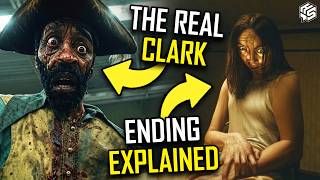
Pirate Clark appears before Clark enters the backrooms, possibly because of Phil's subconscious. The theory suggests that Phil saw Clark's advert, and his mind filled the backrooms with that image.
The beach image and no credit sign appear early in the film, and the beach image reappears distorted at the end, suggesting timey-wimey effects.
Async employees are advised against entering the complex alone; they must travel in groups of three. Researcher Peter Tench stepped away and was missing for months, traveling through time.
Seagulls appear throughout the film, linking to the ocean as a metaphor for the backrooms. Kane likened exploring the backrooms to crossing an ocean.
The complex is a manifestation of memory, like a photocopy of a photocopy. Each iteration experiences generation loss, distorting forms until they become unrecognizable.
Text in the backrooms is mirrored, showing how the complex recalls objects without understanding them, similar to early AI art failing to duplicate text.
Mary's concrete handprint outside her childhood home symbolizes preserving a memory. It later becomes a tool for her to break free from her trauma.
The film's central idea is that memories inform present behavior, keeping people trapped in patterns. Clark is consumed by rage from his divorce, while Mary is consumed by the need to help others.
Clark's furniture store, 'Captain Clark's Ottoman Empire,' has mismatched themes (pirate vs. sultan), reflecting how the backrooms stitch spaces without context.
Clark learned to push people away before they could hurt him. He blames others for his issues and refuses accountability, which ultimately leads to his demise.
Mary proposes a roleplay reenacting the night Clark's wife left him. Clark constantly reasserts that the behavior wasn't his fault, showing his inability to accept responsibility.
Clark can't bear to have his embarrassing moment (falling with a peg leg) recorded because it paints him as lesser. This moment becomes a traumatic thing that haunts him.
Clark's store has high electricity bills and power outages. The circuit breaker has additional switches that do nothing, suggesting the backrooms' influence leaks into the real world.
Mary's book encourages opening the window to leave the past behind. Both Mary and Clark are living behind glass, unable to move on from their baggage.
The audiobook explains that each time you recall a memory, you remember the last time you remembered it, not the event itself. This mirrors how the complex works.
Clark pulls up outside his old house and looks through the window, consumed by his past. This contrasts with Mary, who is trying to open the window and move on.
Some theorize that Clark killed his wife Barbara after the events of the film, as the complex brings out his true violent nature. The film doesn't confirm this, but it's a popular theory.
After flicking a strange switch, Clark discovers a sliver of light from the basement wall and steps into the backrooms. The backrooms themselves are not evil; it's what people bring into them.
The film built 30,000 square feet of actual backrooms sets, allowing the DP unrestricted freedom. The score was composed by Ido Van Breamman alongside Parsons.
Caveman cutouts are used by Async to lure entities and trapped humans towards security cameras. The voices are from the Voyager golden record, intended to make contact with alien life.
Clark discovers Narin's bag with ID and tapes. The bag likely ended up there because Async researchers recovered it and stashed it, possibly hiding evidence of their dead employee.
The lopsided chair from Clark's commercial appears larger in the backrooms, suggesting it's Pirate Clark's birthplace. Pirate Clark embodies Clark's rage and inferiority complex.
After Clark's trip, the real world starts to look strange, with warped perspectives and overlapping architecture, showing how the backrooms affect his perception.
Clark asks Mary if she has a 5150 (a mental health hold), suggesting he might be losing his grip. He tries to explain the backrooms using the analogy of describing a dog to someone who's never seen one.
Async developed MRI machines, which take images of the brain without context, similar to how the backrooms copies thoughts. The invention of MRI saved lives but also led to the discovery of the backrooms.
Clark reacts to perceived judgment from Mary, lashing out and pushing her away. This is a display of his loop: whenever he feels dismissed, he withdraws.
Clark has been mapping the backrooms. His map includes a steep ramp, a pool room, and a spot labeled 'old bottles.' The map shows how much time he's spent there.
Mary suggests Clark might have imagined the backrooms due to alcohol withdrawal. Clark immediately leaves, showing his loop of withdrawing when challenged.
Clark's relationships are based on power dynamics: he holds power over Cat and Bobby as their boss, and Mary holds power over him as his therapist. He avoids equal relationships.
The film critiques capitalism: the backrooms are modeled after empty office buildings, Async sells storage space, and Clark's store is failing. Profit is prioritized over people.
When Cat asks what the rope is for, Clark says it's for descending the ramp, but he later uses it to tie up Mary, foreshadowing his violent turn.
Clark withholds vital information from Cat and Bobby, viewing them as expendable. He prioritizes his curiosity over their safety, leading to their deaths.
The smiling sun motif appears throughout the film, possibly referencing a solar flare accident involving Ivan Beck, a key figure in the backrooms lore.
Bobby is lowered down the ramp and finds a room with clothes and a torn hazmat suit, presumed to be Narin's remains. He is then yanked back by Pirate Clark.
Pirate Clark says 'What are you doing here?' suggesting he might be a version of Clark that is difficult to get out of. He smashes a mirror, unable to face himself.
The film recreates the original 4chan backrooms image as an Easter egg, showing how far the concept has come.
The Christmas tree room juxtaposes festive joy with horror. The human statues embedded in the ground may represent Clark's unfulfilled desire for a family.
The Barbara still life appears in the backrooms, missing the top of her head, foreshadowing the scalping scene. Clark runs past Christmas-themed rooms and a green light.
Cat pleads for Clark to let her in, but he sees a wall instead of glass, showing he's put up a barrier. This connects to Mary's book about the window within.
Pirate Clark picks up the camera, and the footage cuts out. The height suggests it's Pirate Clark, not Clark himself.
Mary is swarmed by her mother in a vision, but she uses the concrete handprint to break free, symbolizing letting go of her trauma.
Mary's last name Klein is a nod to the Klein bottle, a mathematical shape with no inside or outside, similar to the backrooms.
Bill watches 'The NeverEnding Story,' a nod to the backrooms being infinite and hiding many stories.
Mary decides to go through the doorway in the basement, reflecting her own doorway to escape. Windchimes indicate something blowing through.
A fly passes through the doorway with Mary, later landing on her shoulder before she's knocked out. The fly was a real, persistent insect that made it into the film.
Mary comes across a mural with wall writings, similar to Portal games. The text 'tables don't bleed blood' is a reference to an interview where Kane was asked about food in the backrooms.
Still lives don't bleed, but Pirate Clark does after eating the real Clark, suggesting the backrooms didn't know how to copy blood until then.
The mural spirals out, representing Clark's descent into madness. He appears from behind a corridor, consumed by the backrooms.
Mary's mother appears in a hospital room like a still life, vacant and in a lampshade. Mary is shown in the corner of the house, boxed in by her trauma.
Clark repeats the book passage about loops and habits. Mary smashes the handprint to break her loop, but Clark stays stuck because he refuses to change.
Clark explains that the backrooms builds still lives by remembering them, and the more it remembers, the less accurate they become. This is the first time the backrooms are explained in the film.
Clark views people like objects, keeping Cat's head in a freezer. He values still lives because they feel nothing, unlike Mary who questions him.
Some theorize that Clark himself is a still life at this point, as his scar is missing. This is ironic because the copy didn't give the full picture.
Clark and Mary reenact the roleplay, but Clark refuses to change. Mary tells him he can stay stuck in his loop, and Pirate Clark eats him, symbolizing his inner darkness consuming him.
The pirate is the real Clark; the Clark we saw was just a front. Pirate Clark was played by Robert Bob Rossiks, who creates an imposing figure.
Mary runs past a green light, which is speculated to be the purest form of the complex, the active act of remembering. It appears when the complex is changing.
Mary sees endless repeating rooms that copy the floor above but miss details, eventually becoming nothing but darkness. This represents generation loss.
Mary uses a gas trap to weaken Pirate Clark and then uses the concrete handprint to defeat him, symbolizing her letting go of her trauma.
Async captures Mary and studies Pirate Clark. Mary is questioned by Phil, and her face is framed between yellow (backrooms) and white (real world), showing she's caught between both.
Mary smiles at the irony of being trapped again, this time by Async. She may be brought into the company to help understand the backrooms due to her empathy.
The film ends with a montage of Mary's life and a still life of Mary seated by a window, mirroring her childhood. This shows that a part of her will always remain in the backrooms.
The backrooms copies trauma, creating a loop where trauma leads to more trauma. This cycle spreads and infects all who come into contact with it.
The film 'Backrooms' is a thought-provoking exploration of trauma and memory, using the backrooms as a metaphor for the loops we get stuck in. The breakdown highlights the film's deep themes, hidden details, and the impressive filmmaking by Kane Parsons.
What is the origin of the backrooms creepypasta?
It originated from an anonymous user posting an image to 4chan in May 2019, describing a liminal space of endless yellow rooms and fluorescent lights.
00:43
What does 'no-clipping' mean in gaming?
It's a cheat or glitch that disables collision, allowing players to go out of bounds.
01:14
Where was the original backrooms photo taken?
At a former furniture store in Oshkosh, Wisconsin, during renovation in 2002.
02:53
Who created the popular backrooms web series on YouTube?
Kane Parsons, also known as Kane Pixels, who was 16 years old when he posted the first short in January 2022.
03:35
What is the name of the research company in the backrooms series?
Async.
04:29
What is the date of Naron's recording in the film?
June 19, 1990.
09:57
What is generation loss in the context of the backrooms?
A phenomenon where each copy of something loses information, causing forms to become distorted and unrecognizable over time.
15:13
What does the concrete handprint symbolize for Mary?
It symbolizes preserving a memory of her first coming to the house, and later becomes a tool for her to break free from her trauma.
17:26
What is Clark's 'loop'?
He learned to push people away before they could hurt him, and he blames others for his issues instead of accepting responsibility.
21:25
What is the significance of the mirrored text in the backrooms?
It shows how the complex recalls objects without understanding them, similar to early AI art failing to duplicate text.
16:06
What is the purpose of the caveman cutouts in the backrooms?
They are used by Async to lure entities and trapped humans towards security cameras.
37:34
What does the green light in the backrooms represent?
It is speculated to be the purest form of the complex, the active act of remembering, appearing when the complex is changing.
01:15:36
Origin of Backrooms
Explains the viral creepypasta origin from a 4chan post in 2019.
00:43Kane Parson's Web Series
Highlights the teenage creator's viral success and subsequent A24 film deal.
03:35Memory and Generation Loss
Key concept explaining how the backrooms distort reality through repeated copying.
15:00Central Theme: Loops
Defines the film's core message about being trapped in behavioral patterns.
19:12Clark's Loop
Illustrates Clark's character flaw of pushing people away and refusing accountability.
21:25Breaking the Loop
Mary breaks her loop by smashing the handprint, while Clark remains stuck.
01:09:36[00:02] your host, Paul. In this video, we're breaking down back groups. there's no way I'm doing it. YOU HARM ME HEARTIES. Come down to the heavy
[00:17] spoilers show where we've got a back rooms breakdown for ye. Got all your Easter eggs and hidden details and a wealth of golden riches for ye to plunder. Back rooms is now out digitally. And in
[00:29] it all down. In it, I want to talk about the hidden details, those little things you might have missed, and also the eerie final shot and what it really back rooms is an online community-driven creepy pasta that originated when an
[00:43] anonymous user posted this image to 4chan in May 2019. The accompanying text clip out of reality in the wrong areas, you'll end up in the back rooms where it's nothing but the stink of old moist carpet, the madness of mono yellow, the
[00:59] endless background noise of fluorescent lights at maximum hum, and approximately 600 square miles of randomly segmented empty rooms to be trapped in. God save you if you hear something wandering around nearby because it sure as hell
[01:14] has heard you. Creepy. And I bet the guy who made that is bloody kicking himself right now. Now, in case you don't know, the term no clipping is is basically a gaming term used to describe a cheat or glitch that disables collision. It
[01:27] boundaries the game normally wouldn't allow. The post imagined that you could ground of the real world and encounter a world that's hidden out of bounds. In liinal space that's become uncanny through its emptiness. I know I've
[01:42] that really have a life and atmosphere when they're open. However, when they're closed and you go through them at night with no one around, the emptiness takes they should be full of people, but for some reason aren't, and there's just an
[01:57] encountered these at some point in life, and they're often used in horror films that add a sense of tension. Classic examples are stuff like an empty school corridor, shopping centers, or an office building. Hell, 28 Days Later in Vanilla
[02:11] Sky use locations like an empty London in New York to give the viewer a real sense of isolation. Limal space photography has been a thing for as long images. And when people began sharing these online with the invention of the
[02:24] their own. By the late '90s/ early naughties, digital aesthetic made them feel weirdly nostalgic, like a memory of a place, which we see perfectly in that wasn't the first piece of liinal space photography, but it certainly
[02:40] popularized the genre with its eerie feel. It's also why I think they set the with the decade that we think about when we think about these images. Now, the photo itself was taken at a former furniture store in Oshkosh. Sound like
[02:53] Shan Conry there. Oshkosh. During the shot, it was apparently being renovated into a hobby town in 2002. It was then uploaded at the store's renovation blog in 2003 and used as the basis for the 4chan post 16 years later. It went viral
[03:07] and the concept of endless piss yellow rooms and fluorescent lights was something that completely fascinated the internet. Adding to this was the idea stalking you around every corner and it was incredibly evocative to the internet
[03:20] horror communities. Since then, it's been used as the basis to make games, horror stories and also some web series. One such web series was created by Kane Parsons aka Kane Pixels on YouTube. In January 2022, he was only 16 years old
[03:35] and posted a Blender animated short titled The Back Rooms Found. In the who's making a film with some friends. It's set in the '90s, and there's a VHS camcorder, which was actually used to obscure Parson CGI discrepancies. In
[03:49] floor and then ends up in the back rooms. He then explores the seemingly endless space, finds writing on the wall, and eventually gets chased by some form or the bacteria. The short then
[04:02] no clipping out the back rooms and falling from the sky, which is when the I'm sure you can tell from the view count, the video was incredibly successful, and Kane quickly got to making more. In the end, he shot four
[04:15] original, but the series is still ongoing. It's quite long uh very very long but to quickly summarize backrooms follows a researcher company called Async who create a doorway to the backrooms. Knowing little about it they
[04:29] the various people who get lost in it over time. Now takes place in and around the '90s but there's a bunch of timey wimy wibbly wobbly stuff and the sense that time doesn't exist in this space. Now obviously the characters have a lot
[04:42] where you're constantly on edge can be very very draining. just kind of leaves you in a slump. I'm sure we've all felt pulled down by the world at some point or anxious that we just have way too much to do. I've definitely felt like
[04:55] about this much on the channel. Um, but back in 2019, I got diagnosed with anxiety which made a lot of things about my life that suddenly makes sense. I'd always been worried about things and used to panic if something went off
[05:08] schedule or I was late for something or behind on my work. Just talking about it though has really helped me deal with it without medication. and mentally I'm way with BetterHelp, who are the paid partner of today's video to bring you
[05:21] this brilliant deal with their online therapy sessions. Now, regardless if you have a clinical mental health issue like depression or anxiety, or you just have some things that you need to unpack, therapy can give you the tools to
[05:33] way. Better Help easily helps you find a therapist, and it can match you with a through an app, it allows sessions to be remote and means that you can balance it around your life. Signing up is easy as well and you can get mashed with a
[05:47] also easily allow you to change your therapist if you don't feel like things perfect one that's the right fit for you. At no additional cost, you can swap someone else if you feel like you've gained all you can. If you've ever been
[06:01] curious about taking therapy in general or have used it in the past, then this is the perfect opportunity to pick it up and see if it can change your life. betterhelp.com/heavyspoilers and get 10% off your first month of
[06:14] betterhelp.com/heavyspoilers for 10% off. Huge thank you to BetterHel thanks to everyone who checks out the deal. Cheers. Now, Kane's series isn't
[06:26] and many online creators have their own spin on the concept. There's lots of different levels and monsters, but his series is the most popular, and it leans way further into sci-fi than horror. Obviously, it can still be scary, but
[06:40] it's more of a cosmic horror based on fear of the unknown and the insignificance of oneself in comparison to the endless complex, which is how Async refers to the back rooms. But in his 22 total episodes, he demonstrated a
[06:53] great talent in not only Blender, but storytelling and film making in general. And when you're getting 250 million views across the board, you know, you're going to get some eyeballs on you. And A24 quickly got involved. In 2023, the
[07:06] feature was announced with a 17-year-old cane attached to direct. As a CGI artist predominantly, he was an experience in many aspects of directing and has admitted in interviews that he was very nervous to take on the project. However,
[07:18] he knows his universe inside and out and knew exactly what he wanted to do with it. He said when it came to the film, dealing with actors, cinematographer, and set designers, that it all came naturally, which is absolutely insane
[07:30] when you think about his age. Now though the screenplay was put in development at the writer strikes impacted it however was completed in 2025 by which point it was credited to Parsons and also Will
[07:42] Sudic. Casting occurred in the summer of 2025 with Chewel Age of 4 and Renate Renzie signing on as leads. It was shot in Vancouver soon after and the production had a very quick turnaround. It was released less than a year later
[07:55] and that's absolutely mental when you think about how long the movies take to make these days. Now, Kane has described the movie as an episode of his Backroom required viewing and that the movie stands on its own. There are, of course,
[08:08] links to the wider narrative, but for the most part, it's a smaller scale story using the complex to explore the lives of the two core characters. It patterns, and whether they succumb to their past or managed to grow beyond it.
[08:22] going to be talking about the movie in this breakdown. We'll obviously point they relate to the film, but it's incredibly dense and we're not experts for a breakdown on some of the other aspects, and I highly recommend this
[08:37] video by Seasorld. There's also an excellent one by Wendigon as well. And permission to go and watch them. But if you leave this one, I'll I'll find you and kill you in a nice way. Don't forget to hit the thumbs up. Anyway, we begin
[08:52] with the A24 logo, which has been styled to look like an old CRT monitor. This is the style that they add over the logos, and it instantly sets the tone for the to a found footage segment reminiscent
[09:04] film is shot with traditional narrative filmm, the core of the series was built on found footage. It's a genre that's kind of been done to death, especially after the Blair Witch Project, but I think they use it to great effect here.
[09:18] thing that got the series started in the first place, but it also adds to the idea that while looking at a relic of the past, in general, the POV shots lend themselves well to the concept because you get to explore the back rooms with
[09:31] the characters. You're totally locked to their perspective and never have more around a corner has this built-in tension because, yeah, you never know side. We then see the Async logo and a title card used by the company to log
[09:45] their exploration. We see the text KL WN A SV V Y and I'm pull that off in one but this is the label of this specific survey. It's their 446th recording and
[09:57] is conducted by Norn. He's listed as Naron War in the credits and is played by Avanogia who actually played Leon Kennedy in the incredible Resident Evil Kennedy in the incredible Resident Evil movie from 2021 that everyone absolutely
[10:10] loves including me. Best movie ever. We then see that the date of the recording is June 19th, 1990. The web series shows a ton of activity by Async in the first half of the 1990s, but by the midpoint of the decade, they seem to have
[10:23] abandoned their research. Though it's unclear exactly why that is, it could be sequel. However, this date is interesting as well, as the recording takes place around 10 days before the main events of the film. Despite this,
[10:35] we do witness some things that shouldn't really be in the back rooms around this time. I'll talk about them more later on in the video, but I do have a in the video, but I do have a about why Pyro Clark is here.
[10:49] Their time is son of a [ __ ] Now, though, you are led to believe that Pyro him being here now could disprove that. The movie does kind of make it seem that that the world starts to fill with your thoughts and trauma. However, Pirate
[11:03] Clark is here before Clark ever steps foot in it. I actually think that Pirate Clark is there because of Phil. Jumping ahead a bit, he's the async worker who several times. Because of this, he's someone whose mind is likely filling the
[11:16] void. Personally, I think that he saw Clark's advert on TV before, and this sunk into his subconsciousness as being something strange. This could be like later on and also the guy with a beard who we don't ever meet outside. We've
[11:29] all had dreams though where we've seen something minor during the day that we the next thing you know you're getting killed by a white dog wearing a polo obviously but because of that I think you witness some pirate guy on TV who
[11:44] had a backdrop similar to the back rooms his mind then filled in this space and that's how pirate clock was created time clearly works differently and when we notice that the figure being fed to pirate Clark has something in their hand
[11:57] this looks a lot like the clothes stand that Mary later beats it with. So potentially there's just lots of tiny wimy wibbly wobbly stuff. This is also added by the fact that we have the no credit sign and beach image there from
[12:09] the start. This beach image appears at the end, though it's stretched out and distorted. So yeah, I think that's how Pirate Clock actually got here before, touch upon later, but that's in the theory. I'll not do the thing again. I'm
[12:21] Anyway, as Narin makes his way through the world, we instantly get the impression that something's already off. Naron's already checking his corners, through open areas of the complex. We then get the impression that this is no
[12:35] longer just a routine survey, and that he's fearful that something's finding him, which is, of course, Pirate Clark. He then picks up the blue duffel bag, begins moving through the corridors. A trail of wires then leads him to his
[12:48] entrance behind him. He then attempts to make radio contact with Async, but is completely unsuccessful. He then explains that he lost the signal of his titled informational video, we learn that async employers are advised against
[13:02] entering the complex alone. They must travel in at least groups of three. And in the same episode, researcher Peter Tench stepped away from the group and Heading straight back to Async, he discovered he'd been missing for months
[13:14] and had actually traveled through time. So, it is possible that Narin's about how this could link to Mary's mother, Nora, later on, but it's quite an interesting idea. He also claims to have witnessed some form of entity,
[13:27] though he didn't get a look at it. And spoiler alert, it's pirate clock. He then hears something and a seagull flies through the room. This seemingly ended up in the complex an unknown threshold or null zone as they're referred to by a
[13:39] sink. These can appear anywhere like the basement of a furniture store, a highway, or even the sky. Personally, I think that these are likely linked to talks about trash being dumped in the frame on parking lot. This is said to
[13:52] bay and they may unwittingly be flying goes to the store, we do see her entering a car park and the seagulls then fly from the ground and we then get a shot of a homeless man with them
[14:04] moving overhead very much linking them that way. The seagull is also the first that reappears throughout the movie. The seagulls, pirate themed objects, pictures of beaches, and they're all stuff that's associated with oceans and
[14:17] seas. I feel that they're all in place because Kane himself has likened the occasions >> like needing to cross an ocean, needing to um again like look around a corner, needing to uh you know ju just go too
[14:33] >> I think it's it's something that's very much baked into every human being. >> They're both seemingly endless frontiers that contain far more than we know. We've only mapped out a small percentage of the ocean floor and the vast majority
[14:46] of it's unexplored. But perhaps more relevant to the film is the ocean as a the series I Remember, a narrator talks about a mana by the seashore that was other forgotten things. Throughout the film, the complex is explained as a
[15:00] manifestation of memory and something that's like a photocopy of a photocopy. Things are remembered again and again, and this happens until their forms are distorted, and they become completely unrecognizable. This is seen most
[15:13] through the copies of the floor of Mary's house and they become less and less like the original. Known as generation loss, this phenomenon occurs but the information isn't able to be copied across perfectly. So, the next
[15:26] iteration is missing that and then copying that causes more information to get lost. Over time, things can look completely differently and enter the uncanny. The ocean idea also explains why Kane decided on Clark's pirate
[15:38] theme. Just like how sailors traverse the sea, he inhabits the back rooms, unable to move on from the past until he's consumed by it. Anyway, Narin moves store. We see his pirate wheel, which is evocative of the KB31 prototype in the
[15:53] the machine that eventually granted Acing access to the complex, and it's sort of similar to how a ship's helm enables nautical travel. There's also the aforementioned no credit sign. Like the stop sign we see later on, any text
[16:06] generated by the back rooms is mirrored, which speaks to how the complex recalls objects and places them without understanding them. It reminds me a lot of the early iterations of AI art and how they were unable to fully duplicate
[16:18] text and faces. He then sees a door open behind him. The sound of it creaking is Kane has credited as being a big source of inspiration. A hulking shadowy figure then emerges, and you can see that it has a pegle and hat. It then chases him
[16:32] to a room and we assume it's killed a character. Now, due to these objects appearing later in the story, I did also wonder if Narin was transported forward present. The footage then cuts out and
[16:44] the reflection of the TV screen, we see three researchers, one of which is series and is portrayed by Cain Parson's father, Michael. We then have the title overlap in a way that's visually reminiscent to the design of the still
[16:58] they've been misremembered by the complex which plays into the idea of throughout with us getting the still life that mimics the character, the two handprints, the Ottoman Empire and pirate themes, the ground floor of the
[17:13] store and basement and much much more. Hell, even the therapy roleplay session is played out twice with it happening in the real world and then later in the concrete and meet Mary alongside her mother. She's pressing her hand into it
[17:26] outside their house. This is a way to preserve a memory of them first coming here when the concrete was still wet. So I imagine this is likely when they moved imprint which is similar to how the back rooms remember. We learn throughout the
[17:39] mental illness and was a hoarder who kept Mary indoors to protect her. Given that this moment takes place outside as well, we can assume that the memory takes place before that and is quite a happy one that Mary holds on to
[17:52] literally. In our questions and answers video, we also talked about how we think Nora may have gone to the back rooms. When we see parts of Mary's childhood, were coming to get her. Though, she kept her and Mary locked up for years with
[18:05] how it's piled on top of each other in the back rooms. Nora was avenging by what could be perceived as outsiders. Mary then kept this handprint, which links in the idea of an impression of the past. I did wonder if the back rooms
[18:19] is also what broke Norah's mind and the still lives could explain why she's scared of people in the expanded lore. The character Peter was driven insane wondering them and Norah could be another victim of that. Even the fact
[18:31] think that that might have been the case. This moment is then interrupted by a wrecking crew who are destroying her childhood home to make way for a new apartment building. It's very much them burying the past which further ties into
[18:44] present self, watching as they do this, and get a close-up of the handprints. the past with her that she literally has to let go of to escape the traumatic block sign behind her could also explain
[18:58] ends up in the back rooms later. We then hear a segment of her book, The Window hear a segment of her book, The Window Within. We all have our loops, Within. We all have our loops, our habits,
[19:12] behaviors that keep us walking in circles, a path you made. It's the one child. >> Now, this is one of the film's central ideas. Our memories inform our present behavior and keep us trapped in patterns
[19:25] are trapped in cycles that hold them back, and Clark's consumed by rage from his divorce, whereas Mary's consumed by the need to help others. A mother's illness weighs heavily on her shoulders, and she's become a therapist to try and
[19:38] make up for not being able to help her. As we hear the book passage, we're then introduced to Clark in his furniture store, Captain Clark's Ottoman Empire. >> Dude, I still don't get it. Are you like a pirate or a sultan? Just be good to
[19:51] >> Yeah, I don't get it either, mate. But we do see the mascot holding two swords. And yeah, it's pointed out in the film that these two themes don't really go together. This points to how the complex itself also doesn't make sense. It's
[20:03] simply just stitching spaces together without context. Additionally, we've of the back rooms with Clark traversing the complex, which itself is full of furniture. So, the back rooms are quite literally Captain Clark's Ottoman
[20:16] Empire. And it's a bit of a reach that as he approaches the store, we then see ripoff. We later learn that Clark's struggling to juggle his finances, so he likely upsells his furniture to cover the costs. How that this also plays upon
[20:29] the idea that the backrooms are a ripoff of the real world. If you rip something off, you copy it. And it's just a nice bit of subtle foreshadowing. Inside the resembling the pirate clock entity and the ship wheel we saw earlier. We'll
[20:43] discuss this more in detail later on, but it's definitely notable how the corporate mascot. with NC Clark's drawings of building designs, followed by overdue bills, which nicely sets up that he had to abandon his architectural
[20:56] school. The buildings themselves are also warped and a bit strange looking, much like the back rooms themselves. Now, I think it's sad because the back possibilities for a man with a big imagination, but Clark's unable to
[21:11] capitalize on it, and he just blames others. We then hear the line, >> "You learned to push people away before they could hurt you.
[21:25] alone. >> Now, this is Clark's loop. We learned shoulder and that he thinks everyone else is the cause of his issues as opposed to himself. He pushes away sources of criticism because it makes
[21:39] himself. >> I hurt people. I don't want to. It's deserve to be alone. Through lines like this, we see how Clark simultaneously
[21:51] accepts responsibility, but also refuses accountability. He admits that he hurt his wife, but porns it off on his innate character instead of his behavioral choices. He repeats this sentiment later in the dinner scene and there refuses to
[22:03] change. This is ultimately why he's killed by a version of himself because he refuses to change who he is and that inner self consumes him. Mary then proposes they do a roleplay exercise, reenacting the night that Clark's wife
[22:15] left him. She plays the role of Barbara and Clark is hesitant to do so, but she insists this and it's later flipped when Clark forces her to play the role. He she kicked him out of his own house which bitterly reframes him as the
[22:28] victim as opposed to the likely alternative. As we learn he got home late drunk, wake Barbara up and then ended up breaking a glass. They then recreate the scene with Clark constantly reasserting that the behavior wasn't his
[22:41] wind down with alcohol after a hard day's work and says that if she wants a family, then someone has to work. >> Who do you think pays for everything like a 30-year-old freshman? >> Now, whether what he says is true or not
[22:55] doesn't really matter. He's undoubtedly made sacrifices as people do in relationships, but he removes his own agency from the equation. He continually makes a murder out of himself and reframes things as happening to him
[23:07] instead of choices that he made with his partner. He then explodes with rage when architect doesn't >> I am a [ __ ] architect. >> It shows how his rage is actually wrapped up in feelings of inadequacy. He
[23:19] even has to constantly reassure her that this is his house as he's the one paying for it. This moment also implies that he gets angry when he's unable to accept his own shortcomings. Out of character, he then apologizes to Mary for getting
[23:31] >> "That's the purpose of the whole exercise. This is a good start to feel what you feel and then learn to identify a new >> It's the last part he struggles with. And when repeating the exercise later in
[23:46] the dinner scene, he makes a say that he doesn't have to change. We then cut to with his employees Bobby and Cat. Dressed up as Captain Clark. He hobbles around with a fake peg leg talking about
[23:58] their great prices, which is at odds with the graffiti we saw earlier. The it definitely speaks to the quality of his product. But when Bobby keeps >> Turn the camera off." >> No, no, it's good. It's outtake stuff,
[24:11] >> Despite Bobby saying it's a good outtake, Clark can't bear for this to be recorded because it paints him as lesser. This is something that haunts see this broken chair highlighting his failure. This moment clearly stuck with
[24:25] the character as Bobby's shirt also appears there on Pyro Clark's lair. So what others see as being just a funny mishap he sees as this big embarrassing moment and it's another traumatic thing that takes shape later on as he
[24:37] scrambles to take off his peg leg. They then ask if he needs help but he dismisses the offer seeing the need for help is weakness. He then tells Cat to is and we get a wide shot of the place and it just looks completely empty. It
[24:50] plays into his isolation and just furthers the stuff from earlier about how the store is failing. Clark's lost his wife in career and all he has to where he has to prance about dressed up like a pirate. Now potentially he'd feel
[25:04] better about himself if the business was successful, but I do also doubt it. He dreamed of being an architect who builds spaces and now the best he can hope for is filling them with crappy furniture. He then asks Cat to clean up the mess
[25:16] while he goes to sulk in his office. It's just a small moment, but it power over people. There's more examples at a lace throughout the movie from him taking the pair to explore the complex to the dinner scene with Mary, but he
[25:28] seems to cope with his inferiority by wielding dominance over others. Inside his office, Clark then looks over some paperwork and the electrician arrives. Also love the set design here as well as the odd shape of the room is not only
[25:40] also reflects how he's been painted into a corner. The bills are piling up, guys just losing money, and yeah, just having them shot like this very, very symbolic. We then learn that the meter itself is
[25:52] fine, but Clark is still being charged high electricity bills and also experiencing power outages. So, something else is using up the power and the web series, Lighting and Tile Survey, we watch some Async researchers
[26:06] as they inspect the wiring in the complex drop ceiling. Perhaps the most confusing thing is that there's also nothing out the ordinary about them and they work like any other electrical system. So, it is possible that the back
[26:18] real world through null salts. We then see the circuit breaker has some additional switches that seemingly do nothing. They're sloppily installed and the electrician says whoever installed it was a complete idiot, which I did
[26:31] find funny as that's pretty much what every single workman says about the linger on this though, but the weird switches are basically exactly how the complex remembers objects without understanding how they work. It heavily
[26:44] suggests that the backroom's influence goes two ways and that the real world can be affected by the complex. Its implications are massive as well. And the back rooms changing the real world, it does suggest it could do so in more
[26:57] significant ways. In the episode of the series found footage 3, the character Ravi discovers a weird corridor in the basement of a house which takes him to after the events of the movie. So it is possible that the back room's influence
[27:10] becomes greater over time. It's actually quite lovecrafty in it as well and evokes the idea of how when you look into the abyss, the abyss gazes back. [ __ ] up that saying, but you know what I mean. They then flick it back and
[27:22] Clock then calls the cat to ask if anything's going on, but all she says is that the rat is back and that she thought they killed the rat. Clock then >> we killed a rat. >> And it really hammers home just how
[27:35] pathetic his life is. Mine's pretty pathetic at the moment as well because I'm dressed up like a pirate. Uh, but instead of wearing this, I could be wearing our brand new backrooms inspired shirt at the merch store below. We've
[27:47] got this fantastic design. Uh, perfect for the film. Backwards text like that. I'll let Sheridan know you said that. H, we've got our obsession one as well. videos like this get made. So, go and pick one up cuz you look better than I
[28:02] do, if that's even possible. A ceiling light flickers and we then transition to a commercial for Mary's book. Do you ever feel like you're living behind glass, watching life happen, but never really stepping into it?
[28:17] Maybe it's time to open the window. >> This is a motif that reappears Mary's childhood where her mother kept her locked indoors. Her only way of viewing the world was through the window and whenever she did, nourish the
[28:30] which fear and trauma keep you trapped you and your life. You can view the world, but only through the windows of your past experiences. So, the book encourages you to open the window and
[28:43] simply move on. Now, metaphorically, both Mary and Clark are living behind glass, unable to move on from their baggage. The similarities between them both have commercials and their general lonely lifestyle. Mary sits at home
[28:56] watching TV with a concrete handprint beside her. We then cut a clock watching TV in bed as well with a photo of Barbara on his bedside table. Both are symbols of how they cling to the past. The fact they're watching TV is also
[29:08] very notable. Screens act as windows through which you can experience life without actually living it. There's a degree of separation between you and the world around you. But but not you, mate. You keep watching the video and give it
[29:20] a like while you're there. Despite the similarities, though, Clark's life is a bit more pathetic. He's drinking in bed and when the TV power cuts out, he sees reminds me a lot of like um if if you've ever played like a video game for 3
[29:33] hours and then the screen goes black between levels and you just see yourself sitting there pathetic and alone dead inside. He then turns on the lights and we see that he's sleeping in the store. You also see that he's got a t-shirt on
[29:46] for the modernist design forum from 1970. Even though this t-shirt is 20 years old at this time, he still holds on to it because of what it represents. Barbara and we can see that she has red hair. This is an important detail and
[29:59] it's another that helps to confirm the theory that the lady in red is a representation of Barbara. When doing the roleplay with Mary, Clark cuts off her scalp and this is so Mary can be more like his wife. That scene also
[30:12] takes place in a recreation of his home and when Pirate Clark enters, she tries to run out the room. The still life then gets stuck in the corner, but she fears happened in the real world. There's also an open bottle of whiskey behind the
[30:26] always hung over the relationship. Unable to sleep, he then heads out listening to Mary's audio book in the car. car. >> Your consciousness is a room full of
[30:39] >> Your consciousness is a room full of memories that is constantly evolving. >> When you recall something, you believe you're doing it perfectly, but each time different. You're not actually remembering the events. You're
[30:51] remembering them as they were the last time you remembered them. This is also very similar how the complex works. Like a photocopy, each iteration experiences generation loss and the details of its room and objects become fuzzy. He then
[31:03] life, the untrained mind can begin to build walls, vocalizing the window/barrier metaphor we mentioned earlier. Clark then pulls up outside of a house and looks through a window. Now, it's not confirmed one way or the other,
[31:16] that Barbara kicked him out of, the one HE'S STILL PAYING FOR. THIS MAKES HIM a nice juosition of Mary, though, as he's looking in on the window while she's what the audio books advising. Instead of opening the window and moving on with
[31:31] your life, Clark literally looks through the window into his past, utterly consumed by it. This paints the pair as opposites as well. Clark is someone whose trauma is tied to him trying to get back through the window whereas Mary
[31:43] figure in their life that's caused this situation and they're represented by a wife and mother. However, Clark blames his wife rather than accepting responsibility whereas Mary blames herself because she couldn't help her
[31:56] mom. Mary was locked in whereas Clark was forced out of the house and it's differ. There's also an interesting theory time about this moment with lots entered the house and killed his wife after this moment sounds crazy at this
[32:10] point in the film. Um, but with everything we later learn about Clark, I The complex brings out a side of him that we weren't introduced to previously. He violently assaults Mary and even seems to have killed Cat due to
[32:23] the Barbara still life and makes Mary say he doesn't need to change. It's stuff like that that's made people think he wasn't necessarily corrupted by the back rooms and that they merely allowed him to be who he always was.
[32:36] Furthermore, as we push in on the window to Barbara's bedroom, the audio book is open the window and leave the past behind. Shortly after this, we even see Clark's drawing buildings again, which could suggest how after killing Barbara,
[32:50] architectural career. It's an interesting theory. Um, and whether you subscribe to it or not, I do think it's worth bringing up. I have to say though, h they don't mention her death at all, like at all in the film. Um, so I I do
[33:04] thin air. But look, I've had my own outlandish theories before as well. I will not hold it against you. Theory will not hold it against you. Theory time away. I had the theory time of my
[33:16] life. Nonetheless, we get a montage of Clark and Mary's days as they go through life unable to break through their barriers. We see him stuck working at the furniture store, sketching buildings, and it's so dead everyone's
[33:28] just sitting about doing other things. We also see Mary at a party and she gets then steps away to take some pills, which mirrors how Clark self-medicates with alcohol. We then cut back to the store and see the stop sign that appears
[33:41] in the back room. Once more drinking in bed, Clark then sees an advert for a competitor, and that is Big Wayne's Furniture Barn. And this video is sponsored by Big Wayne's Furniture Barn. YEEHAW! GET YOURSELF DOWN. USE MY CODE
[33:55] IN THE DESCRIPTION. NO, but I love how the these places all need a bit of a gimmick to sell. I hate people who dress up in costumes and have gimmicks. Those sons of a [ __ ] Big Wayne is clearly doing well for himself, though, as his
[34:08] advert seems to have a much higher budget than Clocks. The TV then cuts out complex. This is from the same async security camera that Clark later another example of the back room's influence leaking into the real world.
[34:22] He's perplexed by before it cuts off and then he gives the TV smack for good measure because kids that is how you fixed a telly in the '90s. He then notices a flickering light coming from the basement.
[34:43] talking about Colton Nogburn there, but we see that the rage bubbles up again once more when he feels like he's not in control. He then flicks every light remains on. This is until he flicks the strange one and the place goes dark.
[34:57] slither of light coming from the basement wall. I love this effect as depending on the angle. Fox then drawn in and at this point, he steps into the back rooms. Now though this place is
[35:10] seen as somewhere bad, I actually think the back rooms is quite nice. It's quite a nice place that it's very chill. There's nothing bad there per se. It's more about the people who come in there that bring the bad with them. You are
[35:23] the one who fills it with your demons. But the back rooms itself isn't evil on its own. Reminds me a lot of places like Silent Hill and how it's more a can navigate it without seeing anything bad. It's more about what you bring into
[35:37] it. In the center of the rooms, also a pile of furniture generated by what's in neatly, though, they're messly stacked in the center because the back rooms Clark even inspects what seems to be a stack of two chairs, but they're
[35:51] actually one object joined together. Almost as if the complex is misinterpreted two stacked objects as one. Now, sadly, he hasn't discovered an infinite furniture glitch and can't just restock the store with all this stuff,
[36:03] which would have been a great business plan, but this is clearly drawing him in, and thus he goes deeper into the complex. This is actually a proper set, Blender, they went all out here with a relocation. However, they did still take
[36:16] making it. In an interview with the Hollywood Reporter, Parson said, "I was working in Blender, modeling the sets, and then we would literally go and build them in real time. The set was huge. We built 30,000 square ft of actual back
[36:29] rooms that we could walk around in. Actually, some people were getting lost. really weird. I think just having an enclosed set though was great for the production, and it allowed the DP Jeremy Cox to have unrestricted freedom to
[36:43] shoot the film how he wanted. We also hear the incredibly eerie score composed by Ido Van Breamman. This was alongside Parsons himself, who wrote all the music for the web series. The entire section is baked in atmosphere as Clark slowly
[36:56] makes his way through the corridors and rooms. There's really bright ones, but really dark ones as well, and you just don't know what's around the corner. I love how he completely ignores the stop sign as well. And a bit of advice, guys.
[37:08] movie and see a big sign that says stop, turn around and go. I know it's backwards, but you you see that bail. The dead seagull is also a clear warning sign as well, but Clark presses on forward. This is towards some voices and
[37:21] different languages. Coming across the caveman cutout, we see more of these cutouts throughout the movie. They came from the web series found footage three. And though viewers were left confused there, the movie does give us a bit of
[37:34] an explanation about their existence. They seem to be left around the complex byers bait to lure both entities and trapped humans towards security cameras. As we later see, Mary knocks one over and sets off gas that pacifies pirate
[37:46] clock, who's then seen being studied by Asich. Now, the voices themselves do playing audio from the Voyager golden record. This was fired into space with a bottle that might be found by some advanced alien race. This could also
[38:01] build off the ocean themes and show how Async were doing something similar. The disc itself contained greetings in 55 languages, and it was intended to make contact with other life forms much like we see here. Clark then follows the wire
[38:13] camera on the wall. Later on, we see this timestamped as June 29th, 1990, confirming we're 10 days after Naron recording at the start. It also features start of the found footage. So, we can assume this is the same general area.
[38:29] door, and though we never find out what's on the other side, I do imagine that it's some sort of research outpost like the one that Narin found earlier. He then discovers Narin's bag with his ID and some of the discs and tapes. This
[38:42] raises some questions as well as we know Naron was carrying this bag when he was killed by pirate clock. So, how has the bag ended up here? Well, I'll tell you I'll tell you my theory and uh we'll see if you agree. So, we know that his
[38:54] async researchers watching it at the start. This means they likely recovered the bag too and stashed it in this cubby for safekeeping. Some have even point where researchers in the field can stash their recordings to be taken back
[39:08] to async. There's also a nod to Ivan Beck with this which could set him up casting all that aside, given the fact that it's Narin's bag, I find it much more likely that this is them hiding evidence of their dead employee. We see
[39:21] lengths to hide the truth of what happened to Peter. They even forged kill him once he returns. So, I don't think it's out the question that also possible that Naron left it here himself and is yet to retrieve it. if he
[39:38] separated him from his group. It's entirely possible that he could come Pyro Clark. This doesn't explain though why the seagull Clark saw already dead, but it's possible multiple birds have found their way into the complex. Now, I
[39:52] do lean towards Narin already being dead at this point though with his possessions being recovered somewhere nearby. This is because of the dead furniture store. If pirate clock was
[40:04] entered it, it's not unreasonable to imagine it was in this area. So perhaps the caveman and Voyager audio has been set up here to lure out Pirate Clock specifically. Anyway, the cruel space opens out on the other side where Clark
[40:17] commercial. The shoes are the same ones at Bobby and Catwall, and we have the lopsided chair we mentioned earlier. Now, though the design is the same, the chair is a lot bigger. Some have even suggested that this is Pirate Clark's
[40:30] created here. He of course dressed identical to how Clark was when shooting the ad, and that moment was deeply embarrassing for him. Since Byro Clark seems to be the embodiment of Clark's rage and inferiority complex, I could
[40:44] creation. There's also a hole full of furniture and a weird slope up to another doorway. This seems to be the backroom's interpretation of a corridor and it clearly misunderstands the perspective and makes it a slope
[40:57] instead. Pirate Clark then attacks and Clark escapes through a small door at the top of the slope which is such a good scene. Think the film just bombards you with emptiness. So when something actually happens, it feels far more
[41:10] intense. Clark then ends up back where he started and then grabs a chair to prove the experience was real. We then cut to Async and see Phil watching back the security footage of Clark in the complex. Now, a directorial choice I
[41:22] love is that after Clark's trip to the complex, even the real world starts to from the top of a hill where the warp perspective of the town below looks like it's above. There's also a row of houses where the architecture overlaps in a way
[41:35] reminiscent of the back rooms. It's also a mess of cables connected to a power line. And though it's pretty normal stuff, it seems strange after being in Clark's outlook has changed since entering and touches upon how when you
[41:48] gaze into the abyss, the abyss gazes back. Then catch up with him and Mary in time he seems more erratic and unhinched. She asks if he's intoxicated right now, but he says he hasn't had a drink since Friday. This was the one we
[42:01] saw him drinking before entering the complex, and it shows that it's actually Otherwise, he would have just said yesterday. He then asks, "You have a 5150 someone." This is a section of the California Welfare and
[42:17] enforcement and mental health professionals to detain an individual experiencing a mental health crisis if they pose a danger to themselves or question for a therapist to hear though, and it suggests to her that Clark might
[42:31] be losing his grip. To be fair, though, I'm not sure how sane I'd appear either if I stumbled across the back rooms. He then tries to explain it to her, and we get this fantastic line. Um, imagine describing a dog to someone who's never
[42:44] draw it. They might get some things right, you know, but there's no way >> This builds on what we've been saying about the back rooms lacking vital you don't know the full context, your brain kind of melds and fills in things
[42:59] are where we of course store our thoughts and memories and these are the things that fill up the complex. Beyond that, it gives us a direct tighter developing MRI machines. And an MRI
[43:12] And the invention of this has saved countless lives. No more drilling into people's heads to see their brain and get the demons out. Yay. But I wish to do it to me. But the photo taken by an MRI is also something that doesn't give
[43:28] the full picture. It takes the image of what your brain itself looks like, but it also doesn't fill in what the person's thinking, what they're like, and also their memories. It lacks the full context and it just copies your
[43:40] brain much like this place copies your thoughts. Async got into this because I know I keep banging on how I'm a watch guy every single [ __ ] video. Uh but watches when they're advertising stuff. They'll often advertise antimagnetic
[43:53] stuff. They always go like, "Oh, this watch is so antimagnetic. You could wear it in an MRI machine and it would be fine." But don't take your watch into an MRI machine, mate. Don't be a [ __ ] idiot. Uh but I did think that in
[44:05] studying that that async might have broke through a field in reality. We all have magnetic fields around us and if you can pass through that you could potentially open up these doorways. Now in the law this is known as project KB31
[44:18] linked to a real life earthquake that also see a small switch in Clark's behavior at this point when he thinks >> Details. So, from a distance, you look at it, you think you're seeing a dog,
[44:31] looking at him? >> I think it's interesting here that Mary doesn't even interrupt Clark, and she hasn't called him crazy or questioning his story, but he reacts to a perceived judgment because he's so focused on how
[44:44] display of his loop, and whenever he perceives dismissal, he lashes out and pushes people away. He then starts to know what he's rambling about. And it's like trying to imagine a dog without
[44:58] you son of a [ __ ] I got that lightning. She then asserts that she's just trying to understand and asks if he's seen any people in the complex. >> Not that I've seen. You know, I hear um
[45:10] gets moved around when I'm not. >> And what's interesting here is that he talks about in the present tense. He doesn't talk about it like it's a place he's been to once, but somewhere he's actively visiting. Combining this with
[45:22] last saw him leads us to believe he spent a lot more time than we initially assume. It also marks a subtle shift in which Clark stops being a reliable narrator as he knows things about the complex that we don't. And this becomes
[45:35] increasingly relevant as the film goes on. We then learn he's been mapping the explorers charting new frontiers. It's difficult to make out at this point, but luckily this was released as promotional material by A24, so we can get a good
[45:48] look at what he's drawn and the things he's seen so far. There's a few things that jump out on a first glance, and you might notice the top half of the map has has it the right way up, and this
[46:00] which plays into the ideas of duality. We can also see he's described the which adds to the theory of it being Pyro Clark's birthplace. The fact that both Kane and Clark describe it as such also implies that it's associated with
[46:14] great power. There's also a spot labeled steep ramp with a large question mark in an empty space nearby. This is where he takes Cat and Bobby to investigate next. old bottles written above it. Old
[46:26] bottles. Wow. Now, I'm not entirely sure what this could be other than somehow linking to Clark's alcohol problem. Is an empty bottle later on in the film that we'll talk about. Uh, and on the top right, it
[46:39] contains multiple pool rooms throughout the movie and web series. And at the something. This actually holds a lot of significance in Kane's backrooms law, which we'll discuss in more detail later with Mary. Shabow. Stay around until the
[46:55] Nonetheless, it's an extremely detailed map and shows just how much time Clark spend the complex. She asks why nobody else has found it if it's so big. And he subterraneous and not on any maps that anyone would think to look at. This
[47:10] shows that despite the fact he's been spending time there, he's not really he's been traveling into an extradimensional space. It's at this point that Mary properly starts to exhibit doubt and begins to say that
[47:23] because he's not had a drink since Friday, he might have imagined it as like some sort of withdrawal symptom. And we've all been there wandering home half cut or drunk on a night out and just went into a massive infinite space
[47:36] just went into a massive infinite space full of trauma that never leaves us. This hat's so tight. He doesn't let her finish though and immediately gets up and leaves again. This is Clark's loop coming into play as he withdraws
[47:49] Before he goes, he also assures her that he's going to return with proof and that he'll go to get this proof as well is also very interesting and it kind of plays into his self-image preservation. I do think there's something else going
[48:04] on here as well, which we'll discuss more in detail later during that dinner with Mary, who exhales in relief, suggesting that she'd found Clark's erratic behavior frightening and perhaps felt threatened. She even gets up to
[48:16] the window as we hear his car drive away. This idea of looking out the her character, and she then looks at the concrete handprint on her desk. As we discussed, this is a symbol of her trauma stemming from her inability to
[48:30] inclusion here points to the fact that despite the danger clock may represent, she still feels an urge to help him. This is Mary's loop. She prioritizes the safety of others over that of herself, which we will see leads to almost fatal
[48:45] actually juxtapose each other quite nicely. Clark then goes to Cat's house and we can see this neighborhood at the end in the ending montage. But Cat clearly loves her boss. And it reminds me a lot of when I talk to my staff and
[48:58] tell them they have to edit a back rooms video in the space of two hours. >> what the [ __ ] >> Taking the camera, they then go to film things deep within the back rooms. And it was only on this video I realized
[49:10] that that Bobby was that son of a [ __ ] from a night of the Seven Kingdoms. But have friends or family to go through first. When asked by Mary at the start wasn't because he had his employees. Since Barbara left him, though, he
[49:24] relationship. Each one he's left with has this built-in power dynamic, as Mary holds power over him as a therapist, and he holds power over Cat and Bobby. Equal relationships require a degree of vulnerability and compromise, and these
[49:39] are things that Clark just isn't comfortable with. Instead, he resorts to structured relationships with clean and predictable dynamics. Doctor and patient, employee and employee, amazing YouTuber, best YouTuber on earth, and
[49:52] viewer who I rely on for everything and must keep my self-image perfect. Who is in control in this relationship? Is it me making the videos that you love and are entertained by, or am I reliant on you to watch said videos so I can keep
[50:06] making videos? It's very symbiotic, and yeah, there's lots of things in life where there's an equal partnership, but Clark just doesn't have that. He then help him out the next day with his research. Now, one take is that the film
[50:19] rooms are modeled after empty office buildings and in the series acing picture to sell housing and storage space. Clark's main issues also stem to start a family and go to law school, but neither are possible without that
[50:33] sweet, sweet cash. Clark also made sacrifices regarding his career and instead opened up the furniture store. This was less fulfilling, built resentment, and ultimately destroyed his marriage. After this, he replaced the
[50:45] connection with his employees. When Mary asks if he's alone, he says he can't be alone because of Cat and Bobby, but then even exploits them and puts him at risk final antagonist of the movie is, of course, Pirate Clark, who's a warped
[50:58] version of a corporate mascot, and he ends up consuming his staff along with Clark. Eva Mary's home is destroyed to make way for a block of flats, which is no doubt built to generate money. Async are also likely doing things for profit.
[51:11] doing things to help people and exploring the back rooms as a way to advance humanity. Now, I suppose you could argue that, but their plans are also based around building things that they can then sell to the public. This
[51:23] idea of profit dressed up as charity could even be why they made MRI machines in the first place. You know, I'm not going to slag off any company who makes an MRI machine, you know, they obviously help people, uh, but they're making them
[51:35] and making money at the same time. So there might be some ulterior motives film, we move back into the found footage stuff with Bobby as our point of view character. He documents things, ask questions, and also acts as a way that
[51:49] loads bags with supplies, and when question what the rope's for, Cat It is a bit of a joke at the time with it being used to descend down the steep ramp. However, he does tie Mary up later
[52:02] on and probably kills Cat. So, this very much acts as foreshadowing for his violent turn. They then question what they're doing, but Clark just says time that we get to see what people think of Clark without him being there.
[52:16] It's understandable as well that after the scene with Mary, you know, he'd want to just show them instead of explaining it. However, it becomes increasingly withholding vital information. One reading of this is that Clark views the
[52:30] pair as expendable. He views them solely as employees and therefore people he can use. The power dynamic can't be ignored here. And then Clark takes advantage of them. He's aware that there's potentially something dangerous in the
[52:43] pair are unable to make informed decisions regarding their safety and both end up dead. Whether or not he does this on purpose, he clearly prioritizes his own curiosity above their safety. He then passes through the null zone, which
[52:57] understandably freaks the pair out, telling them it's fine. Bobby then goes first and eventually CF follows. She's much more apprehensive about this section. And while Bobb's curious about what's going on, she's clearly only
[53:09] going along with it to keep an eye on him. We then cut to a different looking rooms, it's not just the piss yellow office buildings that get remembered. There's also a tiled floor covered in rubble and a window to an area meant to
[53:22] and splendor imagery. And this motif smiling sun. It's something that appeared throughout the Wikman as well beneath the surface and there's a
[53:34] also appeared in the web series and found footage three where the character exploring the complex. Its significance hasn't been properly explained yet, but it could possibly be a reference to claim Splender series that he's teased
[53:48] on Discord. How about generally the sun itself plays a pivotal role in Kane's backroom law. When developing the MRI technology, Ivan Beck was involved in an accident involving a solar flare. The solar storm then overloaded the system,
[54:01] and he supposedly witnessed a bright green glow, which is likely the same green light that Mary sees later. He was blinded in one eye, but experienced a play on the blind sea trope. This is where someone loses their sight, but is
[54:14] granted spiritual enlightenment or cosmic knowledge. He later joined Async trying to access the complex which they eventually achieved in 1988. Kane has described Ivan Beck as both a
[54:26] protagonist and antagonist of the series and he even receives a special thanks in mysterious character and we don't really clear that he's at the center of everything. Kane is even teased a
[54:38] to produce which would likely focus on Beck and conclude the entire series. Clark then ties Bobby up to lower him down the ramp. Cat argues that he that he's curious and wants to see what's down there. It's probably it's
[54:52] tell him that there's something strange roaming the halls. Uh but at this point, it completely slips his mind. They then tie the other end of the rope to a bed and begin luring him in. Design-wise,
[55:05] character Kane's camera fell down when he was killed by the entity at the end reaches the bottom and then finds himself in a room that appears to be on its side. There's a bunch of clothes including the endapartide shirt that
[55:18] Bobby wore earlier. This is chains being torn in two, similar to how the back rooms duplicates Clark and makes him something new. Clark himself is kind of being torn in general as part of him wants to be an architect while the other
[55:31] has to sell furniture. As Bobby enters, we also see that the way the light shadows. The door in the floor seems to have a sort of mold growing out of it as we see in missing persons and found footage, too. We also have a clothes
[55:45] Mary uses later, and the caveman's been torn up as well. Now, I absolutely shot myself the first time watching it as I thought this was someone's head. It's not though. And when Clark and Cat come down, we see a torn up async hazmat
[55:59] suit, which many presume to be the remains of Narin worn. I do think this is Pyro Clark's lair as well. and we see as he emerges in just a bit. Bobby then rushes back up the ramp and I love how he's then yanked back down. It's such a
[56:11] horrifying moment and we just hear his screams coming from the tunnel before >> "What are you saying >> here? Hey, bro. >> I did find this line of dialogue interesting as it seems to suggest that
[56:24] would be difficult to get out of. Might be reaching there. He might have been doing it for his safety, but the beds then pull with a rope attached to it and Bobby's pulled through a door at the end and while Cat goes after him, Clark
[56:37] this in real life, but obviously he's desperate to get some proof. Climbing the body of Narin and also a smash mirror. This gives the idea of a also been done by Pirate Clock. He's someone who finds it difficult to face
[56:52] up to what he is, and he may have smashed it in rage and shame. Running the crutch he used when filming the commercial. There's also another pile of floor, which we see plenty of throughout the movie and series. We then get a
[57:06] recreation of the original backrooms image from 4chan. It's a great Easter egg that really hammers home how far this concept has come with another image from the store being recreated right after this. We then get one of the
[57:18] Christmas tree room. Now, I did wonder if this was also another capitalism metaphor. I know you love hearing metaphors about capitalism. Uh, but Christmas is pretty much a holiday that's built around buying stuff and
[57:32] being nice to people, of course, and spreading love and Christmas cheer, but >> I'VE GIVEN NONE OF THIS TO CHARITY. >> It creates a nice juxtiposition, too, as we have this festive joyful thing set to the backdrop of the scariest place on
[57:47] Earth. We also have human statues embedded in the ground around it. It's mannequins, but some have suggested they're actually failed still lives. There's even some nightmare takes on this, too, and it could be people that
[58:00] zone. But the statues themselves could represent the family that Clark wanted and how it never materialized. Any parent mate, any parent will tell you the biggest event of the year for your kids is Christmas Day. So, that really
[58:14] adds to it. Later at the dinner table, Clark tries to create a family and they all have dinner together. Even Pirate Clark is a bit like a baby. So, I do And it's one that I have just come up with, too. So, I I do think you will
[58:28] have that read. Clark then makes his way to the other side of the tree and finds Misremembered by the complex, he's missing his legs and seemingly only able to turn his lamp on and off. Out from behind him, emerges the Barbara still
[58:41] life. So, if this is a dream of his, it makes sense she would be here. She's in the real world, but the kids aren't, which is why the statues could be in the of her head, almost like she knows the scalping scenes coming soon. From the
[58:54] also know that the Christmas tree room looks a lot like the throne room. If we jump back to earlier in the movie, the film Clark was watching on TV was Santa Claus conquers the Martians. So, this could be a manifestation of that moment.
[59:07] Clark then runs past some more Christmas themed rooms and beneath a green light There's a huge human face emerging from the wall in the style of a Greco Roman statue, which is a common motif in the back room's media. There's also a bunch
[59:20] of signs for McKe Road, which is where Clark's furniture store's located at. He then comes across a large swimming pool area dead end and goes to leave before screaming on the other side, and she pleads for him to let her in. However,
[59:33] he just looks very confused and asks where she is, which is when she responds, "I'm on the other side of the glass." Now, I can't help but notice a connection here to Mary's book and the
[59:46] idea of the window within. Where Cat sees glass, Clark sees a wall becoming more opaque as he travels deeper into the complex. He no longer has that window as he's accepting the fact that he doesn't need to change. He
[1:00:00] connection. So, that could explain why he doesn't see a window here. He's literally unable to see cat on the other side because he's put up this barrier. This moment is also similar to one from found footage 3. However, there it plays
[1:00:13] Ravi finds himself in a back room's recreation of a family home where he speaks to a father through some sort of null zone. However, there the father is seemingly in the real world and years in the future from Ravi's perspective. So,
[1:00:27] while there similar ideas on the surface, the execution's very different. As the pair try and figure out what's happening, a big figure who presumably is Pyro Clark then picks up the camera. Cat screams for clock to look behind him
[1:00:39] and the footage then cuts out. Now we don't know who grabbed the camera for definite but yeah again I believe it's pirate clock. We see the height it goes up to as he lifts it up and this is far beyond how tall that barber is. Him
[1:00:51] it's something that Clark did earlier. Later on the film, the pirate eats Clark and this comes after Clark eats the still life. So the pirate is simply copying Clark and it consumes him because he consumes another person. So,
[1:01:05] the fact that Clark has been running with the camera could explain why it would think it would just go on the attack instead of grabbing that, but that's why it does it potentially. We then de Marary's home, which is kind of
[1:01:17] like the back rooms itself. Furnish is piled up, blocking the doorway, and empty void. Upon going out, she's then sworn by her mother, who comes at her smashed in the vision. And though this is something harrowing, it's also a
[1:01:31] at the handprint. This is a manifestation of her connection to the past and its trauma. It's only upon using this to break free that she's able from Clark who says, >> "I open the window.
[1:01:50] seagulls and homeless man. Now, I did wonder if this trolley could even represent the collection of things that kind of just gets piled on top of each taken away from what their original purpose was and just empty vessels and
[1:02:05] shells of themselves. Poor example h the homeless that's for example the homeless course normally filled with liquids. However, this is empty so it's now no longer really got a purpose. So people have thrown it away but it still exists
[1:02:20] in a sort of memory of the past even though it's moved beyond its context. Mary is also called Mary Klein which is a nod to the Klein bottle. This is a mathematical shape with no inside or outside boundary. A lot like the bottle
[1:02:32] >> Yeah, I guess so. Yeah, >> we're Yeah, we're not we're not article stating that Async received a federal grant. Bill then sits down to watch a movie which is none other than the neverending story. I did wonder if
[1:02:45] this is a nod to the back rooms being infinite and how it's neverending nature could be hiding many stories. He then sees the Captain Clark ad and all of a goes inside the store and sees a mannequin of a pirate at the front. This
[1:02:59] is foreshadowing the reveal later on, and mannequins are a lot like the still life. They seem like people from a distance, but once you're up close and personal, you see that's not the case. She then passes by the beach picture,
[1:03:11] and we see a sign at the back saying how there's more downstairs. This is framed like an arrow, and it's such a nice way to lead her down there, especially with the tease of there being much more down there, which there is.
[1:03:23] >> What? Oh my god. >> Mary then decides to go through the doorway. The door being in a wall also reflects her own doorway to escape and construction team broke through. She then looks up and see some windchimes.
[1:03:36] These are a bit of a deep cut and they appear in level eight cave systems and level 137B of the bird of the moth. However, the concept of levels is from the wider back rooms law and not part of Kane's series, so this could just be a
[1:03:49] something that you'd never have in a basement as obviously there's no bloody wind down there. What? But these highlight that something is blowing through which then pushes Mary to move towards the doorway. Watching a fly pass
[1:04:03] go through the looking glass. The fly later returns and lands on Mary's shoulder just before she's knocked out by Clark. And it's a nice way to book accident in real life. >> So originally the fly did not go through
[1:04:15] some other reworking there and and so yes happy accident as is life and as is is art in general. Most of the time that fly was real and it kept coming back and we kept referring to it as just the fly and so it kind of forced its way it
[1:04:29] loves the spotlight so it it got its way into the film and uh we found a way to >> A seed hand can also be seen near the stop sign with flies buzzing around it. It's possible that this belongs to cat and came from when he was dismembering
[1:04:43] Mary's memories and the hand she placed in the concrete to make the imprint. Heading past where the caveman was, we see remnants of it broken on the floor and also the camera smashed on the wall. Later on, we see Phil looking at a
[1:04:56] picture of Clark and Pirate Clark. Uh, and I do think that, yeah, he smashed it in this moment. Now, this could also be because he doesn't want to face up to what he's done and therefore doesn't want anyone seeing him. Going deeper,
[1:05:08] she then comes across the mural, which is some of the wall writings that we see something that's also in the Portal games. And in the second one, players come across some similar writings on the wall of Aperture Laps. Kane said he
[1:05:20] through this place and realize that also potentially a link to the idea of cave paintings here, which isn't a total reach given the caveman imagery we've seen elsewhere. Cave paintings are
[1:05:33] past, though, which reflects the idea that the back rooms preserve things. that Mary's just seen on the whiteboard, though, and is clearly Clark mocking things that he's seen. Now, I do think this represents elements of the
[1:05:48] like Mary's escape. We have the figure something that Mary's been trying to break through. They're holding something later uses to defend herself. The window also represents the idea of escaping,
[1:06:01] whereas pirate clock represents staying stuck in the back rooms. That's what's trying to pull her down, and she's stuck between the two. We also have people in hazmat suits around the side, which does make it seem that Clarks encountered
[1:06:14] async. Now, you can also spot the text, tables don't bleed blood, which is In an interview with Smash, Kane was asked if there was food in the back >> "So, like on the scale between soup and table, like how close to table are you
[1:06:28] able to get?" During the dinner scene, we then see Clark cut open a still life resembles upholstery stuffing, and he remarks that it's edible. Still lives themselves are a lot like furniture, and though some have movement, for the most
[1:06:42] part, they just sit around and have very limited functions, much like the actual in that they're kind of just set dressing. Who does bleed though is Pyra other entities. This is perhaps due to
[1:06:56] rooms. And we only see parro clock bleed after he eats the real clock. So perhaps the backrooms didn't know how to copy blood until that happened. We also see the text, the floor plan changed again.
[1:07:08] Roof is wrong. I don't know who signed the plans, but the handwriting looks the way the complex changes as it remembers the real world. The probably isn't literal and likely describes how although the complex is
[1:07:24] uncanny, he seems to recognize elements of it from his own life. At the bottom left is also a drawing resembling a calendar with crosses in blue and red. This is accompanied by the text here and now is a two-way street. This could be
[1:07:36] Clark's attempt at tracking time as he comes and goes from the complex. We know that time doesn't function normally, so the idea of here and now becomes street could also be playing into the opposing ideas of Mary and Clark who
[1:07:49] head in opposite directions. The mural also spirals out and this represents Clark's descent into madness. He then appears from behind a corridor almost like a still life. He shots other space completely surrounds him and it makes it
[1:08:02] seem like he's being consumed by the back rooms. He says >> Which reminded me of the original 4chan post about how if you hear something, something's heard you. She then asks how long he's been here and he struggles to
[1:08:15] answer. There's no definitive answer for how long it's been since she last saw the finisher store door, it could be anywhere from weeks to several months. However, that's just from Aries perspective. Since time works
[1:08:28] could have been there much longer. They then hear the foreboating footsteps of Pirate Clark approaching and Clark gives away the twist. away the twist. >> It's only me,
[1:08:44] Mary's then kidnapped and we transition from a light to the windows of her mother's hospital. This too is a gigantic vacant space and her mother appears there much like a still life. She's completely vacant and also in a
[1:08:56] lampshade. Mary then shown in the corner of the house which marries with the idea of the home and descend through the floors. Mary shut in and it plays upon the idea that we put walls up and box ourselves in because of our trauma. We
[1:09:10] I said, I think represents generation loss. However, I did wonder if it also represents memories. Over time, you know, memory changes and distorts things, and the way the room was loses its identity. It becomes something
[1:09:24] rather haunting. And it's here that Clark repeats the book passages we heard earlier. >> As you walk through life, the untrained >> As you walk through life, the untrained mind accumulates loops,
[1:09:36] habits. These loops are based around patterns of behavior that ultimately smashes the handprint, she breaks her loop, but clock stays stuck in his because he refuses to change. And thus, the character has nowhere to go. So,
[1:09:50] the character has nowhere to go. So, oop, dead. When I was a child, I learned to push people away before they could hurt me.
[1:10:02] And now as an adult, I'm still stuck as an adult, I'm still stuck right where I started
[1:10:14] also some guy with a beer that I have seen some people say is actually the case, though. And if you go back and watch that, you can see that it's a Clark's wife. And on the opposite side of the room, we have what I think is the
[1:10:29] picture, albeit a little different. We then get the movie's explanation for the still lives and back rooms. >> This place builds them, or actually more >> This place builds them, or actually more like it remembers them,
[1:10:42] and the more times it remembers something, the less it does. This was actually massive for the fan community because it was the first time anything explained. He then introduces the group,
[1:10:54] the real world, but pauses and stays silent when it comes to Barbara. This is because, unlike the others, he knows exactly who she is. Clark then calls it's clear this is impacted by his worldview. He saw his employees as his
[1:11:08] friends because he had a twisted view of his relationships with them. How that they weren't his pals and were just people he could use. One improvement he anything as well, which we see when he cuts the guy up. Now, this is something
[1:11:21] he values because of how he hurts people. He's unable to push people away if they feel nothing. And therefore, to him, the still life seem better. It leads to a very twisted scene. And even keeping Cat's head in a freezer shows
[1:11:33] that he views people like objects. >> They simply exist like >> This also ties back to what he said about tables not bleeding. Now, why I
[1:11:47] unlike the still lives, she's someone who continuously questioned or was which as we know is something that makes him angry. We don't really know how she died, but she was on the other side of the wall, so it's more than likely they
[1:12:03] condemned him for taking them there and getting Bobby killed. I feel like Clark criticism and likely would have killed her because of this. How about another possibility is that Pirate Clark did it because of what Clark says.
[1:12:18] >> I tried to help her, but she just >> But either way, it is quite ambiguous. been in a literal sense from Pirate Clark or even just trying to make her stay in the complex. Feel like if she wanted to leave, he would make sure she
[1:12:31] couldn't. We also see exactly how Clark sustained himself. He's been consuming the still lives. And in an opposite of this, a still life ends up consuming him. also saw a theory that Clark may be a still life himself at this point, and
[1:12:44] that's apparently because the scar is missing from his forehead. Now, I don't know if people were watching one of those uh dodgy copies of the films that a pirate might get you themselves. Uh but this detail is definitely in the
[1:12:56] film, which also makes it a bit ironic that the copy didn't give the full tells him he did nothing wrong, and the pair go back through the roleplay. This is Clark entering his loop and going back to the moment he's unable to move
[1:13:09] of his home and he dies in the embodiment of a memory that he simply can't move on from. Barbara also refuses to get the lights and Clark gives us a bit of info. I tried this exercise with her before. It doesn't go anywhere. Now,
[1:13:23] doesn't work with it because he's refusing to see things from her side. tells Clark his wife left him because he blames everyone else. She's done trying to help him because all it's done is put her in this dangerous position and she's
[1:13:38] finally starting to break free of her loop. She just wants to leave and says he can stay stuck in his loop, which is ultimately what Clark wants to hear. All he cares about is how people perceive him and thus he needs this to be
[1:13:50] co-signed by someone else. But in doing this, that basically means there's no growth left. The back rooms is just a place that repeats the past and makes things worse and worse and worse. If we live our lives where we constantly look
[1:14:03] back at these moments, then ultimately we'll grow to be bitter. If we don't move on, then we'll just keep revisiting the past, but it will be worse each time because we'll be stuck due to that moment holding us back. The only person
[1:14:15] who gets out of this is Mary because she accepts in this moment that she actually and the Barbara Silai flees, which many have taken to be a sign that Clark was real Barbara though, she's unable to escape and gets stuck in the corner of
[1:14:30] the room. Pyro Clark then eats Clark and we see later on the film that the two get along fine. So, it's notable that Pyro Clark switches up on the character here. If we accept that Pyro Clark is a manifestation of his repressed true
[1:14:42] self, then regular clocks the mask. However, because Mary has just validated the fact he doesn't need to change, there's no longer any need for regular clock. His inner darkness has consumed him and now there's no real reason to
[1:14:55] carry on. what the pirate is. That's the real clock. And the clock that we've seen in the movie is him just putting on a front until this moment. Anyway, now the big pirate clock guy was played by Robert Bob Rossiks, who whose name I've
[1:15:09] messed up quite a lot uh pretty much every time I've tried to talk about it. as I think the guy is going to be a big name in Hollywood. He also starred as Romulus, and due to his height, he creates a really imposing figure. Mary
[1:15:24] before passing by more suns in a room with a glowing green light. We mentioned earlier how Ivan Beck saw a green glow due to a solar flare, so it is notable that these appear alongside each other. As for the glow itself, nothing is
[1:15:36] confirmed, but it's widely speculated that this is the purest form of the complex. While the various rooms we see are remembered places of the real world, the glow seems to be the active act of remembering. It's appeared throughout
[1:15:48] footage, too, where it's coupled with medicine. It appears in moments where the complex is actively changing and reconstructing itself. She then run past some copies of the windchimes before
[1:16:00] running on some sofas. I got a lot of flashes of alien Isolation here, and uh personally, I would have just hidden below them. She then hurts her like doing this and kind of mirrors the limp that pirate clock has. Upon going
[1:16:12] through a cat flap, she then sees a complex with endless repeating rooms to copy the floor above them, but missing out on some details each time. So, the further down they go, they just become nothing but darkness because
[1:16:25] eventually that's all that remains. According to Wendyon, this was also done heights, I actually got a lot of vertigo staircase. Climbing through the roof, we then get a nice kind of fake out when we
[1:16:39] think she might be back in the basement. The store has pretty much been recreated because of its proximity to the doorway. Even the chair is there now as well, but this is quickly revealed to just be a copy. It's here that we then get the big
[1:16:52] showdown with a gas trap working to weaken the pirate. Wendyon also said that this is why Mary survives because it just doesn't have the strength to rip her apart. It also slows Mary down with pirate clock grabbing her. She then uses
[1:17:04] the handprint to escape and takes her own trauma to take down the big bad. The final strike shatters the concrete and this symbolizes her letting go. Throughout the film, it's been a physical manifestation of her inability
[1:17:16] to move on from the past and her need to help others. Here, she uses it to defeat the manifestation of Clark's past, which is someone she previously had an instinctual need to help. Mary then goes to a corridor and she looks almost
[1:17:30] sympathetically at the pirate as it struggles to grab her. As a therapist, she would try and understand why something's the way it is. And I think she finally sees him as a representation of Clark's lowest points. It's here that
[1:17:43] Async then capture her. She passes by what appears to be threshold 31, which is something that comes from Kane's other work. We then see MRI results and they're working on the pirate. This is similar to what they did to the dead
[1:17:56] and also the autopsy report. He's now just something to study though and all the remnants of Clark are now just lost to memory. We also see stacks of the caveman before she's taken to a room for questioning. Mary's observed through a
[1:18:10] other side of the glass. In her childhood home, she was on the other side observing those outside, but now the tables have turned. There's also a fields, so I'm guessing this is somewhere that they used to run MRI
[1:18:24] scans, meeting Phil. He then begins to ask her questions, and we can see the blue sky in the window behind her. How about this? Looks like a fake one and it makes us question whether we're still in the complex. He then shows her photos,
[1:18:36] including one of Clark and Pirate Clark with the ladder being redacted. Shows together though, and possibly explains why the camera was smashed up earlier. He then starts to talk about async and how they began exploring the back rooms.
[1:18:49] Humanity first moved across land and then conquered the sea. And within the last century, we've also moved to space. But a discovery like this would be an extra frontier that people would be desperate to explore. Wendy Goon brought
[1:19:01] up in his video how this would be seen as the final frontier and that people would naturally expect lives to be lost exploring this space. Just in the same way, you know, lives were lost when we explored the Arctic and stuff. You just
[1:19:14] expect these explorations to come with a cost. Async has thrown everything they understand it. However, we are left unsure whether Mary will be held in custody or if she's even going to
[1:19:26] survive this. One detail I love about this moment as well is that the walls in The yellow at the bottom represents the back rooms and the white above represents the real world in freedom. Here, her face is framed between the
[1:19:39] two, signifying how she's caught between the two worlds. Although she's escaped the complex, she isn't free and may never be. Given what we know about how Async plan to deal with Peter, it is possible that they may plan to kill her
[1:19:52] with Phil insisting that it's not up to him. Mary then smiles, recognizing the irony of her situation. She spent her childhood trapped behind glass and able to experience the world beyond it, and that now appears to be her fate at
[1:20:04] Async. I do wonder as well if she could perhaps even be brought into the company understand the space. Therapists of course need to be empathetic and with the back rooms being built on trauma, someone like her could actually be very
[1:20:18] useful. The back rooms itself is also spilling over with her pain and we see start. This includes her home and therapy room as well as the launch of her book. There's also a missing poster for Captain Bobby before we then move to
[1:20:31] their neighborhood. Lastly is Captain Clark's shop before we close in on a still life of Mary. The clone is a copy of her trauma, and it's a negative memory left down there to populate it. Seated by the window, it sits still
[1:20:44] facing the other direction, tragically mirroring her experience as a child, not allowed to look at the outside world. Now, even if Mary manages to get out of here, there'll still always be a piece that remains behind. Just like the
[1:20:56] imprint on the concrete outside her home, this lingering memory will always be stuck there. Just as it imprinted on her, she also imprinted on it. They're now forever connected. And we know this because Mary hasn't gone back there
[1:21:09] since this interrogation. And yet, it's still generating things about this in this moment. Now, I can also highlight that she does return there. And upon re-entering it, it starts to create this. Because of that, it
[1:21:22] possibly confirms that she went to work for Async and helped pioneer them discovering the back rooms. However, I do tend to lean more towards the former. Back rooms is all about trauma and this would be the most horrifying experience
[1:21:34] of her life. So the back rooms has taken this and created a copy of her. Now the back rooms doesn't just copy trauma but in many ways the traumatic events of the past seem to ensure that that's what it leans towards. If someone enters it with
[1:21:47] fill the space with those thoughts. Others will then enter and experience them and thus have their own trauma created from those thoughts creates a loop in which trauma leads to more trauma. This cycle then spreads out and
[1:22:00] infects all those that come into contact with it. It's a never- ending loop that ultimately creates more trauma. Just in the same way Mary's mother caused her because of her own trauma, we'll forever see these cycles repeat until the end of
[1:22:13] time. Closes out what's a brilliant, thought-provoking film, and I cannot wait to see where Kane Parson goes next. I know everyone keeps saying he's 20. Did you know he's 20 years old? Did you know this? But [ __ ] hell, what an
[1:22:27] incredible piece of work in a good way. Hope you've enjoyed us going back to it as well. I'm absolutely dying in this pirate costume. I feel very bad for pirate clock and I would of course love to hear all your thoughts on the film.
[1:22:39] want to keep up to date with what we're doing, then make sure that you check us out at heavy spoilers on Instagram. Did you know as well that members of the like this every single week? And if you click the join button, you get at least
[1:22:52] one breakdown a week, a week before anyone else. Cost just 99 cents a month. It's cheaper than anything Pyro Clark's got. We will not be getting ripoffs sprayed around here. Uh but yeah, I hope that isn't a lot to you. Less than $12 a
[1:23:06] year for about 100 hours of content as well. Huge thank you if you do that though. It really makes videos like this possible. And uh yeah, I just appreciate all you guys support cuz you really mean the world to me. Anyway, if you want
[1:23:18] breakdown on screen right now of Obsession. And hopefully I'll see you over there right after this. If not though, thank you for watching this been the best. I'll see you in the next one. Take care. Peace.
⚡ Saved you 1h 23m reading this? Transcribe any YouTube video for free — no signup needed.