
What is a Slug Line in a Film Script?
57sThis segment clarifies the foundational script element that beginners often misinterpret, making it a must-watch for new writers and actors.
▶ Play Clip"The title accurately promises a beginner-friendly breakdown of script elements, and the video delivers exactly that."
This video provides a beginner-friendly breakdown of the essential elements of a film script, including slug lines, action lines, dialogue, parentheticals, and transitions. The host, actress Mikayla Lizac, explains each component with clear examples and practical tips for actors and writers.
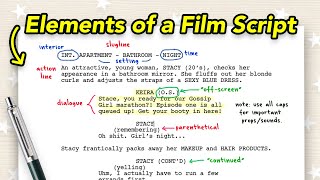
A slug line (scene header) starts with INT (interior) or EXT (exterior), followed by the setting and time (day/night). It establishes time and place for the reader and production.
Action lines describe what's happening. Character names are capitalized only on first introduction. Important props or sounds are also capitalized for emphasis.
Dialogue is formatted with the character name on its own line. Notes like V.O. (voice-over), O.S. (off-screen), and O.C. (off-camera) indicate where the speaker is. O.S. means not in the same room; O.C. means in the same room but not visible.
Parentheticals are short directions under the character name (e.g., 'handing receipt', 'yelling', 're: coffee') that guide the actor's delivery or clarify ambiguous lines.
Transitions (e.g., CUT TO, JUMP CUT) go at the bottom left of a scene to control pacing and tone. Formatting varies by script type (e.g., multicam comedy vs procedural drama).
What do INT and EXT stand for in a slug line?
INT stands for interior, EXT stands for exterior.
1:28
What is the purpose of a slug line?
A slug line (or scene header) establishes the time and setting for the reader or production.
1:00
When should a character's name be written in all caps in action lines?
A character's name is capitalized only when they are first introduced in the script.
4:00
What is the difference between O.S. and O.C. in dialogue notes?
O.S. means off-screen (character is in another room), O.C. means off-camera (character is in the same room but not visible).
5:26
What is a parenthetical and what is it used for?
A parenthetical is a short direction under the character name that tells the actor how to deliver the line (e.g., 'handing receipt', 'yelling', 're: coffee').
6:27
What does V.O. stand for?
V.O. stands for voice-over.
5:26
What information comes after INT or EXT in a slug line?
After the INT/EXT, you specify the setting (location) and then the time (day/night).
2:28
Where are transitions placed in a script and what do they do?
Transitions like 'CUT TO:' or 'JUMP CUT' go at the bottom left corner of a scene and establish pacing and tone.
7:27
How does formatting differ between a multicam comedy script and a procedural drama?
A multicam comedy script uses double-spaced dialogue, while a five-act procedural drama uses different formatting.
8:29
What kind of elements are capitalized in action lines besides character names?
Important props or sounds are capitalized in action lines for emphasis.
4:26
Slug Line Structure
Explains the essential INT/EXT, setting, and time components that every scene header must include.
1:28Character Introduction in Caps
Clarifies the rule that character names are capitalized only on first introduction, a common formatting point.
4:00O.S. vs O.C. Distinction
Provides a clear, practical difference between off-screen and off-camera, which is often confused.
5:26Parentheticals for Clarity
Demonstrates how parentheticals can resolve ambiguous dialogue (e.g., 're: coffee' vs 're: weather').
6:27Script Format Variations
Highlights that different genres (comedy vs drama) use different formatting rules, a key nuance for writers.
8:29[00:03] [Music] having a hard time understanding the difference between os and oc are you unsure about what a parenthetical is or what a slug line is then this video is for you hello lovely people my name is mikayla lizac welcome to my channel or welcome back to my channel if you're new here hey what today i'm going to be showing you all the different elements of a film script i totally understand film language is definitely foreign to a lot of new people who are in the industry and if
[00:35] you're a new actor or new writer you might need a little bit of help so i'm going to show you guys all the different terms and the lingo used within film scripts if you don't already know who i am hi again i already said my name my name is michaela lizac i'm a professional actress of nine years imdb resume in the description and i help aspiring actors and filmmakers try and break into the film and television industry hit subscribe so i can help you navigate your career or maybe you can
[01:00] just follow me on mine we are like a family here we help each other out help each other try and be successful without further ado let's get right on into the video i think it's pretty fitting that we start out with what starts a scene and that would be the slug line or a scene header a slug line or scene header establishes the time and the setting for your reader or for the production at the start of your slug line you're usually going to see three letters and it can
[01:28] either be int or ext but what do these mean int stands for interior and ext stands for exterior sometimes you can also see i dash e and this means both interior and exterior the reason we use interior and exterior is so that we're specific about our setting we're specific about our setting guys take for example if your scene just says coffee house day and there's no interior or exterior this will definitely cause some confusion for everybody in the production having something inside
[01:57] versus outside for production changes everything set dressers and lighting and sound they all have to adjust to being outside or inside so it's very important to be specific and it all starts with interior or exterior after interior or exterior you're going to have your setting which is where your scene takes place this could be as intimate as a coffee house or a bedroom to something way bigger like an airport or space space and sometimes in your slug lines it can go from a larger area to a
[02:28] smaller area for example you can put exterior beach towel bar day so it just makes things a little more specific after you're setting you're going to want to specify time so you're going to specify whether your scene takes place in the day or at night or later or moments later or it's continuous from another scene to that current scene and sometimes creative liberties are taken with slug lines for example if you have a setting that it's not really clear what time it is or if
[02:57] it's inside or outside for example a dark abyss instead of putting like interior dark abyss day you can just put dark abyss and then go into your action line slug lines can be very practical and they can be a little more artistic it just depends on what type of film you're writing and what tone you want to convey in your script i think slug lines are pretty fun and if you agree give this video a thumbs up thank you for the thumbs up if you didn't slugline is very offended
[03:27] he'll find you in your sleep interior viewers bedroom night slug line creeps up to your name lying in bed fast asleep holding a knife don't let that be you don't let that be you after our slug lines we have our action lines those are right down below them slug lines action lines are pretty self-explanatory and they're very important they give the reader and the production more detail about the scene what's going on let me pull up one of the scenes i have written so this is
[04:00] what you can usually expect from an action line interior apartment bathroom night an attractive young woman stacey 20s checks her appearance in a bathroom mirror she fluffs out her blonde curls and adjusts the straps of a sexy blue dress over here where it says stacy her name is in all caps why is it in all caps miss girl you're not gonna put your character name in all caps all the time you just capitalize your character's name when they're first introduced to
[04:26] the audience or first introduced in your script right beside that in parentheses you'll see a little 20s it just gives a little more description about like the character or whatever and also within your action lines if there's a prop that's very specific or important you will also put that in all caps or maybe sometimes sounds like if there's a knock knock knock it's gonna be in all caps usually it doesn't have to it can be italicized again style she looks at a knife it would be in all caps when
[04:58] certain elements are important to the story or they want emphasis a writer will stylistically make the choice to capitalize it after action lines we have our dialogue breaks dialogue now when it comes to formatting dialogue within a script you're usually going to have your character name on its own line and their dialog lines right under that now sometimes on the same line of your character name you're going to see a little dialogue note and it's abbreviated what is this what does it
[05:26] mean now sometimes these abbreviated notes are for the production how this dialogue is supposed to be said where it's supposed to be said so there's a variety of them so let me go over them v o means voice over o s and o c these sound very very similar but they are not similar off screen means the person is talking but they're not really in the same room or the same space kira is off screen so she's in another room she's not in the same room she's not in the bathroom she's yelling over
[05:56] like stacey ready for a gossip girl marathon whereas if it said kira oc then kira would be in the same room and we could literally have the camera pan over and she's right there off camera is really good for reveals when you're writing next we have our parentheticals these are more specific directions for your character or for the way they're supposed to say their lines it's a smaller way to give that direction without taking up a whole action line for example a store employee is giving a
[06:27] customer a receipt they can say have a nice day and in a parenthetical it can say handing receipts that's just like a simple example of that it can be used to explain to the actor how they should say they're lying for example yelling crying or it can be used to tell the actor there needs to be a moment they're talking and then there's a beat or a change in thought then or a sigh or it can help clarify to an actor what specifically they're talking about for
[06:58] example let's go back to the coffee shop exterior coffee house day now we have two characters outside and they're drinking their coffee and one of them says why is it so cold that's kind of a vague statement for an actor we might not know what our character is supposed to be talking about are they talking about why is it so cold outside why is my coffee so cold so a way that a screenwriter can specify that for an actor is by saying re so in a parenthetical they could say re-coffee
[07:27] why is it so cold and it'll help us as an actor understand how we should say our mind because if it was re weather why is it so cold we'd be looking up at this guy we'd go like this why is it so cold you know but if it was our coffee we'd take somebody like why is it so cool take this back lastly we have our transitions and cuts now for transitions these go at the bottom left corner of your scene now transitions again establish more of the tone of the piece uh the pacing how they
[08:00] want to shoot it there's a whole bunch of videos on the different types of cuts and transitions so i'm not really going to go over that in this for example if a writer writes jump cut maybe we know the pace of the sequence is fast and it's energetic maybe if we have a match cut that's a little more artistic or if we just have a cut too and there are so many other things like pre-lapse and act breaks again there's so many different script formats a multicam comedy script is not going to
[08:29] look the same as a five act procedural drama there's different formatting with the action lines in the dialogue because comedy ones use double space and other one doesn't so there's a lot of stuff not every script is the same if you want to learn more about the other types of scripts you already know leave a comment down below and let me know what you want to see next if you want me to explain more about this or if you literally don't care and you want me to make
[08:54] something else comment down below what your favorite script element is my favorite script element my favorite element of script is definitely dialogue i love no this is hard actually i like action lines because they force you to be really concise but also say so much and paint this picture i think action lines are my favorite dialogue's cool i really like frick okay i'm torn but let me know what your favorite element of a script is in the comments below and
[09:24] i would love to see what you guys think and we can compare but yeah screenwriting is very complex this is just the basics of formatting there's so much that goes into it i hope you guys found this helpful and if you made it to the end of the video don't forget to leave without subscribing please like this video so more people find this video and my channel can grow it would mean the world to me you can also follow me on my instagram if you want more screenwriting content be sure to check
[09:49] out this video how to break down a script i think it'll be really helpful especially for actors it's a really good one so i would say check out that video i hope you have i hope you have a lovely day or night whenever it is for you and i will see you in the next one
[10:14] [Music]
[10:24] [Music] you
⚡ Saved you 0h 10m reading this? Transcribe any YouTube video for free — no signup needed.