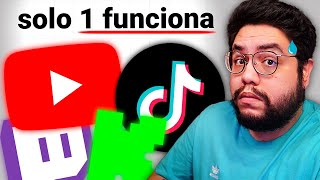

The #1 Mistake Streamers Make
42sChallenges common streaming success metrics and offers a fresh perspective that resonates with struggling creators.
▶ Play Clip"The title promises a platform recommendation and delivers a well-reasoned argument for YouTube, backed by structural analysis."
The video analyzes the structural flaws of streaming platforms like Twitch, Kick, and TikTok Live, arguing they prioritize real-time attention over long-term growth. The creator advocates for YouTube as a primary platform because its VOD system allows streams to accumulate value and be discovered after going live, offering sustainable growth and monetization.
Most streamers measure progress by asking 'Did I have any viewers today?' This short-sighted criterion confuses being live with growing, leading to burnout.
On Twitch and Kick, discovery is almost exclusively real-time. Once you stop streaming, you disappear. Growth depends on external factors like clips and social media, not the platform itself.
TikTok Live offers huge reach but is algorithm-dependent. Viewers are fleeting, retention is fragile, and moving them elsewhere is hard. It works as an entry point, not a home.
On YouTube, streams remain published and discoverable via search, recommendations, and thumbnails. The system tests content with small audiences and expands if retention is good.
YouTube allows a single stream to generate revenue while live and continue earning afterward as a VOD. No need to move audiences elsewhere.
YouTube is slow, doesn't reward live hours, and requires titles, thumbnails, and context. It punishes constant improvisation but rewards clarity.
Multistreaming often splits attention and community. It's not a growth solution; it can fragment chat and make it harder to build a recognizable presence in one place.
The best streaming platform is not the easiest or highest-paying, but the one where your time compounds over the long term. YouTube's system, though demanding, ensures that when growth happens, it's earned and sustainable.
What is the most common mistake modern streamers make according to the video?
They measure progress by asking 'Did I have any viewers today?' instead of focusing on long-term growth.
00:44
Why do traditional streaming platforms like Twitch and Kick hinder long-term growth?
Discovery is almost exclusively real-time; once you stop streaming, you disappear. Growth depends on external factors.
01:26
What is the main weakness of TikTok Live as a primary streaming platform?
Its algorithm controls everything; audiences are volatile, retention is fragile, and moving viewers elsewhere is hard.
03:31
How does YouTube's streaming model differ from Twitch and Kick?
Streams remain published and discoverable after going live via search, recommendations, and thumbnails.
06:29
What monetization advantage does YouTube offer over other platforms?
A single stream can generate revenue while live and continue earning afterward as a VOD.
07:48
What does the video say about multistreaming?
It often splits attention and community, and is not a real growth solution; it can fragment chat and hinder building a recognizable presence.
11:05
According to the video, what does YouTube reward instead of live hours?
Clarity of content, not constant improvisation.
10:09
Short-Sighted Progress Measurement
Identifies a fundamental mindset flaw that traps streamers in a cycle of burnout.
00:44Structural Platform Problem
Explains why even consistent effort fails on platforms designed for real-time attention.
01:26YouTube's Accumulative Advantage
Highlights the key differentiator: streams become evergreen assets.
06:29Discomfort as Design Feature
Reframes YouTube's difficulty as a feature that rewards clarity over time.
10:09[00:02] without Bwers, without viral clips and without a community, and I had to choose a single platform to stream on, I wouldn't make this decision because it's trendy, or for quick money, or because of what everyone says. I would decide based on a single
[00:16] question: where does it make sense to stream today if you want to continue growing tomorrow? And at the end of the video, even if you don't agree with me, you'll have something much more valuable: a clear way to decide if the platform you stream on today
[00:31] is building something for you or just tiring you out. Let's begin. Hey, kids, how are you? For those who don't know me, I'm Yayas and I believe that the most common mistake of the modern streamer has nothing to do with talent, charisma or
[00:44] consistency. It has to do with how you measure progress. Most streamers evaluate whether something worked with just one question. Did I have any viewers today? And if the answer is no, do they feel they wasted their time? If so, they feel they have
[00:58] made progress. The problem is that this criterion is dangerously short- sighted. Many streamers confuse being live with growing; they start streaming, do hours, stop, and the next day they return to the exact same point, as
[01:13] if nothing had happened. Not because the stream was bad, but because what they do on stream has no relevance afterwards. And when that happens, many times the problem stops being the streamer and becomes the place where they are
[01:26] streaming. Because if a system forces you to start from scratch every day, it doesn't matter how consistent you are. That system will never scale with you, and this can make it feel like streaming in general doesn't work, when
[01:41] in reality what doesn't work is the model you're streaming on. One, where everything depends on the absolute present. If you're live, you exist; if not, you disappear. That model pushes you towards a very dangerous mentality, thinking that
[01:55] more hours live will solve a problem of being seen. And this doesn't work in 99% of cases. The streamer ends up working as an hourly employee , hoping that one day that effort will magically start to
[02:09] pay off. When you look at how the more traditional streaming platforms work , you quickly understand why so many streamers feel they aren't progressing on platforms like Twitch or Kick. The whole system revolves around one
[02:23] thing: the live broadcast at that moment. While you're live, you have a minimal chance of being discovered. As soon as you finish, you disappear. Discovery is almost exclusively in real time, and the live stream is not
[02:37] usually a great asset that works later, so if someone arrives late to your stream, they simply missed it. This forces streamers to rely on external factors, clips on other platforms, social media, and
[02:51] communities outside of that platform, which means that growth doesn't happen within the streaming platform, it happens outside of it. And that 's a structural problem with those streaming platforms, not with your
[03:03] effort. And for that reason I think many streamers feel they are always on the verge of growing, because that streaming model is not designed so that today's streamer helps tomorrow's. It is designed to maximize
[03:16] attention in the present, not to build something long-term. And as long as that remains the core of the system, the result is inevitable. Hours of live broadcasts are consumed and forgotten tomorrow. And you might say, "Well, that happens on
[03:31] platforms like Twitch and Kick, but on TikTok Live it's different, right?" Well, TikTok is different, yes, it is different, it has a huge reach and can put you in front of thousands of people in a very short time. The problem
[03:45] is that this reach isn't designed to build a solid foundation for a streamer. On TikTok Live, discovery doesn't depend on who you are or what you've built before. It depends almost entirely on the "for you".
[03:59] This might sound good at first because it gives you quick exposure, but it also means that the platform controls absolutely everything. Who sees you? How long does it take and when does it stop showing you? You could say that the
[04:12] viewer doesn't look for you, you simply appear right under their noses. And that completely changes the relationship with the stream. Many people come in, look around for a few seconds, interact a little, and leave. Not because the content is bad, but because
[04:26] TikTok's system is optimized for constant movement, not for you to just sit and watch a live stream. TikTok is an endless scroll and your stream is just one more in the crowd. Therefore, although TikTok Live can be very good for traffic, it is very
[04:40] weak as a primary streaming platform. Audiences are often volatile, retention is fragile, and moving those viewers to another space is much harder than it seems. In my opinion, streaming on TikTok works as long as the algorithm
[04:54] wants it to, but when it stops showing you, nobody sees you. TikTok Live can serve as an entry point, but not as a home. And for a streamer starting from scratch, that difference matters more than many want to admit, because, to be
[05:08] honest, most people go live on TikTok simply to get easier views, not because it's genuinely a good streaming platform. But what I do think TikTok is excellent at is packaging your viral clips and
[05:23] thereby becoming more well-known so that more people start to find your content. What is tedious is editing them, and that's why you need to start automating the way you edit your content. I've been using a
[05:36] tool that automatically analyzes my live streams with its artificial intelligence to find the best moments and turn them into vertical clips with subtitles. all without having to spend hours editing. In
[05:50] fact, I uploaded this clip from a stream to my secondary channel a while ago and it got a stream to my secondary channel a while ago and it got over 3.3 million views, and it also works with any video you upload manually. Yes, without
[06:03] lifting a finger. Nexus Clip is not just a useful tool, it's a long- term ally that can help you achieve your goals faster. If you want to try Nexus Clip today, I've included a link in the description with a very
[06:16] special discount, or you can also use the code Duo for 2 directly when you register. Being a content creator doesn't have to be difficult with Nexus Clips. When you compare these platforms to how streaming works on
[06:29] YouTube, the difference is immediately noticeable. On YouTube, the stream never ends. When you cut the content, it remains published. A YouTube stream can be discovered after it has gone live. It can appear in recommended listings, it
[06:42] can be found through search results, it can reach someone who has never seen you before. Furthermore, you have a huge advantage in being able to use titles and thumbnails to attract an audience that is actually interested in your content. It's a system that
[06:55] tests the stream with small audiences and expands it if people stay. This gives even a small streamer real opportunities to grow without relying on external traffic. The system doesn't require constant presence to
[07:09] exist; it requires clarity and consistency so that people will click on your stream even after it's finished. Honestly, you wouldn't believe how many people tell me they watch my old streams of me reviewing subscriber videos, that
[07:22] they learn a lot, and that they even listen to it as a podcast while they edit or do something else. And that wouldn't be possible if I streamed on Twitch, Kick, or TikTok. And when streaming works like this, it stops being just a live broadcast and
[07:36] starts to become another piece of a system that does accumulate and reward your YouTube streaming makes sense as a primary platform this year is how
[07:48] monetization works. And not because you pay more or less, but because it doesn't depend on a single moment. On most, if not all, streaming platforms, streaming money is almost entirely tied to what happens while
[08:02] you're live, but as soon as you finish streaming, that's it. And it doesn't work that way on YouTube . A single stream can generate revenue while you're live and continue generating revenue afterward when it remains published. And most importantly, you
[08:17] don't have to move people elsewhere to make the stream visible, because just think about it, what good is it to grow a community here on YouTube only to then send them to another platform? I would understand that 4 or 5
[08:31] years ago when YouTube streaming wasn't so good, but nowadays you can even stream in 4K if you want. And be aware, all this doesn't mean that YouTube is a streaming. In fact, many of the complaints I hear about YouTube are
[08:45] true. It's a slow, demanding, and often frustrating platform. YouTube doesn't recommend you just for existing, it doesn't reward you for live hours, it doesn't warn you about what you did wrong, the algorithm doesn't explain anything to you, and it doesn't
[08:59] owe you anything either. You can be convinced that a stream was good even if nobody watches it. And that's frustrating for many streamers because there's no immediate gratification like TikTok might give you. Furthermore, streaming
[09:12] on YouTube requires other things that are not even relevant on other platforms . Clear titles, contexts, thumbnails. Thinking that the stream is not just for those who are live, but for those who might arrive later. And
[09:26] that's extra work, work that honestly not everyone wants to do just want to turn it on directly without thinking about all these things. And don't worry about copyright on YouTube, because in the description I've included a link
[09:41] to 100% royalty-free music , which you can use to monetize all your videos and streams here on YouTube and any other platform. Personally, I believe that YouTube is not a friendly experience for the
[09:54] streamer who just wants to go live and see the numbers go up. In that sense, YouTube is going to let you down, because it's not designed to make you feel good quickly, but that's precisely the important point of this whole video. That
[10:09] discomfort is not a bug, it's part of YouTube's design. It's not optimized for the immediate present; it's optimized to work better over time, to test, fail, adjust, and test again. It is a platform that
[10:23] tends to punish constant improvisation, but rewards clarity of content. That's why many streamers hate YouTube at first, because it doesn't respond quickly, because it doesn't validate immediately, because it doesn't give you
[10:37] easy dopamine. But when you start to understand how it works, you realize that it's not asking you for more effort, it's asking you to be clearer. YouTube isn't better because it's easy, it's better because it's more honest with time. He prefers to
[10:51] take his time responding rather than pretend to grow. And this is for someone who wants to stream seriously or make a living from creating content; although it hurts at first, it ends up being an advantage later on. And about
[11:05] multistreaming, because I already saw you talking about it. Personally, I don't entirely agree with how it's usually sold. I don't think it's inherently bad or that doing it will harm your channel, but I do think it only
[11:18] works for some profiles, especially when you already have a clear community and know exactly what you're doing. The real problem is when it is presented as a solution for growth. What I've seen is that
[11:32] multistreaming often feels like a white lie you tell yourself as a creator. I mean, I'm not going to deny that you might have a better chance of being seen if your live stream is on several sites, but that
[11:46] often doesn't solve the real problem. You're not really growing, and also, splitting attention, energy, and narrative across different sites makes it harder to build something recognizable in one place. And I do believe that
[11:59] multistreaming tends to separate the community. People might feel like they don't know the right place to see you. The chat becomes fragmented, and the streamer ends up doing the impossible to survive everywhere instead
[12:11] of focusing on growing in one area. I mean, this doesn't always happen, but it happens more than people admit. That said, if multistreaming works for you, perfect. I just wouldn't want you to do it multistreaming works for you, perfect. I just wouldn't want you to do it
[12:26] problems of not being seen. In the end, I think it all boils down to a fairly simple, albeit not very comfortable, decision. The best platform for streaming this year is not the one that's easiest to start with or the one that pays the most. It's going to
[12:41] be where your time makes sense in the medium and long term, because you're going to invest the same amount of time, but the difference is what happens to all of that afterwards. And again, I'm not saying that YouTube is the perfect platform, it isn't, it's
[12:55] awkward, it demands more and punishes mistakes for longer, but precisely because of that, when something starts to work, you know it wasn't a lucky night, it was your work. And for me, that's everything. I prefer one with a system that
[13:08] takes time to respond and ensures my streams don't get lost in the shuffle, rather than one that gives me quick wins but leaves me with nothing good afterward. And that difference, even if it's not popular, could define your future as a creator.
[13:22] If you liked this video, in this other video I explain the fastest way to monetize a new channel this year. Click on it. See you in this
⚡ Saved you 0h 13m reading this? Transcribe any YouTube video for free — no signup needed.