
Binary Trees Explained in 60 Seconds
44sQuick, clear explanation of a core CS concept that's essential for interviews, appealing to students and job seekers.
▶ Play Clip"Delivers a concise, accurate overview of binary trees in under a minute, though it's more of a teaser than a deep dive."
This video provides a rapid-fire overview of binary trees, covering core concepts like nodes, roots, leaves, and height, and then distinguishes three key types: balanced, complete, and binary search trees. It emphasizes the importance of these structures for interview success and complexity analysis.
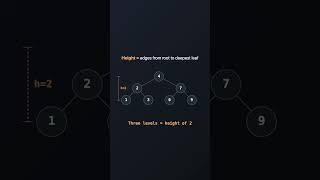
A binary tree is a structure where each node has at most two children (left and right). The top node is the root, and nodes with no children are leaves. The height is the number of edges from root to deepest leaf.
Balanced trees have roughly the same number of nodes on each side at every node. An imbalanced tree, like a skewed tree, degrades into a linked list with terrible performance.
Complete trees have every level fully filled except possibly the last, which is filled left to right. This property is what makes heaps work efficiently.
In a BST, every value on the left of a node is smaller and every value on the right is larger. This allows for O(log n) search operations instead of O(n), making it a fundamental data structure.
The video recommends practicing binary tree problems on Hello Interview, with a link in the pinned comment.
Binary trees are a foundational data structure with several specialized variants—balanced, complete, and binary search trees—each optimized for different use cases. Mastering these concepts is crucial for technical interviews and efficient algorithm design.
What is a binary tree?
A tree structure where each node has at most two children, a left child and a right child.
00:01
What is the height of a binary tree?
The number of edges from the root down to the deepest leaf.
00:14
What is a balanced binary tree?
A tree where the left and right subtrees have roughly the same number of nodes at every node.
00:14
What is a complete binary tree?
A tree where every level is fully filled except possibly the last, which is filled left to right.
00:27
What property makes heaps work efficiently?
The complete binary tree property.
00:27
What is a binary search tree (BST)?
A tree where every value on the left is smaller than the current node and every value on the right is larger.
00:40
What is the time complexity of search in a balanced BST?
O(log n).
00:40
Balanced vs. Skewed Trees
Explains why balanced trees are critical for performance, as skewed trees degrade to linked lists.
00:14Complete Trees Enable Heaps
Connects the complete tree property to the efficiency of heaps, a key data structure.
00:27BST Search Complexity
Highlights the O(log n) search advantage of BSTs, a fundamental concept in computer science.
00:40[00:01] interview. If you don't understand the core concepts, you're going to struggle. structure where each node can have at most two children, a left child and a called the root. Nodes at the bottom with no children are leaf nodes.
[00:14] edges from the root down to the deepest leaf. So, a tree with three levels has a Keep that in mind because it comes up constantly in complexity analysis. you'll see in interviews. First, balanced binary trees.
[00:27] other at every node. An example of an imbalanced tree is a skewed tree where basically a linked list, terrible performance. level is filled left to right before starting the next one. You'll see these
[00:40] makes heaps work efficiently. And third, the binary search tree. In a than the current node and every value on the right is larger. instead of O of n. It's one of the most
[00:53] science. This was binary trees. Now, try these problems for free on Hello Interview. Link is in the pinned comment. Follow for more videos.




⚡ Saved you 0h 01m reading this? Transcribe any YouTube video for free — no signup needed.