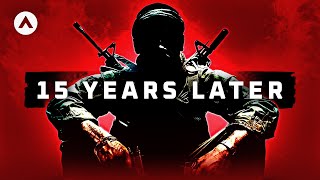

How Black Ops Was Built by 200 Developers
31sReveals the ambitious split-team development process behind a classic game.
▶ Play Clip"The title 'Call of Duty Black Ops in 2026' vaguely references the present, but the video is a historical retrospective, not a forward-looking analysis."
This video provides an in-depth retrospective of Call of Duty: Black Ops, 15 years after its release. It covers the game's development at Treyarch, its shift to the Cold War setting, the creation of its iconic Zombies mode, and its impact on the Call of Duty franchise. The narrative explores the game's critical and commercial success, multiplayer innovations, and enduring legacy.
Emphasized social features and character customization, providing a treasure trove of multiplayer options.
Black Ops remains not only a seminal Call of Duty title but also a genre-defining experience with few competitors.
Early 2009, pre-production on Black Ops began with 200 people split into three groups: single-player, multiplayer, and cooperative.
Developers zeroed in on the Cold War period, centering on the Military Assistance Command, Vietnam Studies and Observations Group (SOG).
Treyarch consulted SOG veteran Major John Plaster and ex-Spetsnaz operative Sonny Puzikas for authentic gameplay elements.
Each mission felt distinctive, with examples showcasing first-person flying, stealth, and base jumping.
Focus on customization and social tools, including theater mode for editing and sharing highlights, and COD Points currency system.
Generated over $650 million in first 5 days, and topped $1 billion in revenue within approximately 6 weeks.
Casting call confirmed the character Frank Woods and the SOG unit, confirming earlier speculation about a Vietnam setting.
Metacritic score of 87 on Xbox 360; praised for closing the gap with Modern Warfare franchise.
Lead character Alex Mason had a voice and personality, facilitated by full performance capture, enhancing narrative connection.
Three new zombie levels (Kino der Toten, Five, Dead Ops) were highlights; theater mode and wager matches also praised.
Raised $360 million in first 24 hours, proving video games as mainstream entertainment.
Infinity Ward co-founders were fired, leading to lawsuits; Treyarch remained focused on Black Ops.
DLC packs (First Strike, Escalation, Annihilation, Resurrection) added multiplayer maps and Zombies content, with celebrity inclusions in Call of the Dead.
Black Ops heralded a new age by bridging the gap between old Call of Duty and contemporary Modern Warfare.
The unproven spin-off defined basic multiplayer and zombies attributes that prevailed across the entire series.
Call of Duty: Black Ops took a calculated risk that paid off, defining key multiplayer and zombies features that have endured for 15 years despite franchise fatigue, remaining exemplary of the series at its best.
When did Activision deploy the original Black Ops?
November 2010.
0:13
What game first introduced killstreaks, perks, weapon customization, and the level-up system in Call of Duty?
Call of Duty 4: Modern Warfare (2007).
0:55
What real-life special operations unit inspired Black Ops?
SOG (Military Assistance Command, Vietnam Studies and Observations Group).
4:07
Which two veterans did Treyarch consult for authenticity?
Major John Plaster (SOG) and Sonny Puzikas (Spetsnaz).
5:54
What was the first Call of Duty game to feature a voiced protagonist?
Black Ops, with Alex Mason.
7:09
How much revenue did Black Ops generate in its first 5 days on the market?
Over $650 million worldwide.
11:56
What was Black Ops' Metacritic score on Xbox 360?
87.
12:35
Which DLC pack introduced the first celebrity Zombies experience?
Escalation Pack (Call of the Dead).
21:22
What element is used to create the undead in the Zombies lore?
Element 115.
21:42
How long did Activision's early DLC exclusivity deal with Microsoft last for Call of Duty?
Until Advanced Warfare in 2014 (3-year plan, but lasted longer).
24:00
What was the name of the game mode that allowed players to gamble their COD Points?
Wager matches.
15:00
Who were the two Infinity Ward co-founders fired by Activision in 2010?
Jason West and Vince Zampella.
19:11
Social features and customization emphasis
Marked a shift toward deeper player expression, influencing future COD titles.
1:26Authenticity through real-world consultations
Demonstrates how direct input from veterans shaped gameplay mechanics like crossbows and Dragon's Breath.
5:54First voiced protagonist in COD
Revolutionized single-player storytelling, moving away from faceless protagonists.
13:04Record-breaking first 24 hours
Proved video games had achieved mainstream entertainment status.
16:23Defined core multiplayer and zombies standards
The spin-off inadvertently set foundational features that persisted across the entire series.
26:44[00:05] Hands up!
[00:13] By the time Activision deployed the
[00:15] original Black Ops in November 2010,
[00:18] Call of Duty had already revolutionized
[00:20] online multiplayer. Call of Duty 2 in
[00:23] 2005 proved itself a must-play online
[00:25] experience for Xbox 360 owners thanks to
[00:28] well-balanced gameplay and a variety of
[00:31] modes that weren't even held back by the
[00:33] limited player counts on console.
[00:35] Treyarch's Call of Duty 3 multiplayer
[00:37] raised the stakes 1 year later despite
[00:40] tepid reception at launch, though
[00:41] nothing could hold a candle to what came
[00:44] next in the fourth main line title.
[00:47] Call of Duty 4: Modern Warfare long held
[00:50] the honorific of the series' best
[00:51] installment for both the single-player
[00:53] campaign and multiplayer suite.
[00:55] Killstreaks perks weapon
[00:57] customization, and the level-up system
[00:59] all first appeared in the landmark 2007
[01:01] release, which endures to this day, its
[01:04] influence permeating nearly every major
[01:06] online shooter. So, when World at War
[01:09] came along the following year,
[01:11] expectations soared through the roof.
[01:13] The Treyarch-created Nazi Zombies mode
[01:16] set World at War apart from the rest of
[01:18] the pack, meaning the studio had its
[01:20] work cut out upon taking the helm yet
[01:22] again for Call of Duty's 2010 outing.
[01:26] Enter Black Ops, the new sub-franchise
[01:29] whose debut emphasized social features
[01:31] and character customization all while
[01:33] providing players with a treasure trove
[01:35] of multiplayer options. 15 years after
[01:38] hitting store shelves for PC,
[01:40] PlayStation 3, Xbox 360, and Wii, Black
[01:43] Ops remains not only a seminal Call of
[01:45] Duty title, but also a genre-defining
[01:48] experience with a pedigree that many
[01:50] would argue has few competitors.
[01:53] This is Call of Duty: Black Ops 15 years
[01:56] later.
[01:59] The numbers, Mason,
[02:01] what do they mean?
[02:03] The numbers
[02:04] Mason, they mean nothing.
[02:08] What?
[02:09] >> [music]
[02:23] >> Incoming!
[02:27] Prior to joining the Call of Duty
[02:29] machine with Big Red One in 2005, Los
[02:32] Angeles-based studio Treyarch exhibited
[02:35] its impressive versatility across a
[02:37] series of sports games and Spider-Man
[02:39] adventures. The developers soon
[02:41] thereafter produced Call of Duty 3
[02:43] before later bringing World at War to
[02:45] the masses. Early in 2009, mere months
[02:48] after shipping World at War,
[02:49] pre-production on Black Ops began and
[02:52] kickstarted a new era for Treyarch since
[02:54] it constituted the first time that every
[02:57] member of the team worked on one project
[02:59] simultaneously.
[03:01] The 200 people attached to Black Ops
[03:03] were split into three groups, one batch
[03:05] creating the single-player campaign and
[03:07] a second building multiplayer with the
[03:10] third tackling a new and improved
[03:12] cooperative experience. With Black Ops
[03:15] shaping up to be the studio's most
[03:17] important game, this all-hands approach
[03:19] seemed necessary. Producer and online
[03:22] director Dan Bunting explained the
[03:23] benefits of the much larger team during
[03:25] a Joystick interview, highlighting how
[03:27] each dedicated division could focus on
[03:30] their part and manage the effort however
[03:32] they saw fit.
[03:33] Notably, the nascent phases of
[03:35] development enjoyed an explosion of
[03:37] creativity as Treyarch broke away from
[03:39] the World War II setting it had
[03:41] previously occupied in a trio of Call of
[03:43] Duty endeavors. The Vietnam War
[03:46] represented the next destination.
[03:55] Developers particularly zeroed in on a
[03:57] stretch of time throughout the 1960s
[04:00] wherein the Cold War period has sensibly
[04:02] birthed special operations or Spec Ops
[04:04] initiatives. The Military Assistance
[04:07] Command, Vietnam Studies and
[04:09] Observations Group, shortened to SOG,
[04:12] sat at the center of Treyarch's Black
[04:14] Ops-related research.
[04:16] US military command formally activated
[04:18] the Joint Forces unit in January 1964 to
[04:21] covertly retaliate against North
[04:23] Vietnam's aggressive behavior. Divided
[04:26] into smaller elite units, SOG carried
[04:28] out clandestine operations until May
[04:30] 1972, its assignments involving the
[04:33] sabotage of enemy munitions, conducting
[04:36] classified and unconventional warfare
[04:38] operations, and leading covert maritime
[04:41] and airborne missions in regions such as
[04:44] Laos and North Vietnam. SOG's unorthodox
[04:47] duties often required equally unorthodox
[04:50] weaponry, making Black Ops commandos the
[04:52] perfect testers of experimental
[04:54] equipment, modified tools, special
[04:57] ammunition, and prototype weapons. As
[05:00] such, they got their hands on unproven
[05:02] carbine variants of the M16 rifle,
[05:04] modified explosives, and even
[05:06] Soviet-made guns like the RPD, the
[05:09] latter comparable to a lighter, more
[05:11] efficient M60 machine gun.
[05:14] These tools proved essential for the
[05:16] unit's success, and said success relied
[05:18] on deniability as US officials publicly
[05:21] insisted they had no boots on the ground
[05:23] beyond the borders of South Vietnam. In
[05:26] reality, buried beneath the
[05:27] then-enduring Cold War was a hot war
[05:30] between the world's superpowers.
[05:31] Treyarch's developers viewed this secret
[05:34] hot war as the ideal backdrop for a
[05:36] different age of Call of Duty. After
[05:38] all, countless Cold War stories have
[05:40] stayed shrouded in mystery with the few
[05:42] Vietnam games to broach the topic
[05:44] pre-Call of Duty: Black Ops barely
[05:46] scratching the surface. Hey, you made
[05:48] special forces training, dude? Yeah,
[05:52] you are one lucky guy. A stirring
[05:54] pursuit of genuine authenticity resulted
[05:56] in Treyarch consulting invaluable
[05:58] sources of information, including Major
[06:00] John Plaster, a three-tour SOG veteran
[06:03] who, at the time, was preparing to
[06:05] release his account of the conflict in
[06:08] SOG: The Secret Wars of America's
[06:10] Commandos in Vietnam.
[06:12] Sonny Puzikas, an ex-operative of the
[06:15] Soviet Union's SOG equivalent, Spetsnaz,
[06:17] also contributed in an advisory
[06:19] capacity. Plaster walked Treyarch
[06:22] through his training, missions, and
[06:23] tactics. Puzikas' expertise provided
[06:26] similar glimpses into the Soviet Union's
[06:28] elite squad. For example, he recalled
[06:30] the drastic methods of superior officers
[06:32] who desensitized him and fellow soldiers
[06:35] by shooting at them. Bunting told USA
[06:37] Today these meetings opened up new
[06:40] avenues of gameplay, evident in the
[06:42] implementation of military-grade
[06:43] crossbows and the real-world-inspired
[06:45] Dragon's Breath incendiary shotgun. In
[06:48] addition, Puzikas demonstrated what
[06:50] developers deemed crazy killing
[06:52] techniques, several of which were
[06:54] mocapped into the actual game.
[07:01] Mocapping authentic Soviet-era combat
[07:03] represented only part of Treyarch's
[07:05] commitment to delivering a very
[07:07] cinematic and immersive experience. The
[07:09] richness of the Cold War plot
[07:11] necessitated the franchise's first
[07:13] voiced protagonist, alongside full
[07:15] performance capture, yet another series
[07:18] first, wherein the actors' voice, body
[07:20] movements, and facial expressions were
[07:22] recorded all at once. According to a
[07:24] sit-down Bunting had with The Guardian,
[07:26] the goal in this regard centered on
[07:28] ensuring lead character Alex Mason
[07:30] played an active role in dialogue
[07:32] exchanges. The game may have
[07:34] superficially presented itself as a
[07:35] story about avoiding the Cuban Missile
[07:37] Crisis, but Bunting and company insisted
[07:40] throughout the marketing cycle that the
[07:41] narrative would dig much deeper, hence
[07:44] the need for a Black Ops squad.
[07:47] Treyarch similarly applied that
[07:48] semblance of depth to the gameplay,
[07:50] emphasizing variety in so far as each
[07:53] mission felt distinctive. For instance,
[07:55] previews showcased the WMD mission's
[07:57] many moving parts, in which it opened
[07:59] with a first-person flying segment
[08:01] before switching back and forth between
[08:03] action-packed gunplay and stealth
[08:05] sequences, then finally tasking the
[08:07] player with base jumping into
[08:09] enemy-occupied territory.
[08:11] The game's locales received the same
[08:13] attention to detail, helped by the
[08:15] enhanced technologies Treyarch
[08:16] implemented into the Call of Duty 4
[08:18] engine, IW 3.0. Updates to the engine
[08:22] promoted lighting improvements and
[08:23] higher-quality texture work, and [music]
[08:25] texture streaming buffs facilitated the
[08:27] crafting of larger vistas colored by
[08:29] longer lines of sight, evident in play
[08:32] spaces like the long and narrow Summit
[08:34] map and the iconic Nuketown area with
[08:37] its mountainous Nevada background.
[08:39] Interestingly, not all locations were
[08:41] designed with single-player top of mind,
[08:43] as had previously been the case. On the
[08:45] contrary, because some content matured
[08:48] so early in the multiplayer design
[08:49] cycle, maps such as Slaughterhouse
[08:52] actually manifested as online levels
[08:54] from the start. This proved a point of
[08:56] pride for the development crew, given
[08:58] community manager Josh Olin once
[09:00] boasting that nothing in multiplayer was
[09:02] produced from single-player content.
[09:11] Treyarch didn't rest on its laurels at
[09:13] all when building Black Ops online
[09:15] suite, either. Since pre-production had
[09:17] gotten underway during World at War's
[09:19] post-launch support period, fan feedback
[09:21] from the 2008 entry became an
[09:23] indispensable resource. The developers
[09:25] obtained instant intel on what the
[09:27] community liked, disliked, and desired,
[09:30] thereby inspiring a focus on
[09:32] customization and social tools for the
[09:34] subsequent Treyarch outing. As an
[09:36] example, World at War and Modern Warfare
[09:38] 2's Create-a-Class feature returned with
[09:40] new accoutrements, namely face paint
[09:43] options and perk-specific character
[09:45] models for the player avatar.
[09:47] All manner of weapon customization
[09:49] possibilities entered the fray, too,
[09:51] allowing users to tinker further with
[09:53] attachments and cosmetically alter their
[09:55] guns by etching on unique clan tags.
[09:57] Deeper weapon personalization spawned
[10:00] from one designer offhandedly mentioning
[10:01] an interest in taking more ownership of
[10:03] their favorite gun. This even extended
[10:05] to the type of reticle a user could
[10:07] attach to their sights.
[10:09] Naturally, such personal ownership
[10:11] motives bled into the all-new social
[10:13] features crafted so players could easily
[10:15] edit and share their finest multiplayer
[10:17] highlights. Black Ops developers called
[10:19] the tool in question theater mode
[10:21] influenced in part by the advent of
[10:23] machinima content. Production on the
[10:25] original Black Ops also begat series
[10:27] mainstays like the COD Points currency
[10:29] system introduced principally because
[10:32] Treyarch felt like it'd be a very
[10:33] interesting way for players to engage
[10:35] with all of their earned unlocks.
[10:38] The title's highly rated November 2010
[10:40] release on PC, PS3, Xbox 360, and Wii
[10:44] demonstrated that critics and players
[10:46] were mostly pleased with the upgraded
[10:48] features and novel additions. Time would
[10:50] tell whether the changes would hold up
[10:52] as Call of Duty continued churning out
[10:54] annual installments.
[11:11] Don't you touch me.
[11:14] Casting call stirred up rumors about the
[11:16] seventh major Call of Duty in February
[11:18] 2010. Referenced as a significant
[11:21] in-game figure, the character Frank
[11:22] Barnes, later renamed Frank Woods,
[11:25] appeared in the casting information as
[11:26] did the SOG unit effectively confirming
[11:29] earlier speculation that the series was
[11:31] Vietnam-bound.
[11:33] Further details accidentally went public
[11:35] that April courtesy of the game's teaser
[11:37] website prematurely going live. However,
[11:39] leaks and rumors had no adverse effect
[11:42] on how audiences received the final
[11:44] product. In announcing Black Ops at the
[11:46] end of April, the Activision press
[11:47] release touted Call of Duty as the
[11:49] number one first-person action series of
[11:52] all time. Black Ops added to the
[11:54] record-breaking numbers at launch.
[11:56] The title's first 5 days on the market
[11:58] generated more than $650 million
[12:01] worldwide blazing past the $550 million
[12:05] that Modern Warfare 2 earned in the same
[12:07] time frame 1 year prior. And the
[12:09] history-making feats kept piling high
[12:12] with Black Ops topping $1 billion in
[12:14] revenue within approximately 6 weeks.
[12:17] Then CEO of Activision Blizzard Bobby
[12:19] Kotick noted that only Call of Duty and
[12:22] James Cameron's Avatar had ever reached
[12:24] such a milestone so quickly. Naturally,
[12:27] the hype, critical acclaim, and positive
[12:29] word of mouth all contributed to Black
[12:31] Ops's meteoric success.
[12:33] Black Ops racked up rave reviews at
[12:35] launch. Its Metacritic score on Xbox 360
[12:38] topping off at 87, lower than Modern
[12:41] Warfare 2's 94 Metacritic score, but
[12:44] generally in line with the ratings of
[12:46] past mainline entries. The GameTrailers
[12:48] review applauded Treyarch for closing
[12:50] the gap between its games and the Modern
[12:52] Warfare franchise with boundless
[12:54] customization and a keen understanding
[12:56] of why the series as a whole worked so
[12:58] well. Other outlets like Game Informer
[13:01] called it Treyarch's best game up until
[13:03] that point.
[13:04] For many, Black Ops's advancements with
[13:06] the franchise's otherwise stagnant
[13:08] single-player storytelling made the most
[13:10] inroads towards carrying Call of Duty
[13:12] forward. No longer were players
[13:14] barreling from one action set piece to
[13:16] another with a faceless cardboard cutout
[13:18] protagonist. Black Ops lead Alex Mason
[13:21] had a voice and personality that
[13:23] facilitated the player's connection to
[13:25] the overarching plot [music] given that
[13:27] the special forces operative's
[13:28] flashbacks steered much of the narrative
[13:30] along.
[13:32] You [ __ ] son of a [ __ ] Repeated
[13:35] perspective shifts and so-called David
[13:38] Fincher-esque twists further elevated
[13:40] the brand's story chops in the eyes of
[13:42] some, though critics who shared mixed
[13:43] and negative reviews were less
[13:45] receptive.
[13:47] Awarding it a 70, Edge magazine argued
[13:49] Black Ops failed at distinguishing
[13:51] itself from its predecessors in any
[13:53] important way. GamingTrend said the
[13:55] shooter featured a less compelling story
[13:57] than that of past titles. The Escapist
[14:00] issued far harsher critiques lambasting
[14:02] the solo campaigns' distracting editing
[14:05] techniques such as the blinding white
[14:07] light transitions and ridiculing the
[14:09] story for being ridiculous and poorly
[14:11] implemented. Mason's POV did nothing for
[14:14] the outlet either evidenced by the
[14:16] reviewer likening the operative to
[14:18] Forrest Gump in that he participated in
[14:20] numerous historical events yet bore
[14:22] little importance in terms of the
[14:24] outcome.
[14:25] The multiplayer experience similarly
[14:27] garnered a gamut of disparate reactions.
[14:29] Many a reviewer lauded Treyarch for
[14:31] improving the online suite. Zombies mode
[14:34] in particular hit its stride courtesy of
[14:36] three new levels. The German theater set
[14:38] Kino der Toten, the Pentagon-themed
[14:41] Five, and the top-down arcade adventure
[14:43] known as Dead Ops. Meanwhile, the main
[14:46] multiplayer component accumulated its
[14:48] fair share of hardcore fans. Theater
[14:50] mode proved a rousing success and the
[14:52] vast upgrade in customization system
[14:54] regularly received praise. Plus, the
[14:56] engrossing wager matches kept players
[14:59] invested for hours on end thanks in no
[15:01] small part to the frenetic gameplay.
[15:03] This free-for-all playlist came packed
[15:06] with four game types that let users
[15:08] gamble their hard-won points across
[15:10] three buying levels, each one contingent
[15:13] on the risk users were willing to take.
[15:15] Oh, this is fun.
[15:17] [ __ ] sake.
[15:19] Fan reception was somewhat of a mixed
[15:21] bag. A contingent of franchise faithful
[15:23] began feeling the downside of
[15:25] annualization with this release
[15:27] believing Black Ops succeeded at
[15:28] delivering a more cogent solo campaign,
[15:31] though the decision to frame the
[15:32] narrative around flashbacks didn't sit
[15:34] well with everyone. As such, there were
[15:37] those who thought the campaign a step
[15:38] down from Modern Warfare 2, while others
[15:41] considered the action-packed story an
[15:43] improvement over Call of Duty's usual
[15:45] fare.
[15:46] Opinions concerning the multiplayer
[15:48] modes proved less divisive. The new
[15:50] features, wager matches, and the
[15:52] upgraded Zombies experience stole the
[15:54] show by most accounts. By and large,
[15:56] community members felt rewarded for
[15:58] their efforts online thanks to the
[16:00] arguably solid gameplay balancing that
[16:02] Treyarch elevated through major economy
[16:04] adjustments as well as perk,
[16:06] attachments, and create-a-class
[16:08] upgrades. Unbeknownst to Treyarch and
[16:11] the player base, these modifications to
[16:13] the Call of Duty formula would
[16:15] eventually shift the multiplayer
[16:16] landscape in more ways than one.
[16:19] >> [cheering]
[16:23] >> If there was any doubt that video games
[16:26] weren't mainstream entertainment, the
[16:28] latest first-person shooter has blown
[16:30] that uncertainty away. Call of Duty:
[16:33] Black Ops has shattered entertainment
[16:35] records by raking in $360 million in its
[16:39] first [music] 24 hours on sale. Part of
[16:41] the appeal of the military-inspired
[16:43] adventure The cultural zeitgeist in
[16:45] which Activision and Treyarch released
[16:47] Black Ops was a different beast than the
[16:48] one Call of Duty had been born into 7
[16:50] years beforehand. By the time the
[16:53] Infinity Ward created brand came along,
[16:55] first-person multiplayer shooters were
[16:57] still getting their sea legs on console
[16:59] following the pioneering 2001 debut of
[17:01] Halo: Combat Evolved on the original
[17:03] Xbox. 2002's Medal of Honor: Allied
[17:07] Assault and Battlefield 1942 maintained
[17:10] PC exclusivity. Call of Duty executives
[17:12] understandably didn't feel the need to
[17:14] buck the trend. But times changed rather
[17:17] swiftly thus permitting an epic wherein
[17:19] first-person experiences of the
[17:21] narrative-centric and online variety had
[17:23] become all the rage on PlayStation and
[17:25] Xbox hardware.
[17:27] Amidst Battlefield, Call of Duty, and
[17:29] Medal of Honor spreading their reach to
[17:31] console, Halo had grown into an
[17:33] important fixture within the multiplayer
[17:35] and cooperative landscape during the
[17:36] years preceding Black Ops. Halo 2 set
[17:39] the new standard by popularizing
[17:41] matchmaking, a move that bid farewell to
[17:43] the common use of server browsers for
[17:45] players seeking competitive matches.
[17:47] While not an FPS title, Gears of War 2
[17:50] left an indelible mark on multiplayer
[17:52] gameplay upon introducing the wave-based
[17:54] Horde mode. Horde and World at War's
[17:57] Zombies offering serendipitously arrived
[17:59] days apart, but Gears of War shepherded
[18:02] the game type from fun ancillary mode to
[18:05] influential phenomenon that countless
[18:07] titles across genres later emulated.
[18:09] Competition between Battlefield and Call
[18:11] of Duty increased tenfold throughout
[18:13] this period, too, especially with Bad
[18:15] Company 2 giving Modern Warfare 2 a run
[18:17] for its money earlier in 2010.
[18:20] Meanwhile, genre pioneers Doom and Quake
[18:22] were undergoing identity crises. 2004
[18:25] saw the former dabble in action Horde
[18:27] and Quake dove headfirst into strategic
[18:30] gameplay with Enemy Territory: Quake
[18:32] Wars in 2007, then returned in 2010 with
[18:36] an updated version of Quake 3 Arena.
[18:38] Needless to say, Call of Duty busied
[18:40] itself with laying new ground perfecting
[18:42] a frenetic style of play that would
[18:44] beget many a COD clone.
[18:54] >> [music]
[18:57] >> Ready.
[19:01] Hey, what's up Infinity Ward? Come on
[19:03] in.
[19:05] Call of Duty: Black Ops was partly
[19:06] developed and deployed at a tumultuous
[19:08] time within the wider Activision family.
[19:11] It all started on March 1st, 2010 when
[19:14] Infinity Ward co-founders Jason West and
[19:16] Vince Zampella were escorted from studio
[19:18] premises by security. The cause for such
[19:21] an act on the heels of Modern Warfare
[19:23] 2's billion-dollar success? Activision
[19:26] had fired the pair on the grounds of
[19:27] insubordination and a breach of
[19:29] contract.
[19:31] West and Zampella filed a $36 million
[19:33] lawsuit days later accusing the
[19:35] publisher of manufacturing a basis on
[19:38] which to effectuate their termination
[19:39] and thereby avoid paying royalties owed
[19:42] for the Modern Warfare sequel.
[19:44] Activision wasted no time countersuing
[19:46] in a claim that alleged the Call of Duty
[19:48] co-creators were secretly in talks with
[19:50] business rival Electronic Arts to steal
[19:53] Infinity Ward. In the end, Infinity Ward
[19:56] suffered an exodus of talent as numerous
[19:58] staffers joined West and Zampella in
[20:00] establishing Respawn Entertainment and
[20:02] producing Titanfall in partnership with
[20:04] EA.
[20:06] When questioned in a May 2010 interview
[20:08] about how the fallout may have impacted
[20:10] Black Ops' development, producer Dan
[20:12] Bunting said he and his colleagues
[20:13] weren't distracted by it in the
[20:15] slightest. On the contrary, their focus
[20:17] remained solely on the game, a focus
[20:19] that crew maintained for several months
[20:21] after the military shooter landed on
[20:23] store shelves. Treyarch devoted large
[20:25] swaths of post-launch support to issuing
[20:28] balance improvements and fixing bugs
[20:29] through patches. Early fixes addressed
[20:31] everything from performance hiccups and
[20:33] game-breaking exploits to bizarre
[20:35] sniper-related errors that adversely
[20:37] affected ADS.
[20:39] But, the meat and potatoes came from the
[20:41] DLC Treyarch delivered between February
[20:44] and September 2011. The initial release
[20:47] being the First Strike Pack, which added
[20:49] four multiplayer maps in addition to the
[20:51] Ascension Zombies content that dropped
[20:53] players into a Soviet space station with
[20:56] two new perks, Stamina-Up and PhD
[20:59] Flopper. Ascension further introduced
[21:01] special weapons like Gersh devices and
[21:04] Matryoshka dolls, plus the space monkey
[21:06] enemies that returned in later Black Ops
[21:08] installments made their grand debut.
[21:10] These additions, paired with the mode's
[21:12] first-ever main mission Easter Egg, set
[21:14] the standard for zombie support going
[21:16] forward, thus securing Ascension a spot
[21:18] among the long list of fan-favorite
[21:20] updates.
[21:22] The Escalation Pack went live in May
[21:24] 2011, unleashing another batch of
[21:26] multiplayer maps complete with the
[21:28] star-studded Call of the Dead Zombies
[21:30] experience. Call of the Dead marked the
[21:32] first instance of celebrities featuring
[21:34] in the co-op mode, honoring director
[21:36] George Romero in an epic tale of
[21:38] survival where players assume the role
[21:40] of four adventurers investigating the
[21:42] origins of Element 115, the element used
[21:45] to create the undead. Having been
[21:47] stranded at a Siberian outpost, the
[21:49] group unwittingly let a zombie horde and
[21:51] were forced to defend themselves. The
[21:54] actors involved represented one key
[21:55] selling point since Sarah Michelle
[21:57] Gellar, Robert Englund, Danny Trejo, and
[22:00] Michael Rooker were cast as playable
[22:02] heroes opposite George Romero himself.
[22:06] No, hit me. I do it like this.
[22:09] Daddy.
[22:11] I didn't do it like this.
[22:15] Call of the Dead alone has long
[22:17] constituted a highlight of the brand's
[22:19] post-launch efforts, enough so that fans
[22:21] still hold out hope for a remake of the
[22:23] map.
[22:24] Black Ops' Annihilation DLC hit digital
[22:27] storefronts late in June 2011, boasting
[22:30] four multiplayer maps and one zombies
[22:32] locale. The Hangar 18 map invited users
[22:35] to battle each other in an Area 51
[22:37] hangar, while another, Drive-In,
[22:39] unleashed chaos on a 1960s drive-in
[22:42] theater. As for the zombies content, the
[22:44] mysteries of Shangri-La in an exotic
[22:46] jungle occupied center stage.
[22:49] Annihilation reviews fell in line with
[22:51] the map packs preceding it, settling on
[22:53] a high 70s Metacritic score.
[22:56] The same held true for the fourth and
[22:57] final DLC release, Resurrection, which
[23:00] initially launched in August and brought
[23:02] the zombie saga full circle in a mission
[23:05] to space. Set on a secret moon base,
[23:07] this content packed in extra firepower
[23:10] and whatever else players needed to end
[23:12] the overwhelming zombie threat. What's
[23:14] more, Resurrection included the four
[23:16] original zombies maps from World at War,
[23:18] giving long-time fans a chance to relive
[23:21] the nightmarish action of the Nacht der
[23:23] Untoten, Verruckt, Shi No Numa, and Der
[23:26] Riese locales.
[23:27] The community at large came away from
[23:29] the roughly 1 year of extra Black Ops
[23:31] content with different opinions, best
[23:33] reflected in each release's critic and
[23:35] user reviews. New downloadable maps were
[23:38] generally considered enjoyable, albeit
[23:40] exceptionally challenging in some
[23:42] instances. However, many were also
[23:44] chomping at the bit for more gameplay
[23:46] innovation, and without it, found
[23:47] themselves unable to justify the $15
[23:50] price per pack for anyone other than the
[23:52] staunchest of Call of Duty diehards.
[23:55] This era of downloadable COD content
[23:57] further precipitated change via a 3-year
[24:00] deal between Activision and Microsoft
[24:02] that guaranteed Xbox 360 players
[24:04] received 1 month of early DLC access
[24:07] before PC and PS3, as had been the case
[24:10] with Modern Warfare 2. Despite the
[24:12] 3-year plan, the exclusivity agreement
[24:15] lasted until Advanced Warfare in 2014.
[24:18] Then, PlayStation 4 became the place to
[24:20] play Call of Duty DLC early upon the
[24:23] rollout of Black Ops 3: Awakening in
[24:25] December 2013.
[24:28] The spin-off series ultimately lived far
[24:30] beyond the third numbered entry. Yet,
[24:32] not even Treyarch anticipated where
[24:34] Black Ops would take the studio and the
[24:36] series after the 2010 chapter.
[24:47] >> [music]
[24:52] >> Black Ops, for its part, reinforced the
[24:54] brand's staying power all while catering
[24:56] to both newcomers and veterans. Design
[24:59] director David Vonderhaar noted in the
[25:00] multiplayer overview that combat
[25:03] training stemmed from Treyarch's desire
[25:05] to provide single-player aficionados
[25:07] with a low-stakes entry point into the
[25:09] world of online play. These hopeful
[25:11] converts would get comfortable learning
[25:13] the mechanics, and multiplayer savants
[25:15] would find value in familiarizing
[25:17] themselves with certain weapons and map
[25:19] layouts. But, for all this forward
[25:21] thinking, Dan Bunting spoke in a 2010
[25:24] interview of his uncertainty about
[25:25] whether Black Ops could evolve into a
[25:27] subseries ala Modern Warfare. When
[25:30] questioned by Joystiq, the producer
[25:32] merely stated, "We'll have to see where
[25:34] it goes, because no one had even looked
[25:37] that far into the future yet."
[25:39] Unsurprisingly, one game generating a
[25:41] billion dollars in the span of 6 weeks
[25:43] had a way of shifting perspectives. The
[25:46] Call of Duty machine consequently kept
[25:48] churning, folding six more Black Ops
[25:50] titles into the mix across a decade and
[25:53] a half.
[25:54] That original Black Ops, though, Call of
[25:56] Duty's first foray into the Cold War
[25:58] era, heralded a brand new age by
[26:00] bridging the gap between the COD of old
[26:02] and the contemporary action on display
[26:05] in Modern Warfare. The zombies offering
[26:07] especially contributed to the project's
[26:09] long tail of success, given it elevated
[26:11] the World at War mode by every measure.
[26:14] Yes, Kino der Toten tossed players back
[26:16] into the zombies arc from World at War
[26:18] with simple pick-up-and-play mechanics,
[26:20] but its instant popularity served as
[26:22] proof positive that audiences were
[26:24] rooting for the mode's longevity. The
[26:26] second zombies map at launch, Five,
[26:29] similarly acted as a testing bed by
[26:31] starring playable historical figures,
[26:33] thus opening the door for the Call of
[26:35] the Dead DLC's more ambitious premise.
[26:38] And therein lies the core essence of
[26:40] Call of Duty: Black Ops and its
[26:42] significance. This once unproven
[26:44] spin-off defined a litany of the basic
[26:46] multiplayer and zombies attributes that
[26:48] have prevailed across the entire series.
[26:51] It wasn't perfect. At the time, a
[26:53] contingent of critics and players
[26:55] believed it fell short of expectations,
[26:58] but Activision and Treyarch took a
[27:00] calculated risk, one that quickly paid
[27:02] off in various ways, so much so that 15
[27:05] years later, despite growing pains,
[27:08] pitfalls, and franchise fatigue, Black
[27:10] Ops remains exemplary of the series at
[27:13] its best.
[27:15] It's over.
[27:17] We won.
[27:18] >> [music]
[27:18] >> For now.
[27:27] >> [music]
[27:38] >> This video was made possible by you.
[27:42] To keep doing what we do and take the
[27:43] channel to the next level, giving us
[27:45] extra time to create even more videos,
[27:48] we've made supporting us more exciting
[27:50] than ever. Consider joining us on
[27:52] Patreon, where for just $5 a month,
[27:54] you'll gain access to an ever-expanding
[27:57] library of exclusive documentaries in
[27:59] which we dive into gaming's strangest
[28:01] oddities, such as the many different
[28:03] versions of Crytek's Ryse that never saw
[28:06] the light of day, and some of the
[28:08] industry's biggest mysteries like the
[28:10] strange vanishing of Capcom's Deep Down.
[28:14] What's more, for the first time, we're
[28:15] also launching a truly bespoke line of
[28:17] merchandise, including shirts, hoodies,
[28:20] caps, posters, and [music] more. If you
[28:22] enjoy what we do and want to see more,
[28:24] please consider joining us on Patreon,
[28:26] YouTube, or checking out our new merch.
[28:29] Your support means the world to us,
[28:31] [music] and it's what allows us to keep
[28:33] doing what we love. Thank you.
[28:39] Thank you for watching our video.
[28:41] We'd like to take this time to thank, by
[28:43] name, the generous Patreons who have
[28:45] pledged to our Hall of Fame reward tier.
[28:48] Disco Cobra 2013.
[28:51] Ice Cold Water $1.
[28:54] Karoo.
[28:56] Sauer Crowd.
[28:57] Shu-Wan Chen-Win.
[28:59] Fat Green Dragon.
[29:01] And those currently subscribed to our
[29:03] producer reward tier.
[29:05] Dave Oshry. DCX NG. DJ Redden. Edward
[29:10] Reigns.
[29:12] Fallen Asterisk.
[29:13] Jaguar Nod.
[29:15] Jon Kristofferson. Crash Course.
[29:18] Matthew McLaughlin. Pierre Burrell.
[29:21] Sea Rob Cason.
[29:24] If you enjoy our content, please
[29:25] consider subscribing to our channel and
[29:28] backing us on Patreon.
⚡ Saved you 0h 29m reading this? Transcribe any YouTube video for free — no signup needed.