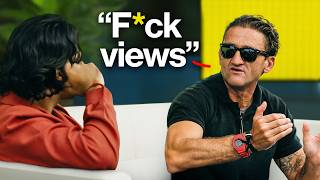

I Quit YouTube to Be a Dad
60sCasey's raw and relatable explanation of stepping away from fame to prioritize family creates an emotional and aspirational hook.
▶ Play Clip"Title accurately reflects the in-depth conversation with Casey Neistat about creativity vs. commerce."
In this live conversation at Press Publish NYC, Casey Neistat discusses his perspective on the creator economy, the shift from creativity to commerce, and his personal journey stepping away from daily vlogging to focus on family. He shares insights on authenticity, collaboration, and the importance of staying true to creative instincts.
The hosts introduce Casey Neistat as a surprise guest at Press Publish NYC, expressing that he is the most influential figure in their creator careers.
Casey explains he stepped away from YouTube to spend time with his children, describing it as a 'cash advance' on retirement. He now feels ready to return to work.
Casey resents the term 'creator economy,' arguing the focus has shifted from creativity to monetization, which he finds heartbreaking.
He compares YouTube's data-driven approach to Netflix and Hollywood, noting that access to data often stifles artistic risk-taking.
Casey states bluntly: if you're creating solely for money or views, he doesn't care. He respects creators like Mr. Beast who are honest about their goals.
Casey discusses the challenge of commercializing art, emphasizing alignment with brands that value creativity over reach.
He highlights Mark Felton Productions as an example of niche content thriving, proving that narrow subjects can find global audiences.
Casey observes that fame on YouTube is now fragmented, with many creators having substantial audiences without mainstream recognition.
Casey prefers working alone, citing Max Joseph as the only collaborator he trusts. He describes his creative process as finding interesting moments from his life.
He advises creators to evaluate what Hollywood brings to the table, using Mr. Beast's Amazon show as an example of a mutually beneficial deal.
Casey quotes Oscar Wilde: 'Some things are too important to be taken seriously.' He urges creators to prioritize creativity over metrics.
The hosts apologize for a cringeworthy first encounter years ago, and Casey recalls it as a moment where they talked only about themselves.
Casey Neistat emphasizes that staying loyal to creativity, rather than chasing metrics or money, is the key to lasting success and fulfillment as a creator.
What does Casey Neistat resent about the term 'creator economy'?
He feels the focus has shifted from creativity to monetization, which he finds heartbreaking.
04:00
According to Casey, what is the cautionary tale for creators chasing views and money?
Be honest with yourself about why you're creating; if it's only for money or views, you'll lose the creative spark.
09:00
What example does Casey give of a creator who is honest about his goals?
Mr. Beast (Jimmy Donaldson), who never claimed to be an artist but wanted the most views.
10:00
How does Casey describe his approach to brand deals?
He ensures alignment with brands that value creativity over reach, and avoids standard ad reads.
12:00
Who is Mark Felton and why does Casey admire him?
Mark Felton is a British historian who makes niche World War II videos; Casey admires his success in finding a narrow audience.
15:00
What does Casey say about collaboration?
He doesn't work well with others; Max Joseph is the only person he collaborates with creatively.
21:00
What was Casey's biggest shortcoming in the CNN acquisition?
He was naive to think they wanted his technology when they actually wanted his audience.
24:00
What Oscar Wilde quote does Casey share?
'Some things are too important to be taken seriously.'
27:00
What was the awkward first meeting between Casey and the hosts?
They talked only about themselves and their work, and Casey responded with a condescending 'congrats on all your success.'
30:00
Shift from Creativity to Economy
Casey articulates a core tension in the creator economy: the prioritization of monetization over art.
04:00Hardline on Motivation
Casey's blunt statement about creators who only care about money is a memorable and provocative take.
09:00Niche is Rich
The success of Mark Felton Productions demonstrates that narrow subjects can find global audiences on YouTube.
15:00Solo Creative Process
Casey's preference for working alone and his description of finding interesting moments offers insight into his creative method.
21:00Too Important to Be Taken Seriously
The Oscar Wilde quote encapsulates Casey's philosophy of prioritizing creativity over metrics.
27:00[00:00] The focus has shifted away from the creativity part of creator and shifted towards the economy part. You don't have to fit in a lane. There's a million lanes and if your lane doesn't exist, just go ahead and start it. If you're in it because you want to make money, you want to get the view, like [ __ ] you, I don't care about you. >> So we've been wanting to make this episode ever since we started this channel
[00:22] and the fact that we got to do it in front of our audience live at Press Publish NYC and surprise everyone in the room with Casey Neistat, that was kind of a dream come true. >> When it comes to our career as creators, there is no one more influential than Casey Neistat. >> So in this conversation we talked to Casey about his perspective on what is now called the creator economy. We also talk about what he
[00:45] considers to be his all-time greatest episode of the vlog and what made it so great. We also talk about his perspective on the world of Hollywood getting involved with creators like Mr. Beast and lastly we touch on the first time we ever met Casey, which was one of the most awkward and cringeworthy encounters of our lives. >> We've thought about it pretty much every single day since it happened. >> And we finally got to talk it
[01:07] out live on stage, which is actually kind of like just this nice cathartic experience. Felt like closure. >> Now Press Publish NYC was made possible by a few sponsors who really saw our vision before we put on this event and one of those is a long-time partner of ours, Adobe. They're also the sponsor of this episode. We'll tell you more about that later in the conversation. >> Um >> Casey, where have you been? >> You know,
[01:30] before we get into that, I have a question. Is the reason why I was a surprise announcement because you didn't think I was going to show up? >> Yes, 100%. >> Yeah. >> The The break would have been longer. It was going to be a surprise to us whether you showed up. >> Okay. >> It was mostly a surprise to us. I did That is a real thing. Yes. >> Yeah. >> But you have real on
[01:52] time. >> I was super on time. I'm not great with scheduling. >> I couldn't be happier to be here. Great to see you all. Okay, back to my question. What have you been up to? >> I have no idea. Where have the years gone? You want How deep do you want to go? How Should we just stay here? >> You guys vote on how deep we How deep? How deep? >> Really deep. >> Very deep. All
[02:15] right. >> Okay, so deep meaningful therapy session here cuz I was just having this conversation with a friend yesterday. I think I made a movie about this, which we could just watch instead of me having to explain, but you know, when my son was born, when I was a kid, we had like no money. It was a really tough go of it. And I fantasized about what I would do when I had kids again later in
[02:37] life. And I painted this like portrait of what that would be. And then by hard work and all that [ __ ] and mostly luck, I like got that. I achieved like that thing right when my daughters were born. Like I had just sold Beam. I had like the YouTube thing. Like all this [ __ ] happened and I found myself in this position that I had these two little girls. And then I got really spooked because of YouTube fame.
[03:00] And I was like, you know, like [ __ ] this. Let me just go away and hang out with my kids for a while. And that was like 7 years ago. And it's like a really amazing awesome special thing, but it's also like really indulgent and I think I might be like, you know, when your dad catches you smoking in the basement and he makes you smoke the entire carton of cigarettes? I think I've like I might need
[03:22] to get back to work soon because I'm I'm starting to lose the lose the story a little bit. >> So you smoked the entire carton of cigarettes? >> It's been [ __ ] fantastic. >> of relaxation. >> I've taken a break. >> Of being a dad of like spending time with my kids. Like I don't know. I'm 44 and my dad's 73 and he just retired. And I was like, you know, 5 years ago I looked at my
[03:45] life and I was like, I'm in a position to not retire, but to like take a piece of life that most people don't get the opportunity to do till much later. Let me just like take a cash advance on that and do it right now. >> Yeah. >> And that's what it's been. It's been great. And like I think I'm like the luckiest human being in the world that to have had that opportunity. >> Yeah. I
[04:07] want to ask you about your perspective on the creator economy now. Because when I was watching you during the daily vlogs, to me you were the heart and center of the creator economy. You were the proudest of creators. You were putting them in your vlogs, amplifying them. You were proud of the the format of this new version of media. And I think that was inspiring Justin and I and it was inspiring to a lot of people.
[04:30] And then like you said, you kind of stepped away. And the creator economy has has sort of run and it's gone in a direction. I'd be curious outside you know, having not posted as much frequently, not being in it as much, what's your perspective both the good and the bad of where we're at now? >> Well, I resent your usage of the term creator economy to begin with. I I've always been good at business and I've
[04:52] always like it's always been a major priority of mine. But I always had a real distinction between creator and an economy. And you know, I was doing the daily show and then I was like, anytime I saw someone interesting, no matter how big of a creator, how small of a creator they were, I wanted them to like come on my channel so I could tell the world about them cuz they're awesome. But it was never the
[05:15] economy part. So I I have a take on that, but it was less informed that because then it was like I couldn't have been more excited about the creative aspect of YouTube. And maybe to give like an abbreviated I feel like I've told this story a million times in my life, but you know, like I I started working in sort of mainstream movies in Hollywood and you know, like I produced the Safdie brothers first two movies
[05:37] and I had them shown on HBO and I worked directing traditional TV commercials. I did that whole thing and it [ __ ] sucked. And then I found YouTube and I was like this is a place where there's no distance between the work that I want to make in the audience. Like it's the most virtuous amazing thing ever. And I got really excited about purely from like a creativity perspective. And I feel like that's what I was trying
[06:00] to do with my daily vlog, the creators I'm excited by, that's why I get excited about them. And I feel like in the last decade, like 2015 to 2025, I feel like the the the priority, the focus has shifted away from the creativity part of creator and shifted towards the economy part of creator. And it breaks my [ __ ] heart and it makes me so sad. >> Mhm. >> Um, I I understand it and I celebrate those
[06:22] who are able to make like money, make a living off of it. Um, it's an incredible success cuz that's really hard to do. But there's a there's a difference between like art, not to use the word be pretentious, but like the art of it and then the economy of it and I feel like there's been a lot of surrendering of the art of it and a a zeroing in on the you know, the the business of
[06:45] it. >> But I think that's like the inherent nature of publishing video to a platform like YouTube where it's almost like a video game. Both like your bank account and your YouTube channel are numbers on a screen that go up or down, right? And I I I would assume like you said you got spooked by by fake. I would also and assume, and you tell me, if there's like a little bit of a there's obviously a
[07:07] drug to the numbers going up on the screen. So I guess to the creators in the room and to like the creators on YouTube, what is the cautionary tale or what is the caution of that drug from your experience of the numbers going up and down on this >> I don't know. I mean I'm I'm hard pretty hard lined about it. You know what? Let me just give a little bit more context. It's not unique what
[07:29] I just described to YouTube. Like I think a really good example of that is like cinema in the 1970s was for me like peak cinema because the studios didn't know what a successful movie was. They were just making all kinds of movies like Harold and Maude and these like movies that could never be made today. And some of the greatest cinema in history was made and some of them were really financially successful 50 years ago. And
[07:52] now we have Netflix which has all of the data. Netflix is the Mr. Beast of of cinema. And they like what do people want to see? They want action, they want this star that and they're just putting out like it's [ __ ] So this is not unique to YouTube. It is just like this is what happens to art when there when you have access to the data behind it. So I don't I don't fault creators for that.
[08:14] I don't fault the industry. This is just this is a very natural thing. >> Right. >> I just have always fallen the thing that gets me excited that I'm passionate about is always the creative. And the business lives in a different different world. Now, what was your question? >> That was I think that was kind of the question. I don't think it was. I think I just asked you what you've been up to. That's it. >>
[08:37] No, no, no. You asked a specific question and I said let me give you context. >> I just the cautionary tale how do you how do you >> I see. >> rationalize like cuz like even for me, you know, like when I first got into this I was like I want to be a filmmaker. But what what naturally happens is you search for validation and validation in our world comes from views and money. And you're trying
[08:59] to navigate yourself as an artist or as a creative and immediately these people are paying you for something and you're like I guess that's the thing I should do or these people are watching so you're I guess that's the thing I should do. And then when that dips you're like oh I guess that's the thing I shouldn't do. Right? And like you're trying to navigate yourself and I'm just curious like if you if you've experienced that
[09:22] feeling >> Of of course and like I have a hard line take on it that I'm reluctant to to you know, to really represent because I'm I I am successful. I have made money. I have financial like I've done all these things. So, it's easy for me to say. But, that hardline thing is like >> Now, before Casey answers that question, I want to talk about the two biggest factors in us starting our YouTube journey. One
[09:44] was watching Casey Neistat's vlogs, and the second was downloading Adobe Premiere Pro. Adobe has been a part of our creator journey literally since day one. I designed our logo in Adobe Illustrator. All of our graphics are done in After Effects, and every single episode of this show has been edited in Premiere Pro. >> It felt really surreal to have Adobe be a sponsor of Press Publish NYC and to be a sponsor of this episode because if
[10:07] you're a creator like us, then Adobe has probably been a huge part of your life and is probably a big part of your day-to-day. >> At Press Publish NYC, we partnered with Adobe to host a session all about the future of storytelling. And during that session, Jared from Adobe announced that Premiere is now going to be on mobile. >> Now, everyone in the room, including us, got early access to Premiere on mobile, and after testing it,
[10:29] it's not like a stripped-down version of Premiere. Premiere mobile has everything from multi-track editing to 4K HDR support, motion effects, and even background removal, and you can do all of this on your iPhone. >> You also have AI-powered tools like enhanced speech to clean up your audio, generative sound effects, and the ability to create original assets with Adobe's generative AI. >> Now, if you're like me and you need to like sit at a computer to edit,
[10:52] you can actually start a project on mobile and then move it over to desktop and finish it in Premiere Pro. That's really cool. >> That's That's cool. >> That's cool. >> That's cool. Did I already say that? >> I think you said that cuz that's cool. >> Cuz it's cool. >> So, thanks so much to Adobe for supporting our careers and supporting our vision with Press Publish NYC. >> So, click the link in the description and
[11:14] you can try Adobe Premiere mobile. It is completely free. >> All right. Now, back to our conversation with Casey Neistat. >> That hardline thing is like if you're in it because you want to make money, you want to get the views, like [ __ ] you, I don't care about you. >> Right. >> Like there's a place for you and you you might be able to find success in that world, but I don't care. Get someone else to
[11:37] talk about that cuz I don't give a [ __ ] about that. That is so uninteresting for me. Like none of that excites me. The The creators that excite me are people who make something because they love making it. And there's often a connection between people who make stuff cuz they love making it and success. Usually not as successful as the people who are just there to win. Like A great example of this is the Academy Awards are
[11:59] like 80 or 90 years old. I used to know the exact number 19 Yeah, 90-something years old. And in the history of the Academy Awards, the amount of movies that were the highest grossing movie of the year that also won Best Picture, it's happened like twice. Like Return of the King and I can't remember the other one, which means the movies that artistically were the most celebrated were 97% of the time not the ones that made
[12:22] the most money. And I love the movies that were most celebrated. Like I love good art and good creativity. So your question about like what's the cautionary tale? I think it's like be honest with yourself about why you're getting into it. The reason why I'm such a huge fan of Jimmy Donaldson, like I'm the biggest Mr. Beast fan, is because of the clarity of his purpose. >> Yeah. >> Jimmy like I've known Jimmy since he started
[12:44] on YouTube and when we met before he was Mr. Beast, he never said to me like how can I be a great filmmaker? I want to tell the best stories. >> Yeah. >> I want to make art. He never said that to me. He came to me and he was like, I want the most [ __ ] views. And I was like, I like your focus there. I like your focus. >> Yeah. >> And I was like I
[13:07] was like >> And that's consistent to today. >> Yeah, I was like, I don't I don't know, bro. Like >> Yeah. >> I don't know. Like I tried this. Get 10 people to stand in a red circle. I'm just kidding. That was not my idea. But like that's what I respect about Jimmy. Cuz Jimmy has never claimed to be anything but exactly what he is. And he's succeeded in that world beyond anyone that's come before him.
[13:29] And I have tremendous admiration for that. It's the conflation. It's when people you know, they say they want to be art and they care they say they care about the creativity but all that matters to them is that blue line. I don't have I don't know what to I don't have What's that app called where you see your stats? >> YouTube Studio. >> I don't have that app. >> That's so healthy. Yeah, it's a good decision.
[13:51] >> Yeah. It's made my life so much better. >> Yeah. >> Um but again, it's really easy for me to say. It's really [ __ ] easy for me to say. >> Do you have any rules for yourself around how you commercialize your art? Because when I look back pre-vlog with you, one of my favorite series ever was your Mercedes CLA project where you made four separate videos about uh making an ad for Mercedes. And that inspired Samir
[14:14] and I a lot. And whenever we would get the opportunity to work with a brand very very early on, we would just say, like we'll make you a four-part series, a two-part series. Like we'll we'll make a whole thing about this. We'll make a whole show. And then that that kind of shifted now. People don't even really want that. They just want you to kind of like talk about it and integrate it, but I'd be curious
[14:36] how you look at like how do you commercialize it and still keep to your taste? >> Did you just say you got in trouble for that? >> I had so much trouble for that. I just I can't talk about it. >> You can't talk about it? >> But I did. In the end, like there was supposed to be like a seven-figure ad buy behind the Mercedes campaign. And in the end, they're like, you can publish it
[14:59] and they killed the entire ad buy. Because of like internal politics and stuff. We left on good terms. Okay, parenthetical to that. This was not why things went south with the Mercedes deal, but the CLA they gave me was a pre-production one that was meant to be pushed onto the floor of like New York City auto show. Like they didn't have a finished one. This thing was like put together by hand, had no suspension. Like the
[15:21] door gaps really wide and stuff. And they like loaned it to me on the back of a flatbed truck, and I brought it out to the Bonneville Salt Flats and was doing 360s at 90 miles an hour during rehearsal, and we totaled it. >> Oh, really? >> And we had to put it on the back of the truck and cover it. So, all Mercedes was like, "Cover it. Do not let anyone photograph it." That was my
[15:44] bad. Um and they were chill about that. Mercedes was all They were incredible to work with. There was just some political [ __ ] at the end that that made that go south, which was a real bummer. Um but your question about how do I navigate it? I think it's challenging. You know, I will say one thing that's that's awesome and virtuous and that all the creators in this room get the benefit from is that when I made
[16:06] the Mercedes campaign, it was 2012, or when when Max and I made Make It Count for Maxie's over there. When Max Joseph and I made Make It Count for Nike, before we got to do those sorts of campaigns, you had to first convince the client. You had to convince Nike. You had to convince Mercedes that this was a good idea. That anyone on YouTube might give a [ __ ] about their car or their sneakers or their light-up
[16:29] wristband. And that was the hardest part. And now that is just it is understood. Like my agent said to me, "YouTube is the most important platform on television." Like there's no doubting the role that all of you play in in the economy of of advertising and marketing, and that's an incredible thing. Like to have seen that happen is a really amazing thing. Uh for me, it's it's tough because like I still do need to, you know,
[16:51] make some living. Like I'm I I need to I need income. And the value, even though I don't post as much and I probably don't get as many views, the value of reach just keeps going up. So, even though like my relevance as I spend 4 months in the summer playing with my kids in the sand goes down, the value of YouTube reach continues to go up. So, I still get really meaningful opportunities. And it's challenging
[17:14] for me because I don't put out a lot of work. So, if I'm doing something with a brand, I I to make sure there's really good alignment. And every time I've done deals with brands that just want like a standard ad read, I've never really landed the plane. Like it's it's always felt kind of [ __ ] I think there's something super honest about doing a brand read. Like pause and be like, "This video is sponsored by." I
[17:36] think that's a totally cool transact When I see creators do that, I want to high-five the screen cuz I'm proud of them for getting that brand deal. They did it. They got paid. Like that's a validation. Creatively, it's really challenging. >> Yeah. >> And right now brands value almost always brands value the reach more than the creativity. When Max and I did Nike, there was no reach. They only valued the creativity. Mercedes only valued the creativity.
[17:59] And that's really I remember the first time I got a brand deal, my agent called me and it was a significant dollar deal. And I was like, "What's the creative?" And she was like, "No, they just want you to do a 30-second read." And I was like, "They want me to do what now?" >> Yeah. >> She was like, "They just want you to make" And I was like, my feelings were so hurt. I was like,
[18:21] "They only like me for my followers." And she was like, "They literally only like you because of your followers. Take the money." >> Yeah. Yeah, it's interesting cuz that's kind of a format that was borrowed from the radio. You know what I mean? Like it's like in the middle of the programming, you break and you say who the sponsor is. Um but on that note, like YouTube has been the most watched app on connected TVs for
[18:44] the past 6 months, which is honestly insane. That like more than Disney, more than Netflix, more than Hulu. So in this world where like we're all competing on the same screen now, what do you find interesting? Like what do you think is interesting today? What are you interested in for yourself? Like what's capturing your attention um on the screens? >> I can't remember his name. I'll look it up so I can say his name. Mark Felton.
[19:06] He's my favorite YouTuber. >> What does he make? >> Mark Felton Productions. He's like some middle-aged older British dude who's really not good at making YouTube videos. And he puts out like two videos a week and I've watched him blow up. >> What's he talking about? >> He picks out hyper esoteric um aspects of World War II. He's a historian, so they're perfectly his- Do you know Mark Felton Productions? Are you [ __ ] crazy? I've never met
[19:29] someone who knows Mark Felton Productions. >> Dude, this is the room to meet someone. >> And like it has this intro and it's like He's like, "Hello. Today on Mark Felton Productions, we will discuss the hand gun that changed the face of war from September 4th to September 19th, 1941." And it's 12 minutes. I'm like, "Fascinated." >> And he's like 2 million subscribers. >> That's amazing. >> His videos are all evergreen. And for me it's like
[19:51] it's indicative of the fact that like I'm interested in something very narrow. >> Yeah. >> And there's this guy and if 5 years ago or 10 years ago when like creators were like young handsome people sitting on the your pretty people sitting on the edge of their beds saying, "Hey guys." The idea that this adult historian was going to be able to find an audience like this on YouTube is preposterous and he's wildly successful. So like
[20:14] that's what excites me about the platform. It's that that What is it? Niche is niche is rich? Like these really narrow subjects are now connecting with their audiences. And when the audience went from me YouTube this weird platform to being the world, your narrow thing will reach its whole audience. >> I think we've seen that the most recently at like conferences like a VidCon. Where back in the day when there was like the height of beam
[20:36] when you would run through VidCon, it was like madness. When Logan ran through the fountain, right? There was like clarity on these are the celebrities of the platform. These are the most like the biggest creators on the platform. You go to VidCon now, you meet someone they're like, "Oh, I'm a big fan of you." You're like, "Oh, cool." And like, "What do you do?" And you look them up, they have 19 million followers on TikTok. And
[20:58] there's a fragmentation of fame now, right? Where it's kind of like everybody's a creator. Everybody has a thing. Everybody has an audience in some way, shape, or form. So it's a really interesting new phenomenon in this. Like probably in this room there's people with like 10 million subscribers, right? You have Jordan Matter back there. He's got 30 million subscribers. Like you're you're going to look through this room and be like, "Wow, everybody at this point has
[21:21] an audience." Which is fascinating. >> How many subscribers does does Nassir have? You know, this [ __ ] guy >> Nassir. >> He thinks that he's special. You show up in my talk and you're looking at your [ __ ] phone back there. >> Okay. >> Good to see. You look great. Um I think it's incredible. I used to take issue with it. Because like when I was getting started on YouTube, YouTube hand-picked who the creators were. Remember they put
[21:43] them on billboards and stuff? And it felt then that YouTube really wanted to take a role in defining what it meant to be a creator. And then PewDiePie [ __ ] the whole thing. He did. Destroyed the whole thing. And I don't know this cuz I never spoke to them leadership level about this. But what it seems like from afar is they made a deliberate decision to step back from that. Like let's not pick who the winners are.
[22:06] Let's not pick who defines this platform. Let's just make it the generic platform. And I remember when I felt that pull back in the late 2010s, I was almost disappointed. So I was like, "Oh, they don't care about creativity anymore. They don't And what came out of that, and this is largely Neal's leadership, and I think it's an incredible thing, is it just sort of leveled the playing field. >> Yeah. >> Because so long as they
[22:28] from the top are saying this is what creativity is or this is what it means to be a creator, it means everyone who's not that sees the platform is not for them. But by making it this thing, you have this guy in England who makes weird videos about World War II [ __ ] and he's wildly successful. And it means like it becomes this thing where like there's a million lane You don't have to fit in a lane.
[22:51] There's a million lanes. And if your lane doesn't exist, just go ahead and start it. >> That's cool. >> And I think it's a it's a really virtuous, wonderful, wonderful thing. >> Yeah. Do you Do you feel like seeing that YouTube now and video creation is is a place where you can be extremely niche and you can find your crowd, you can find your people, you can be validated by it. Do you feel like if you
[23:13] were to really dig into YouTube again, you would see yourself digging into a niche? Like you're a big runner, you'd be running a lot or do you feel like you there's something inside of you where if you are to create and put effort into something, the goal is for as many people to see it? I know you don't care about views, but you're like you're someone who comes from a background of like major impact. >> I
[23:36] like met with a running app yesterday and they were like wanted to work with me. They're awesome, but I was like, I don't know that I have anything else to say about running. >> Yeah. >> I think I'm out. Um but no, for me it's it's We were just having this conversation about like I This is true for my HBO shows, this is true for the videos that I was making in, you know, 1999 on my
[23:58] iMac when I lived in a trailer park. Things when I see things that are interesting, especially things from my own life that are interesting, I want to share that interestingness. And that is at the core of my whole creative approach. It's why like, you know, going all the way around the world figuratively when it comes to being a filmmaker, sitting on the stage at the Cannes Film Festival. Uh you know, like there's a point in my
[24:21] life where I feel like I could have gone in any direction. I could have stayed with television. I could have stayed as a commercial director. I could have been a big Hollywood filmmaker. But I just returned to this little thing. And you know, like I'm an old man now and I've I've got financial security and I've got the confidence that come with with being old. And I like I look in the mirror and say, "What's the
[24:43] one thing I want to do if I could do anything in the world?" And it's like I just want to sit alone and like make whatever interesting thing seems funny to me. The movie I've been working on for the last 10 days is that my baby daughter taped up in the shower facing the shower stone the glass on the outside. It's just a list of eight things that you have to do in the shower. Number one
[25:06] is sing. Number two is eat the water. Number three is spit it out. Number four is have a disco. Number five is make a potion. Number six is get the potion in your eyes because you're dumb. She wrote like I didn't like that. Number seven is blow bubbles. Don't remember what number eight. I've been reading that every day and I was like I have to make that video. I have destroyed four Sony a7S III cameras because
[25:28] filming in a shower is impossible. But like that is fascinating to me and I'm like I want to make this movie. And there's nothing that I've done in my career including standing on the stage at the Cannes Film Festival that gets me excited the way that little idea does. >> So let's unpack that cuz that that idea you see something. Is it just that it's so like wonderful and wonderfully human that it's like almost or it
[25:51] like because how do you discern like this one is enough for me to work on a video. This one's just got a cool I'll share with a friend. Like I feel like I have a million ideas during the day and to invest the time into making a video especially with the scarcity that you're making them. What what what's like the >> I don't know that I intellectualize it quite on that level. But I will say like
[26:13] the threshold is much higher now. Like the beauty of doing the daily vlog and I feel like of the 800 episodes 750 were about this idea is like I was there's a forcing agent. So like I go to get a smoothie. I'm like how do I make this interesting enough to warrant a video. And that was an incredible creative exercise cuz you had to find it wasn't what interesting that strikes me it was when I I
[26:36] had to find it. I was always on the search. If I came here today be like oh [ __ ] do I make a scene out of this? And that's a really good creative exercise. And I'm on the other side of that now. So it's always just sort of looking around. But like I stared at that thing every day and I'm like this is funny. I can do something with this. And the irony of it is all the
[26:58] camera gear that I've soaked and doesn't don't work and I flooded my apartment bathroom and I only that whole scene is going to be about 9 seconds of like a 5-minute video cuz I made that video and I was like this isn't a movie. What was I thinking? And then I have to figure out the movie and it's like the process is the reward. >> Yeah. >> So I guess it's just like whatever is motivating enough
[27:20] to pick up the camera and get started. That kind of initiates the process. >> I think one of my favorite videos of yours that I always reference when it comes to turning something in like really understanding how storytelling works is when you had to rescue the drone. Remember that video? >> Yeah, it's called my all-time >> My all-time greatest >> Because that was my all-time greatest movie ever. >> Cuz I looked at I I don't know
[27:43] if you changed the title at some point, but I remember seeing that of like my all-time greatest and I was like this is actually turning a situation that you got into into like an incredible story structure of problem, solution, triumph, this like Harmon story circle. >> This is the greatest threat narrative ever. I remember editing that in my apartment and we had a baby and it was like 1:00 in the morning and I finished it and
[28:05] I'm like jumping in the chair and I was like Candace, you've got to see this and she watched it and she's like You lost your [ __ ] drone, Casey. Nothing happens here. And she's completely right. This is such a nothing video. >> Yeah. >> But it was like finding the dramatic tension. >> Right. >> Mhm. >> Of like a truly like that scene in like Argo when they finally like escape to Iran and like the plane's taking
[28:28] off and they're like we're now serving alcohol. We're over international waters and it's this moment of like they did it in elation. Like I felt like I achieved that in a video about nothing. >> Yeah. >> Like so it's purely about you know that idea of finding the story structure even though the subject matter was about something that was like not even incidental. It was a it was such a nothing. There was no substance to it
[28:50] whatsoever. >> Yeah. I love that. I want to ask you about working with other people because we're about to speak with Max and Cleo and I know you've worked a lot with Max and historically you've said that you you are not good at managing people but there are people that you collaborate with. And I'm wondering what does it take for you to collaborate with with someone? >> It's not just that I don't like work managing people.
[29:13] I don't work well with others period. Like when I moved back to New York from Los Angeles, my only goal was to have no employees and in my office like I mop the floors every week. I take out the trash. Like I have no one. And it's my happy place. Like it's my favorite thing. Um and at Beam like at the height we had 38 employees and the rule was I will shut this company down before
[29:35] I'll have a one-on-one meeting with any of our employees. And the And the only reason why that company worked is because I had a partner. Matt Hackett who's one of the best managers, one of the best people people people I've ever met in my life. And we sort of found that at the very early. I was like, "Look, here's the role I can play. This is the role he can play." And it was a perfect marriage.
[29:58] Um but creatively like I don't work well collaborating with others. Max Joseph is the only person I work well collaborating with. Like there are 1,200 videos on my YouTube channel. 1,198 of them I edited. The two best videos Max edited. Like he's the only he's the only person that I work with. Like a great version of this is um Dan Mace. Yeah. Dan Mace is a better filmmaker than me in every capacity. He's a better storyteller.
[30:20] He's a better narrative filmmaker. He's he's a better technical filmmaker. He's an incredible filmmaker and I moved him from South Africa to New York cuz I couldn't make a video a day anymore. I was losing my mind. So I'd have somebody to help me. The first 2 weeks I had him try to assist me on the edit. After 2 weeks I was like, "This is taking 10 times as long and the videos are half as good.
[30:43] Like you're completely fired. The only thing we're going to do now is just hang out with me every day cuz he's awesome and he's my best friend and he's great on camera. And like that reflects vividly on how bad I am at collaborating because he's an incredibly capable filmmaker and an incredible collaborator. The weakness was all here. Like I couldn't have had a better partner and I still failed miserably. I don't like it. I love being
[31:05] alone. Like just myself sitting there staring and figuring it out. The only exception to that is Max. Max is the only person I show my rough edits to and he's like, nah bro. You [ __ ] this. I was like, ah. And why I hate Max's feedback is that he's always right. >> Yeah. >> It's the worst kind of worst kind of credit. >> So we're we're entering this moment where it feels like like obviously when CNN bought
[31:28] Beam, I remember that. I remember I remember that. >> Yeah, you remember that? >> I remember recognizing I was like, oh that's really interesting. >> So my uh perspective or my perception of it was man, they really they really want Casey. They really want to work with Casey. >> Yeah, I didn't see it that way. >> I am seeing kind of a moment in time that's happening again in the creator economy where I'm seeing Hollywood studios
[31:50] get really interested in us. I'm seeing more traditional companies and brands get interested in creators because of what's happening on connected TVs. Like we are the the thing. We're we're controlling attention. What What's your advice for like we want to get involved with a brand like that or like big Hollywood studios or how do we navigate that? >> I you know, I I have a simplistic take on it which is like what do they bring to
[32:13] the table? What are you bringing to the table? >> Yeah. >> You know, I had this talk with with Jimmy about his Netflix show. >> Amazon show. >> Amazon show, yeah. >> Which was awesome, by the way. And I remember saying to him I was like, look, this show, if it's the most successful show in the history of Amazon, will do less views than your worst performing video. What do they bring to the table? And he
[32:35] had a fantastic answer. He was like a kind of formality in my production I've never done before. They introduced me to a new audience. They forced me out of my comfort zone. And I was like, those are fantastic answers. You should do it. But if you're not asking yourself that question or if you're like me because like I grew up in a Like my mom has framed in her house. I was there this weekend in Connecticut.
[32:58] The TV Guide. No one here under 40 even knows what a TV Guide is. You know what a TV Guide is. My mom has from when my our HBO show came out 15 years ago, she cut it out of the TV Guide. And for me, there's nothing I will do in life that will trump that success. That show was seen by hundreds of people. >> Right. >> But to her, that's this thing. So like I still
[33:20] have this I've shed it, but like there's no greater thing than television. There's no bigger deal than being in a film festival. There's no you know, there's nothing more important than having Netflix say, "We want to give you a show." And I think that's mostly ego. Like I I don't think that's the case. And if you're chasing that because of ego or because of validation, I think it's it's it's it's most often a mistake. >> Yeah.
[33:43] >> So I think it's it's it's about really appreciating what you're providing and then what that partnership might be providing. And like the Mr. Beast example is a really really good one. It gave him an opportunity to something he otherwise would not have had to do. But um I think that we're going to see more of that. As creators are consuming the attention in this economy uh attention economy, then naturally whoever needs attention, they're going to
[34:05] start courting those individuals. And in those moments, you just sort of ask like, "What do you What do you want from me?" You brought up CNN and I know we're running low on time, but like my biggest shortcoming in the CNN acquisition, which I can speak freely about cuz everyone involved at CNN when they bought my company is now gone. Um I was completely naive. And that sounds silly, but I was completely naive to the fact
[34:27] that they just wanted me. >> Mhm. Because my first meeting with them is And by the way, I was under a NDA for like 3 years, but it's long dead. My first meeting with them, they were like, "How can we work together?" And they purely meant, "How can we get you on CNN? How can we bring your audience" And I was like, "We can't. There's nothing you have to offer me." And then I stopped and I
[34:50] was like, "You know, your tech sucks though." I was like, "I make really good tech. Like we we don't we make incredible video products. Um we should work together." And that's what started. And there was as silly as this sounds, there wasn't really a conversation about what we were going to do together once they bought my technology company. And it became super evident to me like in the weeks and months after. They were great to work
[35:12] with. They'd do whatever you want. That what they wanted is they wanted sort of what I did for my channel to do for And I was like, "Attention. They're in the business of attention." Yeah, and it was kind of like a little bit of a letdown for me and I don't fault them. It was purely my own short-sightedness that like and my own naivete, I thought that they wanted to build good tech together when really like
[35:35] No, they wanted to see if there's a way for me to bring that audience to them and I think that's why it was such a tumultuous relationship. I think the the intentions were really misaligned and it started with me not saying, "What am I bringing to them and what are they bringing to me?" I didn't give a clear perspective on that big sort of existential consideration. >> So after this event, a lot of these creators and
[35:57] co- >> [ __ ] hot in here, man. >> in here. >> Getting steamy. >> After this event, creators are going to go home including us and and carry on with their creative journeys. You leave us with like a guiding principle or just like a thought that everyone should take home with them. >> No. >> I can tell everyone what you told us. >> There's a great >> Yeah, actually that's true. >> There's a great um Oscar Wilde
[36:20] quote and it's that some things are some things are too important to be taken seriously. And I think that that a I feel like from afar a lot of that is sort of lost in YouTube. And it's like because they can give you these metrics, because you can make so much because some people make so much money. >> Yeah. >> Like people take it too seriously. And in that pursuit of whatever it is, numbers views metrics
[36:42] this magic, like you there's a you can lose sight of that. And it's that magic has been the only thing that's ever turned me on in my whole career. In the end by by being faithful to that magic, I've had all of this success. >> That's cool. >> And I think if ever I'd let go of that and just chase the that other thing, I think I would have I would have lost that. I don't think
[37:05] I would have found the success that I was able to find if I if I surrendered that loyalty to creativity. So do that. Is that good? >> Okay. What are these What are these ping pong rackets >> everybody has? >> Uh they double as fans, but they allow people to say if they like the talk or don't like the talk. And if we get too many reds, it means >> Uh we've been getting people disagreeing with
[37:27] me. Are you blocking your son or you didn't like what I had to say? Oh, can you flip that around while you block this on? Thank you. Thank you. >> So I I just wanted to wrap here. Like I don't know if you remember this, but probably 7 years ago we met for the first time, us as fans of yours, at Collins' old high school. >> You were speaking at the Hun School in in >> I
[37:50] remember it vividly. >> Okay. Okay. >> We had about 30 seconds with you and walked you out the door. And I'll never forget it. We walked up to you, camera cocked out as far as we could to vlog, right? Capture the moment on camera. And we're just like so over the moon to get a clip with you. We're like, "Casey, can you give us any I don't even know actually what we said. I think we just
[38:12] told you everything we did. >> Yeah. >> We killed almost all the time with everything we had done. >> All the time with all the cool videos we made and asked you a question and then we get to the door, you look at us and you're like, "Listen, nobody's going to tell you. You're just going to have to go figure it out yourself." And then you pause and he goes, "Congrats on all your success." And you
[38:35] walked out. And Colin and I didn't talk to each other for the rest of the day. >> We were like, something was wrong about >> like, what did we just do? And we realized that we just didn't say one thing that we wanted to say to you, which is just thank you. >> Yeah, just everything >> the inspiration you put into the world. Like Truly truly truly I I went to film school, I worked as an
[38:57] editor at Red Studios and then I watched Make It Count and credit to you and Max, I was like, I'm going to do that. So, I appreciate it. >> I hope I wasn't a dick about it. >> No, no, you were kind about it. You were very gracious. You listened to us the whole time. >> I loosely remember it. You guys just sort of assaulted me. >> Yeah, we Yeah, yeah. That's what I'm saying. >> Exactly.
[39:20] >> We're sorry to >> Which is why we felt bad and we wanted to apologize. >> We've been holding on to that for 7 years. >> I know, I appreciate it, but so what degree I would love to see the footage like to what degree I remember, I think the reason why I said congrats on all your success, which was me being condescending, that was a polite way of saying, "Go [ __ ] yourself." >> yourself. I understand.
[39:42] By the way, it was heard loud and clear. >> It was because like when you approach to approach someone >> You know what I'm saying. >> No, just say it. Just say it. Just say it. >> Like I would have loved to engage with you guys. >> It's like going on a date and just being like "Look, sweetheart, I want to use this whole date to tell you about how [ __ ] great I am. You ready? Buckle
[40:05] up, babe. Like it's not going to work out man." >> Yeah, yeah. I didn't know we were going to dig into that here, but here we are. >> That's all right. I appreciate it. I said I've always wanted to talk to you about it. So, I >> I appreciate you acknowledging it. >> We have We have the clip. >> You've long forgotten it. Okay, we've thought about it every day for 7 years. >> We'll We'll send
[40:27] you We'll send you the clip. >> Please do. >> Should make a video about it. >> All right, guys. Ladies and gentlemen, Casey Neistat. >> Casey Neistat. That was so fun.

⚡ Saved you 0h 40m reading this? Transcribe any YouTube video for free — no signup needed.