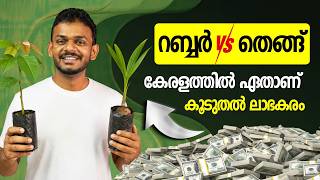

I Did the Math: Coconut vs Rubber Profits
60sStarts with a non-farmer doing the math, instantly hooking viewers who want a data-driven farming income comparison.
▶ Play Clip"The comparison is real and includes useful figures, but the rambling presentation and unclear numbers diminish the impact."
This video compares coconut and rubber farming on one acre in Kerala, detailing initial costs, maintenance, revenue, and net profit. The presenter also discusses value addition, risks, and gives a recommendation based on his analysis of 2026 market prices.
The speaker analyzed data to determine the more profitable crop between rubber and coconut, focusing on costs and net profit.
Farmers can grow intercrops like pulses and sell produce directly at evening markets to increase income.
One acre can hold 200–250 rubber trees, which take 6–7 years to yield returns.
One acre can hold 70–100 coconut trees, yielding in about 4 years for modern varieties.
Coconut setup costs 80,000–1 lakh rupees; seedlings cost around 300 rupees each, with premium trees up to 1,200.
Rubber maintenance is around 65,000 rupees per year, while coconut requires less (plus ~5,000 rupees employee cost).
Converting copra to coconut oil can triple income, while rubber faces high price fluctuation risk.
With 10 acres, a farmer can generate stable monthly income; avoid over-dependence on one crop.
How many rubber trees can be planted per acre?
200 to 250 trees.
03:11
How long does rubber take to start yielding returns?
About 6 to 7 years.
03:11
What is the planting density for coconut per acre?
70 to 100 coconut trees.
03:25
What is the initial setup cost for one acre of coconut farming?
80,000 to 1 lakh rupees.
04:25
What is the average net monthly profit from one acre of rubber farming?
Around 5,000 rupees.
06:02
How can coconut revenue be tripled?
By converting copra into coconut oil.
06:49
What makes rubber farming high risk?
Large fluctuations in rubber prices.
07:03
Rubber vs coconut yield timelines
Rubber takes 6-7 years to yield, coconut about 4, which affects cash flow planning.
03:11Coconut setup cost
80,000–1 lakh initial investment is a key barrier for new farmers.
04:25Value addition triples income
Copra-to-oil conversion is a clear strategy to boost coconut profitability.
06:49Rubber price volatility
High price fluctuations make rubber riskier despite steady demand.
07:03Fixed income from 10 acres
Scaling to 10 acres can create stable monthly income, illustrating agriculture's long-term potential.
08:12[00:03] one who does not like the agricultural sector. IT professionals are
[00:19] come to this sector think a lot about agriculture. The you ever thought about whether rubber or coconut is the most profitable? Let's look at whether this coconut or rubber is profitable.
[00:34] I am not a farmer or anything else, but when I did a deep analysis and analyzed some data, Rubber vs. coconut. I am going to tell you exactly how much
[00:49] I am going to tell you exactly how much cost, and how much will be the net profit. but saying that agriculture is very easy. It is not a task, rather than
[01:03] doing small type crosses, it would be better to I am also a person who loves agriculture a lot because if we say this IT sector, it is a sector with tremendous pressure. That is, if we
[01:19] do not do certain activities today, our work will be ruined. Or if we do not do this, our affected. So, regarding coconut and rubber, even if we have some even if big problems arise, we will always have a department from which we can live with dignity.
[01:32] Agriculture is always an opportunity for agriculture. We can do some things as an intercrop. We can grow things as an intercrop, we can do pulses, and so on. We can do many things. We can bring all the farming events to our country and not sell them in the shops, but in our country, we can
[01:48] put them in the town in the evening like a market and if we want, we can do direct sales. live. This farming can be done in any way, survival. There must be some land.
[02:01] Then study a little better . Study the soil well. What is soil? We must learn exactly how to grow gold in the soil a lot of soil and a lot of land without studying the soil . We need to completely insert
[02:14] what elements it needs, and what it lacks, and then clear the soil for each crop . I am not a farmer. still some things to learn in the future. Now let's
[02:28] learn in the future. Now let's cultivation of one acre of land. I am telling you the basic figures based on the market price in 2026 . I consider the income method to be a farm gate income method
[02:42] . That means we are farming on one acre of land. If this is how much does rubber normally cost? I think the record price is count coconuts, the number is 25 . Now the goal is to
[02:57] . Now the goal is to . That means the goal is a cost of our overall setup as well as the specific revenue from it. When that income
[03:11] comes in, we also have to find its net income . Let 's first look at the characteristics of crops. We can plant 200 to 250 trees per acre of rubber farming land. It will take about six
[03:25] to seven years to get a return. Many people sometimes it can take more years. If it is coconut farming, we can plant 70 to 100 coconuts per acre and we will
[03:42] four years. There are modern coconuts, and coconuts. Sometimes you see ads on YouTube and Facebook saying things like Ganga Bondam. So if it is something like that, it will take Sometimes you see ads on YouTube and Facebook saying things like Ganga Bondam. So if it is something like that, it will take
[03:55] This has a life of a long time. We have to look at all these things and mix them up like this. Now those who have studied more will know or after thinking about it, we will know that very soon we will
[04:09] know that very soon we will we will be able to understand a lot of things. Okay, now what we need to know is that the income we get from rubber is the cost we have to pay and the return on it is the cost we have to pay.
[04:25] us 12 to 13 years to produce it. If it is coconut, it will take us 1 years. In 12 to 13 years, we will get it from which source? We will get it from rubber. Let's understand the initial costs. Let's
[04:38] understand the initial costs. Let's set up all this, we need to take care of how many trees there are. 200 to 250 trees to set up. If it is coconut, the initial cost will be
[04:53] 80,000 to 1 lakh. We will need to buy some coconut seedlings and plant them. I think coconuts and seedlings cost around 300 rupees above that, there are some large coconut trees worth 500, 600, and 1200.
[05:06] we can plant anywhere from 70 to 100 coconuts per 100 acres. So we will have a cost accordingly . Okay. Now comes the annual maintenance. Maintenance will come every month. That would cost about 65,000 rupees per rubber. For
[05:20] coconuts, it should be applied. Similarly, the remaining employees, after adding up all the costs, should cost us around ₹5,000 a year .
[05:34] Let's look at the profit and loss figures. Let's look at an annual cost . If you have rubber for a year, the cost will be Rs. 10,55,000. If it's a coconut, it will cost Rs. 4,000 a little more rubber and a little less coconut. If we
[05:48] talk about gross revenue, we get a revenue of Rs. 94,000 to Rs. 1.5 lakh from rubber, and get a revenue of Rs. 94,000 to Rs. 1.5 lakh from rubber, and . The average profit is when we only get
[06:02] . No, it's not a model with a lot of revenue. But it doesn't cost that much . Now, for us, I was talking about net revenue, the income after all our expenses. If we
[06:17] we can expect an average of Rs. 5,000 per month. After spending all of 5000 rupees a month, I we have calculated the cost at ₹5 lakh . If we can earn good source of income.
[06:32] make it 400 rubber. So if it's 10,000, increase it by 600, and it's 15,000. Then make it 800, 20,000, 1000 rubber, etc., 25,000, 25,000 every month. You can get better said it was an average, in a way. There are more
[06:49] made 1,000 rubbers, this is what the program looks like. Because it's incredibly expensive and expensive for . That's why they said there wasn't much revenue . Now let's do it like this. I think coconut would be a little better. Value addition and opportunities Risk and
[07:03] Talking about value addition, if copra is converted into coconut oil, the can be tripled. If the market is feasible, the coconut industry also feasible, the coconut industry also
[07:18] Large fluctuations in rubber prices are possible. Rubber is also high risk. Rubber is also high risk. Speaking of coconuts. Coconut to start anew . If you currently have rubber,
[07:32] you understand, let's start a new plan, let's start coconut farming, and now many people are saying that kaving has a huge scope, so let's have this pepper, let's make a video about it, let's do some
[07:46] calculations, and in the video I'm making, I'm not doing booming or anything like that, I'm getting an average, if you have 200 rubber now, you will get
[07:59] 5000 rupees in revenue, you will get 5000 rupees, you will get 2000 to 5000, that's the calculation, in 20 years, 20,000 to 5,000, 2000 to 7000 net, . That's how we should see revenue. When you
[08:12] say that's 50,000 rupees a month on just one acre of land, doesn't that mean that income of about one lakh rupees in a year is a ? It became a fixed income . So, if we have 10 acres to plan on, we can do it. And I would never say that you have to
[08:25] do multiple instances of a specific crop. Create a happy mood. live with a sense of honor. Even though
[08:42] lower initial costs, and longer-term returns, depending on what you plan to do with your life. The coconut is the one that has added value to the mango. That is, revenue can be generated from coconut trees.
[08:56] doesn't get that much revenue model from Kawang. So if you say coconut is better, far far better is Take some land. Let's cultivate coconut here. No, let's Then in the next video, we will look at pumpkin plus pepper, that is, pepper. Let's look at pumpkin.
[09:10] anyone needs a study on pumpkin and pepper, a study on pumpkin and pepper, or pepper, we have
[09:23] share this video with them. We'll see you tomorrow for another great video. It's mean Shawnee signing off bye bye.
[09:35] signing off bye bye. [Music]




⚡ Saved you 0h 09m reading this? Transcribe any YouTube video for free — no signup needed.