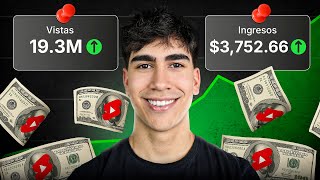

YouTube Shorts Pay $50-$300 per Million Views?
44sReveals surprisingly low earnings for Shorts, sparking curiosity and debate about whether it's worth it.
▶ Play Clip"Delivers on the promise of explaining Shorts monetization, but the heavy push toward long-form content feels like a bait-and-switch."
The video explains how to make money with YouTube Shorts in 2025, covering monetization methods, content creation strategies, and the creator's personal preference for long-form content. It provides practical steps for finding profitable niches, building a team, and analyzing metrics, while also revealing the limitations of Shorts compared to long-form videos.
YouTube Shorts are vertical videos under 60 seconds, designed to compete with TikTok and Reels. They have high viral potential, can reach millions of views quickly, and are easier to produce than long-form content.
Standard RPM for Shorts is between $0.05 and $0.30 per 1,000 views. To earn over $1,000, you need more than 20 million views (assuming $0.05 RPM).
Launched in mid-2024, this program pays creators more for using licensed music. RPM can increase to $1-$7 per 1,000 views, potentially earning $1,000-$7,000 per million views depending on niche and music.
To qualify, you need at least 1 million views on Shorts in the last 30 days, apply through music distribution companies, and be accepted based on content, niche, and performance (retention, frequency, consistency).
Focus on unsaturated niches in your target language market. Look at successful English channels and adapt their formats to your market. Prioritize what works over personal preference.
Make videos as interesting as possible, structure voice appropriately, choose music that fits the topic, and study editing styles of reference channels.
Delegate editing, voiceover, scriptwriting, and publishing to a team. Focus on ideas and hooks. Use reference channels for inspiration and leverage tools like ChatGPT for scripts and ElevenLabs for voiceovers.
Publish daily. Analyze swipe rate (less than 20% is good) and retention (aim for 85-90% with a flat graph). Consistency is key as channels take time to enter the algorithm.
Long-form content has higher RPM ($3-$20+ per 1,000 views), allows sponsorships, affiliates, and product sales, builds trust, and provides more stable, long-term views. A single long video can outperform 30 Shorts.
While YouTube Shorts offer a quick path to virality and monetization, the creator strongly recommends long-form content for sustainable income due to higher RPM, stability, and monetization opportunities.
What is the standard RPM range for YouTube Shorts?
$0.05 to $0.30 per 1,000 views.
01:03
How many views are needed to earn $1,000 with standard Shorts monetization?
More than 20 million views (at $0.05 RPM).
01:15
What is the RPM range for the YouTube Music Program?
$1 to $7 per 1,000 views.
02:07
What are the requirements to join the YouTube Music Program?
At least 1 million views on Shorts in the last 30 days, apply through music distribution companies, and be accepted based on content, niche, and performance.
02:19
What is a good swipe rate for Shorts?
Less than 20%.
06:31
What retention rate should you aim for in Shorts?
Between 85% and 90% with a flat graph.
06:43
Why does the creator prefer long-form content over Shorts?
Higher RPM ($3-$20+), more stable views, and better monetization opportunities like sponsorships and product sales.
06:56
Shorts RPM is low
Reveals the low earning potential of standard Shorts monetization, setting realistic expectations.
01:03Music Program boosts earnings
Shows how using licensed music can multiply RPM by up to 20x.
02:07Focus on what works, not what you like
Emphasizes a data-driven approach to niche selection over personal preference.
03:39Long-form is superior
Provides a strong argument for long-form content over Shorts for sustainable income.
06:56[00:01] Do you want to make money with YouTube Shores in 2025? You're in the right place. Today I'm work, how much you can earn, and the real steps that creators who are already making thousands of euros are using. But I'm also going to tell you
[00:14] a truth that nobody is telling you. My name is Erica Lanis and I make money by uploading videos to YouTube without showing my face. Although the truth is that I don't do it with short videos, but with long-form content. But I
[00:26] also know perfectly how the YouTube algorithm works and I've content creators who earn thousands of euros with this business model. YouTube Sh are vertical videos of less than 60 seconds. They are designed to compete
[00:39] against TikTok and Reels, and their advantage is that they have a very high viral potential . You can go from zero to millions of views in days, even without subscribers. There are even people who, thanks to YouTube shorts, are
[00:51] getting YouTube badges in record time, and because they are short, they are easier to produce, since they are much easier to edit. You don't have to make any thumbnails, nor a very long narrative, nor a large
[01:03] edition. Now let's look at the two main ways you can make money with YouTube Shorts. The first way would be standard monetization. The way would be standard monetization. The RPM is between 0.05 and 0.30 per 1000
[01:15] views, which, remember, is what YouTube pays us for every 1000 views. That means that for every 1 billion views you earn between $50 and $300, so to earn more than $1,000 you need more than 20,000
[01:28] views. Let's move on to the second method, which is the YouTube music program monetization program that YouTube launched in mid-2024 to help Shorts creators earn more money using licensed music. How does it
[01:42] work when you use certain songs within the music catalog? Usually popular songs or songs distributed by certain record labels. YouTube pays you more money for each view that short video gets. This happens
[01:54] because these songs are part of agreements with music companies that share revenue with the creators instead of simply claiming the video rights. As I told you before, the standard RPM is 0.05 to 0
[02:07] program I just told you about earlier, you can earn between $1 and $7 more for every 1,000 visits. That means you can go from earning $100
[02:19] per 1 million views to earning $1,000 or even $7,000 depending on your niche and the music used. To get in, here's what you need. One, have at least one million views on the shots during the last 30 days. Two, apply
[02:34] used by music distribution companies . Third, be accepted based on your content, niche and performance, which would be retention, frequency and consistency. Now that we've seen how you can make money, let's look at how
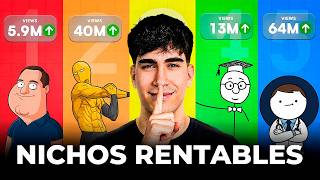
[02:47] you can create that content and make it go viral. And this part is really I do it with my own automated long-form content channels. So let's get to it. The first step would be how to find profitable niches. First
[03:02] what is talked about on the channel, and you have to focus on niches that are not saturated in the market where you are going to open the channel. Note, by market I mean language. I personally never recommend that you start creating
[03:15] videos within a channel that another user or another channel is already doing, because in the end we get a smaller share of the pie. So, the point is to find niches, to find formats of those channels that someone is
[03:27] doing in the English market, that English channels are doing and we can be inspired by them, bring it to the Spanish market and be a new trend. Above all, focus on what works. I don't want you to be
[03:39] attached to doing something you really like, because, as I always say, what you like is what works. Today I earn a lot of money every month having channels that I know nothing about and don't like talking about, but when I
[03:53] opened those channels I was smart and I really did what today it's generating the income you see on screen. Let's now look at the characteristics that these profitable niches must have. Ultimately,
[04:06] you have to focus on making the less than 60-second video as interesting as possible. Also focus on how they structure their voice. Ultimately, if you're talking about a specific topic, you'll need one type of voice or another.
[04:21] Also, what kind of music goes well with those shorts? It is very important that you cannot play just any music with any topic you are talking about. And finally, how do they edit? How are those short films edited? Ultimately, that's why
[04:33] reference channels. Because? Because if you have reference channels, you can see how they are doing it and you can be inspired by them. Let's move on to the second step, which is to find a team to help you produce all that content.
[04:45] Take charge of the ideas and the hooks, as that's what will give you the best results. But for everything—editing, voiceover, writing the scripts for those shorts, or even publishing—I'll find a team to take care of everything so I can
[04:57] focus solely on growing the channel. As I've told you, I want you to be the idea and the mastermind behind it. And how can you find those potential ideas? In the end, by browsing YouTube and, as I said, finding
[05:10] channels in the English market that haven't been made in the Spanish market. It's before, that you need to have several reference channels to be able to leverage the time those people have spent figuring out what works, and
[05:25] you just have to replicate and be inspired by it. Also the script; you have to write a short and powerful script. You can leverage either a screenwriter or someone to do it for you, or use GPT Chat. Today, Chat
[05:37] GPT creates incredible scripts, especially for videos under 60 seconds long. Look, you can use it, but don't write a whole script with Chat GPT, because these days Chat GPT isn't up to par, just like a real person. Also, make your
[05:50] elevenlabs. Elevenlabs is a free artificial intelligence that can make voiceovers at a quality that few other artificial intelligences have. You have a free plan, but once it runs out it costs a few dollars a month.
[06:04] But you can use the technique of creating multiple Gmail accounts and starting with a different one each time your . And the editing has to be fast and visual. tools usually used to make these types of videos are either Caput or
[06:19] Adobe Premiere. Once you know all this, let's move on to the next step, which is that you have to publish every day and analyze your metrics. You need to aim for a daily short. The more you upload per day, the faster your growth will be
[06:31] . You need to analyze the following. First, the swipe rate, less following. First, the swipe rate, less than 20% is a good hook. Retention than 20% is a good hook. Retention aims for between 85% and 90% of the video and
[06:43] a flat graph because people will stay on the short version. Make sure you are consistent. A channel takes a while to enter the algorithm. Okay, now that we've seen what YouTube shorts are and how you can make money from them, I'm going
[06:56] to explain the reality. The truth about why long-form content is the best way to make money in 2025, because otherwise, even I would have really see many advantages in long-form content. The first would be the
[07:10] RPM. You can have from $3 to even more than $20 of RPM. That is, for every 1000 views, YouTube can pay you more than $20. A single video can earn more than 30 short videos. In other words, a single idea and a single miniature. It can generate
[07:24] more than 30 ideas, 30 scripts. And to publish it 30 times. You can integrate sponsorships, affiliates, or even sell an external product yourself. Longer videos generate more sales, as they build more trust. Nobody is going to
[07:38] buy from a single 30-second video. Most people stagnate and stop growing. quickly, which makes it more unstable. In contrast, with long videos you can receive views for much longer and
[07:52] are therefore more stable. And for those reasons alone I much prefer to create long-form content, which is ultimately what has been working for over 15 years and continues to grow. So if you'd also like to learn how to make
[08:05] money with long-form content, here's a free course where I teach you the process that allows me to generate over €10,000 net per month with my automated channels, which my students are also using, and where
[08:18] students are also using, and where I teach the whole process from scratch.

⚡ Saved you 0h 08m reading this? Transcribe any YouTube video for free — no signup needed.