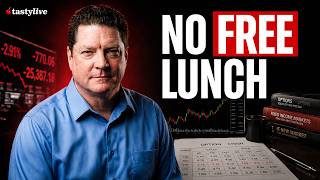

Why Buying 100 Shares of Nvidia Costs Twice as Much as a Call
45sHigh-priced stock capital requirements are a common pain point, and the example with Nvidia makes the cost-saving benefit of call options immediately relatable.
▶ Play Clip"The title promises a catch, and it delivers with a clear explanation of interest rate effects on option pricing, though some filler exists."
This video explains a stock replacement strategy using in-the-money call options, which allows traders to control stock for a fraction of the capital required to buy shares outright. The presenter demonstrates how to set up the trade, manage risk by selling out-of-the-money calls, and highlights a critical catch: the impact of interest rates on option pricing.
Buying stock, especially high-priced ones like Nvidia at $198, requires significant capital. For 100 shares, you need $19,800, or $9,900 with 50% margin. This is expensive for a bullish trade.
Instead of buying stock, you can buy an in-the-money call option. For example, a 170 call with 49 days to expiration has an 83 delta, meaning it moves like 83 shares. This costs $3,200, about a third of the stock's cost.
To lower the trade's cost and risk, you can sell an out-of-the-money call against your long call. Selling a 205 call with 7 days to expiration drops delta from 82 to 54 and turns theta positive at +$15 per day.
The extrinsic value of an in-the-money call is higher than the corresponding put due to positive interest rates. For the 170 call, extrinsic value is $3.74, while the 170 put is only $3.05. This difference is because calls compensate for the interest you lose or pay when using cash to buy stock.
To offset the extrinsic value, you need to sell front-month calls against your long call. The extrinsic value includes both volatility and interest. Use the extrinsic column to determine how many times you need to sell to cover this cost.
Stock replacement with in-the-money calls is a valid strategy if you're bullish. Use the extrinsic column to judge how much premium to sell. This is not a trade recommendation; manage risk appropriately.
The video concludes that while stock replacement with in-the-money calls is a capital-efficient strategy, traders must account for the hidden cost of interest rates embedded in option premiums. By selling front-month calls, you can offset this extrinsic value, but it's essential to understand the mechanics to avoid overpaying.
What is the capital requirement for buying 100 shares of Nvidia at $198 with 50% margin?
$9,900
00:32
What is the delta of the 170 call option mentioned in the example?
83 delta
01:12
How does selling a 205 call against a long 170 call affect delta and theta?
Delta drops from 82 to 54, and theta becomes positive at +$15 per day.
02:50
Why is the extrinsic value of an in-the-money call higher than the corresponding put?
Because positive interest rates inflate call values and deflate put values, compensating for the interest lost or paid on cash used to buy stock.
05:28
What is the extrinsic value of the 170 call and the 170 put in the example?
Call: $3.74; Put: $3.05
05:13
Interest Rates Affect Option Pricing
Explains a non-obvious factor in option pricing that can catch traders off guard.
05:28Risk Reduction Technique
Shows a concrete way to reduce delta and improve theta, making the trade more efficient.
02:50Offsetting Extrinsic Value
Provides a practical method to calculate how much premium to sell to cover costs.
08:31[00:04] a good strategy. Why? Well, buying stock, especially when the stock is relatively high priced, can be pretty expensive. In other words, they require a lot of capital. And if you're bullish, buying a call can be a lot less
[00:18] expensive or less capital intensive. Let's take a Let's just take a look at an example here. I have Nvidia loaded up, very popular stock to trade, trading up, very popular stock to trade, trading at $198 a share. If I were to buy
[00:32] uh 100 shares of that, that would require $9,900 of capital, about 50% of the value of the stock. So, in other words, 100 the stock. So, in other words, 100 shares at $198 a share, $19,800, half of
[00:47] that is $9,900. Pretty uh expensive. Um "I don't know if I want to put that kind of money into a bullish trade in
[00:59] Nvidia." So, what you might want to do, clear this out. Um maybe go out to 49 days, take your pick, and look at buying an in-the-money call option. Uh this
[01:12] one, the 170 calls, um have an 83 delta, and you can choose whichever one, you know, you want more risk, less risk. Uh more risk, you'd buy a deeper in-the-money call, get 91 deltas. In other words, delta is how
[01:25] um uh equivalent shares of equivalency that option has. Um so, this 145 call is going to move up and down theoretically um as if it were uh 94 shares of stock.
[01:39] That's one way of thinking about it. Um but let's say if I buy this 170 call, um and I'm only paying $3,200, about a third of what it costs uh to buy the
[01:52] stock. Now, it's still not very cheap uh cuz you're buying an in-the-money call, and the premium is is is high. In other words, you're buying some intrinsic what I want to talk about. Um but the strategy would be then is okay, maybe
[02:08] I'll sell a call against my long call. So I'm long this um September uh 170 call. Maybe I'll go out to uh uh 7 days even, 1 week and see what I
[02:21] get for selling an out of the money call in 7 days. So this one maybe I'll sell in 7 days. So this one maybe I'll sell the 205 call. Um so notice now if I have 82 deltas, watch this number here, 82 deltas. If I sell this this 205 call
[02:35] against it, um I'm reducing the cost of the trade a little bit. Let me let me take this out. Let me delete this leg. Remove leg. I want you to look at this, too. -9.8 theta when I just buy that call when I
[02:50] buy that September call. Um I 82 deltas -9.8 theta. Okay? -9.8 theta. Okay? Um if I sell that 205 call, um my deltas Um if I sell that 205 call, um my deltas drop to 54. Okay? So I take the risk off
[03:05] pretty significantly and I bounce my theta to positive to positive $15 a day. Not bad. So using this as a stock replacement strategy, buying an in the money call, selling an out of the money call is a
[03:20] is a valid strategy. Uh it it can require less capital. It also has less risk. Uh if theoretically if the Nvidia goes to zero, you're going to lose a lot more um buying 100 shares of stock than you would be buying an in the money
[03:35] But there's one aspect of this that I want you to take a look at and this gets into my expertise, option pricing. Not going to get too deep into the weeds with this, but I want you to be aware. Let's take a look at um let's clear this
[03:50] out for a second. Remove legs. It's very easy to do this with the platform. whichever option strike I want to and then add
[04:02] delete legs. It's very convenient. Buying this 170 call, it is comprised and as you know, an option's value is made up of in the money value, intrinsic
[04:14] and extrinsic value. Intrinsic value if it's in the money. Out of the money options have zero intrinsic value. So, when you're talking about the in the money option, this 170 call, I have loaded up here. I have the delta loaded
[04:29] want to buy. Um, and I have intrinsic value. Um, and I have intrinsic value. Go down here and intrinsic INT and extrinsic E EXT right there. Okay. I have these two All right, let's let's
[04:43] open this up again. I have these two loaded up. Because sometimes, you know, I I I talk about, well, the the out of the money the out of the money put, the 170 call,
[04:59] 170 call is in the money, the out of the money the 170 put is out of the money. That out of the money the corresponding out of the money option is roughly the out of the money option is roughly the same extrinsic value as the as the in
[05:13] the money option. But, look at this look at this number. The extrinsic value of this 170 call is 374. 374. The put the 170 put is only $3.05.
[05:28] Right? Why is that call so much higher? Why is it does it have about 70 cents more extrinsic value? The reason is interest rates. So, positive interest rates and
[05:43] short-term rates are I don't know, 4 and 1/2 5%. Anytime interest rates are positive, it's going to inflate the value of it's going to inflate the value of calls, deflate the value of puts. Why?
[05:56] Because you're not the only person who knows that buying an in the money call is a stock replacement strategy. If I buy stock and I put out, you know, $19,000 of cash,
[06:09] not buying power pri- requirement, but cash. I'm spending $19,000 to buy 500 shares of the stock, then I'm either borrowing money to buy the stock, to finance it, to buy to come up with that $19,000, or I'm losing
[06:26] interest that I'm earning on that $19,000. So, instead of earning 5% interest on the cash, I'm using it to buy the stock. the cash, I'm using it to buy the stock. There's no free lunch in option trading.
[06:39] And so, that call compensates for the fact that you're you're you're you're you're losing money on on that interest, or you're paying interest on that, they inflate the value of that in the money
[06:55] call, or specifically, the extrinsic value of the call. When inter- if interest rates if interest rates were zero and there were no dividend, the extrinsic value of this 170
[07:07] call would be the same as the same as the extrinsic value of the 170 put, if interest rates were zero, theoretically. Okay? But, because of positive interest the extrinsic value is higher. So, if you're buying this call, this 170
[07:23] call, how much premium, extra premium, are you paying? How much extrinsic value are you paying? Are you paying $3, or you paying $3.78? Well, let's let's think about it for a
[07:37] second. And, you know, you're selling this this call with seven days, and you're collecting um you know, $1.80 for it, and you say, "Okay, gee, if I if if that expires worthless, or even if
[07:49] I buy it back before it expires, and I sell another 7-day option, another 7-day option, pretty soon I might be generating enough credit from those short options to erase this extrinsic value. Then I'm just left with the
[08:03] intrinsic value, paying the intrinsic value of the 170 call." Okay? So, in other words, if the stock just sits here at 198.41,
[08:16] here. Let's just say it's right here. That call, that 170 call is going to be worth $28.43. Okay? So, if um if if I want to offset this extrinsic
[08:31] buying, I can sell that uh front month, they're closer to money call against it, just like selling a call against long stock.
[08:45] But how much extrinsic do I value do I have to cover? $3, or $3.83? Why? Because if this option is worth $28.34
[08:59] at expiration, and I pay, you know, $32.25 for it, $32.25 for it, I'm going to lose that $3.94. I need to come up with that somehow. So, this extrinsic value, this $3, this $3
[09:15] all is all volatility. This one is volatility plus interest. Okay? And whether you like it or not, you're going to have to pay for that interest. So, the number of times you need to sell a front month call to offset the
[09:29] extrinsic of the 170 call, use the extrinsic value, use this number right here in this column. to to to judge how many times you have to do that or how much how much premium
[09:43] you have to generate selling front month options against it. So, that's a little little bit. Um you can get you can drill down into these numbers and get the exact, you know, calculations you want if you
[09:58] the formulas. It's a lot of fun. I've done it, you know, that's that's one of my, again, areas of expertise. But, the general idea is option prices factor in interest rates. Um they factor in dividends, they factor
[10:14] in interest rates. So, you're you're paying for it eventually in some way, that interest just as if you're buying stock. So, long and short of it is, if you're doing if you're buying in-the-money calls for stock replacement
[10:29] in-the-money calls for stock replacement strategy, no problem. Great strategy. Um if you're bullish on the stock, just use this extrinsic column to see the buying to judge how much front month premium
[10:45] you have to sell and how many times you have to do it to offset that value. So, none of this is a trade recommendation. If you do decide to use this strategy, yeah, that's on you and good luck with it, but please, if you do, do not take
[10:59] any more risk than you are comfortable with.




⚡ Saved you 0h 11m reading this? Transcribe any YouTube video for free — no signup needed.