

Crypto Trading Basics: 24/7 Market & Leverage
45sExplains key advantages of crypto over stock market (24/7 trading, high leverage) attracting beginners.
▶ Play Clip"The title accurately promises a full beginner course, and the video delivers on that promise with comprehensive basics."
This video is the first episode of a comprehensive crypto trading course for beginners. It covers the basics of crypto trading, including why it differs from stock market trading, the legal and tax implications in India, and an introduction to key concepts like leverage, liquidation, and contract sizes. The presenter also recommends Delta Exchange as a platform for trading crypto futures.
Crypto trading involves buying and selling cryptocurrencies or their derivatives (futures and options) to profit from price movements.
Crypto markets operate 24/7, unlike stock markets (9:15 AM to 3:30 PM). Crypto also offers higher leverage (up to 200x) compared to intraday leverage in stocks (up to 5x).
Crypto trading is not illegal in India; there is no law prohibiting it. The government treats cryptocurrencies as digital assets but not legal tender. Exchanges must follow KYC/AML rules and register with the Financial Intelligence Unit (FIU).
Profits from crypto trading are taxed at 30% under the Income Tax Act. Losses cannot be set off against profits. Additionally, 1% TDS is deducted on transactions exceeding ₹50,000 annually.
Spot trading involves direct purchase/sale of crypto and is subject to 30% tax. Derivatives (futures and options) are not subject to the 30% tax rule, making them more tax-efficient.
Crypto futures offer perpetual contracts (no expiry), high leverage (up to 200x), and no theta decay. Options have expiry, lower leverage, and theta decay, making futures more suitable for most traders.
You can start with as little as ₹100, but for serious trading with proper risk management, ₹12,000–₹15,000 is recommended. With ₹5,000 and 20x leverage, you can control a ₹1 lakh position.
Delta Exchange is FIU-registered in India, allows deposits/withdrawals in INR, offers up to 200x leverage, and has good liquidity. Account setup takes about 5 minutes.
Leverage allows you to control a larger position with a smaller capital. For example, with ₹1,000 and 200x leverage, you control ₹2 lakh. A 5% move can double your money or wipe out your capital.
Liquidation occurs when losses reach the amount of your invested capital. The broker automatically closes the position to prevent further losses. Higher leverage brings liquidation price closer.
Each cryptocurrency has a standard lot size. For Bitcoin, 1 lot = 0.0001 BTC. For Ethereum, 1 lot = 0.01 ETH. For Solana, 1 lot = 1 SOL. You must trade in multiples of these lots.
Makers add liquidity by placing limit orders and pay lower fees. Takers remove liquidity by placing market orders and pay higher fees. Using limit orders can reduce brokerage by more than half.
Bitcoin and Ethereum are recommended due to high liquidity and lower manipulation risk. Smaller or meme coins can have sharp, unpredictable moves leading to losses.
The US session (7–9 PM IST) offers high liquidity and volatility. The afternoon session (12:30 PM IST) also sees good activity. Trading during these times is more favorable.
This episode lays the foundation for crypto trading, covering legal, tax, and platform considerations. The next episode will focus on chart analysis and practical trade execution.
What is the main advantage of crypto trading over stock market trading?
Crypto markets operate 24/7 and offer higher leverage (up to 200x).
01:00
Is crypto trading legal in India?
Yes, there is no law making it illegal. The government treats cryptocurrencies as digital assets but not legal tender.
03:03
What is the tax rate on crypto trading profits in India?
30% under the Income Tax Act, and losses cannot be set off against profits.
04:10
What is the TDS rate on crypto transactions exceeding ₹50,000 annually?
1% TDS is deducted.
04:39
Why is derivative trading (futures) preferred over spot trading for tax purposes?
Derivatives are not subject to the 30% tax rule that applies to direct crypto purchases/sales.
06:14
What is a perpetual contract in crypto futures?
A futures contract with no expiry date, allowing traders to hold positions indefinitely.
08:41
What is the recommended minimum capital for serious crypto futures trading?
₹12,000 to ₹15,000 for proper risk management.
10:03
What is liquidation in crypto futures trading?
When losses reach the amount of invested capital, the broker automatically closes the position to prevent further losses.
16:05
What is the lot size for Bitcoin on Delta Exchange?
1 lot = 0.0001 BTC.
18:32
What is the difference between a maker and a taker?
A maker adds liquidity by placing limit orders and pays lower fees; a taker removes liquidity by placing market orders and pays higher fees.
19:44
Which cryptocurrencies are recommended for beginners?
Bitcoin and Ethereum due to high liquidity and lower manipulation risk.
21:40
What is the best time to trade crypto in IST?
7–9 PM IST during the US session, when liquidity and volatility are high.
22:56
24/7 Market and High Leverage
Key differentiators that attract traders from stock markets to crypto.
01:0030% Tax on Crypto Profits
Critical tax implication that affects profitability and trading strategy.
04:10Derivatives Avoid 30% Tax
A legal loophole that makes futures trading more tax-efficient than spot trading.
06:14Leverage Explained with Example
Clear illustration of how leverage amplifies both gains and losses.
13:14Liquidation Mechanism
Essential risk management concept that every trader must understand.
16:05[00:04] start on our channel. In which there will be a total of four episodes. In its first episode we will explain the entire basics to you. We will also tell you some important things. Next we will ? How to do chart analysis. I
[00:21] algo trading in crypto. Meaning this will be a very advanced course in which you will understand everything related to crypto trading and if you watch this video carefully and even
[00:35] go anywhere else related to crypto trading. You will get everything absolutely free on our channel. So let's start this video and understand what is this crypto trading all about ? So the simple meaning of crypto trading is to
[00:47] ? So the simple meaning of crypto trading is to question might be coming to your mind that brother, is this legal or not and what is the benefit of doing this ? Because if we have to trade then we will do it in the stock market.
[01:00] Why should we come to the crypto market? So let's understand this. So the first thing is the reason behind getting into crypto trading is that if you want to trade in the stock market then the market opens from 9:15 am to 3:30 pm. Now,
[01:14] if you work during this time period, you are in the office. If you study in college, you are in college. That means the timing does not suit many people. Whereas if we talk about crypto currencies, then trading goes on here 24*7. This
[01:27] means you can trade at any time. And even the best time to trade in this is in the evening. Why is it like this? I will tell you this also later. The second reason is that if you want to trade in the stock market, then the
[01:40] rules and restrictions there are becoming very strict these days. in intraday trading you get leverage only up to five times. Whereas there are get leverage only up to five times. Whereas there are
[01:54] no specific restrictions in crypto trading. And secondly, here you get leverage up to 200 times. Now what is this leverage of up to 200 times ? I will tell you in detail later. I will tell you in short now. This means that you can take a bigger trade even by investing less money
[02:07] and if you make a profit in this, it can be very high and if there is a risk, then the risk is only of the amount you have invested. This is a huge reason why people are getting into crypto currencies today and now you might be
[02:22] many doubts in your mind. All this will become clear in the future and you will understand why people are moving from the stock market to the crypto market these days. So now some things are clear to you. So now let
[02:37] me tell you here that if you want to trade in crypto currency then trading can be done in two ways. Either you can trade in crypto currency directly directly buy Bitcoin,
[02:50] sell Bitcoin or you can also trade in its futures and options contracts. So what are these two now? Let us understand this and also know where it would be better to trade. But before that, let us first clear a big question that might be
[03:03] coming to your mind. That is, whether crypto trading is legal or illegal. So, if we talk about legal status, there is no law in India which says that crypto trading is illegal. And
[03:16] there is no law which says that this is legal. So then it means that when something is not said to be illegal then it means that you can do that work. There is no problem in that. And the second thing you should also know is that the
[03:29] Indian Government considers cryptocurrencies as digital assets. But only she does not consider it a legal tender. Meaning it does not say that you should do transactions in it. Apart from this, the government has
[03:45] follow KYC rules. AML rules have to be followed. And basically there is a Financial Intelligence Unit in India under which they have to get registered. If an exchange has FIU registration then
[03:58] it can operate comfortably in India. And the platform I will tell you about has FIU registration in India. That means if you trade in crypto currency then you will not face any legal problem. But there may be taxation
[04:10] problems. And that problem is that in India the government has that in India the government has Income Tax Act. Now another condition in this is that you will have to pay
[04:25] 30% tax on the profit you make. But if you incur any loss, it will not be set off against your profit. This means that if you earn a profit of Rs 10,000 by trading, you will have to pay a tax of Rs 3,000 on it. But if there is a loss, it will
[04:39] not be set off against the profit. Besides, there are TDS rules. If you make transactions of more than Rs 500 annually, 1% TDS is deducted. He is everywhere. But this 30% rule is
[04:53] very harsh. Due to which most of the people had stopped working in crypto currencies. Because if you make profit then you will have to pay up to 30%. So now in today's time there is a solution to this, it is a completely legal solution. I will
[05:05] tell you that later. So before that, my first question was that you can do crypto current trading in two ways. Firstly, you can trade in spot crypto and secondly, you can trade in derivatives i.e. futures and options.
[05:19] So let us understand this. First of all, talking about spot trading, spot trading means that you are directly taking it into your wallet. Now the 30% tax at this place is completely applicable.
[05:33] But if you want to invest in crypto currency for the long term, then there will be no better option than buying crypto currency and keeping it with you. But when you sell it, you will have to pay 30% tax, which is a big hassle.
[05:47] Nowadays people have found a solution to that too. But if you want to invest in crypto currencies for 1 month, 2 months, 6 months, or a year, then here you then here you
[06:01] if you want to take it for a short while or a few hours or a few minutes, derivatives are the best. Even if you want to take it for a few months, it is best. Why is it the best? Let us know. Now the first reason for this is that if you trade
[06:14] in crypto derivatives i.e. futures and options , then this 30% rule is not applicable here. Where is this applicable? Where you are directly buying and selling crypto currencies. If you
[06:27] you do not directly buy and sell cryptocurrencies. You are buying its futures So, 30% tax will not be applicable on buying and selling of a contract. 30% tax will not be applicable on buying and selling of a contract. Because of this, you are saved from the 30%
[06:42] rule here. The second most important reason behind derivative trading is that this is where you get leverage up to 200 times. get leverage up to 200 times. Meaning you can take a trade of up to ₹ lakh by investing ₹ 1000.
[06:56] Your risk in that will be only Rs 1000. It is not that you invest Rs 1000 and after that you will have to pay Rs 5000 or Rs 1,000. If you lose, only Rs 1000 will be lost and if you make a profit, it can be quite big. But when you
[07:11] take leverage up to 200 times, then the risk of losing ₹1000 increases significantly. So what is the right way in that too? What is the correct lovage? We will learn further. But because here you know that 30% tax is not applicable. Hence this
[07:24] derivative trading is best. But if you want to do this derivative trading in crypto, then there are two types. You know that you can also trade crypto futures. You can also trade crypto options. So
[07:36] what is the right place then? Where should we trade ? So let us understand this also. First of all, if we talk about crypto options, because many people do options trading in the stock market and if they are looking for an alternative, then they are
[07:49] thinking that even after coming here they will do options trading. But here if we talk about option trading, then first of all, you do not get as much leverage as you get in futures. Secondly, you already know that if you are already trading options in the stock market, then there is
[08:03] an expiry in that too. There is expiry here also. Expiry means that you cannot hold it beyond a particular date. Whether you make profit or loss. Apart from this, there is also Theta Duck in options trading. This
[08:16] means that even if you have bought it and there is no significant movement in the price, you may still incur a loss. Also, if we are buying options then our chances of making profit are less. If you are selling options then the risk becomes
[08:28] unlimited. Whereas if we talk about the futures of crypto, then you will definitely enjoy seeing these things. First of all, here you get leverage up to 200 times. here you get leverage up to 200 times.
[08:41] contracts here are perpetual contracts. That means there are permanent contracts. Meaning it has no expiry. You bought it today, you can no expiry. You bought it today, you can
[08:54] that contract has no expiry. So you can keep it with you for as long as you want. And because it is a futures trading. So there is no theta sticking here. Meaning, if you take a trade, then that trade can be held for a day
[09:07] , a week or a month. If the movement in it is upwards then you will make profit. If it comes downwards then you will see the loss. Apart from this, if you do futures trading then it is
[09:22] learn many options weeks. What is g theta ? What is a delta? You have to understand all these things. Whereas all this has no meaning in futures. So according to me, if you want to trade in crypto currency
[09:35] then trading in crypto futures is the best option. And when most people come into crypto currency, they trade in its futures only. You understand the reason. So now the question arises that if one wants to trade in crypto futures
[09:48] then how much money will it cost? How much will it cost ? So, if you want to just try crypto and see how it works, why not try it? So you can trade even with ₹100. But if you genuinely want to trade and earn money, then
[10:03] according to me, you should have at least ₹15 to ₹00 so that you can do proper risk management. Because even if you have ₹00, you may be investing 1/4 of your capital i.e. ₹5,000. On top of that, if you take leverage up to 20 times, then
[10:18] you can take a trade of ₹1 lakh by investing ₹5,000 from your pocket. And because here you have taken leverage only up to 20 times. I have not taken leverage up to 200 times. So the risk will also generally be less in comparison to 200 times. So because
[10:31] leverage is available here. So even if you have less money but still want to trade, crypto trading is a better option. But you can start with Rs 100 but to earn money you will need at least Rs 12000 so that you
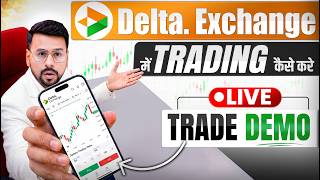
[10:44] need? I have understood this also. So now the question arises that where should we trade? Which platform should I trade on that is also FIU registered in India? So the platform that I use is called Delta Exchange. Even most people
[10:58] first reason behind this is that it is FIU registered in India. The second reason is that you can add money in Indian Rupees only. Even if you withdraw, it will be Thirdly, there is good liquidity here. Their platform
[11:13] is easy to use and leverage is also available up to 200 times here. So if you available up to 200 times here. So if you description and if you open your account using our link, then
[11:26] you will get a discount on your trading fees. Also, we have given a link to a Google form below. You should also fill that form. This will make you eligible for our upcoming giveaways. Now I have given you the link to open an account in Delta Exchange in the
[11:39] As soon as you click on that link, then you have to sign up in which you can sign up with your email ID. Then you have to entered. KYC verification has to be completed and after that your account
[11:53] and after that your account you can start your trading just 5 minutes after opening the account and no matter at what time you open the account. It becomes active within 5 to 10 minutes in most cases.
[12:07] Now once your account is created, you will have to sign in. I am already signed in. You can see that this platform is made for India only. It runs 24* 7 and is also FIU registered in India. So now if you want to trade in it, then
[12:20] for futures trading you have to click on futures. As soon as you click on futures, you get the option to set leverage here. For example, suppose you do not take any leverage. If we take leverage of 1x, then at this point,
[12:34] suppose you want to buy one lot of Ethereum. What is this lot size etc. ? I am going to tell you next. So this is costing you $34. But if is costing you $34. But if I take leverage up to 25x here, then this
[12:47] same lot will cost me only $1.42 and if I take leverage up to 200 times, then you will see that one lot will cost me $0.21 now. So from here you can set your leverage. $0.21 now. So from here you can set your leverage.
[13:02] if you want to trade then there is an option to buy here. You can also see the chart from here. So you get to see all the things at one place. So the You can open your account from there.
[13:14] how to do all this and how to take trades. For now, let's
[13:26] you should know about this is leverage. I have already told you a little about love. But I will explain it in a little detail here. So leverage means the money that your broker, which in this case is
[13:40] Now if you do not have any money then it is not that they will give you capital to trade. But suppose you have ₹1000 of your own. So invest your ₹1000 here. Delta Exchange says I am
[13:55] ready to give you up to 200 times your money. Meaning, if you multiply it by 200, then if you multiply it by 200, then 200 means ₹2 lakh. Now, suppose you have invested ₹1000 from your pocket and on top of that you have taken leverage up to 200 times, then the
[14:10] and on top of that you have taken leverage up to 200 times, then the money you are investing in the market here is ₹2 lakh. Now, if the Now, if the market increases by even 5% above this ₹2 lakh, then what is ₹5 of a lakh
[14:23] ? ₹1000, you had invested only ₹1000 from your pocket and here you will get a profit of ₹1000. But if the market here falls by just 5%, then
[14:35] market here falls by just 5%, then you will suffer a loss of ₹1000 at this place. Now this ₹1000 was yours, so you can take full risk on it. But the remaining can take full risk on it. But the remaining ₹1,99,000 was
[14:48] given to you by Delta Exchange. So in this case he will not take any risk on his money. So here if the price falls by 5% then all your money can be lost and then your trade will be exited. So that is why one should not take so much leverage.
[15:03] Generally the leverage that should be taken is that suppose you have ₹1000 then what should you do ? You can take leverage up to 20 times on your own. So how many did you plant now? You have invested ₹1000 from your pocket. But
[15:19] ₹00 has been invested from your side in the market. Now, if the market increases by even 1% in ₹00, then you will get a profit of ₹200, which is a profit of 20% on your capital of ₹1000. Instead, suppose you have ₹1000 of your own and you have
[15:36] not taken any leverage. So how much money will it cost you from your pocket in the market how much money will it cost you from your pocket in the market ? It will cost ₹1000. Now if the market increases by 1% then what is 1% of 1000? ₹10 means you would have benefited by only ₹10.
[15:49] Therefore, this leverage increases your position size, which can increase your profit but also your risk. But again I told you that the risk is n't happen more than that. So if you use leverage correctly,
[16:05] it can work to your advantage. If used incorrectly, it may even look like a reverse knife. Now after this the second concept you have to learn is liquidation. By the way, I have told you a little about liquidation.
[16:18] I just did n't tell you the term. Now what does this mean? Let's take that example. Suppose you invested this ₹1000 from your pocket. I you invested this ₹1000 from your pocket. I took 200 times leverage from the market. So
[16:31] how much money did you invest in the market here? That cost Rs. one lakh. invest in the market here? That cost Rs. one lakh. So here, if the market increases even by 5%, how much profit do you get ? You get a profit of ₹1000. You
[16:46] invested ₹1000 from your pocket, the market increased by only 5% and you made a profit of ₹1000. it's so great. But if the it's so great. But if the market falls by 0.5% here, then as
[16:58] I told you, you have invested only ₹1000 from your pocket. So the risk you can take is only on your own money. You cannot take more than what the broker is giving you. So as soon as your loss occurs, it will start going around ₹1000.
[17:12] So in this case, your broker will automatically exit that position so that he can save his loss and this is called liquidation. So that is why I told you that when you are taking leverage, you should take it thoughtfully.
[17:25] People suffer losses due to excessive greed. So liquidation means that price after reaching which your trade will automatically exit because your loss will have become very huge. So if you have taken less leverage
[17:39] then that liquidation price will be very far away. Where the chances of you incurring loss are very less. But if you have taken leverage then that price will be slightly lower. If the price comes down a little, you will incur a loss. Now this
[17:52] liquidation, in the next video I will also show you my liquidation once so that you can understand it well. For this, just write part two and comment. we will upload that part as soon as possible.
[18:04] like the video then please like it. So now you have some idea about liquidation. So now let us understand the next concept which is contract size. If you have done options trading or futures trading in the stock market,
[18:18] size. If you have done options trading or futures trading in the stock market, options, then it is not like that if you feel like I want half a Bitcoin, I want 0.1 Bitcoin, then you can buy it. There is a proper lot size here
[18:32] and you have to buy minimum that quantity. So now what is this lot size ? Let's take a look at that. So if we talk about crypto, then the example, if we talk about Bitcoin, then one lot of it is 0.0001
[18:50] BTC, that is, one 1000th part of Bitcoin is one lot. So if you take 10 lots, it means you have taken 0.01 BTC. If you buy 100 lots, it means you have bought 0.1 BTC and if you buy 1000 lots,
[19:05] it means you have bought one Bitcoin. After this, if we talk about Ethereum, then one lot here is 0.01 Ethereum. Talking about Solana, here one lot is equal to one Solana. For all other
[19:19] smaller cryptocurrencies, one lot is equal to one particular cryptocurrency, and you will find almost all cryptocurrencies on Even Delta Exchange.
[19:31] Now, when we use this contract size in Delta Exchange, show it to you by trading, teach it, then you will get to see these things practically there. So now after this, our next concept which you should know is
[19:44] Maker vs Taker. See, a maker is a person who adds liquidity to the market. A taker is a person who takes liquidity from the market. Now what is this thing? So look, whenever you place a limit order in the market. We will also
[19:59] idea now, you will understand things easily in the future. So, suppose there is a crypto currency named ABC whose price is 1.5,
[20:14] then what you said was that I want to buy this crypto currency for $1.4 and you placed an order for it. So what will it be like in this place ? This will be a limit order. So in a way a new order has been created in the market and if the price reaches that level
[20:27] then the order is executed. If it does n't come then it doesn't happen. But this has created liquidity in the market. Because this order can be executed whenever desired. So we call this a maker. But if you said that G is a crypto currency,
[20:43] if you said that G is a crypto currency, am ready to buy A B C at whatever its price is. That means you place your trade in the market order. So there was an order placed at this place, you executed it and finished it. So here
[20:59] you have taken liquidity from the market, so we call it taker because you have taken liquidity from the market exchanges want to
[21:11] So for this, generally less brokerage or less fees are charged for whatever limit orders are placed. Whereas those who place market orders are charged a slightly higher fee. So if you are ever trading and
[21:26] you feel that you are paying more brokerage then it is possible that you are If you place them in limit orders, your brokerage can be reduced by more than half. Now after this the next thing you should know is that if you are
[21:40] cryptocurrencies. Where should you trade? So according to me, if you want to trade in crypto currency then it is best that you trade in Bitcoin and Ethereum. If you trade in these,
[21:52] liquidity is always available here. That means you can buy and sell easily. trade on Delta Exchange, then you amount of liquidity in that. This means you will be able to buy and sell easily. You will
[22:05] not face any problem. The second reason is that these cryptocurrencies like Bitcoin, Ethereum, these are very big cryptocurrencies. The chances of a sharp move in these are very less. That means the chances of manipulation are
[22:17] very less. Whereas if you trade in a small or new crypto currency, the price can suddenly go up or down very fast, which can lead to huge losses. Therefore, it is better to
[22:31] you have a strategy in which you feel that when the meme coin is crashing, then you will trade in it, then there can be different cases there, but generally if you different cases there, but generally if you
[22:44] Now the next thing you should know is that if you are trading in crypto currency then you know that the market runs 24*7. So, when should we trade, at what time should we do it because it is not necessary that there will be a big movement at every time. So for this
[22:56] you should look at some things. For example, Like the time it starts, like around 12:30 in the afternoon, if you start trading,
[23:11] trade in crypto, then you will get to see more liquidity. If you trade between 7:00 pm and 8:00 pm or 9:00 pm, the US session starts at that time. Even at that time, you get to
[23:26] better for trading in crypto. , in an office, then after coming back from office in the evening, you will place your trade at 7:30 or 8:00. So at that time you will
[23:38] see a lot of volatility and liquidity. So this time period is our first episode ends here. Now in the next episode we will teach you how to do chart analysis for cryptocurrency.
[23:52] If you want to trade on Delta Exchange, here's how to do it. How to place limit orders and market orders. How to decide your risk to reward. Stop loss has to be decided.
[24:05] So that episode will be very interesting. In that you will get to see practically all the things. So don't want us to bring that video soon, then please comment by writing part two for it.
[24:18] gets 3000 comments then we will upload that video also. So please do comment. If you want to open your account in Delta Exchange for crypto trading and if you face any problem then you

⚡ Saved you 0h 24m reading this? Transcribe any YouTube video for free — no signup needed.