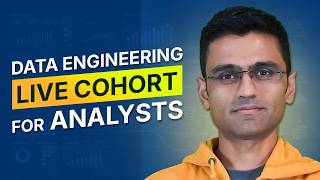

AI can do half your data analyst job 😳
58sIt taps into job-security anxiety by saying AI can handle SQL/DAX work in half the time.
▶ Play Clip"An honest promo that delivers exactly what it promises—a bootcamp overview—though it's heavy on sales pitch and light on depth."
The video discusses how AI is automating core data analyst tasks like writing SQL and DAX queries, and argues that analysts must expand into data engineering to stay valuable. It then presents the CodeBasics live data engineering bootcamp as a solution, detailing its curriculum, instructors, pricing, and refund policy.
AI is automating technical work done by data analysts, so companies now expect analysts to contribute to other areas of the data lifecycle such as data engineering.
What used to take 8 hours of work (SQL queries, DAX) can now be done in 4 hours with AI tools, leaving 4 hours for analysts to contribute elsewhere.
Data engineers build the pipelines that land data into a warehouse. This makes data engineering a natural extension for analysts who want to manage the entire data lifecycle end-to-end.
The live bootcamp is an 8-week program with weekend live sessions conducted via Zoom, with a brochure available for detailed curriculum.
1) Industry-relevant, adaptive curriculum; 2) Covers Databricks and Fabric; 3) Fundamentals explained simply and practically; 4) Production-first mindset; 5) AI-assisted data engineering.
Dhaval worked at Bloomberg as a software/data engineer and data scientist; Hemanand was a data analytics manager in Europe. Haroun (lead faculty) has 10+ years experience; Naveen transitioned from data analyst to data engineer.
Week 1: Advanced SQL engineering; Week 2: Advanced Python engineering; Week 3: PySpark and distributed engineering; Week 4: Cloud (Azure stack, Fabric); Week 5: Analytics engineering and DBT; Week 6: Orchestration (Airflow, Kafka, CI/CD, Git); Final week: Architecture, capstone project, career prep.
No-questions-asked refund after attending the first two live sessions; 100% money back with no reason required.
The live bootcamp includes the full pre-recorded data engineering bootcamp, providing more detailed content and hands-on practice for deeper dives.
Regular price is 48,000 rupees in India. A 36,000-rupee tier is available for 'inner circle' participants who provide feedback. Discounts apply if you already bought the pre-recorded bootcamp, Python, or SQL courses.
The video positions data engineering as the logical next step for data analysts facing AI-driven automation, and promotes the CodeBasics live bootcamp as a practical way to gain these skills with industry-experienced instructors.
According to the video, how much time can AI save on a data analyst's 8-hour workday?
It can reduce 8 hours of work to 4 hours, freeing up 4 hours for other tasks.
00:56
What is the natural career extension for data analysts, according to the video?
Data engineering, because analysts can learn to build data pipelines and manage the data lifecycle end-to-end.
01:24
What are the five highlights of the CodeBasics bootcamp?
1) Industry-relevant adaptive curriculum, 2) Covers Databricks and Fabric, 3) Simple practical fundamentals, 4) Production-first mindset, 5) AI-assisted data engineering.
02:50
Who is the lead faculty of the bootcamp and what is his experience?
Haroun, with 10+ years of experience in the data engineering field.
04:25
What topics are covered in Week 3 of the bootcamp?
PySpark and distributed engineering.
05:35
What is the refund policy for the live bootcamp?
Attend the first two live sessions, and if it's not a right fit, you can request a 100% refund with no questions asked.
06:45
What is the regular price of the bootcamp in India, and what is the inner-circle discounted price?
Regular price is 48,000 rupees; the inner-circle price is 36,000 rupees.
08:37
AI halves analyst workload
Quantifies the impact of AI on data analyst tasks, making the case for upskilling tangible.
00:56Analysts can become end-to-end data professionals
Presents data engineering as an attainable extension for analysts rather than a completely separate career.
01:40Production-first mindset in curriculum design
Emphasizes that learning is evaluated by whether it can go to production, a valuable principle for any tech education.
02:50Structured 8-week curriculum from SQL to architecture
Shows a clear career pathway from core analyst skills to advanced data engineering competencies.
04:51[00:01] expand your skills in data engineering, then [music] this video is for you. Due [snorts] to AI, some of the technical work that you are doing as a data analyst is being automated and now companies expect [music] you to
[00:13] contribute into other areas of data life cycle such as data [music] engineering. In this video, I'm going to discuss CodeBasics live data engineering bootcamp and we'll go over how this bootcamp can help you learn data
[00:28] engineering skill and prepare yourself for the future. If you don't belong to this category, please skip the video. There are thousands of data analysts working in the industry right now and their job is to provide [music] insight
[00:42] in any company. The way they do that is by building dashboards, let's [music] say in Power BI or Tableau. If you're using Power BI, you'll be writing DAX queries. For ad hoc analysis, you might be writing SQL queries. Now, you all
[00:56] know that writing SQL queries, DAX queries, etc. can be done by AI. So, if you were doing 8 hours of work previously, now same amount of work you can do it in 4 hours with the help of AI tools. So, for
[01:10] remaining 4 hours, companies [music] expect you to contribute in other areas. Now, what are the other areas? As a data analyst, typically you extract data into your Power BI dashboard from a data warehouse. But, how does data come into
[01:24] engineering. Someone has built data engineering pipeline, data pipeline through which the data lands into the data warehouse. And that person is data engineer. So, [music] data engineer can be a natural extension for any data
[01:40] analyst where other than building dashboards and SQL [music] queries, you can also do some of the data pipelining work. That way, you're managing the entire thing end-to-end. Of course, for complex data engineering problem, you
[01:54] need a skilled data engineer. But, some of the average tasks that they are doing, you can do it. And that way you are doing the whole thing end-to-end, and you are adding a lot of value to any
[02:06] organization. Any company would love to hire this type of person who knows data analyst skills, plus some of the data engineering skills. Now, let me tell you how our boot camp can help you achieve this goal. On the screen, you are seeing
[02:19] the page for this cohort. It is an 8-week program where we have sessions [music] on weekends. These are live sessions which are conducted via Zoom. If you want to know uh exact curriculum, etc., then click on
[02:34] this download brochure button and check the detailed content on chapters, lectures, etc. There are five main highlights of this boot camp. The first one is it teaches you what is relevant in the industry today. The curriculum is
[02:50] built and taught by people who are building data pipelines in the industry, and it is extremely [music] adaptive. So, as things are changing, we are uh teaching you the latest things because it's a live cohort. Second, it
[03:03] covers Databricks and Fabric, which are the top unified analytics tools used [music] in the industry. Third, the fundamentals are covered using a very simple and practical explanations. Fourth, production-first mindset.
[03:17] [music] Whatever you will be learning, it will focus on one question. Can this go to production? Can this be approved by a company which is having a good data engineering practice? And the last one, [music] AI-assisted data engineering.
[03:31] You will use AI tools to do your data engineering work. Now, why you should trust us? If you don't know about us, please check our YouTube channel Look at the comments. Look at the videos
[03:44] that we have. And also check our courses on codebasics.io. Check the reviews and feedback that people have. Every single review on our website is 100% genuine. We don't put anything [music] fake. So, by talking to these past students, you
[03:59] an understanding of the quality of our teaching. A little intro on myself and Hemanand, we both are a data professionals. We have worked in the industry international market. Hemanand was working as a data analytics manager
[04:13] [music] in Europe for many years. I was with Bloomberg. I was doing a mixed role of software engineer and data engineer and data scientist. And we are translating all that industry experience [music] into the teaching content of
[04:25] this cohort. Haroun is going to be the lead faculty of this boot camp. He has [music] 10 plus years of experience in this field. Naveen is an analytics head [music] at CodeBasics. He was a data analyst before. Then he transitioned to
[04:38] data engineering and he has created working pipelines in our company. [music] This way the instructors who will be teaching you have real industry experience [music] as well as they know the art of teaching. On the boot camp
[04:51] page, when you scroll towards the bottom, you will find this weekly curriculum. It is 8 weeks in total. The first week will be advanced SQL engineering. As a data analyst, you already know SQL basics or intermediate
[05:05] SQL. In this one, we are teaching advanced SQL engineering specifically for data engineering. Then we are covering some data modeling and warehousing concepts. Week two is advanced Python engineering. Once again,
[05:20] as a data analyst, you'll have idea about Python programming language. But here, what we are teaching is Python specifically for data engineering. Okay, these are all live classes which happens on weekend over Zoom. Week three,
[05:35] on weekend over Zoom. Week three, PySpark and distributed engineering. PySpark and distributed engineering. Then week four is cloud and modern data When you are going to do data engineering in any company, when you are
[05:47] working on a project, you will be doing all of it in one of the cloud providers, Azure, GCP, or AWS. So, here we are covering Azure data engineering stack, okay? We are also covering Microsoft Fabric
[06:03] engineering. And once you know one cloud platform, learning other cloud platforms becomes very easy. Week five is analytics engineering and DBT. Then you have orchestration and pipelining where we'll cover Apache
[06:19] Airflow, enterprise data pipeline, streaming CI/CD, and reliability is data engineering. So, here we are going to go over Kafka, normal CI/CD concepts, you know, Git branching, GitHub actions, and so on.
[06:33] And then the last week is architecture, capstone, and career. You will build end-to-end capstone project. There will be a project show down, and then there
[06:45] will be sessions on interview prep and system design. We have no question asked refund policy. You will attend first two live sessions, and after that if you feel it is not a right fit, you can just request a
[06:59] right fit, you can just request a refund, and we will give you 100% money back. We will not ask your reason why you are canceling it. Also, it includes our pre-recorded data engineering boot camp. So, the boot camp that we are
[07:12] talking about right now is a live boot camp, but we also have a recorded boot camp where you see recorded videos and you learn on your own. That entire recorded boot camp is included when you enroll for this live boot camp. When you
[07:27] go to this dashboard, you will see this tab, data engineering boot camp, and here you can see that entire recorded boot camp. Now, what you get by going
[07:39] through this lectures is much more detailed content, okay? In the live session, we will be focusing on building. We will of course cover theory, but live sessions are 8 weeks. Whereas, this recorded content contains
[07:54] so much information, so much details on the various data engineering concepts along with the hands-on practice. So, this way you're learning through live sessions, and if you have any questions, etc., you can obviously uh watch the
[08:10] recording of those live sessions. And if you want to do a deeper dive into a specific topic, then you can go to this particular recorded content. And it will have a little more uh content as well than what you're learning in live. For
[08:24] example, all these projects, you know, hyper delivery project and so on. So, you'll find here. Let's talk about price. There are two tiers. [music] The regular pricing is 48,000 rupees in India.
[08:37] [music] category, then the price is 36,000. So, why is it 12,000 less? Well, it is based on value exchange. [music] If you are part of inner circle group, in that case, we will ask you for the
[08:53] feedback, okay? So, we'll be asking you for the feedback on our content on our >> And then, by receiving that feedback, we can make improvements. So, this way you are spending your time, you are helping
[09:06] us improve this [music] particular cohort. And to uh return the value of your effort, we will give you this 12,000 rupees price reduction. One more thing, [music] if you have already bought our pre-recorded data engineering
[09:20] boot camp, and when you enroll for this live boot camp, you will get the price reduction. So, let's say the price of this live boot camp is X, and if you this live boot camp is X, and if you have paid money Y for the recorded boot
[09:34] camp, when you enroll to this, you will pay X minus Y. If you already have bought either Python [music] or SQL course, which are part of this live boot camp curriculum, in that case also, you will get price [music] reduction. This
[09:48] is all automated, so what you need to do is login using the ID which you used at the time of buying these previous courses and boot camps. And when you just add things to cart and go to checkout, it will automatically adjust
[10:01] Check out the link in the video description below. If you have questions, [music] post in the comment box below.
⚡ Saved you 0h 10m reading this? Transcribe any YouTube video for free — no signup needed.