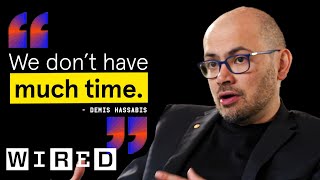

The Promise & Danger of AI
45sHassabis contrasts AI's potential to cure diseases with the risk of unsafe systems, a high-stakes ethical debate that hooks viewers.
▶ Play Clip"The title accurately reflects the main theme of the interview, which heavily discusses the future of work in the context of AGI."
In this interview, Demis Hassabis, CEO of Google DeepMind, discusses the definition, progress, and timeline for achieving Artificial General Intelligence (AGI). He outlines both the immense potential for solving global problems and the significant risks of misuse and technical control, emphasizing the need for smart regulation and international cooperation.
Hassabis defines AGI as a system that can exhibit all cognitive capabilities of a human.
He estimates a 50% chance of AGI within 5-10 years.
Current AI lacks consistency; fails at basic tasks despite excelling in others.
He thinks AGI arrival will be incremental, not a sudden step function.
Two main risks: bad actors using AI for harm, and technical risks of powerful AI.
Calls for smart, nimble, international regulation.
Advises students to master prompting, fine-tuning, and STEM to stay productive.
Envisions AGI solving root problems like disease, energy, and water access.
Hopes radical abundance will shift societal mindset to non-zero-sum.
What is Demis Hassabis's definition of AGI?
A system that can exhibit all the cognitive capabilities humans have.
01:52
Why is the human mind used as a reference for AGI?
The human mind is the only existence proof we have that general intelligence is possible.
01:59
What is one main reason Demis Hassabis believes current AI is not yet AGI?
Consistency of responses, as systems excel in some areas but fail in basic tasks.
02:47
What is Demis Hassabis's timeline for a 50% chance of achieving AGI?
5 to 10 years.
01:12
Does Demis Hassabis believe the arrival of AGI will be a sudden 'phase shift' or an incremental process?
He thinks it will more likely be an incremental transition rather than a step function.
03:41
What are the two main risks Demis Hassabis worries about?
Bad actors repurposing AI for harm, and technical risks of AI becoming more powerful and agentic.
06:14
What type of regulation does Demis Hassabis advocate for?
It needs to be smart, nimble, and international.
07:29
What advice does Demis Hassabis give to students to thrive in the age of AI?
By studying STEM, programming, and learning to fine-tune systems and prompt engineer.
12:36
What examples of 'root node problems' does Demis Hassabis say AGI could solve?
Curing diseases, finding new energy sources (like fusion), and solving water access.
13:43
What is Demis Hassabis's hope for how society will change after AGI creates radical abundance?
He hopes it will lead to 'radical abundance' and shift societal mindset to non-zero-sum thinking.
16:44
Defining AGI
Hassabis provides a clear, non-corporate definition of AGI as a system matching human cognitive capabilities, framing the entire discussion.
01:30Inconsistency of Current AI
He identifies the lack of consistency across domains as a key reason current AI is not AGI, a tangible metric for assessing progress.
02:47Urgency of Time
Hassabis admits 'we don't have much time' to solve safety and governance issues, lending urgency to the need for international collaboration.
09:26Advice for the AI Native
He gives actionable advice for students to stay relevant, emphasizing mastery of fine-tuning and system prompting, not just theoretical knowledge.
12:36Radical Abundance and Non-Zero-Sum
His vision of radical abundance solving resource conflicts offers a compelling counterargument to dystopian AI narratives.
13:34[00:00] - It's a very intense time in the field.
[00:02] We obviously want all
[00:03] of the brilliant things
[00:05] come up with new cures for
[00:07] incredible things for humanity.
[00:09] That's the promise of AI.
[00:11] But also, there are worries
[00:12] if the first AI systems are built
[00:13] with the wrong value systems
[00:16] that could be also very bad.
[00:18] - Wired sat down with Demis Hassabis,
[00:20] who's the CEO of Google
[00:23] of the company's artificial intelligence.
[00:25] He's a Nobel Prize
[00:27] We discussed AGI, the future of work,
[00:30] and how Google plans to
[00:33] This is "The Big Interview."
[00:35] [upbeat music]
[00:42] Well, welcome to "The
[00:43] - Thank you, thanks for having me.
[00:44] - So let's start talking
[00:48] Now, you founded DeepMind with the idea
[00:51] that you would solve intelligence
[00:56] to solve everything else.
[00:57] And I think it was like a 20-year mission.
[00:59] We're like 15 years into
[01:02] - I feel like, yeah,
[01:02] we're pretty much dead on track, actually,
[01:04] is what would be our estimate.
[01:06] - That means five years away
[01:08] from what I guess people will call AGI.
[01:11] - Yeah, I think in the
[01:13] that would be maybe 50% chance
[01:16] that we'll have what we
[01:18] - Well, some of your peers are saying,
[01:20] "Two years, three years,"
[01:22] and others say a little more,
[01:25] that's really soon.
[01:27] How do we know that we're that close?
[01:30] - There's a bit of a debate
[01:32] in the field about definitions of AGI,
[01:34] and then obviously, of
[01:36] There's different predictions
[01:39] We've been pretty consistent
[01:41] And actually, Shane Legg,
[01:42] one of my co-founders
[01:44] you know, he helped define
[01:47] early 2001 type of timeframe.
[01:50] And we've always thought
[01:52] that has the ability to exhibit,
[01:54] sort of all the cognitive
[01:58] And the reason that's important,
[01:59] the reference to the human mind,
[02:01] is the human mind is the
[02:04] Maybe in the universe, the
[02:07] So if you want to claim sort
[02:10] then you need to show that it generalizes
[02:13] to all these domains.
[02:14] - Is when everything's filled in,
[02:15] all the check marks are
[02:20] - Yes, so I think there are
[02:23] You know, that all of us
[02:24] who have used the latest
[02:27] will know very well, like on reasoning,
[02:29] on planning, on memory.
[02:30] I don't think today's
[02:33] do true invention,
[02:35] you know, true creativity,
[02:36] hypothesize new scientific theories.
[02:39] They're extremely useful,
[02:41] but they have holes.
[02:43] And actually, one of the
[02:45] we are at AGI yet is
[02:47] because of the consistency of responses.
[02:50] You know, in some domains,
[02:52] we have systems that can do
[02:55] math problems to gold medal standard-
[02:57] - Sure.
[02:59] But on the other hand,
[03:00] these systems sometimes still
[03:03] or even counting the number
[03:05] - Yeah.
[03:07] what you would expect.
[03:08] That level of sort of difference
[03:10] in performance across the
[03:14] and therefore shows
[03:15] that these systems are not
[03:17] - But when we get it,
[03:18] is it then like a phase
[03:21] then all of a sudden things are different,
[03:24] all the check marks are checked?
[03:26] - Yeah.
[03:27] and we have a thing
[03:28] - Mm-hmm.
[03:29] - Are we then power in a new world?
[03:30] - I think, you know, that again,
[03:32] that is debated, and it's not clear to me
[03:34] whether it's gonna be more
[03:35] of a kind of incremental
[03:41] My guess is, it looks
[03:43] of an incremental shift.
[03:44] Even if you had a system like
[03:47] still operates with the physical laws,
[03:50] you know, factories,
[03:53] So it'll take a while for the
[03:56] this sort of digital
[03:58] to really impact, I think, a
[04:02] Maybe another decade plus,
[04:04] but there's other theories on that too,
[04:05] where it could come faster.
[04:06] - Yeah, Eric Schmidt, who I
[04:10] has said that, "It's almost
[04:12] He says, "If China,
[04:16] then we're cooked."
[04:17] Because if someone gets
[04:19] before the next guy, then
[04:24] You know, because then
[04:26] bigger leads there.
[04:27] You don't buy that, I guess.
[04:29] - I think it's an unknown.
[04:30] It's one of the many unknowns,
[04:31] which is that, you know,
[04:32] that's sometimes called
[04:34] where the idea there is
[04:37] they're able to self-improve,
[04:39] maybe code themselves
[04:41] that maybe they're extremely
[04:43] So what would be a slight lead,
[04:46] let's say, you know, a few days,
[04:48] could suddenly become a
[04:51] But there are many other
[04:53] where it's more incremental.
[04:54] Some of these self-improvement
[04:57] to kind of accelerate in that way,
[05:00] then being around the same time,
[05:03] would not make much difference.
[05:05] But it's important, I mean,
[05:06] these issues are the geopolitical issues.
[05:08] I think the systems that are being built,
[05:10] they'll have some imprint of the values
[05:13] and the kind of norms of the
[05:16] that they were embedded in.
[05:18] - So, you know, I think it is important,
[05:20] these kinds of international questions.
[05:22] - So when you build AI at Google,
[05:26] you know, you have that in mind.
[05:28] Do you feel competitive imperative
[05:32] "Oh my God, we better be first?"
[05:34] - It's a very intense time
[05:37] as everyone knows.
[05:38] There's so many resources going
[05:41] lots of things that need to be researched.
[05:43] And there's sort of
[05:45] of pressures going on.
[05:46] We obviously want all
[05:48] that these AI systems can do.
[05:50] You know, I think eventually,
[05:51] we'll be able to advance
[05:54] like we've done with AlphaFold,
[05:56] come up with new cures for
[05:58] incredible things for humanity,
[06:02] But also there are worries
[06:05] if the first AI systems are built
[06:07] with the wrong value systems
[06:10] that could be also very bad.
[06:11] And, you know, there
[06:14] that I worry a lot about.
[06:15] One is, bad actors in
[06:17] or rogue nations repurposing
[06:21] for harmful lens.
[06:22] And then the second one is, obviously,
[06:24] the technical risk of AI itself.
[06:26] As it gets more and more powerful,
[06:27] more and more agentic,
[06:28] can we make sure the
[06:32] They can't be circumvented.
[06:33] And that interacts with
[06:36] what are the first systems that are built
[06:38] by humanity gonna be like?
[06:40] There's commercial imperative-
[06:42] - [Steven] Right.
[06:43] and there's a safety aspect to worry
[06:46] about who's in the lead and
[06:50] - A few years ago, the
[06:53] "Please, regulate us.
[06:54] We need regulation."
[06:55] - And now, in the US at least,
[06:57] the current administration
[07:00] in putting regulations on
[07:04] so we can beat the Chinese.
[07:07] Are you still asking for regulation?
[07:09] Do you think that that's
[07:11] - I think, you know,
[07:13] and I've been consistent in this,
[07:14] I think there are these other
[07:19] that have to be taken into account,
[07:21] and the world's a very different place
[07:22] to how it was five years
[07:25] But there's also, you know,
[07:26] I think the idea of smart regulation
[07:29] that makes sense around these
[07:32] I think is gonna be important.
[07:33] I continue to believe that.
[07:35] I think though, and I've
[07:37] it sort of needs to be international,
[07:38] which looks hard at the moment
[07:40] in the way the world is working,
[07:41] because these systems, you know,
[07:43] they're gonna affect everyone,
[07:45] and they're digital systems.
[07:47] - So, you know, if you sort
[07:51] that doesn't really help
[07:52] in terms of the overall safety
[07:53] of these systems getting
[07:57] and as a society.
[07:58] - So that's the bigger problem, I think,
[08:00] is some kind of international
[08:03] I think, is what's required.
[08:05] And then smart regulation,
[08:07] that moves as the knowledge
[08:09] about the research
[08:13] - Would it ever reach a point
[08:15] "Man, we're not putting the guardrails in.
[08:18] You know, we're competing,
[08:21] or you can't get involved in that?"
[08:24] - I think a lot of the
[08:27] at least the western labs,
[08:29] you know, there's a small number of them
[08:31] and we do all know each other
[08:33] and talk to each other regularly.
[08:34] And a lot of the lead researchers do.
[08:35] The problem is, is that it's not clear
[08:39] we have the right definitions
[08:42] Like, today's systems,
[08:43] although they're impressive
[08:46] they're also very flawed.
[08:47] And I don't think today's systems,
[08:49] are posing any sort of existential risk.
[08:52] - Mm-hmm.
[08:55] but the problem is that a lot of unknowns,
[08:56] we don't know how fast those will come,
[08:58] and we don't know how risky they will be.
[09:00] But in my view, when there
[09:03] then I'm optimistic we'll overcome them.
[09:06] At least technically,
[09:07] I think the geopolitical
[09:09] end up being trickier, given
[09:12] and thoughtfulness, you know,
[09:13] sort of using the scientific method
[09:15] as we approach this AGI point.
[09:18] - That makes perfect sense.
[09:20] But on the other hand, if
[09:23] we just don't have much time, you know?
[09:25] - No, we don't.
[09:26] We don't have much time.
[09:27] I mean, we're increasingly
[09:31] and things like cyber,
[09:34] and also research into controllability
[09:37] and understanding of these systems,
[09:38] sometimes called mechanistic
[09:40] You know, there's a lot of
[09:43] - Yeah, that's right.
[09:44] I wanna get to interpretability.
[09:45] - Yeah, that are being invested in,
[09:46] and I think even more needs to happen.
[09:48] And then at the same time,
[09:50] we need to also have societal debates more
[09:53] about institutional building.
[09:55] How do we want governance to work?
[09:57] How are we gonna get
[09:59] at least on some basic principles,
[10:01] around how these systems
[10:04] and also built?
[10:05] - What about the effect on
[10:09] - Yeah.
[10:10] how much do you feel that AI is going
[10:13] to change people's jobs,
[10:15] you know, the way jobs are
[10:18] - I don't think we've seen,
[10:19] my view is if you talk to economists,
[10:20] they feel like there's
[10:23] You know, people are
[10:25] certainly in certain domains-
[10:26] - [Steven] Yeah.
[10:27] many, many scientists are using
[10:30] So it seems to be additive at the moment.
[10:32] We'll see what happens over
[10:34] I think there's gonna be a lot of change
[10:37] with the jobs world, but
[10:40] what generally tends to
[10:44] that are actually better,
[10:45] that utilize these tools
[10:47] what happened with the internet,
[10:49] We'll see if it's different this time.
[10:51] - Yeah.
[10:52] - Obviously everyone
[10:53] will be different.
[10:53] And it may be, it will be,
[10:55] but I think for the next few years,
[10:57] it's most likely to be, you know,
[10:59] we'll have these incredible tools
[11:00] that supercharge our productivity,
[11:03] make us really useful for creative tools,
[11:07] and actually almost make
[11:09] in some ways in what we're
[11:13] So I think there's gonna
[11:16] over the next period of
[11:19] - Well, if AGI can do
[11:22] then it would seem that they
[11:24] - That's the next question
[11:28] But, you know, even if you
[11:30] there's a lot of things I
[11:32] with a machine.
[11:34] You know, I sometimes give this example
[11:36] of doctors and nurses.
[11:38] You know, maybe a doctor
[11:39] and what the doctor
[11:41] you know, one could imagine
[11:44] or even having an AI kind of doctor.
[11:47] On the other hand, like nursing,
[11:49] you know, I don't think you'd
[11:51] I think there's something
[11:52] about the human empathy
[11:55] and so on, that's particularly humanistic.
[11:59] I think there's lots of examples like that
[12:01] but it's gonna be a
[12:04] - If you would talk to a graduate now,
[12:07] what advice would you give
[12:09] to keep working-
[12:11] - Through the course
[12:12] of a lifetime-
[12:14] - You know, in the age of AGI?
[12:16] - My view is, currently,
[12:18] and of course, this is
[12:20] with the technology developing.
[12:22] But right now, you know,
[12:24] if you think of the next
[12:27] the most productive people
[12:30] if they are native with these tools.
[12:33] So I think kids today, students today,
[12:36] my encouragement would be immerse yourself
[12:39] in these new systems, understand them.
[12:41] So I think it's still important
[12:43] to study STEM and
[12:45] so that you understand how they're built,
[12:47] maybe you can modify them yourself
[12:49] on top of the models that are available.
[12:50] There's lots of great open
[12:53] And then become, you know,
[12:55] incredible at things like
[12:59] you know, system instructions,
[13:01] all of these additional
[13:03] And really know how to get
[13:07] and do it for your
[13:10] and things that you are
[13:12] And then come out of that being incredible
[13:14] at utilizing those new tools
[13:17] for whatever it is you're going to do.
[13:18] - Let's look a little beyond
[13:21] Tell me what you envision
[13:26] in 20 years, in 30 years,
[13:30] what's the world like
[13:33] - Well, if everything goes well,
[13:34] then we should be in an era of what I like
[13:37] to call sort of radical abundance.
[13:40] So, you know, AGI solves
[13:43] what I sometimes call root node problems
[13:45] in the world facing society.
[13:46] So a good one, examples
[13:50] much healthier, longer lifespans,
[13:52] finding new energy sources,
[13:54] you know, whether that's optimal batteries
[13:56] and better room temperature,
[14:01] And then if that all happens,
[14:04] then we know it should be a kind of era
[14:06] of maximum human flourishing
[14:10] and colonize the galaxy.
[14:14] You know, I think the
[14:16] in the next 20, 30 years if
[14:20] - I'm a little skeptical of that.
[14:22] I think we have an
[14:25] but we don't distribute it,
[14:27] you know, fairly.
[14:28] - I think that we kind of know
[14:29] how to fix climate change, right?
[14:31] We don't need a AGI to
[14:33] yet we're not doing it.
[14:36] I think we being as a species,
[14:38] a society not good at collaborating,
[14:41] and I think climate is a good example.
[14:42] But I think we are still operating,
[14:45] humans are still operating
[14:48] Because actually, the
[14:50] relative to the amount
[14:53] in our cities.
[14:54] And I mean, this is why
[14:56] are being destroyed,
[14:58] and it's affecting
[15:01] and everything.
[15:02] - And it's also partly
[15:04] to accept, we do now
[15:08] But it would require
[15:10] - Yeah.
[15:12] But this radical abundance
[15:15] We would be in a finally, like,
[15:17] it would feel like a non-zero-sum game.
[15:20] - How will we get [indistinct] to that?
[15:21] Like, you talk about diseases-
[15:22] - Well, I gave you an example.
[15:24] and now some people think
[15:26] - Let me give you a very simple example.
[15:28] - Sure.
[15:29] This is gonna be a huge issue
[15:31] It's already an issue.
[15:32] Countries in different, you know,
[15:34] poorer parts of the world,
[15:35] also obviously compounded
[15:38] - [Steven] Yeah.
[15:38] - We have a solution to water access.
[15:40] It's desalination, it's easy.
[15:42] There's plenty of sea water.
[15:43] - Almost all countries have a coastline.
[15:45] But the problem is, it's salty water,
[15:47] but desalination only very rich countries.
[15:50] Some countries do do
[15:52] as a solution to their
[15:54] but it costs a lot of energy.
[15:55] - But if energy was essentially zero,
[15:57] there was renewable free
[16:01] Like fusion, suddenly, you
[16:04] Water is, who controls a river
[16:06] or what you do with that does not,
[16:08] it becomes much less
[16:11] I think things like water access,
[16:13] you know, if you run forward 20 years,
[16:15] and there isn't a solution
[16:17] to all sorts of conflicts,
[16:18] probably that's the way it's trending-
[16:19] - Mm-hmm, right.
[16:21] further climate change.
[16:22] - So-
[16:23] many examples like that.
[16:23] You could create rocket fuel easily-
[16:25] - Mm-hmm.
[16:27] that from seawater, hydrogen and oxygen.
[16:29] It's just energy again.
[16:30] - So you feel that these problems
[16:37] then we're going to,
[16:41] and we will be-
[16:44] Yes, that's what I hope.
[16:45] But that's still a secondary part.
[16:47] So the AGI will give us the
[16:50] technically, like the water access.
[16:52] - Yeah.
[16:53] and this is where I think we
[16:55] or social scientists to be involved.
[16:58] That should hopefully shift our mindset
[17:01] as a society to non-zero-sum.
[17:04] You know, there's still the issue
[17:05] of do you divide even the
[17:08] Of course, that's what should happen.
[17:10] But I think there's much more likely,
[17:11] once people start
[17:13] that there is this almost
[17:18] and energy and things like that.
[17:19] - Do you think that
[17:23] by profit-making companies
[17:26] We're most likely to reach
[17:27] that optimistic high point through that?
[17:29] - I think it's the current capitalism
[17:31] or, you know, is the current
[17:32] or the western sort of
[17:37] have so far been proven
[17:39] to be sort of the best
[17:41] - Mm-hmm.
[17:43] My view is that once you get
[17:44] to that sort of stage of
[17:48] I think economics starts changing,
[17:51] even the notion of value and money.
[17:53] And so again, I think we need,
[17:55] I'm not sure why economists
[17:57] if maybe they don't believe
[18:00] But if they really did that,
[18:04] then I think there's a lot
[18:06] of economic new economic
[18:08] - You know, one final thing,
[18:10] I actually agree with you
[18:14] and is gonna have a huge impact.
[18:16] But when I write about it,
[18:18] I always get a lot of response from people
[18:21] who are really angry already
[18:26] and what's happening.
[18:28] Have you tasted that?
[18:29] Have you gotten that pushback
[18:34] It's almost like the
[18:36] - Yeah.
[18:37] - I mean, I think that anytime there's,
[18:39] I haven't personally seen a lot of that,
[18:41] but obviously, I've read
[18:42] and it's very understandable.
[18:44] That's all that's happened many times.
[18:45] As you say, industrial revolution,
[18:47] when there's big change,
[18:48] a big revolution.
[18:49] - And I think this will be at least
[18:50] as big as the industrial
[18:52] That's surprising, there's unknowns,
[18:54] it's scary, things will change.
[18:56] But on the other hand,
[18:57] when I talk to people about the passion,
[18:59] the why I'm building AI-
[19:00] - Which is to advance science
[19:01] and medicine-
[19:02] - And understanding of
[19:04] And then I explain to people, you know,
[19:06] and I've demonstrated, it's not just talk.
[19:08] Here's AlphaFold, you know,
[19:09] Nobel Prize winning breakthrough,
[19:11] can help with medicine and drug discovery.
[19:13] Obviously, we're doing
[19:14] to extend it into drug discovery,
[19:16] and we can cure terrible diseases
[19:18] that might be afflicting your family.
[19:20] Suddenly, people are like,
[19:21] "Well, of course, we need that."
[19:23] - Right.
[19:24] to have that if that's within our grasp.
[19:26] And the same with climate and energy.
[19:29] - Yeah.
[19:30] many of the big societal problems,
[19:31] it's not like you know,
[19:34] we know, we've talked about,
[19:35] there's many big challenges
[19:38] And I often say I would be
[19:41] if I didn't know something
[19:43] as revolutionary as AI
[19:45] to help with those other challenges.
[19:47] Of course, it's also a
[19:50] But at least, it's one of these challenges
[19:52] that can actually help with
[19:54] - Well, I hope your optimism
[19:59] Thank you so much.
[20:00] Thank you.
[20:01] [upbeat music]
⚡ Saved you 0h 20m reading this? Transcribe any YouTube video for free — no signup needed.