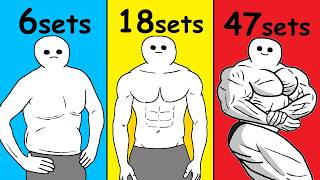

Why More Sets Can Make You LESS Jacked
60sIt flips the common 'more is better' gym myth and name-drops Rich Piana's legendary 8-hour arm workout.
▶ Play Clip"Delivers on the promise with a clear answer and specific weekly set ranges, though a mid-video plug adds minor fluff."
The video tackles the common question of whether doing more sets automatically leads to more muscle growth. It explains that the optimal number of weekly sets varies by body part, exercise selection, and individual experience level, and introduces the concept of 'junk volume' as a counterproductive factor. The creator then provides specific weekly set recommendations for each major muscle group, assuming a twice-per-week training frequency.
The perfect number of sets differs for each person. The video aims to give a rough estimate of weekly sets per body part that viewers can apply immediately to their workouts.
Doing sets past your body's recovery threshold is 'junk volume' and doesn't build more muscle. Rich Piana's 8-hour arm workout is cited as an example of this counterproductive approach.
Exercise taxing level matters. Three sets of deadlifts aren't comparable to three sets of lat pulldowns, and overhead presses aren't the same as rear-delt isolation sets, so exercise difficulty must factor into volume decisions.
Larger body parts can handle more volume than smaller ones, and training intensity determines how many sets you can do before being completely fried. Calves can be hit frequently, while the back cannot.
The golden standard for most people is to split training so each body part is worked twice per week. All subsequent set recommendations are based on this frequency.
For experienced lifters, the chest layout is horizontal press, incline press, and one isolation exercise for 3 sets each, done twice a week, totaling 18 weekly sets. Beginners can drop to 2 sets per movement, totaling 12 sets.
Vertical and horizontal pulls for 3 sets each, twice a week, equal 12 weekly sets. Advanced lifters can push to 18 sets, and low-rep pull-up work can easily push volume over 20 sets.
The main press plus side and rear delt isolations for 3 sets each, twice a week, gives 18 weekly sets. Adding extra rear delt sets (4–5 per session) is recommended and can bring volume to 20+.
Two bicep movement types for 3 sets each, twice a week, yields 12 weekly sets. To hit all three types, use a rotating schedule across workouts. Advanced max is around 18 sets.
Both triceps exercises are isolation movements, and pressing exercises already load the triceps significantly. The golden standard is 12 weekly sets, which can be adjusted based on recovery.
Using a heavy exercise like the cable crunch with progressive overload, six weekly sets is the minimum for noticeable ab thickness. You can scale to 12 sets by combining with an easier exercise, but no more.
For each, a main compound (squat for quads, RDL for hamstrings) plus isolation (leg extension, leg curl) for 3 sets each, twice a week, hits 12 weekly sets per muscle group. Adjust based on how much you prioritize leg training.
Calves are mostly genetic but respond to cumulative work. Even 3 sets twice a week adds up over years, and if adapted, you can train calves up to 4 times weekly — but build up gradually.
There is no one-size-fits-all set number, but a solid baseline is 12–18 weekly sets per body part when training each muscle twice a week. More sets beyond your sweet spot won't add muscle — they'll only add junk volume.
What is 'junk volume'?
Sets performed after a muscle group has already reached its recovery threshold; they don't add muscle and can be counterproductive.
00:42
How many chest sets per week does the video recommend for experienced lifters?
18 sets (3 exercises × 3 sets each, done twice a week).
02:57
What chest set volume is recommended for beginners?
12 sets per week (2 sets per movement pattern).
03:23
What is the minimum weekly set volume for the back?
12 sets per week (vertical and horizontal pulls, 3 sets each, twice a week).
04:13
When can back volume reasonably exceed 20 sets per week?
When doing pull-ups with only a couple of reps per set (e.g., 3 reps), more sets are justified.
04:51
What is the golden standard for shoulder weekly volume?
18 sets per week (overhead press, side delts, and rear delts, 3 sets each, twice a week).
05:34
Which shoulder isolation exercise benefits most from extra sets?
Rear delt isolation, because most people are underdeveloped in that area.
06:01
How can you incorporate all three bicep exercise types without extending workout time?
Rotate them across workouts — do two types per session and alternate the third in the next session.
07:16
Why doesn't the triceps need high direct volume?
Because pressing exercises already load the triceps heavily, so 12 weekly direct isolation sets is enough.
08:19
What is the minimum effective weekly ab volume with a heavy exercise like the cable crunch?
6 sets per week.
08:43
What is the recommended weekly set volume for quads and hamstrings?
12 sets per week each (main compound + isolation, twice a week).
09:09
How often can well-adapted lifters train calves?
Up to 4 times per week, provided they build up gradually.
10:27
Junk Volume Is Real
Explains why training to extremes can backfire, a key principle for programming sustainable volume.
00:42Exercise Taxing Level Affects Set Count
Highlights that set number alone is meaningless without considering exercise difficulty, informing smarter programming.
01:12Twice-Weekly Frequency as the Baseline
Gives a concrete frequency target that underpins all the set recommendations in the video.
02:31Triceps Get Indirect Work from Pressing
Shows how to account for compound movements when counting total weekly volume.
07:28Calves Can Handle High Frequency
Demonstrates that muscle recovery capacity varies by body part, allowing for more training frequency on calves.
10:13[00:02] more jacked? Yes, but no. The answer is a little more complicated because the perfect number is a little different for each one of us. And my mission is to just a rough estimate of the overall amount of sets. I want to give you the
[00:16] perfect number of sets for each body part that you can then apply to your workout right away. Right now, you might be thinking, "Why can I just do like a million sets? I will just push myself really hard and get super jacked." And
[00:28] while in theory this sounds like it should work because more work should equal more muscle, in reality, this is unfortunately not the case. Because each go over, you will not be getting more jacked. You will in fact just be getting
[00:42] less jacked. But why does that happen? Well, the reason is fairly simple. There which you need to understand to get to the bottom of this. If you have ever seen the video of Rich Piana, rest in peace, training his arms for 8 hours,
[00:57] then you already know exactly what junk volume is. It simply means that you are doing sets even after that body part is already gone. You want to completely you hit that threshold of what your body is capable of, there is really no point
[01:12] in going further. So now you know that you should not be blasting an extreme amount of sets because that will do you more harm than good. Because what really builds the most muscle possible is finding that sweet spot that is specific
[01:24] to you. But to find it, you need to realize that not all sets are created equal. Mainly because some exercises are simply less taxing and just overall easier to do than others. You can't really say that three sets of deadlifts
[01:36] the lat pulldown. Or that the barbell overhead press is the same thing as doing a set of rear delt isolation with 10 lb dumbbells. That would just be insane. You really have to factor in how much each exercise taxes you. That's the
[01:50] perfect amount of sets in your routine. Plus, some body parts are bigger and some are smaller, which can also be the reason why it either has a large amount of sets or just a couple. Because the larger the body part is, the longer it
[02:03] could hammer calves almost every day, but you would absolutely not be able to do the same thing for the back. This is also highly connected to the level of intensity in your workouts. If you train like a little cat, of course that
[02:16] because none of them counted anyway. But if you train really hard, you could be completely fried even just after a couple. So you really have to that you understand what are all the factors that you need to consider, let
[02:31] me show you what I would consider the golden standard for the average gym part per body part basis. The amount of training, which in most cases will be split into two workouts. Because as you
[02:44] hopefully know, training each body part twice per week is where you want to be. So let's break it down body part by body part. But before we do that, let me bundle, which will teach you the basics of training, nutrition, and even cardio.
[02:57] So that you know exactly what to do in each point of your journey without link down below to learn more about it. And now let's start it up with the different types of exercises you should do, the amount of sets per week might
[03:11] seem rather high at the first glance. But let me show you that it really isn't The classic layout would be doing the horizontal press, incline press, and isolation exercise for three sets each.
[03:23] And you would do this twice a week, which would total up to 18 sets per week, which some people might think is a lot, but really this is the golden standard for people who already spent some time in the gym. If you are brand
[03:35] new, I can see this layout changing to just two sets per each movement pattern, totaling 12 sets per week. And not only for the chest, but for any body part. something that might seem standard for
[03:47] overwhelming for you. And you don't even need to ask me like, am I still considered a beginner if I already trained for X months? Because it's not about the number of months, it's about the feeling you get when you work out.
[04:00] If you feel like it's still a lot for you, then just do only two sets for overwhelming. And over time, as you adapt, you can go to three sets. So, there is absolutely nothing wrong with doing just two sets per exercise for
[04:13] anybody part if you feel like you need it. On paper, it might look like you are not doing enough, but because you are still a beginner, the threshold of what is considered junk volume for you is so much lower than what it is for a person
[04:25] Now, let's take a look at the number of sets for the back. Because there are two types of exercises, vertical and horizontal, and we do three sets each twice per week, that would equal to 12 sets per week in total. This is around
[04:39] should be doing for your back. And based on how many times per week you are working out and what type of training plan you are doing, this could be increased even more. So, you could for example do three back exercises in one
[04:51] workout and two in the second workout, which would be 15 sets in total. Or in the most evolved scenario, it could be three back exercises in both the first equal to 18 sets per week. I would consider this the absolute maximum for
[05:05] the back, which should be used only by more experienced lifters. The only way if you are doing pull-ups and you are only able to do a couple of them in each set. In that case, doing more sets is completely reasonable. So, it could
[05:19] easily end up being over 20 sets per week. So, to recap, 12 sets per week of back training is around the bare minimum that will be perfectly fine for most sets per week if you are hardcore grinding and up to like 24 sets per week
[05:34] pull-ups where you can only do a couple of reps in each set, which sounds absolutely insane, but if you are doing something like six sets of pull-ups and you can only do three reps in in one of them, it really isn't that crazy.
[05:47] when you factor in the amount of reps, it's completely fine. Now, let's talk about the shoulders. Similarly to the chest, we have three types of exercises. The main press, which is some variation of the overhead press, and two isolation
[06:01] exercises. One for the side delts, and one for the rear delts. So, if we were to do three sets for each one of those exercises twice per week, we would end up with 18 sets per week. And as with the chest, I would consider this number
[06:13] to be the golden standard for shoulders. You could go over 18 sets per week by adding some more sets to the side and rear delt isolation, which you could easily do without destroying yourself, because these isolation exercises are
[06:25] not really that taxing overall for your body. I would especially recommend this for the rear delt isolation in particular, because that's the area most people are lacking in. So, going from just three sets per workout to four or
[06:37] five can be a brilliant idea. So, the best number for shoulders is 18 sets per week, and 20 plus sets per week if you decide to add a couple of extra sets to your shoulder isolation exercises. Now, it's time for the biceps. As with the
[06:51] chest and shoulders, here we also have three types of exercises, but this time it's a little different, as these two types are a must do, and this is more of an optional exercise. So, if we take just these two types of exercises and do
[07:04] them for three sets each twice per week, we would end up with 12 sets per week. I would consider this the bare minimum, but you of course want to include all three types of bicep exercises, but that might hard to fit in your plan. That's
[07:16] why I recommend having just two types at a time. And if you really want to fit all three types in without increasing the length of your workout, you can simply utilize a rotating schedule, where the biceps work in the first
[07:28] workout would look like this, and in the second workout like this. That way, you can hit all three types of exercises while still doing only two exercises per workout. So, 12 sets of biceps per week is around the minimum you should be
[07:40] doing, with have maximum being around 18 sets per week, but once again, you have to be more advanced for that. And most importantly, you have to listen to your body because as you have learned here today, more sets doesn't necessarily
[07:52] mean more gains. Now, let's talk about the triceps because the two types of exercises we are all doing for the triceps are both isolation exercises, which as you know, are not very taxing overall. So, you can really up the
[08:05] to recover from it. After all, it's not something like the deadlift where your entire body just gets rolled over with a bulldozer. The golden standard for the triceps isolation would look like this, which is 12 sets per week. And going
[08:19] number based on your needs is perfectly fine. And while 12 sets per week might seem like not a lot for a body part where we only use isolation exercises to focus it, you have to remember that all
[08:31] the pressing exercises are already hitting your triceps a lot. So, in the grand scheme of things, being somewhere around the 12 sets per week is perfectly fine. And before we get to the lower body, let me show you the number of sets
[08:43] for abs. Here, it can vary a lot based on what exercise you are doing. If you utilize the method I recommend and do an exercise like the machine crunch, cable really focus on progressively getting stronger, then you could get away with
[08:57] just six sets per week. This, in my opinion, is the bare minimum amount which will make your abs noticeably thicker without spending hours on training abs. This number could get scaled up to 12 sets per week either by
[09:09] doing one of these exercises four times a week for three sets each or introducing some a little easier exercise to combine with the main ab exercise and doing this combination twice per week. So, for example, you do
[09:21] the cable crunch for three sets, and after that, you do three sets of the hanging leg raise. I would not recommend doing more than 12 sets per week as even six sets of these main ab exercises per week might feel like a lot for someone
[09:34] who has never seriously trained their abs before. Now, let's finally talk depends on how much you care about training legs. For both the quads and hamstrings, the golden standard would be 12 sets per week for each one of those
[09:47] body parts. For quads, the most basic setup is three sets of a main quad exercise like the squat and three sets of isolation like the leg extensions. You do this twice a week and you end up with 12 sets per week. Same for the
[10:00] hamstrings. You got three sets of the main lift like the Romanian deadlift for example and three sets of isolation like the machine hamstring curl. This setup is perfectly fine for the vast majority of people and is exactly what I would
[10:13] recommend. If you really care about your leg size, this number can be a little about your legs that much, you will be fine even if you decrease this number by a little bit. It's just all about your personal goals. And finally, calves.
[10:27] While you probably know that calves are mostly genetic, that doesn't mean that compounding effect really pays dividends over time. So even if you did just three sets of calf raises twice per week, over the years you would have much more
[10:41] don't even have to put in that much work. And if your number one goal is getting bigger calves, you can do much more than just six sets per week as calves can really take a beating like no other body part. So you could easily
[10:54] train your calves like four times per week because as you get more and more even get sore anymore. So you will be able to put an insane amount of workload on them. But you know, you got to get there gradually. There is no way I would
[11:07] recommend training your calves so many times per week if you are not used to it it. And now you know exactly how many sets you should do for each body part. out the beginner bundle in the first link below if you want to get your
[11:21] for watching and I will see you next time. If you found this video helpful, then you absolutely need to watch this one, you absolutely need to watch this one, too.




⚡ Saved you 0h 11m reading this? Transcribe any YouTube video for free — no signup needed.