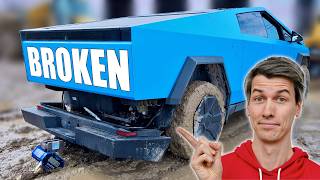

Cybertruck Hitch Snaps at 10,400 lbs!
43sShocking failure below the rated 11,000 lb tow capacity sparks immediate concern and curiosity.
▶ Play Clip"Thoroughly investigates the hitch failure, but the title implies a definitive problem while the conclusion is uncertain."
The video investigates the Tesla Cybertruck's tow hitch failure, which broke at 10,400 lbs of force—below its 11,000 lb tow rating. It examines regulatory requirements, real-world scenarios that could exceed that load, industry practices from Ram, and material differences between steel and aluminum. The conclusion is that while the Cybertruck meets minimum standards, potential dynamic loads and aluminum's fatigue properties raise concerns for long-term durability.
Zach from JerryRigEverything tested the Cybertruck hitch; it broke at 10,400 lbs, less than the 11,000 lb tow rating.
SAE J2807 and J684 specify vertical load requirements: coupling must handle half tow rating (5,500 lbs), ball-coupling interaction must handle 1.3x gross trailer weight (14,300 lbs), and the hitch itself must support 5,650 lbs for 5 seconds.
Dynamic situations like braking, potholes, and downhill gradients can spike vertical loads. A whiteboard analysis showed that with a high center of gravity and 1g braking, the entire trailer weight could rest on the hitch.
Ram engineers use 15% tongue weight (vs. 10% minimum) and target 120,000 miles of real-world towing. They perform fatigue tests on proving grounds, observing G-forces up to 3g.
Steel is three times stiffer, has a fatigue limit (infinite life below a stress threshold), and 5-10 times greater toughness than aluminum. Aluminum lacks a fatigue limit, meaning it weakens over cycles.
EU Regulation 55/2012 requires that critical hitch parts be made of steel unless equivalence is demonstrated, highlighting steel's suitability for towing.
The Cybertruck meets SAE static requirements, but dynamic scenarios could exceed the failure point. Aluminum's fatigue life remains unknown, and time will tell if long-term towing causes issues.
The Cybertruck's hitch meets regulatory minimums, but real-world dynamic loads could exceed its failure threshold, and aluminum's fatigue properties may degrade strength over time. Customers towing at capacity should be aware of these limitations.
What is the minimum vertical load the Cybertruck hitch must support per SAE regulations?
5,650 lbs for 5 seconds.
03:28
What is the endurance limit of steel?
Below a certain stress level, steel will never fail regardless of cycles.
14:55
Why does aluminum not have a fatigue limit?
Aluminum weakens with every cycle even at low stresses; no infinite life threshold.
15:23
What percentage of tongue weight does Ram use for internal testing?
15% instead of the standard 10%.
12:30
What does EU Regulation 55/2012 require for critical hitch parts?
They must be made of steel unless equivalence is demonstrated.
17:53
Meets Regulations
Clarifies that the Cybertruck legally meets SAE requirements despite the hitch failure.
04:08Full Trailer Weight on Hitch
Shows it's theoretically possible for the entire trailer weight to rest on the hitch under braking.
07:48Ram's Customer-Centric Philosophy
Ram engineers go beyond regulations to avoid customer dissatisfaction, contrasting with Tesla's minimum-approach.
11:25Fatigue Limit Difference
Steel's endurance limit vs. aluminum's continuous degradation is key for long-term durability.
14:40Uncertain Conclusion
The video admits uncertainty, highlighting that time will reveal true durability.
18:36[00:02] truck take on its trailer hitch before something breaks? Well, Zach from JerryRig Everything tested exactly this. And the hitch snapped off of the rear casting when the scale was reading 10,400 lb of force, a number that's
[00:17] actually less than the Cybertruck's 11,000lb tow rating. Now, seeing this hitch failure led me to five questions, which we will answer in this video. First, what do regulations say this hitch needs to be able to support
[00:32] considering the vehicle's 11,000lb tow rating? Second, are there any realworld scenarios where we could see the Cybert truck hitch hit 11,000 lb of vertical load, say under heavy braking or perhaps hitting a pothole? Third, what are the
[00:47] industry standards for other OEMs? In the video, we saw Dodge Ram 2500 handle close to 11,000 lb without failing. So, for those who have been in the trucking business a long time, what are their requirements? Fourth, are there any
[01:02] fatigue life concerns considering the Cybert truck's hitch is attached to an aluminum casting rather than a steel frame? And finally, should customers be concerned about towing at rated capacity with a Tesla Cybertruck? All right, so
[01:16] let's start off with how much weight should a trailer hitch support? The Cybert truck has a tow rating of 11,000 lb and as such has a maximum tongue weight of,00 lb. In other words, the amount of weight resting on the trailer
[01:31] hitch when the vehicle is stationary is,00 lb or the industry standard of is,00 lb or the industry standard of 10%. Nothing unusual there. Okay, but what do regulations state the hitch needs to be capable of supporting? Well,
[01:44] there are three critical interactions that the Society of Automotive Engineers SAE point out. First, there's the coupling itself, which attaches to the trailer. Second, there's the internal mechanism of the coupling and how it
[01:57] attaches to the ball of the trailer hitch. And finally, we have the hitch itself, which attaches to the truck. Now, in the regulations, there are all kinds of different forces that will be applied to these components. For this
[02:09] video, we're just going to focus on vertical loads since that's the kind of failure we saw in the video Zach posted. These requirements are all spelled out SapJ2807 and SapJ684. Okay, so for number one, the
[02:24] coupling. This needs to be able to handle half the towing capacity as a vertical load without breaking off or failing. So in the case of the Cybertruck with an 11,000lb tow rating, it needs to be able to handle 5,500 lb.
[02:37] Number two, the interaction between the coupling and the ball. This needs to be able to handle the gross trailer weight times 1.3. So, times 1.3. So, 14,300 lb. Now, you'll note that this is
[02:50] greater than where the Tesla failed. That said, this regulation is not about testing the vehicle itself. It's about testing this coupling. You really don't want this internal mechanism to fail in tension or compression. Both of which
[03:03] have requirements for the same force of at least 14,300 lb. Okay. So, finally, we get to the truck itself. And this is very clear because the regulation states
[03:15] the hitch shall be attached in such a manner that the loads indicated in table 3 are transferred to the towing vehicle without incurring loss of attachment. In other words, it needs to be able to
[03:28] handle these loads without breaking the hitch or breaking off from the vehicle. So the maximum vertical load indicated in table 3 in table 3 is47R plus 480 lb with R being your
[03:40] trailer hitches rating in terms of maximum trailer gross vehicle weight maximum trailer gross vehicle weight rating. So47 * 11,000 lb plus 480 gives you a load of 5,650 lb that you need to apply to this
[03:54] trailer hitch and it needs to be able to withstand it for at least 5 seconds. All right. So, the Cybertruck broke at about 10,400 lb, but per SAPEL, it only needs 10,400 lb, but per SAPEL, it only needs to support 5,650 lb before failure. So,
[04:09] from a requirement standpoint, no problem. Okay, sigh of relief if you're a Cybertruck customer. However, just because you meet the minimum requirements doesn't necessarily rule out the possibility of problems in the
[04:22] real world. So, my next question is, is there a realworld scenario in which you could reach 10,400 lb of vertical load on the trailer hitch? And to be clear, I'm not talking about abuse. That's very easy to
[04:37] the vehicle's weight rating, putting more than a 10% trailer tongue weight, jumping the vehicle while towing, or perhaps flying down the highway at 100 mph and hitting a massive pothole. I guarantee you in the right abusive
[04:52] circumstances, you can break this hitch off. We've already seen videos of it. What I'm curious of is, is there a way to exceed 10,400 lb of vertical load on
[05:04] that trailer hitch following the guidelines outlined in the Cybertruck's owner's manual to the tea? Can you do everything right and still fall into a situation where you'd exceed that vertical load? Okay, so Wes Moral,
[05:17] Cybertruck lead engineer, tweeted, "Zach's test demonstrated about 10 times factor of safety on rated tongue weight. This should inspire confidence to use the vehicle up to its maximum rating." Now, Wes's statement is accurate, but I
[05:32] do think it's worth pointing out, as I am sure Wes is well aware, that 10% of the trailer weight is not the maximum force that you're going to see on the trailer hitch. Why? Well, three simple examples. First, you have load transfer.
[05:46] So, as you're braking, you're going to have some of that trailer's weight shift to the trailer hitch. Second, road irregularities. You're constantly hitting road irregularities as you're driving, whether big or small, and that
[05:59] is changing the loading at the hitch. The biggest concern here would be hitting a pothole at speed, which could spike the G-forces at the hitch. And finally, while the world may be flat, roads are definitely not. If you're
[06:11] traveling downhill, you're going to shift more of the trailer's weight to the vehicle's hitch. Okay, so it's fair to say it has about a 10x factor of safety in a static situation where the vehicle isn't moving on flat ground, say
[06:25] sitting at a stoplight. But in dynamic situations, it is not fair to say that it's a 10x factor of safety. All right, so is it possible that the hitch could ever see its full towing capacity on it? It's time for the whiteboard. So, here
[06:39] we have our Cybert truck and it is towing a MadMax style fuel pod. And this is all designed to be very simple to understand and to prove a point. So, you can look at where is its center of mass and that happens to be about 3 ft
[06:53] back from the trailer hitch from the Cybertruck and it happens to be about 3 ft vertically from that Cybert truck's trailer hitch. Now, if this whole system is to slam on the brakes for a panic stop and we're breaking at 1g, well,
[07:06] then we can look at all of the forces involved and sum them about this point right here, simple statics engineering problem, and set all of those equal to zero, all of those moments. So, this force right here is going to be mass
[07:19] times acceleration, right? Well, we know what our mass is, and we know what our panic stop. So, that's going to give us our 11,000 lb force. Now we multiply that by three. And then we're going to set that equal to whatever force number
[07:33] two is. The force from the trailer hitch pushing up also multiplied by three. Of right? You do the math. Turns out force number two is going to be 11,000 lb that that Cybertruck hitch needs to push up in order to counteract that moment from
[07:48] this high center of gravity mass wanting to push that load as you break onto that trailer hitch. In other words, the entire weight of the trailer is now resting on that trailer hitch. Now, of course, this problem was designed to
[08:01] prove a point. There are very good reasons why you'd never want to tow something like this with a simple passenger truck, but there wouldn't be anything illegal about it. And more importantly, it proves a point. If you
[08:13] have a high enough center of gravity, load transfer alone means you could get the full weight of the trailer on the hitch. Now, you'd probably crash if this happened. That's so much force and it'd be incredibly unstable. But this is just
[08:27] focusing on one variable so far, weight transfer. What about other factors like a pothole? Well, a pothole could add another 3gs of force to the situation. We'll get to where that number comes from later, but consider if you're in a
[08:42] situation where you're breaking and 25% of the trailer load is now resting on the hitch. Of course, not that difficult to think up. We've already shown that you could have much higher than 25%. Then while you're breaking, you hit a
[08:55] bad pothole and get an additional 3gs of force. Well, boom. 25% trailer loading force. Well, boom. 25% trailer loading plus 3 times that 25% and that gets you at 100% of the trailer's load on that trailer hitch. So, there you go. A force
[09:09] big enough with only 2,750 lb of actual weight on the hitch in order to hit the trailer weight as a load. And if you're going downhill, it only makes things worse as you have more weight resting on the hitch. All right,
[09:23] so with some combination of a high CG load, heavy braking, road irregularities, and going downhill, it seems very feasible that you could exceed that 10,400 lb on the trailer hitch where the Cybert truck broke. To
[09:38] me, that seems concerning. Now, obviously, it's a very rare scenario, but even still, it seems possible while following all of the rules. Now, this brings up optimization, right? Because so it's clear, I absolutely don't think
[09:51] the engineers at Tesla are dumb. In fact, quite the opposite. Engineering is always a matter of optimization, and you choose materials, thicknesses, and designs based on where you want the product to be. If you want a hitch that
[10:05] can hold a 100,000 lbs, it's easy to design it to do that, right? But if it You're just wasting money and making something heavier needlessly. But if you go too far in the other direction, the product breaks and now customers are
[10:20] unhappy. So, it's an intentional choice. What should the product be able to withstand? Now, I don't know the answer to this question. So, I chatted with an engineer at Ram to paint a more clear picture. They've been making trucks for
[10:33] a hundred years. So, how do they target where a truck's strength should fall? Okay, some backstory. Independent of this video, Ram is launching the new Ram Charger, a plug-in pickup, which has a tow rating of 14,000 lb. I had the
[10:48] engineers, and I thought, hey, what a perfect opportunity to chat with a traditional automaker and see how they approach towing. And if you haven't seen it, I have a whole video deep diving into how manufacturers land on their tow
[11:01] rating number. It's a fascinating watch. And just so we're clear, this is not Ram's opinion on the Cybertruck. This is simply me taking advantage of a situation I had to chat with their engineers and then, you know, maybe I'm
[11:13] going to compare all that to Tesla. So, the first thing I asked Ram about was the regulations and if they had their own standards or simply go by what the regulations state when it comes to hitch loads. And they basically said the
[11:25] equivalent of, "Oh, the regulations are really easy to meet. If we only met the minimum requirements, customers would be unhappy." So I asked what they meant and they brought up the example of SAPE684, which states, "The hitch shall
[11:39] withstand the applied forces without incurring permanent deformation more than 5° from the original position." And their point here was, okay, imagine a customer sees the maximum load outlined by SAPEL guidelines for the RAM charger.
[11:55] In this case, it'd be just over 7,000 lb. Now, there are dynamic situations in which this can happen. So, the customer has done nothing wrong so far. So, you're using the truck abiding by all the rules and suddenly your hitch bends
[12:09] the rules and suddenly your hitch bends down by 5°. 5 degrees. So, you go to Ram then Ram just points at the regulations and says, "That's allowed. That's fine." I think rightfully you'd be pretty upset. So understandably, Ram has their
[12:23] own internal metrics that the truck needs to handle. Now, they didn't share a ton of specifics. Of course, companies protect their internal info, but they instead of doing their testing with a 10% tongue weight, they do it at 15%,
[12:37] making it harder, and they have their own internal fatigue requirements. For Ram trucks, they target 120,000 miles of realworld towing. Now, internal targets warranties, right? So, when they look at the engineering optimization problem,
[12:52] they're saying, "Okay, who's a very high use at capacity towing customer, basically 95th percentile, and how do we make sure our product keeps them happy for the life of the truck?" So, Ram runs their own fatigue test where they
[13:06] it on their proving grounds on rough roads that impart loading into the truck and trailer. There's bumps and potholes and starts and stops. And the truck and strain gauges and load cells, and they look at the load trace over time. And
[13:21] they said that in addition to the tongue weight, they can see G forces spike as weight, they can see G forces spike as high as 1, 2, and even 3 G's. They did higher than that unless you're traveling at really high speeds or hit a really
[13:34] bad pothole. So, that's where that additional 3G force I mentioned comes from, real world testing. Okay. Now, something else Zach brought up in his video was fatigue limits. So, I asked Ram their thoughts on using steel versus
[13:47] aluminum in their frames and why they choose what they choose. Now, they were quick to point out that they use plenty of aluminum in their products, but for all Ram truck frames, they use steel. And they brought up three big reasons
[13:59] why they use steel versus aluminum. The first thing they mentioned was stiffness. Steel is about three times stiffer than aluminum, meaning it resists bending and deformation better under load. Of course, you don't want
[14:12] your vehicle bending under the loads of towing, but you can also design with material choices and thicknesses to avoid that. The second reason they mentioned was fatigue life. Okay. So, we need to understand something called an
[14:25] SN curve because this highlights a very distinct and powerful difference between steel and aluminum. So, here we're looking at on the y-axis we have stress or s and on the x-axis we have cycles or n the number of cycles. And so what this
[14:40] is showing you is if you apply a certain stress, let's say a high stress for a certain number of cycles, well that's where you can expect that steel to fail. about it in that it has an endurance limit. So after a bunch of stress
[14:55] cycles, eventually it reaches this endurance limit. And so long as your stresses applied to that steel are less than this endurance limit, it's never going to fail. So just as an example, say you're an engineer designing a
[15:09] product and you know that the stresses that are going to be applied to that product, say a truck frame, are never going to exceed a certain stress. Well, you know then that that truck frame will last forever. But if your truck frame
[15:23] happens to be made of aluminum, aluminum does not have a fatigue limit. So the more cycles you have, the weaker it gets always. Even if those cycles are at a very low stress, eventually that aluminum is going to fail. So you have
[15:37] to be very careful about how many cycles is this product going to see and can I ensure that it will never reach a point where that product is going to fail after a certain number of cycles at a certain amount of stress. So again,
[15:51] putting this in context of our hitch test, you can design a truck with a steel frame that meets the SAPE requirements for an infinite amount of time so long as the stresses remain below the fatigue limit. But you can't
[16:05] do this with an aluminum frame. So long-term, steel is the better option. In terms of the Cybert truck, it means the weight required to break the hitch off will decrease over time. Now, I asked Ram if there are any SAPE
[16:19] requirements surrounding fatigue lie for trailer hitches in the United States, and it seems there are cyclic tests for certain hitch types like gooseenecks, but not for this kind of conventional trailer hitch. However, there are
[16:32] fatigue life requirements in Europe, and Ram does ensure that their trucks meet these requirements. It's worth noting the Cybertruck isn't sold in Europe. All right. The third reason they mentioned preference of steel rather than aluminum
[16:44] for truck frames is that steel has a toughness about 5 to 10 times greater than aluminum. So toughness is looking at how much energy a material can absorb without fracturing. In towing applications, you have impact loads at
[16:59] the hitchball. And so steel does a much better job of absorbing these impact loads than you would get from cast aluminum. Another way of describing this is that steel is strong and ductile. So, it can handle high loads, and when the
[17:12] loads get too high, it deforms. Aluminum is also strong, but it's more brittle, so it breaks when the loads get really high. And that's exactly what we saw in Zach's comparison. The Ram probably experienced some deformation, but it
[17:26] didn't break, whereas the Cybertruck's rear aluminum casting did break. So, the Cybertruck uses stainless steel on the outside, which is objectively very tough, but it uses aluminum on the inside. It's like the appearance doesn't
[17:40] really match what's going on inside, which reminds me of something Elon said during the Cybertruck presentation. You want a truck that's tough. You want a tough. I agree. And this leads me to a very
[17:53] powerful quote in the European requirements for mechanical couplings for towing. Regulation 554.2 states, "All parts of the mechanical coupling device or component whose failure could result in separation
[18:08] of the vehicle and trailer shall be made of steel." Wow. Now, it does go on to say other materials may be used provided that equivalence has been demonstrated.
[18:21] Okay. So you'd still need to show that aluminum could demonstrate equivalence. But I think just a very another strong point where it's like, well, steel does application. So this leads us to our final question. Should customers be
[18:36] concerned about towing at capacity with a Tesla Cybert truck? And to be honest, I don't know. Here's what we do know. Number one, the Cybert truck does meet the loading requirements outlined by SAPE for towing at its rated capacity.
[18:51] That's good. Number two, it does seem there are realworld scenarios in which you could reach the tow rating on the trailer hitch, which is above the force we saw the tow hitch break at. That's not good. And number three, the
[19:04] Cybertruck uses aluminum rather than steel for the rear casting, which is we've explained numerous reasons why this is not the ideal material for the job. So, another point doesn't seem great. If I could ask Tesla just one
[19:19] question, it would be how many miles towing at rated capacity is the Cybertruck's rear aluminum casting designed to handle. I think depending on help alleviate a lot of customer concerns. And I think part of the
[19:34] reality of the situation is that time will tell, right? These trucks haven't been out very long. So, how are we to know for certain at this point whether concerned about? But I also can see the
[19:46] argument that there are valid reasons to be concerned regardless because steel seems like a much smarter choice for towing, especially if you're marketing a truck as really tough, not fake tough. So, what do you think? Any engineers
[19:59] watching this that want to provide their opinions or any context? Happy to hear it. Also, a huge thank you to Zach from JerryRig Everything for sending me all of his footage to use in this video. If you haven't yet seen his video, it's a
[20:12] fun watch. You should absolutely check it out. I'll include a link. As always, feel free to leave them below. Thanks for watching.



⚡ Saved you 0h 20m reading this? Transcribe any YouTube video for free — no signup needed.