
The New Day Trading Rule That Changes Everything
42sThe shift from the $25,000 rule to a risk-based margin system is a major regulatory change that traders will find highly relevant and controversial.
▶ Play Clip"Delivers a solid, structured breakdown of 0DTE risks and rules, though the title slightly oversells the urgency."
This video explains the mechanics and risks of trading zero days to expiration (0DTE) options, which expire at the end of the trading day. It highlights the extreme speed of these contracts, the dangers of theta decay and gamma, and provides a disciplined framework for beginners to approach them safely.
0DTE stands for zero days to expiration. These are option contracts that expire at the end of the current trading session, making them extremely fast-moving and sensitive to time.
The old pattern day trader rule, which required a $25,000 minimum and limited trades to three every five days, is being replaced by an intraday risk-based margin system. Brokers will now focus on whether your account can support the intraday risk.
With 0DTE options, every minute matters. If the underlying stock doesn't move in your direction quickly, the contract can lose value fast, even if the chart isn't doing anything dramatic.
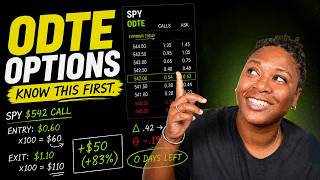
If SPY is around $530 and breaks a key level with momentum, a same-day call option costing $60 could jump to $110, yielding a $50 profit per contract. The key is having a level, real momentum, and a fast exit.
It's crucial to identify the market regime: trending, choppy, or transition. Zero DTE momentum trades work well on trending days but can expire worthless on choppy days. A custom indicator can help filter entries.
Theta decay is accelerated with 0DTE. If the market goes sideways, the option can lose significant value even if the underlying price doesn't crash. For example, a call can drop from $0.70 to $0.40 while SPY only moves up 30 cents.
Gamma makes profit and loss feel violent. A single candle can completely flip the contract's behavior. A put bought for $0.80 can drop to $0.30 if SPY rips a dollar on one reversal candle.
The biggest enemy is overtrading. Fast moves trigger fast emotions, leading to revenge trading. It's essential to build rules to protect yourself from your own impulses.
Check the economic calendar for big news or events. These can be fireworks for same-day options, but beginners should avoid trading around news.
Only trade same-day options with a clear setup and a 'line in the sand'—pre-market highs/lows, yesterday's highs/lows, pivot points, and support/resistance. Use a timeframe stack: mark levels on the 1-hour chart, setups on the 5-minute chart, and entries on the 1-minute chart.
Decide your risk before buying. Max loss should be 1-2% of the entire account, or as low as 0.5% for beginners. Have daily stop limits, e.g., if you're down two losses back-to-back, stop trading for the day.
Trade in one window (first 1-2 hours), only one setup, use levels plus confirmation (breakouts, retests, strong candle closes). Keep stop loss at 30-40% of premium paid, take profits at 30-50%, and limit to two trades per day.
0DTE options are not good or bad; they are just fast and require clean rules. Start small, stay structured, and focus on fundamentals, technicals, and risk management every single trade.
0DTE options are a high-speed tool that can be profitable but are extremely risky without discipline. By following a structured approach—checking fundamentals, using technical levels, and strict risk management—traders can survive and build confidence.
What does 0DTE stand for?
Zero days to expiration.
00:46
What is the old pattern day trader rule being replaced by?
An intraday risk-based margin system.
00:18
What are the three dangers of 0DTE options?
Theta decay, gamma risk, and overtrading.
03:13
What is the recommended max loss per trade for a beginner?
1-2% of the account, or as low as 0.5% for beginners.
06:18
What is the recommended stop loss for a 0DTE trade?
30-40% of the premium paid.
07:19
What is the maximum number of trades per day recommended?
Two trades per day.
07:33
What are the three lenses to check before every 0DTE trade?
Fundamentals/news, technicals, and risk management.
05:23
Time is not your friend
Highlights the core risk of 0DTE: time decay accelerates, making it critical to have a fast exit.
01:15Market regime is key
Emphasizes the importance of identifying trending vs. choppy days to avoid worthless expirations.
02:30Overtrading is the biggest enemy
Stresses that emotional discipline is more important than chart analysis for 0DTE success.
04:390DTE is just fast
Reframes the tool as neutral, emphasizing that rules and discipline are what make it safe or dangerous.
07:48[00:03] expiration. And these are options that expire today, not tomorrow, not next week, today. And because the clock is literally running out, these contracts can move extremely fast. And here's why this is a big conversation right now.
[00:18] the old pattern day trader rule, the one that used to slap you around with the $25,000 requirement and the trade counting rules, you couldn't do more than three every five trading days. That's being replaced by an intraday
[00:33] riskbased margin system. So instead of your broker counting how many day trades that you made this week, they're going to focus on one thing. Can your actual account support the risk that you're taking intraday? So, in this video, I'm
[00:46] going to break down what zero DTE really is, why it can work, and why it's dangerous. And then I want to show you how to approach it like a disciplined trader. Okay, zero DTE means zero days to expiration. And these are option
[01:01] contracts that expire today at the end of the trading session. So, if it's Friday morning and you buy an SPY call that expires on Friday, that's a zero that expires on Friday, that's a zero DTE contract. But with zero DTE, time
[01:15] isn't your friend. It's not on your side. Every single minute that time passes, it matters for your trade. And so if your stock doesn't move soon and in your direction, then the contract can lose value fast. Even if the chart isn't
[01:30] doing anything crazy, when zero DT is good, then the upside is going to be simple. When you catch momentum at a real level, then the contract can move quickly. Picture this. Let's say that spy is trading around $530
[01:46] and it starts pushing up and breaking a key level like a pre-market high or yesterday's high or even a pivot point. And let's say that you buy a same day And let's say that you buy a same day option contract that's a call for 60
[02:00] that's going to cost you about $60 a contract. So the spy pops, momentum follows through and that contract jumps to $110. And so right now you're looking at about $110 per contract. So essentially you made roughly $50 on one
[02:16] contract. And I want you to take note what actually made that work. You have a level plus real momentum and a fast exit. And you took profits quickly. That's it. And this is where a lot of people level up. So they stop asking is
[02:30] this a call or a put situation? And they want to know and pinpoint what type of day it actually is. Is this a trending day? If so, then zero DTE momentum trades can work beautifully. If it's a choppy day, then that same contract will
[02:45] literally expire worthless by one o'clock. And that's also why I love to use this simple market regime tool. Okay, we talked about it in the last video. And so this custom indicator that I built basically labels the
[02:58] environment, trend, chop, or transition, and it gives you the bias. It's not necessary. You don't have to have it, but it's really good for having a quick daytight filter that can keep you out of a lot of bad zero DTE entries. Okay, so
[03:13] make sure you check out my free Trading View indicator in the link below. Why zerodte options are dangerous. Now, here's the part that saves accounts. So, the first danger is theta decay is on turbo. So, with the same day options,
[03:28] you non-stop the entire time you're in it. And so if the market goes sideways, even if it doesn't really drop or move at all, your option can still lose a lot of value. And here's what that looks like. So let's say spy is still around
[03:43] like. So let's say spy is still around $530. You buy a same day call for.7 expecting that breakout and spy even moves up a little bit like 30 cent, but then price starts chopping sideways for 20 or 30 minutes. So your option
[03:58] 20 or 30 minutes. So your option contract can drop from.7 cents to 40 even though spy's price didn't crash. And that's that's basically zero DTE. Sideways action can quietly drain that contract. Now the second thing gamma
[04:12] makes the profit and loss feel violent. So zero DTE options can change sensitivity fast and that's what the gamma will show. So one candle can completely flip how the contract behaves. For example, let's say you buy
[04:26] behaves. For example, let's say you buy a put for 80 cents and then spy rips a dollar on one reversal candle. Your put can drop down something like 30 cents almost immediately. And that's why zero DTE feels like your profit and losses on
[04:39] a bungee cord. Now, the third danger, the biggest enemy isn't even the charts, but it's actually overtrading. Because zero DTE moves so fast, it triggers fast emotions at the same time. So, one loss turns into another entry, then another,
[04:55] You're basically [music] trading your feelings. And trust me, I've been there. And if you've done it, you're not bad at trading. You're just human. But you are responsible for building the rules that protect you from your own impulses. In
[05:10] my opinion, if you're just starting off, then this is how you should approach zero DTE options. You don't have to be afraid of them. You just have to follow rules. When you're trading same day expiration options, I want you to think
[05:23] in three different lenses every single trade. So, first thing is to check fundamentals and news. Check the calendar for any big news or events. Those [music] things can be fireworks for same day options. So, if you're new,
[05:37] I really wouldn't suggest cha trading around news. The second thing is going to be technical. Only trade same day options if you have a clear setup and a line in the sand. That's pre-market highs and lows, yesterday's highs and
[05:50] lows, pivot points, support and resistance levels, different things like that. Okay? And so when you're marking up those levels, use the time frame stack. If you're day trading, mark up your levels on the 1 hour chart, your
[06:02] setups on the five minute chart, and your entries to get triggered on the one confirmation. And so for me that could be something like the MACD lining up on the time frame that I'm trading. I'm not buying calls into weak momentum. And the
[06:18] last thing is risk management. Decide your risk before you click buy. And I would say a max loss of 1 to 2% of the entire account. And if you're new, even something as low as.5% is good. And also have your daily stop limits for your
[06:34] account. Let's say if you're down two losses back to back, be done. Okay? Don't go back in that day. If you have a small account, that's perfect. This is where discipline is going to be built. Start with one contract if you need to.
[06:47] Your job early on isn't to hit those home runs, but it's to survive and get reps in. And if you want training wheels, then here's a beginnerfriendly way to do it. If you're going to trade same day options, trade in one window.
[07:02] So maybe within the first hour or 2 hours of the day, and then you're done. only trade one setup. So, use levels plus confirmation like breakouts and a retest or if you're looking at a strong candle close. Keep your stop loss 30 to
[07:19] 40% of the premium that you paid. That's preddecided. And your take-profit levels, you can start to scale around 30 or 50% and only leave runners if the trend is clean. For the maximum number of trades per day, I would say two.
[07:33] seriously too because again confidence in options isn't built by taking more trades. It's going to be built by taking better trades with smaller size and doing that on repeat until it becomes automatic. Here's the truth about zero
[07:48] DTE options. They're not good or bad. They're just fast and fast tools do require clean rules. So if you're new, you don't have to prove anything. Start small, stay structured, and focus on things that actually move the needle.
[08:03] Fundamentals, technicals, and risk management every single trade, okay? And that's how confidence gets built. Also, if you like this video, please make sure you click that thumbs up button for me. It really helps the channel. Also,
[08:17] subscribe and click that notification bell so that you get notified anytime I right, and I'll catch you on the next one. one. [music]
⚡ Saved you 0h 08m reading this? Transcribe any YouTube video for free — no signup needed.