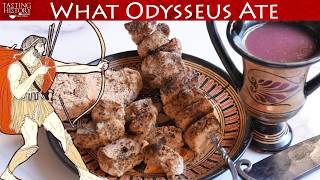

Ancient Greek Potion That Turns Men into Pigs
45sThe dramatic transformation of men into pigs by a magical potion is highly visual and shocking, perfect for hooking viewers.
▶ Play Clip"The title accurately promises a culinary exploration of Homer's Odyssey, and the video delivers exactly that."
This video explores the food described in Homer's 'Odyssey', recreating two dishes: kykeon (a drinkable potion) and roast pork with barley. It also delves into the cultural and historical context of eating in ancient Greece, highlighting how food reflects social status and divine interactions.
The video focuses on recreating dishes from Homer's 'Odyssey', emphasizing that Odysseus eats a lot of food on his journey home.
Kykeon is a drinkable potion described in the 'Odyssey', made with wine, barley flour, honey, and cheese. It was used by Circe to drug Odysseus's crew.
Kykeon requires 1/2 cup Pramnian wine (or dark dry red wine), 1 tbsp grated hard goat cheese, 1/4 cup honey, and 2 tbsp barley flour. The wine is watered down half and half.
The new kykeon is more liquidy than the porridge-like version made in 2020, due to using barley flour instead of whole barley groats.
Eumaeus serves Odysseus roasted suckling pig sprinkled with white barley meal, accompanied by honey-sweet wine.
The pork dish uses 3/4 lb pork, olive oil, salt, barley flour, coriander, celery seed, and either cumin or fennel. The pork is coated in the flour mixture and roasted.
The 'Odyssey' emphasizes meat (especially beef), wine, and bread, while downplaying common foods like fish, fruits, and vegetables, reflecting heroic ideals rather than actual diets.
Polyphemus is a shepherd who makes cheese from sheep and goat milk. Cheese was a common food but seen as lower status in literature.
Odysseus uses a very strong wine given by Maron, which requires 20 parts water to 1 part wine, to get Polyphemus drunk.
The blind prophet Tiresias warns Odysseus not to harm the cattle of Helios on the island of Thrinacia, or his ship and men will be destroyed.
Eurylochus convinces the crew to sacrifice one of Helios's cattle, leading to their destruction by Zeus.
The roast pork is simple but flavorful, with cumin or fennel as the dominant spice. It would be even better cooked over an open fire.
The kykeon is much improved from the first version: more liquid, well-balanced, with honey sweetness. The cheese adds saltiness but is not essential.
The video successfully recreates two ancient Greek dishes from the 'Odyssey', showing that with adjusted recipes, they can be palatable. The exploration of food in the epic reveals cultural values and social hierarchies of the time.
What is kykeon?
A drinkable potion made from wine, barley flour, honey, and cheese, described in Homer's 'Odyssey'.
00:51
What ingredients are used in the kykeon recipe?
1/2 cup Pramnian wine (or dark dry red wine), 1 tbsp grated hard goat cheese, 1/4 cup honey, 2 tbsp barley flour.
03:14
How is the wine prepared for kykeon?
The wine is mixed with an equal amount of water (half wine, half water).
03:47
What is the significance of barley flour in the pork dish?
It is sprinkled on the roasted pork as part of a religious practice, similar to sacrifices.
09:47
What spices are used in the pork dish?
Coriander, celery seed, and either cumin or fennel.
10:56
How long should the pork be roasted?
At 425°F (220°C) for 18-20 minutes.
11:29
What does the 'Odyssey' emphasize in its food descriptions?
Meat (especially beef), wine, and bread, while downplaying fish, fruits, and vegetables.
12:50
Why is cheese considered a common food in the 'Odyssey'?
It is associated with shepherds and common people, not heroes.
14:32
What wine did Odysseus use to get Polyphemus drunk?
A very strong wine given by Maron, which required 20 parts water to 1 part wine.
16:27
What warning did Tiresias give Odysseus?
Not to harm the cattle of Helios on the island of Thrinacia, or his ship and men would be destroyed.
18:14
Kykeon as a Drinkable Potion
Reveals the mythical potion's ingredients and its role in Circe's magic.
00:51Food in the Odyssey vs. Reality
Highlights the discrepancy between epic food descriptions and actual ancient Greek diets.
12:34Maron's Wine Strength
Illustrates the Greek practice of watering down wine and the extreme strength of Maron's wine.
16:27Sacrificial Practices
Provides detailed description of ancient Greek sacrificial rituals from the epic.
20:41[00:00] I feel like most people know at least the basic plot. Essentially, Odysseus is on a really long trip home after the Trojan War. but what usually gets overlooked is that he also eats a lot of food along the way.
[00:15] So today I am going to recreate two of the dishes that are served to Odysseus on his journey home. So thank you to Wildgrain for sponsoring this video as we cook for Odysseus, Eh, still Tasting History.
[00:36] So, when I decided to cook something from the 'Odyssey', I knew that I had to do two dishes. Something new, of course, but then also this was just the perfect opportunity unpleasant things I've ever made here on the channel,
[00:51] kykeon. Now I first made that way back in 2020 when I first started the channel. And the version that I made was more based on the description from the 'Iliad'. Now, I did make an updated version in the 'Tasting History' cookbook, but even that was still really
[01:10] thick and probably should be best eaten with a spoon rather than drunk out of a cup. But the version that is described in the 'Odyssey' is definitely a drinkable potion. The drink is mentioned in book 10 when Odysseus and his crew find themselves on the aisle of Aeaea,
[01:25] which while a mythical island is often suggested to have been off the coast of Italy south of Rome. Mount Circeo taking its name from the sorceress who lived there, Circe. Not to be confused with my cat Cersei, who is actually named after Cersei from 'The Game of Thrones'.
[01:39] his crew end up meeting Circe, who invites them so kindly into her home. she set them upon chairs and benches, and mixed a mess of cheese and barley meal,
[01:53] but then drugged it with wicked poisons to make them utterly forget their homes. And when they drank the potion she turned them into pigs with her wand, and Circe flung them some acorns, fruit, and mast - food greedily eaten by swallowing swine."
[02:12] Maybe it was that she was trying to neutralize them. She saw them as a Regardless, what sucks for them is that while they looked like pigs, they still had the minds of men.
[02:29] So that's depressing because they remembered everything that had happened to them. Now eventually Odysseus would also be given this kykeon, but he did not have the effects that they did because he had been given an antidote by the god Mercury.
[02:45] "Plucked from the ground... black at the root, while the flower was white in milk. The gods call it moly, and to dig it up is a great labor for mortal men, Now despite what my doting mother says,
[02:58] I am but a mortal man, and so I was unable to dig up this moly root. So I'm going to not include any of the wicked poisons that Circe added to her concoction. So for this non-wickedly poisoned version of kykeon, what you'll need is
[03:14] 1/2 cup or 120 ml of Pramnian wine. So, I'm guessing like me, And I think you do have to say it Pramnian, but that was the wine that grew on Mount Pramnos on the island of Ikaria.
[03:30] And it was the wine that was said to be associated with the god of wine, Dionysus. Aristophanes said that it was a hard wine And therefore it should never be drunk without watering it down.
[03:47] You can't drink this wine straight. That is how strong it is. So find the darkest and the driest red wine that you can and then mix it with some water. I am going half wine, half water. Then you'll need 1 tbsp of grated hard goat cheese like Kefalotyri.
[04:05] And you don't want to use pre-grated cheese because it does not melt as well. Unfortunately, it seems that my neck of the woods is having like a Greek cheese shortage because I called all around. I couldn't find any that wasn't pre-grated so that's what I'm using,
[04:18] and I just have to go into this knowing that. So, do as I say and not as I do. Then, 1/4 cup or 85 grams of honey and two tablespoons of barley flour. So start by toasting the barley flour in a dry pan over medium heat for four to five minutes,
[04:32] just until it starts to darken up and becomes fragrant. And then once it does, And I'm realizing now that I could have just toasted it in that saucepan so I didn't have to dirty up two pans, but here we are
[04:45] just to warm the honey and then mix the flour and the honey together. you can add in the cheese which should... Again, mine wasn't great,
[05:00] but eventually it did melt enough that I could add in my watered down wine. and then it can be drunk whenever you're ready to turn your guests into swine. Now like I said this is a very different consistency than the one that I made back in 2020.
[05:16] That one was more porridge-like partly because of the wine to barley ratio that I used, and partly because I used full barley groats back And in today's version I am making I'm using
[05:32] barley flour or barley meal which is more like what you would use to make a bread or something like that. And they still use it today in parts of Greece, namely on the aisle of Crete to make a sort of hard barley bread.
[05:46] They call them paximadia or barley rusks, but really they're barley hardtack. I bought these when I was in Greece in 2023, 3 years ago,
[05:58] and they're still just as hard as they were the day that I bought them. So good job to these, for their staying power. Now, if you don't want really hard barley bread, then
[06:10] you want to probably make your own bread at home, like a nice soft wheat bread, a sourdough perhaps, using the bread from today's sponsor, Wildgrain. My favorite day of the month now is when my Wildgrain box arrives at my door
[06:24] because I know that within 20, 25 minutes, my entire house is just going to smell like a bakery. Because Wildgrain is the first bake from frozen subscription box that gathers breads, pastas, and artisal pastries from small bakers around the country
[06:39] And so all you have to do is take the dough and put it in the oven and actually do the baking. 20, 25 minutes and you're done. And the finished products are always unbelievable. They've got wonderful pastries again,
[06:55] like the the croissants and they have biscuits and the best chocolate chip cookies. I know I'm always saying this, but seriously, the best chocolate chip cookies. I've started to double up my order every time I get it, and I still eat every darn cookie.
[07:10] They also offer a number of gluten-free options and vegan options, and they have protein boxes So check out Wildgrain by clicking my link in the description, wildgrain.com/tastinghistory,
[07:24] or just click this QR code. And new customers will get $30 off of their first box, plus free croissants for life. And now on to our next dish. So after Circe turns
[07:36] the crew back into humans, from pigs to humans, they kind of hang around for a while. Actually, a long while because it turns out Odysseus has the hots for her.
[07:48] So they're there for a whole year. When they eventually do leave, though, they go through a bunch of different stuff. Odysseus goes to the Underworld. the passage between the monster Scylla and the whirlpool Charybdis
[08:03] before ending up on an island filled with the sun god's sacred cattle. One of these men kills and eats one of the cattle, and in retribution, and kills all of the crew save for Odysseus.
[08:17] So when Odysseus finally does get back to Ithaca where he's actually the king but has been gone for about 20 years, he is alas alone. Odysseus does not just waltz on into his old palace and say,
[08:33] since he's been gone, a bunch of suitors have kind of taken over the place and are eating all of his food and are wooing his wife Penelope. Instead, Athena turns him into a beggar or kind of makes him look like a beggar
[08:49] and sends him to his faithful servant and swine herd, Eumaeus's house. And here, Eumaeus shows him some of the first truly selfless hospitality that Odysseus has experienced in decades.
[09:01] Choosing two sucklings, he carried them in, slaughtered and singed them both, then cut them in pieces, and spitted them on skewers. Then, when all was well roasted, he served it to Odysseus, piping hot on the skewers,
[09:17] sprinkling the meat with white barley meal. Then he mixed honey sweet wine in a bowl of ivy, urging him: 'Eat now, stranger - this is food that a servant can offer - suckling pig.
[09:30] men that regard not the wrath of the gods, nor the call of compassion." Now while I could just roast a piece of pork plain and then sprinkle some raw barley flour over it,
[09:47] it's going to be pretty gross - rather tasteless. And really, the sprinkling of the barley flour was actually part of a religious thing. They would do that in sacrifices and things like that.
[09:59] more barley flour and actually coat the pork for some flavor. we know were being used during this period.
[10:11] period that the 'Odyssey' is supposed to be taking place, the Mycenaean period about 1650 to 1100 BC. Archaeology from palaces of this time show that coriander, cumin,
[10:26] And while eaten by the wealthy, they would have also been something I think commonly available to the common man like a swine herd, so we're going to use some of those just to flavor up this pork.
[10:41] So to make this pork dish served by Eumaeus to Odysseus, what you'll need is 3/4 pound or 340 grams of pork, any cut will do. 1 tbsp of olive oil, 2 tsps of salt, 1/2 cup or 70 grams of barley flour,
[10:56] 1 tsp coriander, 2 teaspoons celery seed and a 1/2 teaspoon of cumin or fennel. Both are very dominant flavors, so I wouldn't use both. I'd just pick one. in the olive oil and sprinkle with plenty of salt, rubbing it in.
[11:14] Then leave those to sit for about 10 minutes while you add the herbs And then toss a few pieces of the pork into the flour mixture and get them coated all over. Then skewer each piece until an entire skewer is filled up.
[11:29] if you have a barbecue or if you want to use your oven, you can pop it in the oven at 425° F, 220° C. Then roast them for about 18 to 20 minutes or until the pork is cooked all the way through.
[11:44] It really does actually help get it out there. It helps the channel more than I can tell you or as much as I just told you. And I can take a look-
[11:56] rather we can take a look at the other foods mentioned in the 'Odyssey'. Homer's 'Odyssey' is absolutely filled with talk of food, so I'm not going to
[12:08] cover everything because we'd be here all day. Plus, it does kind of get repetitive. They ate these same kind of things pretty much throughout. So I'm going to pinpoint a couple of the most important instances where they eat something where
[12:22] we can also glean something about what the Greeks of this period, or probably actually Homer's period which was some centuries later were thinking about food because
[12:34] actually the food in the 'Odyssey' is not at all indicative of what the average person was eating, or even the wealthy people of Greece were eating at the time. Even though there are a few mentions of hunting, fishing, seafood,
[12:50] fruits, vegetables, they are sparse, even though those were all staples of the diet. What you hear a lot more about is meat, namely beef, wine,
[13:02] and bread. And the beef, or rather really any meat that is mentioned, is only ever cooked roasted. It's never boiled, which would be the more common way to cook meat in years to come.
[13:15] In fact, Athenaeus, who lived a thousand years, give or take, "Where does Homer say that any of the Achaeans ate fish? So I think it's most interesting to explore those times when either they were eating forbidden beef
[13:33] or when they were forced to eat other meat like when they were on the island of the Cyclops. which is the home of the one eyed race of giants known as the Cyclops.
[13:48] And in need of food, they end up at the cave of one of the Cyclops named Polyphemus. 15th century terracotta figurine of Polyphemus,
[14:00] which I can only imagine was the inspiration for the alien in the 1980s movie 'Mac and Me.' Anyway, Polyphemus was a shepherd of sheep and goats. Greek hero could eat, they were really a B tier meat.
[14:15] The S tier meat being beef, of course, but in a pinch they could eat that. But the thing is those meats were really more associated with kind of common people. Even more common was the fact that Polyphemus was taking the milk of these animals and making
[14:32] cheese. Again, people were eating cheese during this period, people in all tiers. We know from archaeologists that everybody was eating cheese. But in literature, it's seen as a food for the common people. But when you are starving,
[14:49] you are allowed to eat anything, I guess. And so, Odysseus and his men creep into the cave of Polyphemus. he had more lambs and kids than his pens could hold...
[15:03] bowls, and milk pales into which he milked were swimming with whey. When they saw all this, my men begged me to let them first steal some cheeses, they would then return, drive down the lambs and kids, put them on board and sail away with them."
[15:21] It really kind of makes you feel bad for Polyphemus. He's just gone through all of this work to raise these sheep and goats and milk them and make the cheese and then these yahoos come in and steal everything.
[15:34] At this point, he is the one who has been wronged, but he's about to do something that really kind of makes the audience turn on him. Odysseus and then takes two of the men and smashes them into
[15:50] the ground. "Then he tore them limb from limb and made ready his supper. marrow, and entrails,without leaving anything uneaten...
[16:02] with human flesh, he washed it down with a drink of milk..." And here too we get an insight into what the Greeks of the time were eating and specifically
[16:14] drinking. Because in order to escape, Odysseus decides he needs to get this cyclops drunk. And so he pulls out a wine which is supposed to be the best kind of wine.
[16:27] It was given to him by the Thracian Maron for thanking him for not killing him. "Maron... gave me seven talents of fine gold, in a silver mixing bowl, with twelve jars of sweet wine, unblended, and of the most exquisite flavor....
[16:42] When he drank it, he mixed twenty parts of water to one of wine, so marvelously sweet that it was impossible to stop from drinking." As I mentioned earlier, the Greeks would always water down their wine.
[16:57] Only barbarians drank undiluted wine, but usually it was, you know, one part wine, maybe two parts water, three parts water, four parts water. So a wine that needs twenty parts water has to be something really, really strong.
[17:13] But that means it is the perfect wine to get a cyclops drunk when drunk undiluted. So after Polyphemus has several bowls of it, he passes out, giving Odysseus the opportunity to stab him in his one eye so that they could make their escape.
[17:30] it turns out that Polyphemus had like a really famous and powerful dad, Poseidon, the god of earthquakes and the sea. And so when Poseidon learned
[17:43] that Odysseus had poked his son's eye out, he got mad and basically said, okay, well, your trip back to Ithaca is going to be a very unpleasant one. So the next time that Odysseus had the opportunity to annoy one of the gods, he really tried
[18:01] He was even warned two times to not make this mistake again. The first was when he was in the Underworld and the blind prophet Tiresias told him that
[18:14] you already made Poseidon mad, but I think- I think that you can still make it home to Ithaca all right. You and your men as long as you don't screw things up when you're on the island of Thrinacia.
[18:27] "There you will find the sheep and cattle belonging to the sun-god Helios, who sees and hears all. If you leave these flocks and herds unharmed, you may yet after much hardship, reach Ithaca.
[18:39] But if you harm them, I predict the complete destruction of your ship and your men and when you arrive, in another's ship, you will find your home overrun by men eating your food and wooing your wife."
[18:53] Now the audience already knows that this is happening. We have seen that his home is overrun by a bunch of suitors who are eating all of his food and who are wooing his wife Penelope. But at this point,
[19:07] Odysseus doesn't know that. So, he still has some hope that uh things might turn out just dandy. Now Odysseus sees Circe, the sorceress, again, and she too warns him, you're going to run into some cows
[19:25] that belong to Helios. Don't touch those cows. Don't do it. And so maybe because she felt bad about turning his crew into pigs, she even gave them a bunch of food so that they wouldn't be tempted to eat those darn cows.
[19:39] Unfortunately, they ate pretty much all of the food. But "They were forced to wander in search of game, fish, and foul, whatever might come to their hands.
[19:52] Now today we might think of fishing and hunting as manly pursuits, but in Homer's time less so because they were the pursuits of the common people. Wealthy, or heroes, didn't need to hunt for their food or fish for their food because
[20:10] they had domesticated animals that were there to feed them. It was only poor people who couldn't afford those animals that had to do the hunting and fishing. But again, they were hungry and so they needed to do what they needed to do. Unfortunately, in every group,
[20:27] there is always someone who screws it up for everyone else. And on Odysseus's crew, that man was Eurylochus. While Odysseus was sleeping, Eurylochus convinced the others that so long as they sacrificed one of the cows to the gods
[20:41] and then promised to build a temple to Helios when they got back to Ithaca, they should be good to eat just one of them. And while this was a bad thing for them and for Odysseus, it's a good thing for us
[20:53] because it's going to give us a glimpse into the sacrificial practices of the day in some decent detail. Essentially, they get the cow and then they stand around it and pray and take oak leaves
[21:08] and put it onto it because they had run out of barley. And originally, "After they prayed they killed the cows and butchered them; they cut out slices of the thigh,
[21:21] wrapped them in two layers of fat, and laid pieces of raw meat on top of them. They had no pure wine to pour over the flaming sacrifices, so kept pouring on a little water from time to time and roasted the entrails over the fire. When the thighs were done and they had tasted the inner parts,
[21:38] they cut the rest up small and put the pieces on spits." Now for me, waking up to the smell of bacon cooking is just one of the best experiences a person can have. For Odysseus, waking up to the smell of beef cooking was really not a good thing.
[21:55] And he says a little prayer to the gods who were going to be mad and then goes and chastises his men and then kind of resigns himself to the fact that they are screwed.
[22:08] Then they actually keep eating the cows. They kill like six more, but eventually they get off the island and Zeus sends a thunderbolt and destroys their ship, kills all of the men. Odysseus is the only one that survives.
[22:22] Eventually, he makes it alone to Ithaca where Eumaeus makes him a dish, And here we are the kykeon and roast pork with barley served to Odysseus in Homer's 'Odyssey'.
[22:38] So I'm going to start with a piece of the pork here. I'm not sure that like the crusting is actually going to make like a crunchy crust, but it does- it is going to give it some texture. And again, it's there more for the flavor. Smells good. Definitely smells like the cumin.
[22:56] That is the dominant odor. If you're going to use fennel, that's going to be the dominant odor. So you don't really need that much in comparison with the other spices. Here we go. [chomp chomp]
[23:11] Simple, but rather flavorful. I think if it was over an open fire, even better. You're going to get a lot more of the, you know, open fire flavors.
[23:26] But the pork is nicely done. And now, my friends, the kykeon. I am having flashbacks to the first time that I drank this.
[23:41] This is much more liquidy. It is more like a thick wine rather than a watery porridge. It's a pretty color. There are still a bit of pieces of cheese kind of floating in it,
[23:54] but I think a good deal of it kind of integrated. Anyway, cheers.
[24:10] Okay. I actually think that I saved this. That I've made a version that is something a human would want to consume.
[24:29] Has a lot more honey in it. The wine is watered down, so it just mixes better. It's not super strong of any one flavor. The thickness from the barley flour, it is thicker than regular wine would be,
[24:45] but it's not chunky like when you use full groats. The cheese is not necessary. Not just because of- there is kind of a texture to some of the pieces that haven't melted, but
[25:02] it's more that it's just it's a rather salty cheese and they would have all been rather salty. But it's actually pretty good. Not so good that I actually need to keep drinking it, but I don't hate it.
[25:16] And I hated the first one. I will say that. So I'm going to call that a win in my book. No wicked poisons, no baneful potions, so there is that. But,
[25:35] you know, other than that, it's pretty spot-on, I think. Who knows? Homer was not really writing a recipe book. He was just writing down, you know, we were lucky to even get the information that he actually left us.
[25:49] Anyway I think that I'm also going to do a video on maybe what the Trojans would have been eating, what we know about Trojan food. So
[26:02] maybe keep an eye out for that. I haven't started the research and I never really know. So, I maybe I shouldn't even mention this. Hopefully I find some good information. I can make a Trojan meal from the 'Iliad'. Anyway,
[26:16] I'll see you next time on Tasting Mythology on Tasting History.


⚡ Saved you 0h 26m reading this? Transcribe any YouTube video for free — no signup needed.