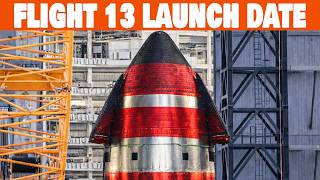

Starship Flight 13: No More 7-Month Wait!
45sThe promise of an imminent launch after a long wait creates immediate excitement and curiosity.
▶ Play Clip"Title accurately promises updates on Flight 13; content delivers detailed timeline and analysis."
Starship Flight 13 is approaching much faster than Flight 12, with SpaceX aiming for a launch between June and July 2026. The mission will attempt the first full orbital flight of a Starship, marking a historic milestone. However, delays may arise from Booster 20, which needs to incorporate lessons from Booster 19's failure.
No seven-month wait; flight is imminent with major improvements from SpaceX engineers.
SpaceX spent over $15 billion on Starship, compared to $400 million on Falcon 9.
SpaceX filed an STA for Flight 13 two months before Flight 12, showing advanced planning.
First time SpaceX requests radio frequencies for a full orbital ship profile; ship will go orbital.
SpaceX builds twice as many ships as boosters; ships are more complex and needed for Mars.
Ship 40 completed cryo tests in early May, now undergoing Raptor 3 engine installation.
Based on 75-day benchmark from cryo completion, Flight 13 could land before mid-July 2026.
Booster 20 hasn't started testing; lessons from Booster 19's failure must be applied first.
Likely repeat of Flight 12: suborbital ship, splashdown in Indian Ocean, no ship catch yet.
Starship Flight 13 is a critical stepping stone for the V3 generation, aiming to validate engine and control systems before more ambitious milestones like a ship catch.
How much has SpaceX spent developing Starship?
Over $15 billion.
01:06
What is the launch window for Starship Flight 13?
May 29, 2026 to November 29, 2026.
02:40
What is historic about Flight 13's ship profile?
It will be the first full orbital flight of a Starship.
03:14
Why does SpaceX build twice as many ships as boosters?
Ships are more complex and needed for orbital flights, propellant transfer, and Mars missions; boosters are larger and more expensive, so they prioritize reuse.
04:50
What caused Booster 19's failure on Flight 12?
After stage separation, Booster 19 flipped rapidly and abnormally, causing most engines to fail; only one engine ignited for landing burn, and it impacted at over 1,450 km/h.
07:43
What is the estimated launch date for Flight 13 based on Ship 40's cryo completion?
Before mid-July 2026, potentially earlier.
07:05
What is the main bottleneck for Flight 13's launch timeline?
Booster 20, which hasn't started testing and needs to incorporate lessons from Booster 19's failure.
07:29
Starship vs Falcon 9 Cost
The $15 billion vs $400 million comparison highlights the massive scale of investment in Starship.
01:06First Full Orbital Flight
Historic first for SpaceX requesting orbital frequencies, marking a major milestone.
03:14Booster 19 Impact
Description of booster slamming into Gulf at 1,450 km/h is dramatic and underscores the failure's severity.
07:43[00:00] While the excitement from Starship Flight 12 is still sky-high, we're already getting fresh official updates for the next big one. Starship Flight 13. The best news? We won't have to endure another long seven-month wait.
[00:13] This flight is coming up very soon. Even more exciting, it reflects major improvements from SpaceX's top engineers, making it significantly more reliable and successful than Flight 12. This mission is definitely one to watch closely.
[00:27] So, let's dive in and explore everything you need to know about Starship Flight 13. If you had more money than anyone else on Earth, like legitimately the richest person alive,
[00:39] what would you do with it? Retire in absolute luxury? Sip cocktails on your own private island? Zero responsibilities? Pure bliss? And sure, it wouldn't be anything like Little St. James.
[00:51] But Elon Musk? He looked at that same mountain of money and said, Let's build a rocket. According to SpaceX's IPO financial filings, the company has spent over $15 billion developing Starship.
[01:06] And that figure becomes almost absurd when you hold it next to Falcon 9, which costs roughly $400 million to develop. That's not a rounding error. That's a completely different universe of investment.
[01:19] So why does he keep going? Why keep pouring money into this? Because Starship isn't just another rocket. Starship is how humanity changes its relationship with space forever. Falcon 9 moves satellites.
[01:31] Starship moves civilizations. That's the difference. And that's why Musk keeps pushing. And that momentum, it's not slowing down for anyone. After Flight 12, the FAA acknowledged there had been an anomaly with the booster during the flyback phase.
[01:46] But instead of immediately opening a mishap investigation and making life difficult for SpaceX the way they have in the past, the agency simply put out a statement saying they were assessing the operation and that a mishap determination has not been made at this time.
[02:01] It almost feels like the FAA has finally started to grasp just how significant Starship really is. And before the dust had even settled on that flight, less than a week later, official details about Flight 13 were already starting to surface.
[02:15] What we found was more interesting than anyone expected. SpaceX filed a special temporary authority, or STA with the FCC for Starship Test Flight 13.
[02:27] And here's the part that'll make you do a double take. They filed it two months ago. You did not mishear that. While the rest of us were still watching Flight 12 replays, SpaceX was already meticulously planning the next one.
[02:40] The authorized window. May the 29th, 2026 through November 29th, 2026. A full six-month launch window. So the launch is confirmed somewhere inside that range.
[02:53] Could be June, could slide into July. We'll break that timeline down in just a moment. But honestly the when is almost secondary to the what because the flight profile is where things get really interesting The flight profile and this is the part worth paying close attention to Super Heavy configuration will be similar to Flight 12
[03:14] It'll splash down in the ocean again. But ship, she is going orbital, full orbital flight. And this is a historic first. This is the very first time SpaceX has ever requested radio frequencies
[03:26] for a full orbital ship profile. That's not just an incremental step forward. That is a statement. Are you as hyped as I am right now? If yes, drop a Go 13 in the comments below.
[03:39] Let's see it. And if you haven't subscribed yet, hit that button. Because next up, we're going deep on the actual launch date for Starship Flight 13, and trust me, you do not want to miss that. Now, predicting a launch date isn't something you do by throwing a dart at a calendar.
[03:54] A real launch timeline depends on a web of variables, vehicle readiness, launch pad status, regulatory approvals, and official word from SpaceX itself. So, Yadid, before we talk dates, let's do what we always do here, start with the hardware.
[04:10] According to the current plan, the first two Starship V3 vehicles, Ship 39 and Booster 19, have already made their mark out over the ocean. So, the natural next parent line is Ship 40 and Booster 20.
[04:24] And here's a fun detail. Divide ship's number by boosters number, and you get exactly two, which actually aligns perfectly with something Elon Musk once said. The Starship production pipeline is full,
[04:36] and will complete roughly ten more ships and about half that number of boosters this year. This isn't a coincidence. It's deliberate production strategy. SpaceX intentionally builds twice as many ships as boosters, and for good reason.
[04:50] Ships are more complex, and they need more of them. for orbital flights, propellant transfer, and eventually Mars missions. Boosters, on the other hand, are larger, more expensive to manufacture,
[05:02] so SpaceX offsets that by prioritizing catch and rapid reuse to get more flights out of each one. All right, enough on production philosophy. Let's check in on Ship 40 specifically. The second Starship Vivi-3 completed stacking in early March 2026
[05:18] and arrived fully heat-shielded, looking every bit as clean and polished as Ship 39 did before flight. Every bit, that is, except for the 18,000 ceramic heat-shield tiles on Ship 39
[05:30] that came back scorched after surviving re-entry. Ship 40's tiles? Still pristine. For now. In early May, Ship 40 was rolled out to Massey's test site, where it completed two cryogenic proof tests on May 3rd and 4th.
[05:45] Both passed with flying colors, validating the full pressure-bearing structure of both the LOX and CH-4 tanks. Then, on May 6th, it was rolled back to Mega Bay 2 to begin Raptor 3 engine installation.
[06:00] That was roughly three weeks ago. As of now, Ship 40 is still in final integration. Engines going in plumbing being routed last systems being buttoned up Working toward a full six static fire in the near future Based on current pace that window looks like somewhere between June 10th and June 20th give or take
[06:21] The slight delay is deliberate. SpaceX collected gigabytes of flight data from Ship 39. Heat shield performance, engine behavior, the flip-and-catch maneuver. And they're taking the time to study it and apply those lessons to Ship 40 before proceeding.
[06:37] Now, here's where the timeline math gets interesting. Ship 39 completed its full cryo campaign on March 8, 2026, then flew on May 22, 2026, exactly 75 days later, or roughly two and a half months.
[06:53] Ship 40 completed its cryo tests on May 3 to 4, 2026, and is currently in engine installation. With the experience gained from the first C-3 vehicle,
[07:05] Ship 40's integration timeline is noticeably faster. If we apply that same 75-day benchmark from cryo completion, Flight 13 could very realistically land before mid-July 2026,
[07:17] and potentially even earlier. That optimism isn't unfounded either. Elon Musk himself once said, failure today will not affect schedule by more than a month or so. But this is where we need to pump the brakes,
[07:29] because the real bottleneck for Flight 13 is no longer Ship 40. It's Booster 20, and it all traces back to what happened with Booster 19 on Flight 12. After stage separation, Booster 19 flipped so rapidly and so abnormally
[07:43] that most of its engines failed in cascade. By the time the landing burn was supposed to happen, only a single engine managed to ignite, and the booster slammed into the Gulf of Mexico at over 1,450 kilometers per hour.
[07:57] That wasn't a splashdown. That was an impact. And while SpaceX had already accepted the possibility of losing the booster on this first V3 flight, the why behind that flip is what matters.
[08:09] Because every lesson from that failure has to be fully understood and applied to Booster 20 before it ever sees the launch pad. As of right now, Booster 20 is still sitting inside Mega Bay 1, and it hasn't completed a single test.
[08:23] No cryo, no static fire, nothing. Meanwhile, Booster 19's campaign kicked off on February 1st, took weeks just to clear cryo testing, ran into a GSE anomaly that damaged engines on the very first static fire attempt,
[08:38] and didn't complete its whole 33-engine static fire until early May, nearly three months after testing began. Booster 20 hasn't even started that journey yet, and this isn't just about catching up on a checklist.
[08:52] SpaceX now has gigabytes of flight data from Booster 19's anomalous behavior. The sudden flip, the cascade of engine failures, the propellant dynamics under those conditions.
[09:04] All of it needs to be analyzed, design changes need to be validated, and any improvements have to be incorporated into Booster 20 before its test campaign begins. That means Booster 20 will almost certainly spend more time in Mega Bay 1 than Booster 19 ever did So yes Ship 40 is on track but Booster 20 is the variable that could quietly push Flight 13 from June into July or later
[09:29] The 75-day calculation we ran earlier assumed both vehicles would be ready at roughly the same time, and right now, they're not. When it comes to when Flight 13 actually launches, Booster 20 is the honest answer.
[09:42] But here's the thing. Don't lose too much sleep over it. This time around, SpaceX isn't burning weeks refining and upgrading Pad 2's infrastructure the way they had to before Flight 12.
[09:54] Pad 2 was engineered right from the start. Bidirectional flame trench, water-cooled deflector, an optimized OLM, a larger tank farm, faster electromechanical chopstick actuators,
[10:07] and after its very first flight, it proved just how resilient the whole system really is. No major repairs, no scrambling to bolt on extra cooling plates, no damage control. The pad just held up.
[10:20] Pad 2 has genuinely come into its own, and it's ready to support a faster launch cadence going forward. At this point, SpaceX really just needs to roll out Ship 40 and Booster 20, and they can move into launch prep relatively quickly.
[10:34] Flight 13 is in good shape. It's just waiting on Booster 20 to finish its processing. A much tighter flight cadence is coming, and it's closer than you might think. Now, let's talk about what comes next.
[10:46] What is SpaceX actually planning for Flight 13? And will they go for a ship catch or play it safe? The consensus among observers and technical analysts is pretty clear. Flight 13 will almost certainly be a repeat of Flight 12.
[11:00] Same configuration, same flight profile. Rather than rushing toward a high-profile upper-stage catch, The priority here is consistency and control. SpaceX needs to prove they've genuinely fixed the propellant leaks
[11:13] and early Raptor engine shutdowns that plague the new generation hardware. The ship will once again fly a suborbital trajectory, push through re-entry, and simulate a splashdown over the Indian Ocean.
[11:26] That decision makes complete engineering sense. Before you even think about guiding a massive steel structure back toward the launch tower at Starbase, You need absolute confidence in late-trajectory control.
[11:38] Flight 12 had to lean on aerodynamic lift at low angles of attack just to compensate for lost thrusts from engine failures. Valuable data, but not the kind of clean baseline you want to build on.
[11:50] Flight 13 is SpaceX's chance to standardize the entire re-entry sequence and prove the ship can come down vertical, stable, and fully controlled before taking any bigger risks. Zooming out, Flight 13 is a critical stepping stone for the entire V3 generation.
[12:06] If it goes cleanly and validates both the engine system and the flap control authority, then the door opens for much bigger milestones ahead.




⚡ Saved you 0h 12m reading this? Transcribe any YouTube video for free — no signup needed.