
AI Summary
This video simulates 100 million casino sessions to test popular betting systems from classic strategies to viral YouTube promises. The results reveal that while many systems win frequently, they all lose money at the house edge rate, with the main trade-off being between frequent small wins and rare catastrophic losses.
Chapters
Two players, Felix and Nora, start with $1,000. Nora flat bets $10 on red, Felix uses the Martingale (doubling bets after losses). Felix wins 76.09% of sessions, Nora 22.88%. Yet their average losses are nearly identical: $85 vs $83.
The simulation includes American and European roulette, craps, baccarat, and blackjack. House edges: 5.26% (American roulette), 2.70% (European roulette), 1.41% (craps), 1.06% (baccarat banker), 1.24% (baccarat player), 0.64% (blackjack with basic strategy).
For every $100 bet, all classic systems lose between $5.24 and $5.29 on American roulette, and $2.67 to $2.76 on European roulette. The loss per $100 is consistent across systems and games.
The Fibonacci system wins 73.79% of sessions at craps, but loses twice as much as flat betting ($38 vs $17). The James Bond system goes broke 86.11% of the time and loses $665 on average over 4 hours.
In blackjack, the Martingale loses 97 cents per $100, compared to 64 cents for flat betting. It also goes broke 57.56% of the time. The system forces players to miss optimal plays (doubling, splitting) due to insufficient bankroll.
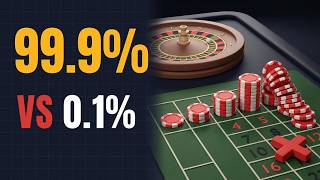
All 12 viral systems failed to reproduce their claimed win rates and maintained the loss per $100. For example, the two-dozen Martingale claimed 99.999% but achieved 34.54%. The 36 system claimed 100% but went broke 58.73% of the time.
To reduce losses: 1) pick a game with a smaller edge (blackjack loses $15 vs. $84 on American roulette), 2) avoid American roulette's double zero, 3) bet less in total (quit early), and 4) no progression system changes the edge.
Mentioned in this Video
💡 Key Takeaways
Martingale wins 76% of nights
Demonstrates a key illusion: a high win rate doesn't mean profitability.
00:58The core law of gambling
Distills the entire video into one fundamental equation: average loss equals house edge times total bets.
05:58The only way to reduce losses
Provides actionable advice: choose lower house edge games, bet less, and quit early.
14:45Viral system numbers debunked
Shows that even popular betting systems are consistent with the house edge, just with different risk profiles.
11:22Full Transcript
[00:02] that is the win rate a roulette video promises for its betting system. 3.6 million people have watched it. Other videos promise 98.6% 100% no loss at all. So I built a casino in a lab and played every one of them.
[00:16] Every classic betting system plus 12 systems from viral videos each with its own rules. 100 million trips to the table. But first, meet two players, Felix and Nora. Same American roulette wheel, same $10 table, $1,000 each. Same
[00:31] plan, leave as soon as you're at $200 up or after 4 hours. Nora bets $10 on red every spin. Nothing clever. Felix plays the most famous system in the world, the Martingale.
[00:44] When he loses, he doubles his bet. When he wins, he goes back to $10. Every win pays back every loss before it plus $10. Night after night, here's what the lab saw. Felix walks away up 76.09%
[00:58] of the time. Nora, 22.88%. Three nights in four, Felix goes home happy. Most nights, Nora goes home a Now count the money instead of the nights. On average, Felix loses $85 a
[01:12] night. Nora loses 83. Almost exactly the same. How can one player win three nights out of four and still lose as much as a player who almost never wins? That question is this whole video. Count
[01:24] winning nights and the systems look brilliant. Count money and every single one of them loses. By the end, you will know where that money goes. The one game where a system makes things worse and where those giant percentages come from.
[01:37] One thing first, [music] this is an educational simulation, not And nothing in it is a way to beat a casino. If gambling ever stops being fun, stop and talk to someone.
[01:50] So what is inside this casino? Six games with real rules. American roulette with a zero and a double zero. European roulette with a single zero. The pass line at craps, banker and player at baccarat, and blackjack.
[02:03] Every game has a house edge, the share of every bet the casino keeps over time. American roulette, 5.26%. European roulette, 2.70. Craps, 1.41.
[02:15] The baccarat banker after its commission, 1.06. The baccarat player, 1.24. Those baccarat figures come from the exact odds of an eight-deck game, worked out from the drawing rules. Blackjack is six decks, the dealer hits
[02:29] soft 17, and blackjack pays three to two. You can double any two cards, double after a split, and split up to four hands with no surrender. The player uses basic strategy from a chart computed from scratch, not copied.
[02:42] Under those rules, the lab measured the edge at 0.64%. Before the big run, every game was played 20 million times with flat bets, and each one landed on its exact edge. Nine rule tests passed, too, including
[02:55] one that checks every viral layout's payouts against the exact odds. Now the systems, 10 classic ones on even money bets. Flat betting, the same bet every time, is the control. Then the Martingale and the Grand Martingale,
[03:09] which doubles and adds one unit. The Paroli, which doubles after a win. The which step up and down one unit at a time. The Fibonacci, which climbs a number sequence after losses. The Labouchère, a list of numbers you cross
[03:22] Labouchère, a list of numbers you cross off. Oscar's Grind. And the 1-3-2-6. Plus the James Bond, a roulette spread, 14 units on 19 to 36, five on a six line, and one on zero. And 12 systems from viral YouTube videos, each played
[03:35] with that video's own bets, chip size, bankroll, and quit rules. For the classic systems, a session is $1,000 at a table that takes bets from $10 to $1,000. The player stays up to four hours at 40
[03:49] roulette spins an hour, 30 craps decisions, 70 baccarat hands, or 60 blackjack hands. The player leaves when time is up, when bet cannot be covered. Every classic system was played two
[04:03] ways, the full 4 hours and quitting as soon as it is $200 up. 136 setups, 100 million sessions, and 2.4 million more just to check Blackjack.
[04:15] So, back to Felix. Here's the scoreboard for his table. American Roulette, quit at $200 up or after 4 hours. Flat betting, the way Nora plays, up 22.88% of the time and never broke.
[04:30] When she wins, she is up $87 on average. When she loses, she's down 143. The Martingale, the way Felix plays, up 76.09% Broke 23.58%. His winning nights ended about $200,
[04:47] And his losing nights, down $990 on average. Almost the whole thousand. That is the trade. Felix gets many small out. Nora gets small losses and never a disaster. And the averages land in the
[05:03] disaster. And the averages land in the same place, minus 85 and minus 83. The Martingale is not alone. The Grand Martingale walks away up 77.73% of the time. The Labouchère 76.19. And on their bad nights, both lose about
[05:17] the full thousand. The D'Alembert does worst of the group, up 68.41% broke 31.46 and an average result of minus $171.
[05:29] The same shape shows up on every game. With the $200 goal, the Martingale walks away up 79.76% of the time on the European wheel, 81.15 of the time on the European wheel, 81.15 at Craps, 81.39 on the Baccarat banker,
[05:44] and 80.53 at Blackjack. About four nights in five. So, if someone swears the Martingale works because they win almost every time, they're probably counting nights. The money follows one simple law.
[05:58] Average loss equals the house edge times everything you bet. Every result in this video obeys it. Take the Martingale with no win goal for the full 4 hours at American Roulette. On average, the player pushes 433.5
[06:13] On average, the player pushes 433.5 units across the table. One unit is $10. Multiply by the edge, 5.26%, and you get 22.8 units. The simulation's and you get 22.8 units. The simulation's average loss, 22.82 units, $228.
[06:28] And in those 4-hour nights, the Martingale goes broke 50.06% of the time. Flat betting for the same 4 hours bets 160 units in total. Average loss, 8.41 units, $84. The
[06:42] Martingale player does not face worse odds. The wheel treats every bet exactly the same. The system simply pushes far more money across the table, and the that crosses it. That is why the most useful number in this lab is not the win
[06:56] rate. It is the loss for every $100 bet. And for every classic system, that number barely moves. On American Roulette, every system lost between Roulette, every system lost between $5.24 and $5.29 for every hundred of bet
[07:09] against an edge of 5.26. On the European wheel, $2.67 to $2.76 against 2.70. Craps and Baccarat tell the same story, each within a few cents Different systems, same loss for every $100.
[07:25] the game you choose. There is one exception, and we will get First, the system that promised you will win more often. Go to the craps table and play the full 4 hours. Flat betting on the pass line
[07:38] walks away up 40.31% of the time. The Fibonacci walks away up 73.79% home a winner of any classic system after 4 hours. >> [music] >> Oscar's Grind is close behind at 71.91%.
[07:53] So, the Fibonacci wins. Now, look at the money. Flat betting loses $17 on average. Oscar's Grind loses 44. The Fibonacci loses 38, more than twice as much as flat betting. Same law. To win more often, these systems climb after
[08:09] losses, so they bet more in total, and the edge takes its share of every extra often is paid for with bigger bets. The James Bond bets 20 units on every spin, and in 4 hours it pushes 1,264.7 units across the table. On American
[08:24] Roulette, that player goes broke 86.11% of the time and loses $665 on average. Most of a $1,000 bankroll gone in a single evening. The Labouchère is not far behind. Over 4 hours on the same wheel, it goes broke
[08:40] 80.10% of the time. And the reverse D'Alembert, on the back red banker, one of the cheapest bets in the casino, pushes 2,310.6 units across the table in a session. It goes broke 72.99%
[08:54] Even a small edge turns into a big loss when you feed it enough money. Some systems are calm. The Paroli and the 1-3-2-6 only raise their bets after a win. A losing spin always costs a small bet, so a bad run
[09:08] never snowballs. Over 4 hours on American Roulette, the Paroli never went broke. 0.00% Its worst 1% of sessions lost $670 or more.
[09:21] For the Martingale, the worst 1% lost the full thousand. So, the Paroli is gentler. But, for every $100 it bets, it still loses $5.26, exactly the edge.
[09:33] These systems feel safer because they keep the bets small, not because they beat anything. Now, the exception. The one game where a betting system changes the loss for every $100, and it changes it the wrong
[09:45] way. Blackjack with basic strategy. Flat betting loses 64 cents for every $100 bet. The Martingale loses 97 cents. The Grand Martingale, also 97. The Labouchère, 86.
[09:59] The Fibonacci, 82. Over 4 hours, Martingale players walk away up 39.71% Martingale players walk away up 39.71% of the time. Flat betters, 45.96. On this game, the system does not even win more often and the Martingale player
[10:14] goes broke 57.56% of the time. the odds of the cards? After a few losses, a Martingale bet is front of you. Then the card say double down or split a
[10:28] pair. Both need more money on the table and the player cannot afford it. So, they hit instead of doubling or play the pair as one hand. The strategy is still right. The wallet will not let them play it. To test that, I ran a separate
[10:41] it. To test that, I ran a separate check. 2.4 million more sessions, once with the normal $1,000 bankroll and once with unlimited money for doubles and splits. With $1,000, the Martingale lost 92
[10:53] cents per hundred, give or take 4 cents. With unlimited money for doubles and splits, it lost 59 cents, give or take four. The Labouchere lost 56 and the Fibonacci 49 against 62 for flat betting in that same check.
[11:07] Give the system the money to play every hand correctly and it falls back to away and the system makes you play Blackjack worse. Now, the big promises. 12 systems from viral videos, each played by that video's own rules and
[11:22] every one of them lost the house edge between $5.22 and $5.31 per hundred on the American wheel. $2.69 to $2.72 on the European wheel, $1.07 to $1.13 at
[11:34] Baccarat and 63 cents at Blackjack. So, the question is where their big numbers come from. Start with the number this video opened on, a two dozen Martingale on American roulette. The video says 99.999%
[11:48] from a simulator. Under the video's own rules, a $10,000 Under the video's own rules, a $10,000 bankroll, it's stop loss in 15 spins, the lab could not reproduce it. The system walked away up 34.54%
[12:01] of the time. The typical session ended $1,125 and one loss in a thousand tries would be 99.9% not 99.999. A Fibonacci on the columns. The video
[12:15] says 98.6% with $1,000 the system walked away up 49.61% of the time and went broke 46.08. A system called Holy Splits. The video says no loss. It reached its goal of
[12:29] $1,000 up 34.61% of the time and the typical session ended $700 down. The Dutch 5. The video says 99.64% 31.71% of the time.
[12:44] Now a pattern. Some of these big numbers are real. They just measure something smaller than a night. The 36 system claims a 100% win rate. It covers the table so every number pays something. But it puts 38 units down each spin and
[12:58] most numbers pay back less than that. It walked away up 5.93% of the time and went broke 58.73. The Romanovsky claims 86.5% on each spin and that really is its chance per spin. But one losing spin wipes out several
[13:13] wins. Quitting at 25% up it reached that goal 74.82% of the time and lost the whole stake the other 25.18. >> [music] >> Also real. Aiming for $350 up on a
[13:29] thousand it hit the goal 61.66% of the time and lost the whole thousand 38.34%. At baccarat one video promises an easy $500 a week. Starting with 800 the plan hit its goal 50.40% of the time and lost
[13:45] all 800 38% of the time. Another baccarat video talks about a 98.6% chance of not losing on the banker. That figure is the house edge 1.06% misread is the chance of losing. The
[13:59] banker actually loses about 44.6% of hands. Played the videos way the session ended up 33.47% of the time. At blackjack a plan to win $300 a day and it really works on most days 83.86%
[14:15] of them. The other days lose enough that the average is minus $42 a day. Two more from the American wheel, one called ride or die talks about winning $1,200. Starting with 250, it walked away up 19.29%
[14:30] of the time and went broke 59.29. And a 135 system starting with $200, up 48.26% broke 51.57. 12 promises, not one of them changed the edge. Several really do win most nights
[14:46] or most spins or most days and everyone pays for it on the days it loses. So, what actually lowers what you lose? The lab gives four answers and none of One, pick the game with the smallest edge.
[15:00] The same flat better for the same 4 hours loses $84 at American Roulette, 17 at Craps, and 15 at Blackjack with basic strategy. Two, [music] extra green pocket almost doubles the edge, 5.26%
[15:17] Three, bet less in total. Quitting early lowers bet. The smallest average loss in all 124 classic setups was minus $11 from sessions that ended after about 21
[15:32] was clever, because the nights were short. Four, no progression changes the edge. And at Blackjack, they make it worse. A betting system changes the [music] and a rare disaster or small steady
[15:47] losses and no disaster at all. It does not change the edge. The limits quickly. The playing speeds are assumptions. The classic systems use a bankroll and a table maximum of 100 units each. Other limits would change the shape of the
[16:01] results, not the loss per $100 bet. Blackjack is basic strategy without card counting. Baccarat hands come from exact shoe odds, not a physical shoe. And bets. Where a viral video left something out,
[16:16] like which wheel or how big the bankroll was, the simulation had to choose, and every choice is in the pinned comment. No comps, no tips, no taxes. Back to the table one last time. Felix and Nora cash out. Felix is $200 up and smiling like
[16:30] most nights. Nora is down a few chips like most nights. Run enough nights and they lose almost exactly the same money. The difference is that Felix has a night thousand. He just does not know which one. This lab runs a new experiment in
[16:44] every video. If you want the next one, subscribe. And tell me in the comments, what is the highest win rate you have ever seen promised for a betting system?