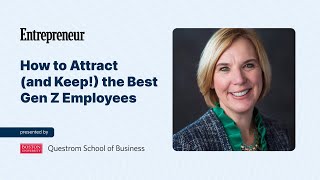
Gen Z Overtakes Boomers in Workforce
45sThis surprising statistic about Gen Z surpassing Boomers is highly shareable and sparks curiosity about the future of work.
▶ Play Clip
The future of your business is in Gen Z's hands. Why? Well, because they are the generation of worker that is not just entering the workforce, but is in the workforce. They are your next leaders. And that, of course, then raises a really important question, particularly in a tight labor market as we are in right now, which is how do you find and keep the best Gen Z talent? It's not just an academic question. It is literally
a the premise of the future of your business and what it takes to thrive today. My name is Jason Pfeiffer. I am editor in chief of Entrepreneur Magazine, and I am excited to be joined for this conversation with someone who is working with and developing the next generation of workers every single day. Her name is Monica Parker James, an associate dean at the Boston University Questrom School of Business. Monica has incredible insights about what Gen Z
talent is looking for today, how to best work with them, and how to best find them. That is what we're going to be talking about today. Monica, welcome to the program. So great to have you. Thank you for having me, Jason. I'm happy to be here. So Monica, this is a big important subject and for everyone who's watching, we want to make this as useful as possible to you. So as you're watching, feel free to chime
in with questions. We're going to be watching that and bringing those questions in. But Monica, let's just dive into these big subjects that we're going to hit today, which is first, let's talk about why it's so important to understand the Gen Z employee? Two, how do you find them? You have lots of great insights on that being on the ground there at BU Questrom. Three, how do you work with them? And then number four is how
do you keep them? So let's start up there at the top. First, why is it so important for us to be understanding specifically Gen Z employees? So, great question. It's important because once the dust settles on the data for this year, folks anticipate that this will be the year that Gen Z overtakes boomers in the workforce. So millennials are still the largest segment of the workforce, but this year, Gen Z, there'll be more Zoomers than Boomers
in the workforce. And so employers do need to understand them, particularly because they have some unique characteristics, they've had some unique life experiences, and the way they show up in the workplace is different from other generations. And Monica, let's just level set here for anybody who might see something coming that's not going to be coming, which is, You know, often when people talk about the next generation, the thing that follows is the next generation is lazy.
The next generation is entitled. That's the thing that everyone says about every generation, which by itself negates the possibility that it is true, right? Every generation can't be bad. But that's not what we're talking about here, right? We're not talking about like, oh, how do you work with this entitled generation? It is rather every generation is unique, draws upon their own life experiences when they were growing up, what was happening in the world, what was happening
in the economy that helped shape their understanding and expectations of work. And that's worth knowing about. Right. Absolutely. And I'm so glad that you framed it that way, Jason, because I think we're not we're not talking about. catering to a generation for any reason other than it's important to sort of understand how generations differ from one another, how they show up in the workplace, what sort of resonates with them, how you might be able to foster
an environment that is more conducive to them being productive, constructive contributors and better understanding always facilitates all of that, right? So the more you kind of understand about the things that have shaped this generation, the things they care about, we have a ton of data about what they care about. And the more you understand those things, the more you can create a work environment where they can thrive, which is good for your company as well. Absolutely.
Because we're live and people will be joining throughout the conversation, occasionally I'm just going to hit reset here. So let me remind you, my name is Jason Pfeiffer. I'm the editor-in-chief of Entrepreneur Magazine. I am with Monica Parker-James, an associate dean at the Boston University Questrom School of Business. And we're talking about how to find and keep great Gen Z talent. So Monica, you set us up really nicely about the importance of understanding this generation. You
have a lot of data to share about what it is they care about. We're going to get to that. But first, let's talk about how to actually find them. If I am a employer and I am looking for great young talent, where do I go? So you go to your local universities, right? So partnership between industry and academia is so important. If you want academia to produce the workforce that's going to help your organization to thrive,
then you should be working closely with academia. And we here at Questrom School of Business at Boston University, we work really closely with our employer partners, with our industry partners. And we're not unique in that. Most colleges have a career center that is eager to partner with you. We like to pride ourselves on providing white glove service to our employer partners, but everybody has opportunities for employers to engage with their student talent. And the more you
do that and the earlier you do that, the better set up for success you'll be. So we have a team of folks who are called industry relations managers who kind of work across industries to help employer partners develop a strategy to engage on campus. And that might be super career focused things like career fairs or information sessions or coffee chats, or it might be how do you get into a classroom and speak to a class? How
do you share your perspectives with faculty so that they can develop their classes in ways that are more industry responsive or more business responsive? So there's a lot of ways to do that. And we have a lot of folks who are eager to partner to help develop strategies. And we're not unique in that. Most universities have people like that. And under this umbrella that you're describing, and I think that you even referenced it a little bit,
but I'd love for you to unpack a little bit more this idea of experiential education. What is that and why is that important? So this is one of my favorite things to talk about because it's such a win-win. Experiential learning can take a lot of forms. It can be internships. It can be
⚡ Saved you time reading this? Transcribe any YouTube video for free — no signup needed.