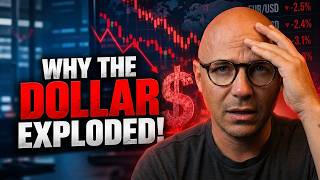

Why the Dollar Just Exploded
55sThe immediate, chaotic market reaction grabs viewers' attention and makes them want to know the cause.
▶ Play Clip"Delivers on the title with a clear, fluid explanation of the Fed and yen-driven dollar surge, plus practical trader advice."
This video explains the sudden surge in the US dollar and the resulting volatility across global markets as a consequence of the Federal Reserve's rate decision and its press conference, combined with Japan's unexpected intervention to support the yen. It breaks down how expectations—rather than actual rate changes—drive market moves, and how a single catalyst can trigger a domino effect across currency pairs, gold, and equities.
The Federal Reserve left interest rates unchanged, but the press conference indicated that officials are not convinced inflation is beaten, which signaled that cheaper money won't come anytime soon.
The inflation comments led traders to buy US dollars. Basic supply and demand pushed the dollar higher, likened to 100 people wanting only 10 PlayStations.
The key takeaway is that the market didn't move because interest rates changed, but because traders' expectations about future rates changed.
After months of yen weakness, Japan intervened to support its currency, giving the yen a big push and causing dramatic USDJPY moves, catching thousands of traders off guard.
Sometimes the biggest player in the market isn't a hedge fund but an entire government intervening, which is not someone you want to fight.
Because the US dollar is involved in so many currency pairs, its sudden strength caused almost every chart to move at once, including EUR/USD, GBP/USD, gold, and stocks.
Many traders blamed market manipulation or broker stop-loss hunting, but the real reason was they didn't know about the macro events driving the moves.
Before opening a trade, spend 2 minutes checking the economic calendar. If major news is coming, don't enter a trade five minutes beforehand—this simple habit can save unnecessary losses.
This week's volatility wasn't manipulation or randomness—it was a combination of Federal Reserve commentary and Japan's currency intervention sending shockwaves through global markets. Understanding these drivers and checking the economic calendar can help traders avoid unnecessary losses.
What did the Federal Reserve do with interest rates?
They left interest rates unchanged.
00:42
Why did the dollar surge even though rates didn't change?
Because the press conference hinted inflation wasn't beaten, changing expectations about future rates.
00:56
What is the key takeaway about market movements?
Markets move because of changes in expectations, not just the actual rate decision.
01:25
What did Japan do to support its currency?
It intervened to support the yen, pushing it higher.
01:53
Why did almost all currency pairs become volatile?
Because the US dollar is involved in many pairs, so its sudden strength caused a domino effect.
02:21
What mistake did many traders make this week?
They blamed manipulation or stop-loss hunting instead of checking economic events.
03:13
What advice is given before opening a trade?
Check the economic calendar and avoid entering a trade five minutes before major news.
03:26
Expectations move markets
This principle explains why no rate change still triggered massive volatility—traders trade on forecast, not current events.
01:25Governments can be the biggest market player
Shifts focus from retail speculation to central bank intervention, a key factor often overlooked by new traders.
02:07The dollar is the center of the market's domino effect
Explains why correlated assets move simultaneously, providing a mental model for understanding cross-market impact.
02:21Check the economic calendar before trading
A simple, actionable technique that can prevent unnecessary losses from news-driven volatility.
03:26Two catalysts: Fed clues and Japan intervention
Summarizes the root causes, showing that major moves often stem from clear, identifiable events.
04:08[00:01] broker was broken. One minute everything looked normal and then the US dollar explodes against almost every major currency. Euro USD dropped, GBPUSD dropped, USD JPY went absolutely crazy. Gold was even flying around. It
[00:16] had lost its mind. So what actually happened? Well, believe it or not, it all started with just a few sentences spoken by one man in Washington. On Reserve announced whether they were changing interest rates. Now, if you're
[00:29] need to know how interest rates work. Just think of the Federal Reserve as a group of people who control the cost of borrowing money in America. Now, here's the problem. Everyone expected them to leave interest rates exactly where they
[00:42] were. And that's exactly what they did. So, why did the market suddenly explode? what they did. They were listening to what they said. During the press world that we're not convinced that inflation is beaten just yet. That's
[00:56] financial language for don't expect cheaper money anytime soon. The second buying US dollars. Now imagine this. There are only 10 PlayStations in a store and suddenly 100 people all come in wanting one. What happens? The price
[01:12] goes up. Currencies work the exact same way. More people buying dollars means the dollar gets stronger. So here's the key takeaway. The market didn't move because interest rates changed. It moved because people's expectations changed.
[01:25] And in trading, expectations move the markets. Now, here's the next situation. When traders thought things were calming down, Japan enters in the chat. The problem with Japan is that for months, the Japanese yen had been getting weaker
[01:39] and weaker. Imagine your paycheck buying less and less every single month because That's not something governments actually like to see. So, Japan basically stepped in and said, "That's enough." And they started supporting
[01:53] their own currency. Think of it like pushing someone on a swing. One big push and suddenly the yen shot higher. The result of all of this buying of the yen was that the USD JPY started making these gigantic moves. Thousands of
[02:07] traders who thought the move would continue in one direction suddenly found trade. The key takeaway here is that sometimes the biggest player in the market isn't a huge hedge fund. It's an entire government. And that's not
[02:21] someone who you want to fight. And here's the biggest situation out of all of it, and it's something that a lot of new traders were asking. Why did almost every single currency pair become volatile this week? Surely, they can't
[02:33] all be connected. The problem is actually that they are. Think of the US dollar as the most popular player on a football team. If that one player changes, everyone around them has to react. Since the US dollar is involved
[02:45] in so many currency pairs, when it suddenly becomes much stronger, almost every chart starts moving. That's why EuroUSD, GBPUSD, OddUSD, gold, and even the stock markets all reacted at the same time. It wasn't five different
[03:00] stories happening all across the globe. It was really one giant domino effect. This is one major thing that you must understand. If you understand what's happening to the US dollar, you've already explained a huge part of the
[03:13] rest of the market and what it's going to do. Now, what most traders got wrong this week, and it's a mistake that I saw all over social media, people were saying the market manipulated me. The broker hunted my stop-loss. The market
[03:26] makes no sense. But the truth is, none of those things were the reason. The traders just didn't know what that reason was. This is exactly why I always tell people before you open a trade, spend 2 minutes checking any economic
[03:42] calendar. If a major news event is coming, don't jump into a trade five minutes beforehand. That simple habit can save you from taking some completely unnecessary losses. Look, you don't need to become an economist to understand all
[03:55] when the big events are happening. So, what really happened this week? It wasn't market manipulation. It wasn't your broker. And it wasn't random. It was a combination of the Federal Reserve giving traders new clues about the
[04:08] future and Japan stepping in to support its own currency. together. These two events sent massive shock waves through almost every major market. If you enjoyed this style of video, let me know down in the comments below. I think it'd
[04:20] like this where every Friday we break down exactly what moved the markets, why it happened, and what traders can learn from it, and how they can react to it next time. Thanks for watching and we'll see you in the next


⚡ Saved you 0h 04m reading this? Transcribe any YouTube video for free — no signup needed.