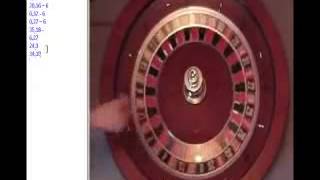

The Secret Trick to Predict Roulette Early
54sReveals a seemingly magical technique to predict roulette outcomes before betting closes, sparking curiosity and challenge.
▶ Play Clip"Title is honest: it delivers a free, teachable basic visual ballistics method, though it is a simplified version of a more complex system."
This video, part of a series from roulettephysics.com, teaches a simple visual ballistics technique for roulette. The method involves tracking a reference number on the wheel when the ball is at a consistent target speed (after a sudden deceleration point) and then charting the distance to the winning number to predict a betting sector. The goal is to make predictions early enough to place bets before 'no more bets' is called.
The technique uses predictable ball deceleration to determine when the ball is at a target speed, at which point the same number of revolutions remain before it falls.
When the ball is at target speed, note the number under a specific diamond or metal deflector; this is 'number A'.
Wait for the ball to land to get 'number B' (the winning number). Record pairs (A, B) across multiple spins to build a dataset.
The ball slows unevenly, with a distinct, sudden deceleration point. This is easier to spot with practice and is called the 'sudden point of deceleration'.
For the average wheel, collect between 30 to 60 spins per direction (15-60 for a quick session). Count the number of ball revolutions after the sudden deceleration point.
Visual ballistics has a margin of error of at least one revolution; this is acceptable because the betting area covers a wide arc (e.g., 18 pockets).
Chart the 'jump count' (distance in pockets between number A and number B). Create a circular chart to see groupings of high bars, which indicate a consistent landing sector.
Bet on the sector listed by the chart's peak; e.g., if grouping is near zero, bet near number A; if in the middle, bet opposite A (180 degrees).
In the example session, the chart showed the same sectors as the collected data, leading to a profit. The technique requires consistent rotor speeds; skip spins with extreme rotor velocities.
What is 'number A'?
The number on the wheel under a specific diamond when the ball is at the target speed (after sudden deceleration).
[00:35]
What is 'number B'?
The winning number after the ball falls.
[00:49]
What is the 'jump count'?
The distance in pockets between number A and number B.
[16:43]
How many times do you need to collect data (samples) for visual ballistics?
Generally, 15 to 60 spins per direction, with 30-60 recommended.
[05:53]
What is the sudden point of deceleration?
The moment when the ball noticeably and suddenly slows down after starting fast.
[04:12]
Why is a margin of error of one revolution acceptable?
Because the betting area covers many pockets (e.g., 18 pockets), which allows for that margin.
[08:18]
What does the chart of high bars tell you?
It shows the most likely sector where the ball will land relative to the reference number A.
[17:40]
What should you do if the rotor speed is inconsistent?
Skip that spin and only play spins with similar rotor speeds.
[27:50]
Predict Before 'No More Bets'
The method allows bet placement earlier than usual, which is the core promise.
[00:19]Sudden Point of Deceleration
A key observable cue that helps identify the target speed for prediction.
[03:24]Margin of Error Accepted
Shows that perfect accuracy isn't necessary, which is a practical and honest tip.
[08:00]Charting Jump Counts
Turns raw data into a visual probability map that is the core of the system.
[16:43]Evolution to Advanced Systems
Reve parlations the foundation for more complex visual ballistics and bias analysis.
[28:04][00:05] that make ret predictable you also learn the basics of visual ballistics determining where the ball is most likely to land in this video I'll teach you how to get visual ballistics predictions much earlier so you still
[00:19] have time to bet before no more bets is called this particular technique is not the most effective uh you can get but it's very easy to learn which is why it's very easy to learn which is why we're teaching it here let's get started
[00:35] is at a specific Target speed when the ball is at this target speed even on different spins it will have the same amount of revolutions left before it falls when we've determined the ball is at this target speed we know which
[00:49] number on the wheel is under a specific diamond or metal deflector on the wheel diamond or metal deflector on the wheel we call this number number a then we wait for the ball to fall we can call the winning number number B so
[01:04] over different spins we will have lots of sets of data consisting of a comma B then on another spin is a comma B and so on I'll show you an example we start by observing the ball as it goes
[01:24] this is just an example not an actual application just watch the the uh the numbers let's say for example example and I'll pause it when the ball is at a particular Diamond okay so in this case the number
[01:40] underneath this diamond when the ball is at this point is number 17 that would be our number a and this is assuming the ball is at our Target speed now we wait ball is at our Target speed now we wait for the ball to land
[02:10] spin sample will be 17 comma 1 now we'll do another spin as an example we're watching the ball as it slows down and we're watching the number underneath this particular Diamond when the ball is at a specific speed now I'll
[02:26] pause it when the ball for example say for example the ball is at this target speed now our reference number will be 19 then we wait for the ball to land
[02:52] five so to this point it's fairly simple now we need to a way to measure the ball speed we need to know when the B pool is at the same speed on each independent at the same speed on each independent spin I'll explain this part
[03:09] this it does vary between Wheels uh depending on what is possible but the you is a a very simple method that pretty much anyone can learn doesn't take long at all on most Wheels the ball does not slow down and at a constant
[03:24] even rate you will notice that the ball starts off very fast for the first few revolutions then suddenly drops in speed you can see this occur without any electronic equipment I'll just show an example watch on this spin the ball
[03:37] starts very very fast it's a fairly even deceleration at fast it's a fairly even deceleration at this point and watch for it to suddenly decelerate noticeably around about
[04:00] were to play all the way to the end and repeat play all the way to the end and repeat another
[04:12] spin you'll notice the same effect I call this the sudden point of different names but that's what I call it so once again it starts off it so once again it starts off fast wait for the sudden point of
[04:26] deceleration we're going through it about now reference number which is number a when the ball is beneath this Above
[04:42] This diamond and we're going to get the reference number at that time that's reference number at that time that's number eight I'll give you an exact an actual example
[05:04] video so again the ball starts off very fast we want it to do a complete Revolution after the ball is sudden de suddenly
[05:19] decelerated okay so number 20 will be our first number
[05:41] we've written down is 20 comma 29 now we'll repeat this for as many spins as is is practical generally speaking for the
[05:53] average wheel anywhere between 50 to 60 uh sorry 15 to uh 60 spins per Direction because uh we're not doing a full course here it's a bit of a crash
[06:11] course so again waiting for the sudden point of
[06:24] deceleration number 19 19 comma and we wait for the next uh the number which is the winning number now for this point we're going to count the number of ball revolutions until the end so it's
[06:36] one 2 3 4 4 5 six this will be the last one seven so
[06:49] seven revolutions and then it undershot this diamond so that's seven this diamond so that's seven revolutions 28
[07:22] nine so we write nine comma and we're waiting for the the winning number for waiting for the the winning number for number B
[07:45] take the number a the ball is going to complete consistently the same number of revolutions give or take one revolution it's impossible for a vis visual ballistics player to have it accurate to one or less than one
[08:00] so you do have a margin of error which is perfectly acceptable how much margin of error is is acceptable comes down to the wheel and the
[08:18] sudden point of deceleration then one revolution after it just to be sure
[08:34] revolutions 1 2 3 4 5
[09:00] got the numbers as we've been tracking we've got the number a this number here and the second number which is number B after the dash we have the number of revolutions remaining in the spin so we take our reference number a then the
[09:14] ball has six revolutions before it actually falls so six revolutions past this uh this particular Diamond so we're going to continue to track like this now of course you will this is not an easily beaten wheel so you'd need realistically
[09:29] between 30 to 60 or so spins uh we'll probably only do about 10 spins uh we'll probably only do about 10 or so we'll see how we go for
[09:47] it pausing it at the time when the ball has reached our sudden deceleration point so zero and comma
[10:04] three 4 4 5 six so the second number is 32 and it completed six revolutions so
[10:19] always going to get uh the correct Revolution down to the exact one uh we're going to be out usually one revolution so sometimes
[11:08] so 0 and 27 and it went around at six times next
[11:43] Revolutions in I think it might have been seven um we'll just let the uh video run so you can practice I won't actually pause it this
[12:55] you can see me in the panel here writing down the numbers as I see them
[15:00] e I'm going to wa a little bit too far out on that one it does happen
[16:43] going to chart this data now what I mean by chart this data is we need to look at the distance in Pockets between number a and number B for each
[16:59] call the jump count it's basically the distance in Pockets between number a and number B so say for example if the value on the x- axis here is zero that means number a and number B are exactly the same a jump can of plus one or first of
[17:15] all hang on the scale goes from 0 to + 18 and then from8 down to -1 this is basically a circular chart so that end here on the left joins up to the end on
[17:27] the right as I was saying a jump count of + one means that the ball has landed or traveled plus one Pockets between number a and number B and in this case
[17:40] the bar is two values High which means the number of times that is happen in our samples is two times now what we need to look for is a grouping of high bars basically where this blue line is above this green line it shows the
[17:57] average this is the green value which is the average value and the blue line is uh just a modified curve it tells us where the grouping of the high bars are so in this case they're highlighted by the green which means in this area here
[18:11] on the left of the chart and on the right of the chart because this green area here or the highlighted area here is cons right next to this part here we can actually join them up and this basically tells us that the dist the
[18:26] approximate distance of the ball land from the reference number a to the to the uh actual end number number B is around about the same point that that's a it's not an uncommon situation but it's uh makes it easier to apply now if
[18:43] for example this green area or the the high Bars were in the middle area what that means is the area we need to bet on which is where the ball is landing is approximately 180° which is opposite number a now I'll
[18:59] 180° which is opposite number a now I'll give you some actual examples of application these are our sample spins here we'll be betting on roughly the the here we'll be betting on roughly the the same number as the as number a covering
[19:14] about 18 pockets in that region which is conveniently half the wheel this number here is just the reference time uh in the uh the spins that I'm I'm using so we want to get the prediction when there's about seven six to seven
[19:27] when there's about seven six to seven revolutions before the ball fall
[19:52] just counted as a win because it's within the U 18 pocket Arc afford to have quite sloppy application and there are a lot of other methods uh
[20:07] speeds but this is a very simplistic method normally we would actually skip method normally we would actually skip this particular
[20:19] spin that's because the rotor speed is outside the norm
[20:54] actually missed that one but it was around about 32 I think
[22:38] there was one revolution too far on that one 23 and
[23:17] actually happens depends on the speed of the rotor uh the configuration of the variables it can be a positive thing or it can be a negative thing basically got it can be a negative thing basically got a 50/50 chance Z
[23:49] number of revolutions because over time you do get a bit sloppy with application
[24:20] obtaining now and the number of revolutions after number a it's not as consistent as it is in the first set so it just shows I'm doing something wrong it just shows I'm doing something wrong or not as good
[25:37] ballistic demonstration on the internet although the wheels they used is a fair bit easier than this one this is much more
[25:52] they're actually looking at it might look U like magic or cheating it's look U like magic or cheating it's actually very a very basic thing
[26:23] we'll just do this one more spin then we'll have a look at the chart
[26:57] the second set of spins these are the spins where we've actually played on now as you can see the green areas are much in the same area the green areas represent the Peaks or the high areas this is the proper statistical analysis
[27:10] the green area and on the right hand side we've got a green area we've got a secondary green area in the center uh but the main areas are the left and the right and that's exactly where we were betting so in this situation we we would
[27:24] betting so in this situation we we would have clearly profited uh now in this here again I have to say that uh it's it's a very very simplistic technique anyone can use it uh there are certain
[27:37] circumstances of course where you can't use it uh but this is by no means uh the techniques there is uh there are techniques that deal better with uh the variation and the rotor speed uh with this particular technique uh what you
[27:50] need to do is you need to stick with uh rotor speeds that are much the same speed uh so if you find a dealer spins the wheel rotor uh far too fast or inconsistent with the other spins that you simply skip that spin now with the
[28:04] actual uh the genuine winner system I while I do teach visual ballistics and more advanced visual ballistics techniques generally there are two visual ballistics which is what I've just taught you and bias analysis there
[28:18] comparatively their uh their older techniques they not as effective as what is available uh in with um the modern techniques that that I teach




⚡ Saved you 0h 29m reading this? Transcribe any YouTube video for free — no signup needed.