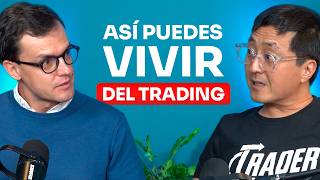

From CEO to Homeless: The Real Story
45sThe shocking contrast between being a CEO and sleeping in a park with children creates emotional engagement and curiosity.
▶ Play Clip"The title promises a realistic look at trading, and the video delivers with honest advice and a compelling personal story."
Jenuk Chu, a former CEO of Hyundai Colombia who went bankrupt and lived in a park with his children, shares his journey from rock bottom to becoming a successful trader and financial educator. He emphasizes that trading is a profession requiring discipline, mathematical logic, and emotional control, not a get-rich-quick scheme.
Trading requires special characteristics similar to being an entrepreneur; it's not a quick way to get rich.
Born in South Korea, moved to Colombia at age 11, faced bankruptcy and personal losses, then reinvented himself as a trader.
After bankruptcy and divorce, he lived in a park with his children, pretending they were camping. A call from a missionary led him to ask for help.
Investing is long-term wealth growth; trading is short-term income generation. Both require different mindsets.
Mathematical logic, continuous learning, technique (fundamental and technical analysis), money management, and emotional control (20% technique, 80% mindset).
1) Pay off consumer debt, 2) Build a strong saving habit (spend less than you earn), 3) Learn to invest for the future.
A community challenge with rules: max 3 trades/day, use only 10% of capital per trade, risk max 2% per trade, and target at least 3x risk. Even with 25% win rate, no one blew up their account.
Trading can be done in 1-1.5 hours per day; it doesn't require full-time screen time. Position trading is suitable for those with other jobs.
1) No trading if in debt. 2) Build an emergency fund (3 years of expenses). 3) 1K Challenge: save $1,000 in cash through extra work (20 hours/week).
Recommends John Bogle's 'The Little Book of Common Sense Investing' and dollar-cost averaging into global ETFs like CSPX or VOO.
Trading is a viable profession but requires discipline, education, and emotional control. Start by building a solid financial foundation—pay off debt, save, and invest in index funds—before speculating with a small portion of your portfolio.
Buffetology
book
Atomic Habits
book
Trading in the Zone
book
The Little Book of Common Sense Investing
book
One Up On Wall Street
book
Strategies for Winning in Bull and Bear Markets
book
Think and Grow Rich
book
Warren Buffett
person
Jim Simons
person
John Bogle
person
Peter Lynch
person
Stan Weinstein
person
Napoleon Hill
person
What is the difference between investing and trading according to Jenuk Chu?
Investing is long-term wealth growth; trading is short-term income generation.
23:58
What are the three key requirements before starting to trade?
1) Pay off consumer debt, 2) Build a strong saving habit (spend less than you earn), 3) Learn to invest for the future.
34:27
What is the recommended risk per trade as a percentage of total capital?
Maximum 2% of total capital per trade.
40:30
What is the '1K Challenge' mentioned in the video?
Save $1,000 in cash through extra work (20 hours per week) to build an emergency fund.
49:45
What book does Jenuk recommend for index investing?
'The Little Book of Common Sense Investing' by John Bogle.
50:58
What is the '20% technique, 80% mindset' rule in trading?
Success in trading is 20% technical knowledge and 80% psychological mindset.
32:22
What was the rule in the community challenge that prevented account blow-ups?
Max 3 trades/day, use only 10% of capital per trade, risk max 2% per trade, and target at least 3x risk.
39:19
How much time per day does Jenuk spend on actual trading?
Between one hour and one and a half hours.
44:30
What does Jenuk say about trading while in debt?
He kicks out anyone who has debts and is taking trading courses; they should not be trading.
48:43
What book does Jenuk recommend for trading technique?
'Strategies for Winning in Bull and Bear Markets' by Stan Weinstein.
56:18
Living in a Park
A powerful personal story of hitting rock bottom and using imagination to protect his children.
14:32Trading is Like Entrepreneurship
Reframes trading as a serious profession requiring specific traits, not a quick scheme.
25:0520% Technique, 80% Mindset
Highlights the critical role of psychology in trading success.
32:22Risk Management Challenge
Demonstrates that even a low win rate can be profitable with proper risk management.
39:19Index Investing for Beginners
Provides a clear, actionable first step for those scared of trading.
50:43[00:01] take to make a living from trading? A trader has to have special characteristics because it's like being an entrepreneur or businessman. Jenukchu was CEO of Hyundai in Colombia, went bankrupt, and reinvented himself as one of the
[00:14] went bankrupt, and reinvented himself as one of the and has more than 20 years of experience in the world of trading. He had nowhere to live. I even managed to live for one or two days in a
[00:26] park with my children in Bogotá. And when my children said they were cold, I would tell them that we were playing at being boy scouts, at going camping. I called my father to ask if he could help me, and my father told me, "For your own good, you have to
[00:41] get out of this on your own." A call comes in , a lucky call. That call really changed your life. Yes, it changed. You can make a living from trading, it's possible. You make a living from trading today; it's part of your income. What other
[00:53] characteristics define a successful trader? If I could highlight three key points, [Music]
[01:12] Jenuk Chu as our guest. He is an investor and financial educator with a strong focus on the world of trading. And although today we know him as a leading trader in the sector, his story is much deeper than
[01:26] you know. He was born in South Korea, and arrived in Colombia as a child and young man. He faced heavy personal losses , a total business bankruptcy, and , a total business bankruptcy, and also a radical reinvention. Jenuk
[01:41] went from being CEO of Hyundai Colombia to having nothing. And it was at that moment that an unexpected call changed his life and showed him that money cannot be the center of everything if it means losing his health, his family, or his
[01:58] purpose. Today, in addition to continuing to invest, Enuk dedicates his life to teaching from a very human perspective. He talks about what it means to live consciously from trading, the importance of emotional balance, and
[02:11] importance of emotional balance, and how we identify the con artists who do us so much harm. This episode isn't about telling you whether trading is good or bad; it's about showing you the reality of a world that many sell
[02:24] as easy, but few talk about honestly. Yenucuk, welcome to my own finances. What a joy to have you here . Thank you so much for inviting me. Well, you are very well known for being a trader, for being a
[02:38] financial educator, but you have a fascinating story. I've been researching her in depth, preparing for this conversation. You were born in South Korea and came to Colombia very young,
[02:53] right? Like in the 80s, maybe . In 1984. Why did you come to Colombia? My parents, uh, I didn't choose it, my parents. Yes, but yes. Uh, I arrived as a child, didn't I? The 11 years. You arrived. You arrive in Colombia, a new country, a
[03:10] You arrived. You arrive in Colombia, a new country, a new language. What do you find? What were you like in Colombia back then? Oh,
[03:22] in Bogotá called San Luis. Mm. It's in Chapinero, that area is ugly today It's in Chapinero, that area is ugly today . But what I remember most about Korea is that the flats or apartments tend to be vertical because there is no
[03:37] tend to be vertical because there is no land and that neighborhood was only of land and that neighborhood was only of houses, the typical, I don't know, Bogota houses that had a front garden and all this. I really loved it. Back then it
[03:50] was like the illusion of going west. Yes. And well, that was my first impression because Korea, I imagine you must have few memories of Korea at that time, but clearly Korea in the 70s
[04:06] is not the South Korea we know today, one of the most developed and richest countries on the planet, right? It's right. When I came here in right. When I came here in the early 80s, well, we
[04:20] were just coming out of the dictatorship that Korea had, but it still had, let's say, Korea had, but it still had, let's say, generals in charge of the country and while it is true that they were already manufacturing cars and so on, I mean, it already
[04:35] existed, I remember the Hyundai Pony 2 version, right? The United States was already being urged to do so, and back then they were quite technologically advanced, but not like they are today, right? I mean, in
[04:51] fact, Colombia was, I think, seriously more advanced than Korea at that time. That's a little sad to hear. Yes, yes, that's true. It's incredible how in 30 or 40 years, if things are done right in a country, you can really achieve that
[05:05] economic miracle that Korea experienced in such a short time. Because in the history of short time. Because in the history of a country, 40 or 50 years is nothing. A a country, 40 or 50 years is nothing. A
[05:19] complete generation. It's incredible to see that contrast and to see how, well, that economic miracle that Korea has experienced in recent years, unfortunately we haven't had it here in Colombia. But anyway , you arrive in Colombia, you were a
[05:32] , you arrive in Colombia, you were a very curious child, eh chemical engineer, you studied chemical engineering and I also read that in those first jobs you had you were a workaholic, you worked long hours and were
[05:46] super disciplined. Tell me a little bit about that. Well, the whole story is because, well, I think the footballer James Rodríguez says so too, right? When he talks about Germany, he says that Germany is super cool, but that they're
[06:02] robots, right? They live only to work. That's what I was taught. Whether you're Chinese or Korean, what Asians usually have in common is that we are very hardworking and disciplined. Yes. And very hardworking. And
[06:18] that comes from the parents' home, from the culture. Home. Yes. the culture. Home. Yes. Uh, I think I can finally talk a little bit about that. Well, I didn't have vacations, weekends off, I wasn't
[06:31] called up to football clubs to learn to play, I was at home learn to play, I was at home learning to sew, to cut, uh, the learning to sew, to cut, uh, the patterns of clothes, I mean, a different subject,
[06:43] right? Let's say you worked from a very young age, then yes, child exploitation. Lies, what he 's saying is not part of Asian culture. Cultica, incredible. And do you think that was a positive thing for your early
[06:58] career years in that discipline? Yes, yes. Uh, at that moment I hated him. What yes. Uh, at that moment I hated him. What child likes to stay put? But today I say thank goodness , because when I was 16, that is, 5 years after we arrived here in
[07:13] Colombia, my parents were already financially well off and went back to Korea again. Are you staying alone? I went with them. Okay. I was in Seoul for a month and I
[07:26] said, "No, uh, I want to go back." I mean, I was 16 years old, I was about to turn 17. And well, my parents at that time, I do n't know, they took a risk and let me come
[07:41] alone. And well, at that time there was no internet, there was nothing like that. Well , I started living alone when I was 16. Yes, those 5 years of
[07:53] alone when I was 16. Yes, those 5 years of them, the story you asked me about is, while I was studying chemical engineering, I got a call from a
[08:08] I got a call from a Korean multinational and fortunately they hired me, Korean multinational and fortunately they hired me, and so I started my career very early. You started, as I understand it, as a commodities trader, right? Uh, trading coffee. I used to
[08:22] make coffee, metals, that's why I mentioned goals. He was one of my clients, in fact. Yes. So, I used to sell quite a lot of metals here in Colombia. Incredible. here in Colombia. Incredible. Yes. Well, not just rolled metals,
[08:37] but coiled ones too. Well, they're all different, aren't they? In fact, I used to sell him the metals for refrigerators and all that at ACEV and all that. That was my job. I remember, don't I? I remember Hyundai well, we have been customers of
[08:51] Yes, yes. From Hyundai, uh, well, in the company La Familia with steel for years. Exact. That discipline took you very far in that company. You became general manager, if I'm not mistaken. Yes, I became,
[09:05] well, let's say manager because that was the actual position, and I was very young, right? At that time. How old were you? Well, I'm 27, 28 years old, very
[09:17] young. And at what point does that passion for markets, for stock exchanges, for shares awaken? No, at that moment I had no idea. You had no idea. What I did want was to invest in a company in Colombia
[09:31] called La Nacional de Chocolates. Yes. I thought it was an amazing company. Not three today. Okay. And I tried to buy it and for that they told me, "You have to open an account with Banc Colombia." I went to Banc
[09:48] account with Banc Colombia." I went to Banc Colombia and at that time I was already a manager enough for me. Basically, they told me I was rejected. Yes. And I remember leaving very frustrated and buying a book called Buffetology, which I
[10:02] think was written by his daughter, right? Mary Buffett. Uh-huh . Yes. Well, because Warren has never actually written a book, but anyway, I bought that book to study with. That was my first step, but what I really knew how to do when it came to investing or trading was
[10:17] trading, buying and selling, guessing prices, where they were going, that kind of thing. And you read that book, and what happened? What happened in your head? Nothing happened. Nothing happened. It was left unresolved. One question, but a curiosity: did it awaken, or at
[10:31] least remain? Well, I say it all makes sense because back then it was the dot-com bubble era. Yes, yes. I'm one of those who don't know, probably most of those who listen, I don't know, but I'm not a boomer,
[10:46] as my children say, but I am from the generation that went from analog to digital, I mean, uh, I don't know, I used corded phones. Sure, sure, sure. Uh, typewriter and stuff like that
[10:59] university presentations. How was trading done back then? That's just phone calls. You were calling Korea on the phone. Yes, phone and tapes. Yes, they were yas. Yes, yes, I
[11:12] remember at the National Federation of Coffee Growers there is a 73 with the satellite launching data. That's cool. Hey, let's get back to the topic of, well, this passion, if you will, for the markets and for stocks. You read that
[11:26] book, not much happens, the bubble arrives and bursts, the bubble bursts and then, what happens? So I said, "Wow, thank goodness, I didn't go in, I didn't buy anything, everything
[11:38] fell apart, right?" And that's the first lesson, isn't it? Because then I saw that everything went up. So, I used to read a lot of magazines like Newswes Times, okay? And I
[11:51] recommend that you always read a lot, right? TikTok or Twitter, because it's really very short, something with more substance, more... Yes. Five pages, five... something like that to think about, right? A bit. And that's when I realized that I
[12:06] said, that moment when it fell is when I should have Warren Buffett said in his book was totally true. And when do you buy your first share? That one comes much later.
[12:20] Much later. Yes, much later, because after the multinational, I already had, let's say, some small businesses set up, but I decided to start my own business . Uh, that's one of the reasons why I don't like to talk about
[12:34] why I don't like to talk about politics because I was bidding with the good work here in Colombia. I did several works, in fact,
[12:46] several works, in fact, large ones, and in one of them I broke down. So, those were the kinds of bankruptcies you're talking about , the kind you never would have wanted to have . I think that of all the banks in Colombia,
[13:02] I owed money to about 90% of them, both personal and business-related. Wow. personal and business-related. Wow. So I went and that's where I learned, let's say, like my first lesson in this,
[13:17] right? I said that I wasn't thinking about investing or trading, nothing like that, I just wanted to get ahead. And I feel that nowadays many people, when they are in difficulty, whether because they have gone
[13:32] bankrupt, because they cannot get ahead, look for solutions to make ahead, look for solutions to make money say, I totally reject it, right? They can start, I think, but little by little.
[13:48] I think we've both read the book Atomic Habits, haven't we? Total. Yes, it's a little bit. And little by little. I was going little by little, I mean , even with the debt, how did I pay it? Little by little. So, I made a decision: to get a job again.
[14:06] So, you went from being a great executive, manager of a large multinational company. Yes. You start a business, things are going well, you get big start a business, things are going well, you get big
[14:20] start from scratch and slowly pay off those at that moment? Uh, I have a beautiful story because that
[14:32] moment was like the worst situation, right? Uh, the mother of my current children asked me for a divorce. Yes. The word we usually use is, well, I tell you,
[14:45] because that was true in a Juan Valdés, I remember, that when hunger enters through the door, love flies out the window. Yes. Wow. Tough, isn't it? Hard. Yes. I had heard the phrase, but I hadn't, uh, I had n't had a person who
[15:00] had lived it firsthand, hard and not suddenly, like I had been a failure my whole life. Well, you say, "Okay, but knowing the background, right? I mean, the guy, well, I think he was capable, he had shown a lot of
[15:15] things, a bad situation, right? And at that moment I remember that I had nowhere to live. I
[15:29] a park with my kids in Bogotá. I can't believe it. Yes. And when my kids said they were cold, I told them we were playing Boy Scout, going camping, so they had to endure it, that's the idea.
[15:43] Yes, many don't know the story. I always say it's very similar to The Pursuit of Happyness, but an Asian version, right? Totally. Yes. Like that. You know what movie came to mind ? Life Is Beautiful. Yes,
[15:57] something like that. Uh, I remembered that movie as soon as you told me about the dad playing, right?, like a tank with the kid in the middle of a concentration camp. So, I encourage you that when you reach a
[16:10] difficult moment, what you should think about is... On positive things. You're alive. How old were your children? They were little. I think the oldest was between 9 and 10 and the youngest was 6.
[16:24] Do they remember that time, or does the oldest? Yes, the oldest doesn't. The youngest hardly remembers anything. The oldest does, because he remembers that, well, the solution was that a friend told me, "Well, I have a room in San
[16:38] told me, "Well, I have a room in San Alejo in the parking lot, in the garage." He there." Yes. Then, I remember my two black bags and starting there again. And that
[16:54] night was the turning point. I talk a lot about spirituality, not about God or things like that, but about your being. Because I believe that a lot of success depends on that,
[17:07] because at that moment all I thought was, well, what if I hadn't multinational? What if I go back and call and what if I go back and hire, right? And
[17:20] I bid on things and what if this, that , and what if I sue, what if I go I complained, and I don't know what else? All those things were going through my head. And so, what do you do when that happens? You call your parents, right? Of course, at that moment I was
[17:35] saying, the iPhone hadn't come out yet, right? That's like, what for? right? That's like, what for? Yes, there was nothing like that. Yes. So, uh, I called my father to ask, with the little I had,
[17:49] if he could help me, and my father told me, "For your own good, you have to get through this on your own." Yes, as many would say today. Not many. Yes. But I say it was the best thing. You
[18:05] see it now as a great gift. Yes, yes, yes, yes. No, you have to get through it on your own . And well, that's how I got out. So, well, the situation is that... But that's how I got out, that's how you got out, because you were really low. Yes, I got out. Yes, yes. Where did you find
[18:18] work again, or how did you look for work? Ah, well, here's where the story comes in. There's a video that I usually show at events called "A Call from..." Good luck. I was one of those people who skipped days to eat.
[18:33] So one day yes, another day no, because it was either work or food. Well, it was something like that. And one day, I wasn't answering my phone. I remember I had one of those Nokia phones, the one with the little snake . Yes. And the one with the little snake. Yes, the one with
[18:50] the snake. And a call came in, and I wasn't answering the phone because all the banks were calling me to collect. banks were calling me to collect. And I don't know why, but I answered that one, and it
[19:04] was a Korean man, a Korean missionary who had just arrived in Colombia. At the embassy, they told him, "Hey, remember this guy? There's a man who works for a multinational, one of the
[19:19] big companies here in our countries, and he's in a difficult situation, he won't let anyone in a difficult situation, he won't let anyone help him. Why don't you call him and help him. Why don't you call him and see if he can train you?"
[19:32] So, obviously, he didn't say that to me, but he called me and said, "Look, I'm but he called me and said, "Look, I'm from such-and-such church, I'm a missionary, and I'd like to talk to you." Yes. Hey, I want to tell you something, maybe it's
[19:45] good news. I'm inviting you for coffee. And when he said, "I'm inviting you for coffee, free coffee, it's been a day since I had free coffee." Exactly. Yes, I said, "Yes, I didn't free coffee." Exactly. Yes, I said, "Yes, I didn't think about it." And yes, he quoted a
[20:00] passage from the Bible to me, he said, "Look, your situation is this, I don't care what you tell me, but you're sinking in quicksand . The more you try to get ahead, make money fast and all that
[20:15] kind of stuff, the deeper and deeper you're going to sink ." And the only way is to ask for help. Someone from outside. Yes, it could be God, it could be Jesus, it
[20:27] could be. Let's go, my mom had already died a while ago. So, ask your mom, someone in your circle, university classmates, schoolmates, coworkers, whoever, for help, put your ego aside, ask for help, and if they
[20:42] offer you help, grab it and get out of that situation. Yes, I thanked him, and as soon as I finished talking to him, that same day a friend from university wrote to me and said, "There's a vacancy at the company where I
[20:57] work—I'm not going to say the name or anything— to work as a salesperson. The pay is minimal and it's commission-based." So, I went,
[21:09] introduced myself, and started working. Yes, I remember it so well because, remember it so well because, uh, I didn't have a dress, all the dresses we uh, I didn't have a dress, all the dresses we had were already old, and a
[21:21] had were already old, and a friend who is a very good friend, who we are still friends with and lives in Italy, he was coming to Colombia for business and it just so happened that we were there, it's all luck, right? He came and told me I had gotten a
[21:35] job, but I didn't have any clothes, and he said, "I know you wouldn't like it, but I'm going to give you some." In other words, think of it this way: I 'm giving you away as a friend. Yes, you can pay me back later when you can. If that's the case. So, I bought a dress at Arturo Call
[21:56] whole month because I didn't have anything else. Clear. Yes. All night long I came to wash, dry, and All night long I came to wash, dry, and iron. I lasted like that for a month. Yes, in case they suddenly feel embarrassed that they do. I didn't feel sorry for you or anything. In fact, I wasn't going to have
[22:11] lunch. They thought it was strange that I was n't going to have lunch with them. I said I had a lot of work, but I didn't have money to go out to eat. Until I received my first salary, and that's when things changed. That's when things started to change
[22:24] . I mean, that call really changed your life. Yes, it changed. But before that there's a more beautiful story, and it's when my children finally beautiful story, and it's when my children finally managed to go to that place, both of them
[22:38] managed to go to that place, both of them resting, sleeping on my thighs, them sleeping and saying, "Dad, we finally won, didn't we?" I mean, yes. And I was crying, begging, I mean, I
[22:51] was saying, well, at some point, if I thought I was very arrogant or whatever , I understood that ultimately you are a tiny dot, your problem is a tiny
[23:03] are a tiny dot, your problem is a tiny dot in the universe, right? And that's where the way of thinking changes a little. And you became a more spiritual person, more of a believer. Spiritual. Yes. Yes. How did you start
[23:16] working on your mind, your head, your spirit from then on? Yes, in my being, in small things, living day by day, working more on myself. So how do you finally enter the world of the stock market, of shares, well, of
[23:32] trading? Yes, that's where it comes in, the second stock market crash comes in, which is the real estate crisis, right? 2008. Yes. And by then I was already
[23:45] And you already had more economic stability. I already had financial stability, I had even taken courses on investment and trading and I had already started. That's when I
[23:58] thought about starting and I got very confused. I confused the topic of investing with trading, didn't I? They are two different concepts. Could you explain the difference in your words? Yes. Uh, yes. My words are
[24:10] very simple. Yes. Um, investment is with a longer-term view, right? Their longer-term view, right? Their goal is to grow, while trading goal is to grow, while trading is shorter-term and the goal is to
[24:24] generate income. What do you like more? I like both. Yes, but hey, I always say, in fact I have one that says trader
[24:36] because I like it, you know? More speculative. There's a question we and Enuki get asked a lot: Is it possible to make a living from we and Enuki get asked a lot: Is it possible to make a living from trading? Is it possible? Yes. Do you make a living
[24:49] from trading today? I don't live solely off trading, but it's part of my income. How to make a living from trading? What does it take to make a living from trading? Yes. And this is where all the smoke is, right? I think that trading is
[25:05] a profession for people with certain characteristics. read it, I have it written down here. Trading is like starting a business; it's not
[25:17] a quick way to get rich. Yes that's how it is . that stuck in my mind, because sometimes when we think about trading, we think about those famous ads that pop up saying, "Look at the trade I just made, $1,000,
[25:33] trade I just made, $1,000, now I have $5,000, this is super easy, " and many of us have fallen for it. Yes. How can we avoid falling into that trap? How do really takes to be a successful trader? Yes, let's say, let's put it in
[25:50] successful trader? Yes, let's say, let's put it in this context. I was saying that trading requires a trader, someone with special characteristics, for a special characteristics, for a reason, because it's like being an entrepreneur or
[26:02] businessman. Everyone should try entrepreneurship or being an entrepreneur, but not entrepreneurship or being an entrepreneur, but not everyone is designed, let's say, to be an entrepreneur or a businessperson. I don't know if you connect with the idea. Yes, yes, absolutely,
[26:15] totally. That's it. So, sometimes it's luck, sometimes it's because you already have a luck, sometimes it's because you already have a background behind you, but yes, uh, for most of those who want and wish to be profitable, the first phase they need
[26:30] profitable, the first phase they need is to have a good grasp of mathematics. Okay? That's going to be an advantage, I think more than a 50% advantage. And knowing mathematics is not what they learned in
[26:44] school or university. Yes, it's another level. In fact, among ourselves we call that the Midas formula, which is the Black Shorts formula. Okay.
[26:56] the Black Shorts formula. Okay. Nobel Prize Winner. You know what I mean. And when I talk about trading and making a living from trading, I'm referring more to the investor style of Paul Tudor Jones, George Soros, Stanley Drocken Miller, Jim Simon
[27:11] who passed away, among others. They are not investors, they are traders. Well, they say that if Jim Simons had lived a few more years he would undoubtedly have been the richest investor in the
[27:26] world, right? Yes, it started later, didn't it? Its disadvantage. It started late, yes, its disadvantage was time. Time, but let's say if it's for profitability over a period of time, even if it beats Warren Buffett. So it's
[27:39] trading, right? That's basically trading. And likewise, they used quantitative, algorithmic trading, and many believe that trading is gambling. Yes, those who sell smoke and all that, yes, it's a
[27:53] gamble. Those of us who do real trading are much more about math, statistics, methodology; it's about other things. Now I have a question that comes to mind, and it is, well, Jim Simmons was a great mathematician from Mighty, a brilliant guy, well,
[28:09] you have that background, uh, as an engineer, as a mathematician, but you also engineer, as a mathematician, but you also teach trading. When you teach trading, you start with the math, and the other question is, is
[28:22] that math, that logic, very difficult to learn, or will I never be able to be a successful trader if I don't have that mathematical logic? I believe that he needs to have more than just
[28:34] believe that he needs to have more than just math as an academic with a degree, yes, it 's math at a logical level. Okay. Yes. Uh, obviously the market isn't logical, it's irrational, but you do have to have logic. Okay. So, for
[28:47] example, we as traders call something that became very popular the term called the holy grail, and it's that methodology, that strategy that will make you a millionaire. And it turns out that most of us traders
[29:01] turns out that most of us traders who are supposedly profitable have multiple strategies. Let's double- click there. What is the holy grail in trading? Yes, it's like the promise that this methodology, this strategy, will
[29:13] lead you to be profitable. So, as a trader, you have to design your own methodology, right? Either copy other methodologies or
[29:25] design your own methodology. Your methodology. So, I don't usually do consulting or coaching, but I, for example, am with you, we've already talked before or I 've seen your content and I already know, for
[29:39] example, what kind of trading style would work very well for you. Yes. If you "Look, off the record." Yes, obviously. Hey, why don't you say it
[29:51] here? I want to know, I want to know from the videos you've watched of my content, work for me? For example, you would be very good at being a position trader, for example, what is what? which is speculation
[30:06] based on, let's say, a market environment. So, for example, you see that a recession is coming, so you stock up, for example, I don't know, with US bonds and gold, right? But that's not something you can sell tomorrow; if you
[30:20] buy it and your idea is that next quarter in the United States they're going to release quarter in the United States they're going to release bad data or something like that, right? If your wife were more like a macro trader, like macro trends, and if
[30:34] your wife were from MIT and all that, more of an engineer, more intelligent. Women are sometimes, I say, better traders because of the say, better traders because of the emotional aspect, but I would go towards, I don't know,
[30:48] derivatives, yes, a little bit with derivatives, you would have to use a derivatives, you would have to use a little more math, statistics and that, a little bit. Before we continue with this episode, listen to me very carefully.
[31:02] The market isn't going to wait for you to learn. Every day you spend without knowing how to invest is an opportunity that slips away . By the time the market recovers, it will probably be too late. This is the perfect time for you to take a
[31:15] serious step in your financial education and achieve different results. And that's why in my own finances we're opening limited spots in our Learn to Invest in the Stock Market course. It's not just a course, it's your map to identify
[31:30] real opportunities amidst so much market uncertainty. This year is n't over yet, and the decision you make today could be a turning point in your financial life. You can find the link to join the program in the description
[31:45] of this episode. Let's continue learning about the world of trading. Look, when you start looking for trading courses, trading books, I came across trading courses, trading books, I came across a little book that I loved because I
[31:58] thought I was going to find a lot of math, a lot of graphs, a lot of statistics, and I'm sure you've read it, trading in the zone. Uh-huh. But it's a book that talks a lot about
[32:10] emotions. Yes. Yes. How to manage emotions when the market falls, when we see these big stock market crashes. Well, it surprised me because, of
[32:22] course, as a trader, you want the tactics. Yes. But in the end, you also talk a lot about psychology. Yes. It's about mindset. We have a motto that mindset. We have a motto that says 20% technique and 80% mindset.
[32:38] Mindset covers everything, doesn't it? From risk management to how you execute it and being consistent with your rules and more. Hmm, I think like many things, right? When you're an entrepreneur, many
[32:52] times, I don't know if you've been asked, people tell you, "How do I know if I'm stubborn or if I'm persisting in the right business?" Yes.
[33:04] What do you think? Well, basically it's a mental issue there. Yes, it's a mental issue there. Yes, it's a behavioral issue; it's how you are able to react to whatever situation comes your way , right? So, like any trader,
[33:17] for example, we all know that there will always be losses. Yes. But many people don't like losses. Clear. So I say, they say yes on the outside, but the truth is they try to do it and they barely
[33:31] truth is they try to do it and they barely have any losses, the behavior is more than that, and that has been studied. The pain of losing is much greater than even the happiness of winning a little, isn't it? Yes. The
[33:44] wallet example, right? Clear. You're walking along, you find a wallet, you pick it up and you find a wallet, you pick it up and find $100. Ah, good luck. But you're on a bus and you lose it, and you had 2 in your wallet. What a pain, right? I've been robbed. That's
[34:02] it. Yes, yes. Now, what other characteristics should a trader have? You spoke to me about an important mathematical logic. What other characteristics should a successful trader have ? Continuous learning. Okay,
[34:15] keep reading all the time, but I think if I could highlight three key points, one would be, obviously, you have to have technique, right? And when
[34:27] I refer to technique, I mean everything: fundamental analysis and technical analysis. Then comes the issue of how you manage money, so much so that you talk about how you manage it, in fact, I always have a term that says, how you manage your
[34:41] money, you also manage your portfolio. So, I have, for example, some community. To all those who criticize me, I say, if you get out of there you're like
[34:54] Anakin Skywalk. Yes, it was about being chosen, but why? Yes. And one of them is that you have to pay off debts. I'm referring to consumer debt, not the debt you mentioned for things and such,
[35:10] mentioned for things and such, right? Second, you must have a strong financial habit that is able to save even when you don't have enough. Many people say, "No, but that's where the difference lies, even if you can't afford it,
[35:24] you have to save." Well, you're practically a living example, you did Well, you're practically a living example, you did So, spend less than you earn. That's the point.
[35:40] Third, in addition to that, you have to learn to invest that money thinking about your future. In Colombia we're still not at 1% investment in the stock market, are we?
[35:52] Yes, yes. Very short. I think Argentina is even at five or ten. I saw it recently. Argentinians are better off, and much less so than Americans, who are more like 50 or 70 percent. Yes.
[36:07] So, an important point is not to depend on the state, paternalistic government, or inheritance, but to prepare your own future. So, yes, you have to invest. Once you meet those three requirements, I invite you to speculate
[36:21] and trade. I love what you said because it's like, love what you said because it's like, take care of what's most important , right? Saving, spending less than you earn.
[36:33] Then, consistently, he starts investing, and I think we all have a bit of a gambling addict inside us, and if we want to speculate and bet, well, with a little bit. What is a little bit? What percentage of assets, of
[36:48] income? It depends on the profile. I also believe and always encourage that they should have different portfolios. Okay? So, for example, you could be a trader with three or four trading accounts. Okay. Yes, it's not one of several. Yes.
[37:05] The more volatile and aggressive it is, which tends to be the case over a short period of time and using financial derivatives, the smaller the bond should be . And the longer the term, the more I
[37:20] for example, the Nike one, right? That right now it's almost at the price of doing things like that. So now it's time to buy, and it's a good company,
[37:35] and I hope there won't be any more tariffs. Yes, yes, yes. That would be position trading. Okay. Let's talk about those terms that sometimes confuse people: day trader, scalper,
[37:51] trader, scalper, swing trader, position trading. Tell me a little about those differences that sometimes confuse us. Yes. Well, what people usually see in ads and such is scalping and day
[38:05] trading. And although it is the easiest predictively, it is the most difficult to actually make money and be profitable in the long run, let's say in a sustained way. One of the reasons is because
[38:21] people are not disciplined, consistent in what they do. In other words, just consistent in what they do. In other words, just as they don't save 10% of their money to invest or things like that, when they are trading they ignore the
[38:34] risk management rules they have, not rules for entering, but risk management rules, and that's where they fail, they burn their money. It's the easiest one. And now I money. It's the easiest one. And now I have a very nice story for you, yes.
[38:48] Oh, do you want me to tell you? Okay. It turns out that I, let's say, regret the videos that because I shouldn't have started that way. It was precisely while popular. And so, many people who follow me
[39:04] want to do day trading, but they usually end up burning through funds, right? money, and it's not the fault of the strategy or anything, it's the way we operate. So, two years ago I proposed a challenge to them. I said, "Okay, I'm going to set this
[39:19] methodology, rule, or technique you want, but we're going to use a certain risk management rule. Let's say you're going to work for me, you
[39:31] work in a bank, and I'm going to give you the same amount of money." It's like the Bible, isn't it? I'll give each of them a talent and see what they do. But I'm giving them one condition do. But I'm giving them one condition number one, and that is they will only operate a maximum of
[39:44] three times a day. Yes. And on the condition that if you have a target that day, you stop trading. Ready? That was the rule. Ready? If you have a target in the second trade , you stop trading, but if you have a stop loss in the second trade, you will trade it until the third trade
[40:00] Everyone's happy so far, since everyone 's a gambler, right? Second rule, let's talk a little about how money should be managed, just as when we talk about saving, we say 10% of your income,
[40:18] let's say that when we are going to bet, we are going to place a position, we are going to use only 10% of your capital. That's all. That's the
[40:30] maximum amount, and you can't lose more than 2% of the total for each transaction you enter, that is more than 2% of the total for each transaction you enter, that is , 20%, right? A stop of and I added another condition. And
[40:44] since they're all like little chickens, I mean, scared chicks, then I said, well, let's use a mathematical formula that guarantees a mathematical expectation, success. Because you're always going
[40:58] to triple what you're willing to lose. If you were willing to lose 20%, you had to start with a minimum target of 60%. That was the rule.
[41:11] It was very simple, wasn't it? Very simple. So obviously, about a thousand and something people participated, so don't tell me, people participated, so don't tell me, "It's already been 20,000 and something."
[41:25] Some of them reported, and others did not. And we had, well, we kept the statistics and there were people who had a success rate, a win rate of 25%.
[41:37] So you say, how can someone who is supposedly a trader have supposedly a trader have 25-30%, right? That's a loser. Clear. And no, notice that when we finished, most of us ended up in the range between 25 and
[41:53] most of us ended up in the range between 25 and 30 and something. He was there for almost 1000. And those who complied with that rule, within that range, none of them burned through their within that range, none of them burned through their accounts. In fact, they were
[42:06] If you worked at a fund, at a firm, and you had a program that told you, yes, like mice, right? Every time you make a mistake, you get
[42:19] an electric shock or trigger an automatic stop, things like that. Most likely you would be , but like many adult things in life and so on, it's your decision whether you choose to become addicted to
[42:35] alcohol, eating a lot of carbohydrates, not exercising, all that because everyone knows that it's bad, but nevertheless we do it. So, in trading, what you were just saying and what Marc Douglas says is a bit of a
[42:50] behavioral issue. Of course, we are people who, even though we know it's wrong, do it anyway, and that's human nature and the reason why people don't lose money. I wanted to ask you a question,
[43:05] money. I wanted to ask you a question, and that is, can I be an entrepreneur or an and that is, can I be an entrepreneur or an employee and at the same time be a trader, or is being a trader a full-time job, being glued to a screen all day
[43:18] and trading for 7 or 8 hours? Yes, it's one of the things I complain about most with people because they spend all day staring at the screen, and I always ask them, "Remember the first sentence you remember writing that explains
[43:32] why you my workshops, it feels like a religious session, doesn't it? So I tell them,
[43:44] "Yes, write it there." Yes. Then they tell me, "What I want is the methodology you tell me." And write it there because that's the phrase you're going to have to look at with that. Yes. So, if I said, "I want you to be free, what freedom is there
[44:00] when you are?" I'm watching all day long. end up becoming slaves to the screen, and yes, because it's addictive, isn't it? That's kind of like TikTok, right? Up and down. You don't make any decisions, but you go
[44:16] down. You don't make any decisions, but you go up and down. Your gaze rises and falls throughout the day. How many hours a day do you dedicate to trading today? Around morning. When I say training, I mean trading, because studying and all that
[44:30] is something else, but trading, trading takes between one hour and one and a half hours at most. between one hour and one and a half hours at most. Okay. Yes. In other words, it is possible to be a trader and do another activity at the same time. Parallel. I thought this was a
[44:43] Parallel. I thought this was a full-time thing. No, no, I don't think the best example would be, for example, Sebastián Toro. Of course, you know him, right? Tri's best financial educator and all that. You see what he does. He himself says,
[44:59] "No, I get up late." Yes, yes, his barbecue on Sundays, he gets up at 8, he trades for one, two hours and hours and that's it
[45:11] . He just tweets and tweets Big hug to Sebas. I was going to
[45:25] a character, but I was going to ask you because many people want to start but have that fear of starting in this investment business. What advice would you give to someone who wants to but is panicking and has suddenly had
[45:40] a bad experience, or you have had a bad experience, perhaps in trading, buying a stock, real estate, or whatever, and it makes them panic? go back in . What would you say to that person? Time to speculate again. Yes, to speculate or
[45:53] even to invest. And they end up making the decision not to, it's better to talk to me at the bank, at the CDT in peace. That's the best one. That's the best one. Do you think so? If that's what you feel, it's the best. Okay. I also say that sometimes the situation,
[46:06] right? Right now, for example, we'll probably never see those rates again for CDs in Colombia. Second, in the United States we will not see those US Treasury bond rates of four and five again. We'll never see him again, that's for sure
[46:20] . Yes. So, if that's the case, then yes. Now, those of us who like to speculate do so because we have different strategies. One possibility is that you worked at oil company, for those who might be from another country. You were fired.
[46:37] Yes, because that's what's happening in many countries, isn't it? You get fired. Even more so in many countries, isn't it? You get fired. Even more so at my age, right? Maybe it's still productive in your case, but when you reach 50, just before you say,
[46:50] "I've already retired," you get laid off. What do you do with your pension if you haven't invested it properly, and so on? Well, a lot of people want to go out and speculate, and that's the wrong thing to do. I would say they don't know their
[47:05] risk profile. I would recommend that you meet with a financial advisor to help you define a portfolio. So, first, make a portfolio. Uh, I think in your book, for example, you explain it very well. I would recommend
[47:21] well. I would recommend Ramit's book. Mm. Ramid has a pretty nice portfolio. Mm. For the United States, right? But I think we can United States, right? But I think we can bring a little bit of that in, no doubt. Ah,
[47:33] if you're in Latin America and once you 've built this and you have a little bit left over , that little bit you could use to predict whether Real Madrid will win or Barcelona will win,
[47:45] then you start with that little bit. Yes, but first you have to understand that trading cannot be learned in a video, a course, or a workshop. It is video, a course, or a workshop. It is a profession. You can't be a
[48:01] mom watching a video or a dad watching a video. Right? But that's where video. Right? But that's where you start. Yes, but you're making a mistake, aren't you? Clear. You will be a trader until the very last day. Yes, I will speculate. Yes, I will speculate
[48:15] until the very last day. But you still use that formula in your personal life of saving, investing, speculating, you maintain it, it's one of the things we do, at least I do, and I hope you do
[48:31] too, and it's about getting a little bit involved . Yes. So if I say we need to do. So, we have several challenges in the community. Uh, I
[48:43] do it in a very oriental style. Mhm. So, the first thing is, man, if debts, don't do trading. In other words, in fact, everyone who tells me, "I have fact, everyone who tells me, "I have debts and I'm taking trading courses," I kick them out
[48:58] . I kick them out; they shouldn't be there. Yes. That is, at your own risk. Second, on Sundays we do a challenge called "You have to create an emergency fund," and if you already have one, you have to create a fund to live peacefully, which
[49:14] I usually say should be a little more than six years, or even three. I learned it from a Korean friend who, when I quit, said to me, "Are you going to quit and Then he said to me, "I'm going to teach you a lesson." Yes. You already have three times what you earn
[49:29] saved for 3 years. I do n't. Then he told me, "Do that first, and then resign." Then he resigns. Good advice. Yes, because he had already done it. Clear. So, uh, we save money on Sundays. It
[49:45] 's very easy. I tell you $ Oh, for those who earn minimum wage, well, you $ Oh, for those who earn minimum wage, well, you take out garbage, drive Uber, walk dogs, whatever you have to do, but you have to do them. It's 20 hours per
[49:58] week. And the ultimate goal is to finally have $1,000 in cash in your hands. That, as they say, the richest man in Babylon gives you power. Yes, you say, "I can do it." If you could do it in a year, you can keep
[50:14] right? There's a change of mindset, a change of perspective, not just for the 20s, but by 20s you reach 1,000, the atomic habit, and you should see the number of people. We've already passed a million in savings across the entire community. Yes.
[50:29] anyone can join this challenge. Yes, anyone. I can join this Sunday . You can do the 1K challenge. Yes. So we always post announcements, we did it, people share it. That's great. But the second one is
[50:43] about indexed ETFs. We recommend reading the book by John Bogor, or Jack Bogur, who also recently passed away. According to Warren Buffett, he's one of those who has changed, who has democratized investing
[50:58] globally, and the book is called The Little Book of Common Sense Investing Little Book of Common Sense Investing . And the idea is not to chase highs and lows, but rather to be stubborn. If you're stubborn, Okay,
[51:14] so it's stubborn, but in that systematic investing or DSA. In what? In global assets, for example. The one that, excuse me, let me stop you there, DCA, for those who
[51:26] don't know what DCA is, is averaging the dollar cost of an asset over time. So, uh, then investing regardless of the LDF price at that moment. Moment, we
[51:39] call that not looking for the timing, right? Not looking for the ceiling or the floor. So, you simply buy, no matter where you are. So, we've been doing that since 2016. Ah, great. Back then,
[51:53] we did it with other, rather unusual assets, SPXL, GBTC, many of those. Nowadays, since 2022, when the downturn was coming in the community, well, I
[52:07] 'm kind of a math whiz and I don't know what. So I said, I think a So I said, I think a bear market is coming. So, uh, we're going to bear market is coming. So, uh, we're going to do this exercise of
[52:19] passively investing in indices and I'm going to show you that In a few years, they'll be grateful. Yes. And we started investing. Those who were in the United States invested in BFX. Ah, I told the others in the community to
[52:35] invest in Bebo. Obviously, it's very expensive now, right? But back then, we started like that. So, I buy three weekly, or you can do it monthly, but I share them weekly,
[52:49] and you can see on my broker how I'm buying three BO shares weekly. And today, buying three BO shares weekly. And today, if I started in 2022, I know, you 're doing the math in your head. Yes, when we started, we started with
[53:02] losses. I told them, there will come a time when everyone will say, " What you have isn't real." They said, "Yes, it's real, that's what we've done." So, I encourage you, it doesn't matter, right? Today you can do it with CSPX,
[53:16] right? Today you can do it with CSPX, with the funds, like I think on the platform you use in your community. That's right. We have a collective investment fund that, in turn, invests, right? In the Vangard ETF. And here, no It
[53:29] matters if they charge a commission fee; I think yours doesn't charge a commission, right? It's a one-year management fee, isn't it? Yes, it's a management fee, but not on the investment. Uh-huh. So it can be done weekly. It's very easy, isn't it?
[53:42] So, thank God, in Colombia, there's Colombia, there's your platform, Tri's, there are many that facilitate this kind of thing nowadays. And well, that's the way for me. For those who say, "I want to
[53:57] start, I've had bad experiences." That's the initial step. Once you've been at it for a year or two, once you feel those market swings, I'll tell you
[54:09] if you really want to continue with this investing or speculating by trading, right? When you see these drops, for example, Liberation Day, Donald Trump announces tariffs and the market, boom, it plummets
[54:24] 10, 15%. Really, what do you feel? Are you scared? Are you excited? What do you feel nowadays with these drops? Black Friday, for example. Yes, it's not, that's the excitement. That's what I feel. I mean, it's like we
[54:38] 're having a sale, right? Yes. I'm like, what do I buy? What do I buy? I mean, yes, I mean, I don't see what else, I mean, I have to buy, I mean, yes, that's it. Everything went on sale. On sale. Yes. Yes, yes. It's exciting
[54:53] for me and most people, I think, in fact, we were expecting more on the street. Of course. Yes. But it hasn't fallen as much as we wanted it to fall, it bounced, it bounced very quickly. I was going to ask you about books, you already recommended one, the one by
[55:08] John Bogle, but I know you're a big reader. Two or three more that you could recommend on trading, on investing. Well, give me one or two on investing and another one on personal growth, spirituality, which is also
[55:23] a cool topic. Uh, well, if it's about investing, I would go for books like the one you had in the hand when I arrived. Yes, yes, yes, yes. Peter
[55:35] Lynch's. Yes, Peter Lynch. There are two books, but well, they're very easy rules because he presents these cocktail-type strategies, and I think they work very well. Street. Of Wall Street. Yes, those kinds of books help a
[55:50] lot because they're rules for making investments in a very logical and easy way, right? Well, the second one is, let's say, that book is about buying, not buying, companies like Peloton. Right. Yes, without a doubt, Peter Lynch would
[56:06] buy Peloton. Yes, never. Right? Uh, well, for trading there are several books, but one of the older ones that still works
[56:18] quite well would be Stan Weinstein's. He's still alive, and the book is called, uh, Strategies for Winning in Bull and Bear Markets. Very good. On a technical level, I think it's the best, let's say, it's not so intraday, that's why I
[56:33] recommend it. More trending, position trading, understanding a little bit about how at least a weekly structure moves or months, that's much calmer to operate than great. Yes, that's great. And regarding mindset
[56:48] and other topics, there are many. There are many, many, many. I, for example, of the books that I remember and that I held like a treasure in my hands, uh, Think, Grow Rich by Napoleon
[57:02] Hill. That book, I think, is the most marked-up book I own. Yes. I mean, it's practically worn out from reading it 10 times, and yes, and I still read it. Yes, I still feel bad about it. I pick up that book and I remember
[57:17] all those beautiful phrases that really... it's quite old. Yes. Today it could even be considered outdated because of some of the terms used there, but I think it's terms used there, but I think it's quite useful, quite.
[57:32] Well, what a spectacular conversation. Uh, I thought I had done my homework well, but no. Uh, I learned so much more about your personal story, and thank you for sharing those personal stories with us so openly and
[57:46] generously , those tips on how to be better traders and how to be better Investors. And I think you're one of those people within the financial education community whom we
[58:00] greatly admire because you're serious, professional, you do things well, you don't spend your time, as you say, selling get- rich-quick schemes through trading, but rather you try to guide people to do it
[58:16] consciously, with careful study, doing their homework, and we, of course, agree with that. Thank you very much, thank you very much for being here. I hope this is the first of many conversations, and that will always be the case with you. Well, thank you very much
[58:30] for listening as well. [Music]
⚡ Saved you 0h 58m reading this? Transcribe any YouTube video for free — no signup needed.