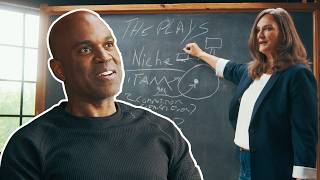

From NFL Rookie to $1.5 Billion Venture
45sThe dramatic story of a top NFL draft pick becoming paralyzed and then building a billion-dollar business is highly inspirational and surprising, perfect for emotional engagement.
▶ Play Clip"Title accurately reflects the content: a former NFL player turned VC shares his journey and advice."
Terrence Jones, a former NFL player turned venture capitalist, shares his journey from a career-ending injury to building a $1.5 billion venture. He discusses the importance of passion, problem-solving, niche-finding, and learning from consumers in entrepreneurship.
Terrence Jones, a D1 player at Texas A&M and top NFL draft pick, never expected to be paralyzed in his rookie year. This led him to learn about himself and eventually build a $1.5 billion venture from a napkin idea.
Key elements for a successful pivot: understanding differentiators, solving a pain point, achieving product-market fit, having hard conversations, listening to trusted advisors, creating an action plan, and communicating the vision.
Terrence's core values are Excellence, Passion, Integrity, Growth, and Hard work. Starting with core values and aligning actions with them provides a straight trajectory to success.
Treating consumers as fans and learning from their immediate feedback (e.g., sales, social media comments) is crucial. Examples include Athletico Dallas kits and Goodles mac and cheese brand with fan tattoos.
Terrence's first startup began with a napkin idea during depression after paralysis. He advises taking it one day, one decision at a time, and asking: Do you have the passion? Is this a real problem?
First step: assess Total Addressable Market (TAM) and identify competitors. Understand what they do well and where you can excel. Find your most passionate fans and what they hunger for that competitors aren't providing.
Build on a foundational brick (your why, brand, values). Everything must stack on that brick. This leads to a castle over time.
Terrence Jones emphasizes that success comes from passion, solving real problems, finding a niche, and building on a strong foundation of core values. His journey from NFL player to venture capitalist shows that setbacks can lead to greater opportunities.
What are Terrence Jones's core values?
Excellence, Passion, Integrity, Growth, and Hard work (EPIGH).
What two questions does Terrence ask entrepreneurs?
Do you have the passion to see it through? Is this a real problem?
How did Terrence's first startup begin?
He wrote an idea on a napkin at age 22 while depressed after being paralyzed, which turned into a $1.5 billion venture.
What is the first step in finding your niche according to Terrence?
Assess the Total Addressable Market (TAM).
What does the 'one brick mentality' refer to?
Building on a foundational brick (your why, brand, values) and stacking everything on top of it to eventually build a castle.
From Paralysis to $1.5B Venture
Demonstrates resilience and the power of turning a setback into a massive success.
Core Values EPIGH
Provides a clear framework for aligning actions with values for success.
Learning from Fans
Highlights the importance of treating consumers as fans and using their feedback to improve.
Niche Finding Steps
Practical advice on assessing market size and competition to find a unique position.
One Brick Mentality
Metaphor for building a business step by step on a solid foundation.
[00:00] Being a D1 player at Texas A &M, a top draft pick for Green Bay Packers, I never in my wildest dreams thought I would get injured in my rookie year. After being paralyzed, I rolled down on a napkin, and that napkin turned into a $1 .5 billion venture. Do you have the passion that you're going to need to be able to see it through? And then the second question I often ask them is, is this a
[00:22] real problem? They all have to stack up on this. foundational brick. It's not going to be easy. And if it was, everybody would be doing it. Hey, Jen. Hey, how are you? Nice to meet you. too. Terrence I'm super happy to sit down with you and it sounds like we've got a lot of overlap in areas that are that are super fun we both came to venture from really non -traditional backgrounds like I didn't go to
[00:44] Stanford and get my MBA and you know put on my Patagonia vest and launch a fund from those networks and being a d1 player at Texas A &M a top draft pick in the NFL for the Green Bay Packers I never in my wildest dreams thought I would get injured my rookie year Never in my wildest dreams thought I would get injured my rookie year, especially getting paralyzed and going through what I went through. On the
[01:06] backside of that, it gave me and afforded me the opportunity to learn more about myself and getting through those tough times. It's not going to be easy. And if it was, everybody would be doing it. You got to go out and play the game, literally no pun intended. And you got to get in the weeds and you got to go through the hard situations and deals to really be able to build something of value. It's been
[01:27] a great learning journey just from going to teaching. yoga, to consulting in health, to building business, to venture. I think that's an encouraging part of your story, that we can inspire a lot of people. And I always tell people, it's not where you start, it's where you're going. How about we go get on the chalkboard and write some of these thoughts out? Okay, let's dig into a pivot. There we go. You can see this is my
[01:49] expertise, is writing on a chalkboard. And I'm sure you've experienced many pivots in your life and career. And so how do you handle a pivot? Yeah. your pivots in your life and career and so how do you handle a pivot yeah i think when we're thinking about a pivot there's a lot of fundamental truths what's my differentiator how do we solve a pain point how do we scale um do we have a true like product market
[02:11] fit and as we've been working through synergy sports capital i really had to have some hard conversations with myself and with my team before we went to market yeah and i think that's important is removing that barrier that people may not feel like that they can come to you and give you that true honest feedback I feel like that they can come to you and give you that true, honest feedback. Something that you just said there
[02:33] really rang true with me is like having the hard conversations. You know, listening process, I think good, trusted advisors, and then I think creating an action plan. Those are all things that really help to make a good pivot. I would say to being able to explain the vision because, you know, it really all starts with getting people on board with whatever that vision is. Yep, absolutely. And if you can't. That's where getting people on board with
[02:55] whatever that vision is. Yeah, absolutely. And if you can't explain it well enough, then it's tough for anybody to want to be associated. They want to follow it. You can't really attract talent. You sure won't attract capital. So you got to be able to really communicate that vision of what's in your head, I think is important. That's one of the things we tell founders is the best founders, they're able to hire better. They're able to raise
[03:17] capital. They're able to reach your consumers better because they know how to communicate. Terrence, of all the things that we could be doing, in this world what took you from from football to real estate to now investing in sports i was able to bring all my worlds together and it's truly like a dream come true that's beautiful that's what gives life so much meaning is like taking all the things that you've learned and being able to
[03:39] like pull them together and then make an impact it brings me great joy to be able to create something that's going to outlive me and then just working with people that i think are amazing it's very satisfying And then just working with people that I think are amazing. It's very satisfying. I'm constantly learning. And that's one of the things also I'm super passionate about is like, how do I keep growing? How do I keep learning? You
[04:01] know, our core values is we call it EPIG, E -P -I -G -H. So excellence, passion, integrity, growth, and hard work. You have to start with your core values. It's like, why are you doing this? And how are you going to do it? And if you nail those things and then continually revisit them and make sure that everything you're doing is aligned with them, and make sure that everything you're doing is aligned with them you have
[04:22] a straight trajectory to success yep no burning one of the most important things in business is continuing to learn and then putting in good processes for learning and listening implementing ways to really continue to learn from your consumers i think is one of the most important things that you can do as a business leader i think that's a great lead -in we think about learning like you know we've talked about individual learning how And we think
[04:44] about learning, like, you know, we've talked about individual learning, how we can grow and study and intake information. But I think this is a really good perspective to pivot on learning about the consumer. You think about universities, right? And you think about like a Texas A &M, year after year, generation after generation, showing up to Kyle Field, 110 ,000. And I think as we look at our consumer brands, our venture and our sports, especially with emerging
[05:06] leagues and teams, how do we build that fan base? The one thing I'll say about learning teams how do we build that fan base the one thing i'll say about learning from fans is they're gonna let you know immediately yeah we have ownership in athletico dallas and we've been dropping we call them kits right these new kits and immediately based on sales and facebook and instagram comments we're learning from them immediately if it's gonna work that's
[05:28] that's fantastic a lot of our consumer brands even call the consumers who are buying their products fans and we see like the best consumer brands they really understand the consumer in the same way They really understand the consumer in the same way that you're talking about fans as sports teams. It's like we're creating something that everybody can kind of get behind. We talk about, we have a brand called Goodles that is a better for you mac
[05:50] and cheese noodle brand. And they talk about their consumers as fans. And they truly are. I mean, we've got fans who have tattoos of noodles. We've got fans who dress up as, you know, a box of mac and cheese for Halloween. So I love that. And I'm going to keep leaning into that more. Yeah, because it could be merchandise. It could be the noodle tattoo or something. into that more yeah because it could be merchandise it
[06:12] could be the noodle tattoo yeah jersey there's so many ways to activate the fans the consumers and really get them to believe in the entire ecosystem of the company you're inspiring me to make a springdale jersey let's do it yeah i'll help you okay love it so when you're thinking about bringing a new venture to life how do you go from zero to something we have these life experiences that shapes our perspective with everything one of
[06:34] my first startups i wrote down on a napkin in the middle of depression at 22 years old after being paralyzed, and that napkin turned into a $1 .5 billion venture. Just taking it one day, one week, one decision, one hire at a time. When we're talking to entrepreneurs, it comes back to, do you have the passion that you're going to need to be able to see it through? And then the second question I often ask them
[06:56] is, is this a real problem? We get a lot of entrepreneurs who are really fascinated with something, but it's like, it's not a real problem. a lot of entrepreneurs who are really fascinated with something but it's like it's not a real problem but i think a lot of times i see people starting things in business and they're like well man i had this passion and it's like well what have you done around that right like if
[07:17] you just started 30 days ago how do you bring it to life yeah all right terrence we've talked about how important finding your niche is and how that can really help you begin to develop a really deep foundation for your business so when you think about that how do you think about finding what your niche is like what would your first So when you think about that, how do you think about finding what your niche is?
[07:39] Like, what would your first step be? My first step on niche is the TAM, total addressable market. Because a lot of times when I'm hearing pitches from these founders, there's a trillion dollar total addressable market. And it's like, OK, I hear you, but what can you get allotted to what you're working on? But then also, who are the competitors, right? So when we think about niche, number two thing is who's already in that space? And then
[08:01] what do they do really well? So what are they really good at? And then what are you guys going to be good at? what are they really good at and then what are you guys going to be good at and what can we be good at no that makes a lot of sense i mean first understanding you know what the opportunity size is if you were the whole pie and then really seeing what slice of the
[08:23] pie can you own so when you're thinking about your niche it's like where can you find your most passionate fans and what are the things that they are hungry for essentially that your competitors aren't already doing and then how do you communicate that through brand i think those are great stuff already doing and then how do you communicate that through brand i think those are great steps in finding your own niche it gets so hard i
[08:45] think for a lot of builders is they want to be everything to everybody because they're so passionate about what they're building that brings me to your earlier thing you were talking about is you know kind of building this one brick at a time it's like find this find this niche and then you lay your first brick but it's like who are you and then what is it that you can build off of from that yeah that's
[09:07] one of the things that we had to discuss as athletes growing up because when you put that atm on texas a &m or you put that g on with the green bay packers everything that you are embodying after that has to be on brand that's right i drew this brick over here because it's like yeah that they all have to stack up on this foundational brick so it's all got to tie back to this and it
[09:29] ties back to something we talked about in the very beginning it's like this is also the why and how do we tie everything back to brand to values to serving those fans and giving them what are really hungry for and then everything has to build on top of that. That's the foundation. Yep. One brick mentality. That's and then you have a castle at the end of the day. It was great to meet you. Oh so great.
[09:51] I really enjoyed it. I know I have a lifetime friend now. Absolutely. Oh, so great. I really enjoyed it. I know I have a lifetime friend now. Absolutely. We're going to co -invest in some stuff together. Looking forward to it.


⚡ Saved you 0h 10m reading this? Transcribe any YouTube video for free — no signup needed.