The EVM's Messy Birth
47sA firsthand account of Ethereum's origins and the ideological shift from top-down trust to decentralized systems sparks curiosity about the foundation of web3.
▶ Play Clip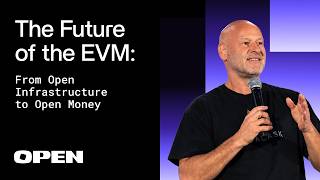
"The title promises a discussion on open infrastructure to open money, and the video delivers a substantive panel on EVM's future, though it's more of a high-level conversation than a deep technical guide."
In this panel discussion from the Open conference, Joe Lubin of ConsenSys and Keone Hon of Monad explore the evolution and future of the Ethereum Virtual Machine (EVM), from its origins as a decentralized trust foundation to its role as the bedrock of global financial infrastructure. They discuss technical improvements like quantum resistance and synchronous composability, the shift from siloed corporate chains to open rails, and the regulatory and market forces driving TradFi adoption.
Joe Lubin explains that his disenchantment with the financial industry led him to Satoshi's whitepaper, which introduced decentralized trust. He saw Ethereum as the most powerful expression of this vision, enabling a new global, decentralized financial system.
Lubin defends the EVM against criticism, highlighting its readable front-end languages like Solidity, which are crucial for writing secure code, and its rich ecosystem of libraries and builders. The open standard ensures future-proofing and avoids vendor lock-in.
Lubin identifies quantum security as a key improvement needed. He explains that the address space can be preserved while swapping out the authentication mechanism to a quantum-resistant signature, protecting user assets without disrupting DeFi positions.
The Ethereum ecosystem is moving from a 'small village' model where every node validates everything to using erasure coding and zero-knowledge proofs to drastically reduce redundancy, enabling the network to scale to internet-level usage.
Keone Hon describes Monad's approach to improving EVM performance while maintaining decentralization: decoupling consensus from execution. This allows for sub-round-trip block times and the possibility of multiple concurrent proposers (MCP).
The discussion shifts to the benefits of open rails over 'corpo chains' or silos. While some entities may launch their own chains, most will benefit from composability, liquidity, and shared infrastructure, leading to a highly connected world.
Lubin explains synchronous composability as a technique to run transactions across different networks in a single atomic execution context, using zero-knowledge proofs to aggregate simulations and unify liquidity without bridges.
Lubin attributes the recent traction to regulatory clarity in the US, technological maturity, and a shift in mindset within financial institutions. Events like price discovery on Hyperliquid and crude oil on-chain during the war forced institutions to be online 24/7.
Keone highlights Monad's focus on delivering value to users and businesses, while Joe describes MetaMask's evolution into a 'personal money operating system' with the Money Account, offering yield, a debit card, and access to various financial products.
The panel concludes that the EVM, despite its challenges, is evolving into the foundation of a unified, open financial system. With innovations like quantum resistance, synchronous composability, and user-centric products like MetaMask's Money Account, the industry is moving from siloed infrastructure to a globally connected, tokenized economy.
Satoshi's Decentralized Trust
This is the foundational insight that motivated the creation of Ethereum and the EVM.
00:49Quantum-Resistant Addresses
A concrete, actionable proposal to future-proof the EVM without disrupting existing DeFi positions.
05:46From Village to Internet
Illustrates the fundamental architectural shift needed for Ethereum to scale globally.
07:06Decoupling Consensus and Execution
A key design principle that enables performance improvements while maintaining decentralization.
10:35Synchronous Composability
A novel technique to unify liquidity across networks without bridges, solving a major interoperability challenge.
16:56Market Events as Catalysts
Real-world events, not just theory, are driving institutional adoption of on-chain finance.
22:17[00:02] >> Everyone. >> So, today we'll be chatting about the future of the EVM from open infrastructure to open money. Maybe to kick it off, Joe, when you were helping to build Ethereum, what did you think
[00:16] the EVM would be and why has it endured as an open standard? >> So, it goes back pre-Ethereum. So, for various reasons, I was disenchanted with the financial industry as many people were. Maybe
[00:32] that's the the entry story of many people. Just something bad happened or just general disappointment with the economy or the financial system. And in that period of disenchantment, I read Satoshi's white paper and I thought,
[00:49] "Holy This is going to change everything." Satoshi invented this new powerful form of trust, decentralized trust. And instead of living in a world trust. And instead of living in a world in society that had a pretty much
[01:02] top-down command and control trust as the only powerful technology that could enable collectives of people to build civilization-scale infrastructure, we now had this new construct where we as engineers have been shown by Satoshi
[01:17] can build a a bottom-up trust system in a a new kind of database and have a trust foundation upon which we can start to build things and sort of think about how to
[01:30] re-architect the world's systems on more sound infrastructure. And so, when I when I met Vitalik and read his white paper, I was already pretty convinced that this is going to be the the most powerful statement of Satoshi's
[01:44] vision and a way that we as engineers around the world could actually go ahead and build it in a reasonable timeframe. I guess that within that is the answer, new trust foundation, new global decentralized integrated financial
[02:00] system. And then once we get this financial system humming, once it's really fluid and very, very inexpensive, so that microtransactions are even can be really, really small and still economically viable, then we can
[02:15] start building social networks and all sorts of other systems on the layers above that. So, I would say I was locked in when I read Satoshi's paper and it it seemed like QED we just got to build this thing when I got involved with
[02:29] >> Q&A, now you could have built a new execution environment. Why was preserving and continue to work on the EVM so important? EVM so important? >> that the EVM, at least in some of the
[02:42] discourse that I've seen in the past, was definitely unfairly maligned. Like you had people in the Solana community or in other communities that were saying that there was something wrong about the bytecode standard, that they didn't like
[02:55] you you know, they they didn't like the stack, that everything was like 32 byte they didn't like. But I think fundamentally the EVM is a great got great sort of quote-unquote front-end languages, most notably
[03:09] Solidity, but some others as well, that are really easy to read and understand. And the understanding is incredibly important to writing secure code because you need to be able to quickly reason about what's actually happening and you
[03:23] know, defend against invariants. And then there's just such a rich ecosystem, libraries, builders, applied cryptography research, and it's really very powerful to build for an open standard that is future-proof and where
[03:37] anyone who's building using it knows that it's going to always continue to work and they're not going to have to randomly port their code to another they might or they might feel vendor lock-in effects if they were building,
[03:50] language. >> Yeah, and and in most technology ecosystems, you have some new need for a solution to solve an identified problem, and then there are a few competitors. One gets out ahead and becomes maybe the
[04:07] the de facto standard. Uh hopefully it stays open source, so people can keep improving on it. Uh but once you once you get into a prominent position, uh of course there going to be lots and lots of weaknesses because the thing was
[04:20] certain problems. It created other problems, and so uh it's an iterative process. Yeah, the EVM for for all its uh peccadillos has been fit for purpose
[04:32] and has been the target because it was um the dominant uh smart contract uh virtual machine. And uh what we need to keep doing over the next years and and things are moving so fast. We'll call it decades also. We we need uh
[04:48] uh the innovations of of Monad and and others in the ecosystem so that we can uh bring all these innovations into a sort of a core branch of the technology or or have a bunch of different forks of the technology that that serve different
[05:03] uh pretty beautifully. >> So, as we look ahead, what must the EVM improve on in order to become the bedrock of global financial infrastructure? What still needs to be done? What are the hurdles to overcome?
[05:18] >> I think I'll mention one um on the quantum security side. I think um you know, it's really important to protect user assets and make sure that um if we got a massive speed up in the capabilities of quantum computers, that
[05:32] we're not taken by surprise. Um I think that there is very reasonable ways to do that. You can actually preserve the same address space um and thus preserve all DeFi positions and address books and so on, and just let people swap out the
[05:46] authentication mechanism on the back end. So, for I guess a bit of a recap, right now the private key that you hold when you have an Ethereum wallet or a Monad wallet, the same key space, you have a private key and then that private
[06:01] key sort of generates a public key and then we all use the public key or rather shortened version of it as the address, but there's no actual reason that that one-way bijective relationship is has to be
[06:14] preserved. You can break that and allow people to sign a transaction to swap in a different signature that's quantum-resistant. That's sort of one specific point that we're really excited about in Monad. We've made a proposal
[06:26] recently and we would love to see the Ethereum ecosystem adopt that. things that the extended call call it the extended Ethereum ecosystem needs to improve on. Some of
[06:39] those things can belong in the Ethereum virtual machine. Some of those things virtual machine. Some of those things can be built on top of or in layers above and so privacy, privacy confidentiality,
[06:52] zero-knowledge, real-time zero-knowledge proving in already viable to some degree, but the road map of Ethereum will see a radical re-architecture of the Ethereum
[07:06] ecosystem so that we reduce a lot of the redundancy that we built into the system in order to achieve uh rigorous decentralization and consensus. And And so, yes, quantum is a big one,
[07:21] but these are these are pieces that require quite a bit of detailed discussion, erasure coding, blobs, moving moving to
[07:33] erasure coding, blobs, moving moving to much more redundant, much more efficient sharing of all of the relevant data, all of the blob data, and other kinds of data amongst the whole system. Essentially, uh all these different
[07:45] pieces are going to take the naive architecture of the Ethereum ecosystem, which was kind of designed to replicate a small village where every transaction could be shouted and everybody heard the transaction and it
[08:00] everybody understood exactly what happened and when. And we achieve that through radical decentralization where where everybody can sort of hear about the transaction and everybody can validate
[08:14] it and and and then we have a a shared source of truth. What we're on the precipice of is making use of things like erasure coding and zero knowledge proofs
[08:26] to drastically shrink shrink the redundancy. We can do that via zero verification. And so we can remove the need for all of the validators all the nodes to hold all of
[08:41] impossible once we start to be the internet and and once we start to be the internet and and be the World Wide Web version 3. And and essentially zero knowledge proofs can
[08:55] amongst a bunch of redundant provers built with different technologies and and formally verified, they can be just as rigorous as a very broad set of nodes that that come into consensus. So they they can prove the
[09:11] And and so we're really moving into an Ethereum technology, extended Ethereum technology that can verify everything and all the compute can be distributed across layer twos, layer
[09:26] threes, private permission networks via zero and as as Vitalik recently described it, it the the cryptographic world computer. >> I think the focus on maintaining
[09:41] decentralization and openness of this base layer infrastructure is really Keone from Monad's perspective, as pushing forward the performance of the EVM,
[09:54] what what has the mindset and the thinking been in terms of pushing forward the frontier performance while at the same time retaining aspects of decentralization and openness? >> Yeah, I think that's that's what make
[10:06] this work really fun, really challenging, and a worthy problem to solve is the effort to reduce block times, for example, below the round trip time around the world, and do that well also continuing to have distributed
[10:20] stake weight all around the world. I think it's you know, with with the Monad architecture, we have already done the first steps in that direction by decoupling consensus from execution and saying consensus is the job of
[10:35] around the world to agree about a payload, but the payload could theoretically be anything. Like it in blockchain, it happens to be like a list of transactions, but it could also just be like pages of a a novel or you know,
[10:48] anything else. And so when you think about blockchain in that sense, then you start to realize like you know, we can just put in rules which protect against spam, protect against DDoS, but then when we decouple consensus from
[11:00] execution, now we can have execution be lagging, you know, potentially by that, then you start to say like, well, do we even need the individual blocks to all depend directly on each other? We could have instead multiple blocks kind
[11:15] of being in a very staggered form produced. And that's sort of the whole idea behind multiple concurrent proposers, and you know, our all of our it's just
[11:29] like this is like his something he wants to see happen, but I think it's it's just it's basically it's hard, but it's very possible because you we started to components. And that that's how you actually get like sub round the world
[11:43] blocks actually being produced at the same time. >> Yeah, so just just to drill down on that a little bit. When last I spoke to Max, he felt like there were a lot of priorities that the
[11:57] Solana technology had before they could address multiple concurrent are you looking at that? >> We are actually. And I guess maybe I can say here a stated goal of our team is to beat Solana to and ship the first MCP
[12:12] consensus protocol. I believe we can do it. But yeah, the team is very actively working on this. Probably I'm changing the world by putting this out there cuz now they'll go and you know, hustle harder and try to try to beat on ad, but
[12:25] I'd say bring it on Solana. >> Yeah, everything is reflexive. And the value of MCP is essentially you can get can get local data all around the world fed into
[12:38] these these different blocks that are concurrently built by by different block and and we're going to need a way to interleave all these these different chains into a single chain. So very exciting stuff.
[12:53] >> The industry is at what I think is a pivotal moment. There we've and obviously seen the rise of what I call corpo chains or these silos
[13:05] that quite mimic the traditional financial system. But maybe for the audience, what becomes possible when payments, markets, credit, and tokenized assets are able to operate on open rails instead of within silos?
[13:20] >> Yeah, I think it's inherently true that you know, crypto gives businesses a lot of great um in the form of instant settlement, uh of course depending on the blockchain that you use, but um you know, for modern,
[13:32] settlement, um you know, plugging into a ton of liquidity, um a lot of services that kind of come out of the box, um yield, access to many different assets, um and a borderless, global financial system. Um and that's the benefit of
[13:47] building in crypto, but for some some corporate uh entities like it might make sense for them to launch their own blockchain, but many it really does not because they would be sacrificing all of the composability and liquidity and so
[14:01] on. Um and so I think that while there is going to be some amount of fragmentation where there's um you know, certain intacts or something that launch most will not want to do that. They'll want to be able to plug into a shared
[14:16] what's around cuz there's a lot that goes into operating a blockchain or to um you know, growing the ecosystem and there's all these integrations and oracles and bridges and um there's a lot that goes into it and I think
[14:30] benefits and I think we can deliver a lot of those benefits, especially if we throw privacy into the mix as well um through more like execution zones where there's private information and then there's the ability to interoperate very
[14:45] seamlessly um with the global layer one. >> Yeah, so I think that we're going to >> Yeah, so I think that we're going to move pretty soon away from uh silos as an artifact of of how the world has evolved um to uh some siloization being
[15:01] evolved um to uh some siloization being used as a as a design technique uh to protect certain things, but but that's intentional. I I really think we're we're moving into a highly connected world um and a bunch of that will be on
[15:15] the internet using web 2 technologies. A bunch of that will be uh web 3 technologies. So, um I think of uh Ethereum layer one as the global digital asset settlement layer. There may be other significant uh layer
[15:29] one settlement layers. Um, I think there will be um, lots of layer two roll-ups will be um, lots of layer two roll-ups uh and and other um, networks that get uh and and other um, networks that get connected in uh in intimate ways to this
[15:43] unified composable system. Um, and I I like the term carpochains. I I think it think it's just going to be kind of standard. I think uh most institutions, just the same way that they use different kinds of databases and they
[15:58] have a web presence, um, an internal web presence and a public-facing web presence. I think because the world is going to be um, increasingly and then
[16:10] ubiquitously tokenized, um, all these different databases that corporations use, they're either going to have to learn how to speak token uh or um, uh tokenized uh network technology is going to uh cover the the sequel, no sequel,
[16:27] graph, vector database database technology. So, um, all those technologies are are going to get mashed together um, and um, with uh so all these networks can currently communicate through
[16:40] bridges and the native bridges to layer twos uh those those are pretty solid, but uh third-party bridge technology is is fraught uh and it may remain problematic uh for forever for the foreseeable future, um, but we do have a
[16:56] technique called synchronous composability. Uh so, our our team at ConsenSys is building that uh into Linea technology and into our private permission network. So, we have a lot of financial institutions in the world that
[17:10] have been building on using the Besu Ethereum execution client to to private permission networks and they they built big businesses. Uh so City Dock Token big businesses. Uh so City Dock Token Services, DTCC, many others have built
[17:23] real businesses and we are now adding zero knowledge proof technologies technology to these networks so that we can do real-time proving on those networks. And so what Robinhood has done is is really
[17:37] great. Tempo is a different architecture. Tempo is a different architecture. Monad is related different architecture but all of us can recognize that we're going to need
[17:50] corporate chains, we're going to need consortium chains, we're going to need alternate architectures and all of them can be brought into a unified compute architecture. And so the world moves from looking like
[18:06] siloed financial systems that are linked together by correspondent banking network to essentially a hierarchical architecture where tokens can move horizontally, vertically, etc. where tokens can tunnel
[18:21] through subspace via synchronous composability magic. You basically if you want a set of transactions to be run simultaneously in a single atomic
[18:36] execution context, you coordinate those things, you orchestrate the transactions, you have a validator network that takes a look at all the simulations that you've done use zero knowledge proof
[18:48] those simulations, you bring that together into an aggregated zero knowledge proof and once everybody is clear, the different networks. You've brought
[19:00] all the fragmented liquidity on those different networks into a unified liquidity pool and you've you've done a whole bunch of things across a bunch of networks with no use of bridges. It settles on
[19:12] uh your validation network, whether it's layer one Ethereum or or a layer two. Um, and uh and and you've got a a world computer, a cryptographic world computer that you can do anything on provided you have permissions to coordinate things.
[19:27] think for years the industry has been always hearing about uh like the global financial system is coming, TradFi is coming. But now it feels like they're actually coming. From from your perspective, what do you think has
[19:41] caused that that change, especially over the past 1 to 2 years? Um, like what is the concrete traction that you're seeing on the ground? And like what has been technology shift? >> Um, so I I think like most technologies,
[19:56] you need a whole bunch of enabling uh technological pieces or enabling uh technological pieces or enabling regulatory pieces or or awareness um to be in place before uh this incredibly um
[20:10] um disruptive uh and exciting technology can can actually have an impact. Uh, and so uh what we've seen is regulatory clarity in the United States. We're getting clarity uh via rule making from the agencies, from the SEC and the CFTC.
[20:26] um preferred form of clarity rather than having the legislators um come to some political compromises. So, I I'm really excited um controversially um
[20:38] about how it worked out because uh because Michael Seelig and Paul Atkins are are tooled up to go really fast. They've got lots of lawyers and stick. We're going to make this stick because we're going to
[20:50] um enable so much capital to to move uh into this technology that uh uh it can't be taken back. And so it's it's privacy tooling, um it's awareness of uh the maturity of the technology. It is finally here, it's scalable, it's
[21:06] It's the um weird Bitcoin guy and that crazy Bitcoin lady inside these financial institutions that that became the
[21:18] leaders of those financial institutions and so there's been a lot of corporate understanding and acceptance and and it was just States. The old guard tried to kill our
[21:33] technology and our industry. The new administration The new administration has been wind in our sales and and it became clear that Bitcoin was going to be
[21:46] accepted and celebrated. It became clear that the DeFi was going to be accepted in some form. It's it's going to be complicated but there was understanding that it would get worked out. All of the legislators
[22:02] they they couldn't get over their bipartisan differences bipartisan differences but when when it became clear that on hyperliquid one weekend, I think silver price discovery was happening. I don't
[22:17] know what the issue was and people were like, "Wow, that's interesting. What do we do about this?" And then a few weeks later in the context of the war,
[22:29] crude oil price discovery happened and tweets happened in the in the middle of clear that to all the financial institutions that they had to be online
[22:41] on chain 24/7 for their institutional customers, for their retail users, they had to offer tokenized instruments and they had to
[22:53] access in case something happened in the middle of the night and somebody needs to to move their assets or or hedge their positions. And so, we were ConsenSys Institutional was busy before that
[23:06] because there was recognition that it was moving in this direction, but it >> Great. Well, we're here at the Open conference, the flagship summit for the on-chain economy. Maybe with 1 minute each,
[23:20] starting with ConsenSys, what is Monad and MetaMask doing in terms of bringing open money to to mainstream? >> Yeah, I think Monad is really a project about bringing value to users, value to businesses, and been really a joy to
[23:38] work with the MetaMask ConsenSys team. It's been a joy to work with you and It's been a joy to work with you and your team as you develop the MetaMask Money OS product and the the earn program and the the card.
[23:53] Basically, it's a I'm I'm describing your product, so I'm doing a worse job than you would, but I I think at the end of the day, it's about giving people access to opportunities in the form of earning yield while also very seamlessly
[24:08] being able to spend money in the real world from that same account and thus never miss out on a moment of earning yield, but also really easily be able to go and and and use your money however you want to. And
[24:23] when we talked previously, we we did a podcast together I guess a couple months ago, and Joe, you were just talking about your vision around use their money anywhere, and I just think that's really powerful. So, it's
[24:37] and your team. >> Yes. Yes, so we >> Yes. Yes, so we we have been moving down a few paths at our company ConsenSys, and we we started recognizing that our
[24:51] doing different things and getting a lot of traction from what our MetaMask retail focus group was doing. The MetaMask wallet had been evolving into a sort of fully featured financial
[25:07] services platform and the holy grail on that side just like the holy grail on the other side of synchronous composability. Holy grail on that side was hey, we now have the ability
[25:20] to give all the people around the world who have access to the internet full control over their financial lives and we think of this as a personal money operating system and it's called the money accounts, the MetaMask money
[25:34] account and instead of distributing your assets on lots of different platforms doing KYCs, re-KYCs, very frictional having to to hold
[25:50] margin capital in different places. Wouldn't it be nice if you could KYC once and have that made use of in lots of different contexts and and wouldn't it be nice nice if all your money was in
[26:03] one pool, it's automatically always earning somewhere between 6% or or or a bit higher. You have access to different vaults. You able to from this pool of money, you're able to
[26:18] use it in your your MasterCard, your debit card. So 150 points of sale, 150 million points of sales around the world. 190 countries that that we have MetaMask users in
[26:32] and so you can pay in stable coin mUSD or other stable coins, use the debit card. You can play around with with perps, with prediction markets, tokenized equities.
[26:48] We have different forms. We essentially um, uh, have aggregation as one of our superpowers. So, uh, we're going to be extending our perps offerings, our prediction markets offerings, vault offerings, uh, and stablecoin offerings.
[27:02] offerings, uh, and stablecoin offerings. And so, it really is, uh, it's one place and it is, I I I can tell you, uh, from experience, it is a a delightful, experience, it is a a delightful, uh, way to unify, um, your financial
[27:15] world uh, and not have to ask anybody for permission. >> Great. Uh, thank you so much for the time, uh, this afternoon. I think I think I've definitely learned a lot. Thank you so much.
The host immediately poses a forward-looking question about the future of the EVM, creating a curiosity gap about what the panelists, especially Joe Lubin, will reveal about its origins and endurance.
What if [COMMON ASSUMPTION] was wrong? In this [VIDEO TYPE], we explore how [TOPIC] is evolving and why [KEY INSIGHT] matters for [AUDIENCE].
AI-generated clip ideas for Shorts based on the transcript
A firsthand account of Ethereum's origins and the ideological shift from top-down trust to decentralized systems sparks curiosity about the foundation of web3.
▶ Play ClipQuantum computing threats to crypto are both alarming and futuristic, and actionable solutions like signature swaps make for an engaging, informative clip.
▶ Play ClipA direct competitive challenge to Solana in a high-stakes blockchain tech race creates drama and excitement for industry watchers.
▶ Play ClipReal-world catalysts like Hyperliquid and oil trading force TradFi to adopt crypto, making a compelling case for blockchain's mainstream relevance.
▶ Play ClipMetaMask's vision of a unified, yield-earning, spendable crypto account that works worldwide is a practical and exciting glimpse into the future of finance.
▶ Play ClipSnapshot 2026-11-18
Every observation TubeSum recorded, plotted as measured.
The vertical axis starts at 357, not zero, so later observations stay readable.
Based on 14 observations · last observed Nov 18, 2026 · solid lines connect consecutive measurements (≤2 days apart); dashed lines span days TubeSum did not measure. · vertical axis focused on the observed range (starts at 357)
Based on 14 observations · last observed Nov 18, 2026 · solid lines connect consecutive measurements (≤2 days apart); dashed lines span days TubeSum did not measure. · vertical axis from zero
Exact daily observations; gaps mean no observation was taken that day.
| Date | Views | Avg views / hour | Channel median |
|---|---|---|---|
| 2026-11-18 | 404 | 0.7 | — |
| 2026-11-17 | 403 | 0.8 | — |
| 2026-11-16 | 402 | 0.8 | — |
| 2026-11-15 | 399 | 0.8 | — |
| 2026-11-14 | 392 | 0.9 | — |
| 2026-11-13 | 391 | 0.9 | — |
| 2026-11-12 | 389 | 1.0 | — |
| 2026-11-10 | 383 | 1.1 | — |
| 2026-11-09 | 378 | 1.2 | — |
| 2026-11-08 | 376 | 1.2 | — |
| 2026-11-07 | 369 | 1.3 | — |
| 2026-11-06 | 362 | 1.4 | — |
| 2026-11-05 | 363 | 1.6 | — |
| 2026-11-04 | 359 | 1.7 | — |
Audience reaction — separate from the performance metrics above.