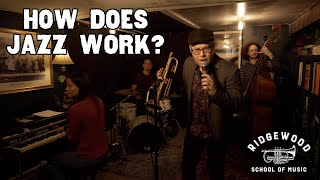
The Bass is the Backbone of Jazz
45sEducational clip showing the bass player's dual role in keeping time and harmony, essential for musicians.
▶ Play ClipJazz improvisation is a collaborative, spontaneous process where each musician has a defined role. The bass provides time and harmony, the drums embellish and interact, the piano comps chords, and the horn plays melodies and solos. A typical 12-bar blues form with specific chords and scales serves as the foundation for improvisation.
The bass plays a walking bass line (quarter notes) to keep time and establishes harmony by playing root notes and chord tones.
The drummer embellishes time, interacts with soloists, and drives the music forward, often using a swing pattern on ride cymbal and hi-hat on 2 and 4.
The piano plays chords (comping) to support harmony, and can also play melodies and solos, improvising rhythms as long as chords fit the form.
The horn section (trumpet, sax, etc.) plays melodies and solos, relying on the rhythm section for rhythm and harmony.
A common jazz form with 12 measures, typically using I7, IV7, and a turnaround (ii-V-I). In the key of F: F7, Bb7, Gmin7, C7.
For each chord, a consonant scale is used: F mixolydian for F7, Bb mixolydian for Bb7, G Dorian for Gmin7, C mixolydian for C7. The blues scale is an alternative.
Musicians develop a unique sound through tone, rhythm, and choice of consonance vs. dissonance. 'Outside' playing uses dissonant scales for expression.
After the head (melody), each musician takes a solo (often one chorus). Trading fours involves alternating 4-bar solos between instruments, and drum solos can be unaccompanied.
"The title accurately promises an explanation of jazz improvisation, and the video delivers with clear demonstrations and theory."
What are the two main jobs of the bass player in a jazz group?
To play the time (walking bass line) and establish the harmony (root notes, chord tones, passing tones).
01:12
What pattern does the drummer typically play on the ride cymbal in a swing feel?
A typical swing pattern.
02:09
What is the 12-bar blues chord progression in the key of F?
F7 (I), Bb7 (IV), F7 (I), Bb7 (IV), F7 (I), Gmin7 (ii), C7 (V), F7 (I).
05:07
What scale is most consonant on an F7 chord?
F mixolydian (major scale with flat 7).
07:11
What scale is used on a G minor 7 chord in a blues turnaround?
G Dorian (minor scale with natural 6, flat 3 and flat 7).
09:10
What is 'comping' in jazz?
Accompanying by playing chords rhythmically, often improvised.
03:18
What is 'trading fours'?
Each musician takes a 4-bar improvisation, alternating with the drummer.
15:31
What is the 'head' in a jazz tune?
The melody, played at the beginning (head in) and end (head out).
14:15
Bass as backbone
Explains the dual role of bass in timekeeping and harmony, fundamental to jazz.
01:1212-bar blues form
Clear breakdown of the most common jazz form, essential for beginners.
04:28Scales for each chord
Practical demonstration of how to choose scales for improvisation over a blues.
06:44Personal sound and dissonance
Highlights that 'wrong notes' are a creative choice, part of a musician's unique voice.
12:30Trading fours
Illustrates a common interactive solo structure in jazz.
15:31[00:03] Theory with Bob
[00:06] hey what's happening beautiful Geniuses
[00:07] Trumpeter Bobby Spellman here and if
[00:10] you're just getting into listening to or
[00:12] playing jazz music or you're interested
[00:14] in learning how to improvise on your
[00:15] instrument you may be asking yourself
[00:17] how does all this Jazz business work how
[00:20] much of the music is improvised versus
[00:21] written down what are the roles of each
[00:23] of the instruments in a jazz band and
[00:25] how is it possible that a bunch of
[00:27] musicians can all be creating music
[00:29] spontaneously without it sounding like
[00:31] total chaos well today I'm going to try
[00:33] to demystify the mechanics of jazz and
[00:36] try to shed some light on why it is such
[00:38] an exciting style of music to play and
[00:41] to listen to but in order to do so I'm
[00:43] going to need a Little Help from My
[00:45] Friends
[00:47] Julian Smith on the base
[00:50] Evan Hyde on the drums
[00:53] and Julia Chen on the piano
[00:56] and we're going to do a little
[00:57] demonstration of some of the mechanics
[00:59] of how a jazz performance works and
[01:02] plays through a little tune for you and
[01:04] have some fun so let's get started we're
[01:06] going to start out with the bass
[01:10] [Music]
[01:12] now the bass is the backbone of most
[01:14] Jazz groups
[01:16] the base has two very important jobs
[01:18] simultaneously
[01:20] first base player's job is to play the
[01:24] time usually in the form of a walking
[01:26] bass line
[01:27] consisting of mostly quarter notes and
[01:29] some Embellishments
[01:30] and the other thing the bass player does
[01:32] is establish the harmony by playing the
[01:35] root notes and connecting them with the
[01:39] chord tones and passing tones so the
[01:41] bass player is going to be playing the
[01:42] time while also holding down the harmony
[01:45] for the rest of the band
[01:47] and it's a big job
[01:51] but Julian's capable of it he's the guy
[01:53] are we gonna bring the drums now all
[01:54] right Evan come on in with the drums
[01:57] the drummer's job
[02:00] is to embellish the time and to interact
[02:02] with the soloists and with the melody
[02:04] in order to drive the music forward and
[02:06] give it a little bit more excitement
[02:09] Evan here is playing a typical swing
[02:12] pattern on the ride cymbal
[02:14] and holding down the two and four on the
[02:16] hi-hat
[02:18] that leaves his left hand and his foot
[02:20] to Accent the music
[02:22] in any way he would choose
[02:24] improvisationally
[02:25] throughout the piece
[02:27] now unliking Rock and pop music the
[02:29] drummer has a lot of freedom to play
[02:31] around with the groove so it's not a
[02:32] strict drum beat but it can be a
[02:34] variable pattern in order to be able to
[02:36] interact with the other musicians while
[02:38] we're improvising all right with that
[02:40] we're going to bring in Julia on the
[02:41] piano
[02:42] and here we go
[02:46] the piano's job
[02:49] the chords
[02:51] and help out with the harmony as well as
[02:53] play solos and play melodies especially
[02:56] in the case of a Piano Trio
[02:58] [Music]
[03:01] now once again in jazz unlike in rock
[03:03] and pop music there isn't a set Rhythm
[03:05] that The Pianist or other harmonic
[03:08] instrument player needs to play but
[03:10] rather they have the opportunity to
[03:12] improvise with those rhythms as long as
[03:14] those chords fit the underlying form
[03:18] now this is called accompanying which we
[03:21] shorten to comping so Julia what I've
[03:23] been talking now has been comping and
[03:26] she will accompany me when I play the
[03:27] trumpet or play uh you know solos play
[03:30] The Melody etc etc alright that brings
[03:33] it to me in the horn section
[03:36] now the horn section in a typical Jazz
[03:38] combo or our jazz quartet or a jazz
[03:40] group of any kind May consist of a
[03:42] number of instruments including trumpet
[03:44] trombone
[03:46] tenor saxophone
[03:48] saxophone any
[03:50] clarinet flute sometimes you might have
[03:53] a harmonica or a recorder or melodica or
[03:56] some kind of other thing but uh our job
[03:59] in the horn section is to play The
[04:01] Melodies and to play solos
[04:03] we in the horn section rely on the
[04:05] Rhythm Section for the Rhythm and for
[04:07] the Harmony and the Rhythm Section
[04:09] relies on us in the horn section for a
[04:12] tenuous sense of existential
[04:15] reality for a for a sense of purpose in
[04:19] all this music and together it's a
[04:20] symbiotic relationship all right
[04:23] so moving along the band as we've been
[04:26] talking has been playing
[04:28] a very common 12 measure form known as
[04:32] the blues a blues typically consists of
[04:35] 12 measures and uh it can change a lot
[04:38] there's a lot of variability in the
[04:39] Blues form but very typically we will
[04:41] have
[04:42] four chords and they go like this the
[04:45] one chord of the key the four chord of
[04:48] the key back to the one
[04:50] you stay on the one for another bar then
[04:52] it goes to the four chord four
[04:57] back to the one and the last four bars
[05:00] of the Blues is called the turnaround it
[05:01] goes two
[05:03] five
[05:05] one now this is a Blues in the key of f
[05:07] so the chords are going to be F7 to B
[05:11] flat seven to F7
[05:14] [Music]
[05:16] going on to B flat seven
[05:19] flat seven
[05:21] back to F7
[05:23] once again to turn around we get G minor
[05:26] seven
[05:27] C7 back to F7 again
[05:32] now most jazz tunes have a unique chord
[05:35] progression based on The Melody of the
[05:37] tune the atmosphere that the composer is
[05:40] trying to create but a blues is one of a
[05:42] number of forms that can be uh used for
[05:45] a number of different tunes and provides
[05:46] the basis for a lot of different tunes
[05:48] that we play so Blues is the most common
[05:50] form that you run into in jazz there are
[05:52] a couple other ones that you see that
[05:54] are common forms but certainly uh the
[05:56] blues is a great one to start with
[05:58] because we're dealing with a relatively
[06:00] simple chord progression and it's really
[06:02] the basis for what we do not only in
[06:04] jazz but in rock and Funk and just about
[06:07] all of American popular music alright so
[06:09] now we're going to talk about how we
[06:12] relate as improvisers to these
[06:14] underlying chords
[06:15] so for each chord in the form there is a
[06:19] scale or mode that is most consonant to
[06:22] that underlying chord so if we can learn
[06:25] these various scales and how to
[06:27] improvise with them how to invent
[06:29] Melodies using these scales we can
[06:31] relate to the chords in such a way that
[06:33] the whole thing sounds harmonious even
[06:35] though we're all improvising at the same
[06:37] time so we're going to go over each
[06:39] chord one at a time in the Blues and
[06:41] talk about some of these scales that I
[06:42] might choose to use so let's start with
[06:44] the F7 so this is the one chord we're
[06:47] just going to hang out on F7 we've
[06:49] abandoned the form we're going to hang
[06:50] out on F7 for a minute
[06:52] on that F7 chord the F7 is an F major
[06:56] Triad with a flat seventh on top so an E
[07:00] flat
[07:01] so that's going to sound like this
[07:04] there it is
[07:06] now I'm going to play generally speaking
[07:08] on that F7 chord I'm going to play an F
[07:11] mixolydian scale an F mixolydian mode
[07:13] mixolydian is a major scale but with a
[07:16] flatted seventh and that flattened
[07:18] seventh is going to match with what's
[07:20] going on in the chords and that scale is
[07:22] going to sound a little something like
[07:24] this
[07:27] [Music]
[07:29] hahaha
[07:31] [Music]
[07:38] [Applause]
[07:38] [Music]
[07:44] all right from our F7 chord we're going
[07:46] to move on to the next chord the four
[07:48] chord in the F major scale
[07:50] and that is going to be the B flat 7
[07:53] chord and we will come in right
[07:57] here all right that's the four chord now
[08:01] just like with the F7 is an f mixolydian
[08:04] scale for the B flat seven I will tend
[08:06] to use a B flat mixolydian scale which
[08:09] once again is going to be the B flat
[08:10] major scale for the flat seven and that
[08:12] is going to sound like this
[08:15] foreign
[08:18] [Music]
[08:32] now typically in the Blues form we go
[08:34] back to the F7 but we're going to skip
[08:35] ahead to the last four bars of the Blues
[08:37] which is called the turnaround and the
[08:39] turnaround gets us back to the top again
[08:40] now the turnaround consists in this
[08:43] particular jazz blues of a very very
[08:46] common chord progression that we know as
[08:48] the two five one and that is because it
[08:51] starts on the second chord of the key of
[08:53] f goes to the V chord and then we're
[08:55] back to the one again so two five one
[08:57] this is a little chord progression that
[08:59] makes up a lot of different tunes that
[09:00] you will hear but for now we're going to
[09:02] stick to one chord at a time so we're
[09:04] gonna go with G minor seven to start
[09:06] it's going to be right here all right
[09:08] now for the G minor seven
[09:10] my tendency is going to be to use a g
[09:13] Dorian mode which is going to be uh G
[09:15] minor scale with a natural six flat
[09:19] three flat seven but natural six and
[09:21] that sounds a little something like that
[09:23] [Music]
[09:39] from there we move on to the five chord
[09:42] coming to the end of the turn around
[09:43] here and that's going to be your C7
[09:45] chord and that's gonna sound like this
[09:48] and for that just like with the F7 and
[09:51] the B flat 7 I'm going to use the C
[09:53] mixolydian mode and that's gonna sound
[09:55] like this
[09:55] [Music]
[10:17] all right so those are the four modes
[10:19] the four chords and corresponding
[10:22] consonant modes that we might use on a
[10:24] blues such as this and we're going to
[10:25] return to the blues form now we're back
[10:29] in the 12 Bar form known as The Blues
[10:33] and we're going to take a little time
[10:34] now to play a Melody that I wrote for
[10:37] this occasion to avoid any copyright
[10:39] strikes on my YouTube channel and then
[10:42] I'm going to take a one chorus solo a
[10:43] chorus is one time through the whole
[10:45] form it's gonna sound like
[10:50] hahaha
[10:51] [Music]
[11:19] hahaha
[11:24] [Music]
[11:44] now our option is to use some of those
[11:46] more consonant modes that you've heard
[11:48] but there's also a number of different
[11:49] kinds of scales that you can use and
[11:51] that's up to the improviser to decide so
[11:53] one very common alternate scale I could
[11:55] use would be the blues scale that's a
[11:57] very common one and that's going to
[11:58] sound a little something like this
[12:00] foreign
[12:02] [Music]
[12:30] now one of the things that makes jazz
[12:32] music so much fun is that each
[12:33] individual musician has their own
[12:36] personal sound and oftentimes you can
[12:39] hear the way that a musician you can
[12:41] identify a musician by just one or two
[12:43] notes now a part of that musician's
[12:45] individual sound is their tone on the
[12:48] instrument uh you know what instrument
[12:49] they're playing as well as what kinds of
[12:51] rhythms and Melodies and what their
[12:53] influences are any number of different
[12:55] things that will make up a musician but
[12:57] one of the things that you can also hear
[12:59] in a musician sound is the way they
[13:01] choose to use consonants versus
[13:03] dissonance so very commonly you know you
[13:06] would think of uh dissonant notes we
[13:08] might have traditionally heard dissonant
[13:09] notes as being referred to as wrong
[13:11] notes but in our post Eric dolphy world
[13:14] it's just another Choice any kind of uh
[13:17] creative musician can choose to use more
[13:19] dissonant sounds dissonant scales
[13:21] dissonant intervals in his or her
[13:23] improvisations and that's going to be a
[13:25] part of his or her characteristic sound
[13:26] so I'm going to show you a little bit
[13:27] about what happens if I Take It Outside
[13:29] of those chords that we played in those
[13:31] regular modes and take it into a
[13:33] different realm and that's going to
[13:33] sound a little something like this
[13:35] [Music]
[14:07] all right so anything's possible here in
[14:09] the world of jazz music or taking it out
[14:12] we're having a good good old time here
[14:13] all right so usually you will play the
[14:15] head in the head in is the melody so we
[14:18] played that already and then everybody
[14:19] in the band will take a little solo
[14:20] we'll trade around it could be any
[14:22] length but for now we're gonna stick to
[14:23] one chorus and we're gonna start with
[14:25] Julia Chan on the piano
[14:30] [Music]
[14:42] foreign
[14:45] [Music]
[14:54] for Mr Julian Smith
[14:55] [Music]
[15:16] all right and once everybody takes a
[15:18] solo of their own chosen length whatever
[15:19] the however much they they want to say
[15:22] in the whole grand scheme of the form
[15:25] comes time for the drum solo now there's
[15:27] a couple different options that we have
[15:28] with the drum solo but one option is
[15:31] called trading fours and in trading
[15:33] fours what we're gonna do is each of us
[15:34] will go around in the band and take four
[15:37] bar improvisations trading with Evan
[15:40] over here on the drums throughout the
[15:42] form so we're gonna stick with the form
[15:44] but we're just each gonna take a little
[15:45] four of our solo now you could trade
[15:47] eights you could trade 16s you could
[15:48] probably trade 32s or 64s but it might
[15:50] get a little unwieldy so we're gonna
[15:51] stick to Fours for now and that sounds a
[15:53] little something like this
[15:56] foreign
[15:58] [Music]
[16:50] now that's one option for a drum solo
[16:53] the other a very common option is for
[16:55] the drummer to take an unaccompanied
[16:57] solo and even though the drummer is
[17:00] going to be playing by himself without
[17:01] any kind of accompaniment by any of the
[17:03] harmonic instruments he's still gonna
[17:05] follow the form so he might play one
[17:07] chorus two chorus three choruses however
[17:09] many courses that's gonna sound like
[17:10] this in this case we're just going to
[17:12] take one chorus of drum solo here we go
[17:14] Evan hide
[17:15] [Music]
[17:38] all right now typically after the drum
[17:41] solo we'd go right back into the head
[17:42] out just like the melody in is called
[17:45] the head in the melody on the end of the
[17:47] tune is called the head out so we're
[17:48] going to play the head out now for you
[17:50] and close out this tune
[17:53] hope you had a little fun here we go
[17:56] [Music]
[18:34] and that's a little introduction on how
[18:36] Jazz improvisation works we got the
[18:38] instruments in a regular Jazz combo
[18:39] there may be many other different
[18:41] instruments that we haven't covered here
[18:42] and anything it goes but for now this is
[18:44] a very standard instrumentation after
[18:46] that we've got the chords of the tune
[18:48] once again the blues is just one of a
[18:50] number of different forms usually jazz
[18:51] tunes will have their own unique chord
[18:53] progressions but it's a good place to
[18:54] start with the blues because it's a
[18:55] common one that you will run into
[18:56] regularly we got four chords in this one
[18:58] each of those chords has a scale that is
[19:01] most consonant to that chord that we can
[19:02] use to create Melodies at any given time
[19:05] any one of us in the band becomes the
[19:07] composer so it's always a very exciting
[19:09] it's an exciting style of music because
[19:11] all of a sudden the job of the
[19:13] individual musician becomes the job of
[19:15] the composer in a spontaneous fashion
[19:17] and we all will interact with each other
[19:19] we all have the opportunity to listen in
[19:21] very closely to what the other one is
[19:22] playing and to try to interact in such a
[19:24] way that we can make beautiful music and
[19:25] have a good old time after that we're
[19:28] able to expand on what we're doing
[19:30] beyond the normal chords that we have
[19:31] and really try to capture some
[19:33] interesting rhythms and and in the whole
[19:35] process of the thing really try to
[19:36] capture our own view of the very essence
[19:39] of The Human Condition and try to convey
[19:42] that through sound to the adoring fans
[19:44] in the audience all right gang and that
[19:46] is a little bit on how to Jazz
[19:50] all right gang and there you have it a
[19:52] little rundown on the fundamental
[19:54] mechanics of how jazz music works hope
[19:56] that clears up a little confusion
[19:57] surrounding what's going on while we're
[19:59] playing and I hope it inspires you to go
[20:01] check out some great records go check
[20:03] out some live music and pick up your own
[20:05] instrument go hang out with your friends
[20:06] and try some of these ideas out for
[20:08] yourself if you like this video be sure
[20:10] to give it a like And subscribe to the
[20:12] channel for more videos on jazz music
[20:14] improvisation and music theory going
[20:17] forward also if you have any questions
[20:18] on any of the topics that we covered in
[20:20] this video be sure to leave them in the
[20:22] comments below and I'll do my best to
[20:23] get back to you and clear up any
[20:25] residual confusion on the topic at hand
[20:28] alright gang well until next time be
[20:31] sure to go check out some great records
[20:32] and have a lot of fun with it and I'll
[20:33] catch you on the next one see ya
[20:38] Theory with Bob
[20:42] all right friends thanks so much for
[20:44] checking out this video I hope it helped
[20:46] in your understanding of the musical
[20:47] world and in your pursuit of the Majesty
[20:49] of musical self-expression if you like
[20:52] this video you can let us know by giving
[20:53] it a like and be sure to subscribe to
[20:55] the channel for more musical education
[20:57] videos going forward you can also follow
[21:00] me on Instagram at Bob Spelman for some
[21:03] more musical fun the Ridgewood school of
[21:06] music is now accepting new students
[21:07] online as well as in person in the
[21:10] Brooklyn Queens and greater New York
[21:12] City area you can find us on our website
[21:14] at
[21:16] www.ridgewoodschoolofmusic.com or you
[21:18] can send us an email at Ridgewood
[21:20] schoolofmusic gmail.com and we'll get
[21:24] back to you as soon as we can try to set
[21:25] you up with a great teacher for the
[21:27] kinds of music that you're looking to
[21:29] study all right gang well thanks again
[21:31] and until next time happy practicing
[21:35] foreign
[21:37] [Music]
⚡ Saved you 0h 21m reading this? Transcribe any YouTube video for free — no signup needed.