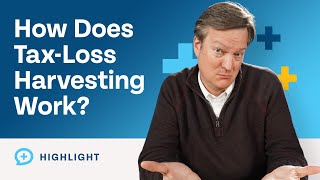

Squirrel Strategy: Harvest Losses for Future Gains
40sUses a relatable squirrel analogy to explain why harvesting losses during bear markets is crucial for long-term tax benefits.
▶ Play Clip"The title accurately reflects the content, which thoroughly explains tax-loss harvesting with a real-world example."
The video explains how tax-loss harvesting works in practice, using historical market data to show that bull markets are more frequent and severe than bear markets. It emphasizes the importance of harvesting losses during downturns to offset future gains and reduce taxes, using a case study of an investor named Jasmine.
From 1942 to present, bull markets last longer and are more severe in positive terms than bear markets are in negative terms.
Bull markets happen more frequently and last longer, so investors should harvest losses during bear markets to prepare for future gains.
Jasmine invests $100,000 in an S&P 500 ETF on Jan 1, 2022, and harvests losses when the holding drops by $10,000.
On Feb 23, she sells the S&P 500 ETF to harvest $11,000 in losses and buys a total market index ETF to avoid wash sale rules.
On June 13, she sells the total market index ETF to harvest $10,600 in losses and buys back the S&P 500 ETF after 30 days.
No one can predict market bottoms; waiting risks missing recovery, as seen in 2020 and 2008 where false recoveries occurred.
By Oct 12, Jasmine harvested $21,700 in losses, which can offset capital gains, $3,000 of ordinary income per year, and carry forward to future years.
For seven-figure portfolios, six-figure losses can be carried forward to offset future gains and distributions, allowing tax-free recovery.
Tax-loss harvesting during bear markets provides significant tax benefits that can be used for years, making it a valuable strategy for long-term investors.
What is the historical frequency of bull markets compared to bear markets?
Bull markets happen more frequently and last longer than bear markets.
0:14
How much did Jasmine harvest in losses on February 23?
She harvested a little over $11,000 in losses.
3:22
What fund did Jasmine buy after selling the S&P 500 ETF to avoid wash sale rules?
She bought a total market index ETF.
3:33
How much did Jasmine harvest in losses on June 13?
She harvested $10,600 in losses.
4:06
Why is it not advisable to wait for the market bottom to harvest losses?
Because no one can predict the bottom, and waiting risks missing the recovery, as seen in 2020 and 2008.
5:21
What is the maximum amount of ordinary income that can be offset by capital losses each year?
$3,000 per year.
6:38
What is the net loss harvested by Jasmine through October 12?
$21,700.
6:27
How can unused capital losses be used in future years?
They can offset capital gains or up to $3,000 of ordinary income each year.
6:43
Bull Markets Outweigh Bear Markets
Provides historical evidence that bull markets are more frequent and severe, reinforcing the value of long-term investing.
0:14Real-World Tax-Loss Harvesting Example
Demonstrates a practical, step-by-step strategy that viewers can apply to their own portfolios.
2:41Market Timing Is Impossible
Highlights the futility of trying to time the market, a key principle for investors.
5:21Long-Term Tax Benefits
Shows how harvested losses can be carried forward for years, providing ongoing tax advantages.
6:24[00:00] it's Brian Preston the money guy so how
[00:03] does this play out in the real world and
[00:05] before we talk about a strategy like a
[00:08] real life actual strategy you could be
[00:10] employing it's important to have some
[00:12] context you guys have seen this chart
[00:14] before but what this chart lays out for
[00:15] you is all of the bear markets and all
[00:18] the bull markets from 1942 all the way
[00:21] through this year uh the length of the
[00:24] of the market shows how long it lasted
[00:27] and then the the depth or the height of
[00:29] it shows how severe it was so what you
[00:30] can see here is that
[00:32] more often than not bull markets are
[00:35] substantially more severe in a positive
[00:39] way than bear markets severe sense of
[00:41] negative bull markets are awesome
[00:43] they're awesome more awesome than bear
[00:45] Mark but see that's just kind of a given
[00:47] more awesome than the bearers the
[00:48] gravity through which you experience a
[00:50] bull market way outpaces the gravity
[00:53] which you experience in a bear market
[00:54] and they tend to last for a lot longer
[00:57] of a period of time so even when you're
[00:59] going through periods of volatility like
[01:00] this it's important to remember that
[01:02] it's important to keep that archive in
[01:03] the back of your mind well that's why
[01:04] here's The Optimist take of this and
[01:07] Bo's already thrown out one of my slides
[01:08] but this is a way for me to put it back
[01:10] in for Daniel's benefit too is that I
[01:13] would we know that fortunately bull
[01:14] markets last much longer and happen more
[01:17] frequently than bear markets so I think
[01:20] that this puts a priority on the fact
[01:22] that when we do have that two out of 10
[01:23] years you want to be like a squirrel
[01:25] who's harvesting and putting a bunch of
[01:27] nuts to save for the winter because
[01:29] there will be really good gains in the
[01:32] future future so the harder you work
[01:34] while things are cold outside you know
[01:37] and you're harvesting and just say that
[01:38] you will see that the the benefit for
[01:41] this for many years in the future you
[01:43] are filling up that Silo of losses
[01:45] that's one of the things I'm telling you
[01:47] me personally I'm talking about my
[01:49] personal portfolio plus what we do for
[01:51] all of our clients I've done this at
[01:53] least twice this year because I take it
[01:55] very serious and we're gonna have an
[01:56] example of how that boom bust Cycle
[01:59] Works this is not a setup and forget it
[02:01] one and done this is something that you
[02:04] actually can use this strategy
[02:05] throughout the volatility of the market
[02:07] so that as we come through this
[02:09] short-lived bear Market you will be able
[02:12] to hit the ground running and really
[02:13] have a really strong tax strategy for
[02:15] when things are good too but you got to
[02:17] be a financial mute you have to
[02:19] recognize that these opportunities don't
[02:21] happen all the time you can see in the
[02:23] chart that we just showed that bear
[02:25] markets don't happen all that frequently
[02:27] despite what the financial media might
[02:29] suggest to you so when we have these
[02:31] large drawdowns like what we're seeing
[02:33] this year it makes a lot of sense to
[02:35] capitalize on them it makes a lot of
[02:36] sense to be able to take advantage of
[02:38] them so let's do a real world
[02:41] live case study based on something that
[02:44] could have happened this year in the
[02:46] year 2022. so let's say that Jasmine has
[02:49] a hundred thousand dollars invested in
[02:51] an S P 500 Index ETF on January 1st of
[02:55] 2022. let's also assume this holding is
[02:57] held inside of our taxable brokerage
[03:00] account
[03:00] she decides that man this year has been
[03:03] volatile and I'm going to take advantage
[03:05] of loss harvesting so every time my
[03:07] holding drops by ten thousand dollars
[03:09] I'm gonna go Harvest those losses and if
[03:11] you look from January through September
[03:13] that occurred in February and then it
[03:16] occurred again in June so here's the
[03:19] Practical nature of what Jasmine did
[03:22] on February 23rd she sells her S P 500
[03:26] ETF to harvest a little over 11 000 of
[03:30] losses she then takes the proceeds from
[03:32] that sale
[03:33] and immediately buys a total market
[03:36] index ETF so as not to violate the wash
[03:39] sale rules they are similar but not
[03:42] identical well then if you remember uh
[03:45] she starts feeling pretty good second
[03:46] quarter started off pretty nice she's
[03:48] like oh wow this worked all I lost
[03:49] harvest the market started making money
[03:52] and then the shoe dropped and then it
[03:53] happened again and then the market in
[03:55] the second quarter continued to drop
[03:58] and so then she decides you know what on
[04:00] June 13th I have crossed over that ten
[04:02] thousand dollar loss mark again so now
[04:04] on June 13th what I'm going to do is I'm
[04:06] going to sell my total market index I'm
[04:09] gonna Harvest another 10 600 of losses
[04:13] and because it's been 30 days since I
[04:16] last did that transaction I'm gonna buy
[04:19] back into the S P 500 Index Fund now so
[04:22] I own the s p i got out of it I rode in
[04:25] the total Market it lost money too I
[04:27] harvested that loss now I got back in
[04:29] the s p 500. well I think that's
[04:32] interesting though if you just bring up
[04:34] the the visual again a lot of people the
[04:37] the naysayers or the the I'll just call
[04:39] them the trolls under the bridge that
[04:40] are going to come out in the comments
[04:42] section they'll say guys why'd you do
[04:44] all these trades why wouldn't you just
[04:45] wait until
[04:46] and just buy them while you do this
[04:49] horse harvesting one time in June when
[04:51] it was at the lowest and it's exactly
[04:53] what you shared and that's why I feel
[04:54] like I'm just giving the the commentary
[04:56] of answering the unspoken part is that
[04:59] we never know when markets are going to
[05:01] recover if you think about like the
[05:03] pandemic of what happened in 2020 the
[05:05] market got crushed went down to 35 but
[05:07] then shot off like a rocket we harvested
[05:10] losses in that downturn but then we hit
[05:13] recovery mode so fast that if you were
[05:16] trying to wait for the second or even
[05:17] the third so you would reached the dead
[05:20] bottom you might have missed it that's
[05:21] right so we don't remember we none of us
[05:23] have the crystal ball of knowing what's
[05:25] going on and when the full recovery
[05:27] because there might be some false
[05:28] positives or false recoveries that occur
[05:30] in any bear Market even in 2008 if you
[05:33] remember after the election season of
[05:36] 2008 the market actually closed up at
[05:39] the end of the year not for the year it
[05:41] was still down 37 but it was at a low of
[05:44] over 50 percent down but then it closed
[05:46] up and closed down 37 because it did
[05:49] have a 10 to 15 percent recovery right
[05:51] after the election cycle before we went
[05:54] right back down to the intested the
[05:56] bottoms of January through March of 2009
[05:59] it's not uncommon to have those fits and
[06:01] starts where things start look like
[06:03] they're getting better that's why you
[06:06] might do this multiple times in a year
[06:08] is because you think you're at a bottom
[06:10] you harvest losses we have a temporary
[06:12] recovery then we fall even lower you
[06:15] harvest again I know it's creating work
[06:17] for you but it shows up and it does
[06:20] create value over the long term pay
[06:22] attention to these cycles and so where
[06:24] is Jasmine net net so through October
[06:27] 12th of this year she's harvested 21 000
[06:31] than seven hundred dollars in losses now
[06:33] what those losses can do is they can
[06:35] offset capital gains this year if she
[06:38] all sets all of her capital gains they
[06:39] can offset three thousand dollars of
[06:41] ordinary income and anything left over
[06:43] can move into future years and in those
[06:45] future years it can offset capital gains
[06:48] or it can offset up to three thousand
[06:49] dollars of capital losses I mean of
[06:51] ordinary income a lot of people don't
[06:53] really say well I don't want to harvest
[06:55] any more loss I've harvested plenty I've
[06:57] harvested plenty of harvested plenty
[06:58] remember bull markets last for a long
[07:02] time and you can have a down year where
[07:05] man it feels painful but the next year
[07:07] is pretty good and you can use those
[07:08] losses and the next year is pretty good
[07:10] you can use those losses the next it's
[07:12] not uncommon to be able to harvest
[07:13] losses in one year they can offset
[07:16] triggered gains for the next number of
[07:19] years you're basically getting to invest
[07:20] your portfolio tax-free which is a super
[07:23] super awesome thing to be able to do
[07:25] well it's not uncommon look I'm going to
[07:27] talk in reality here for from a
[07:29] financial planner is that for seven
[07:32] figure portfolios it's going to be a
[07:34] six-figure loss that you've harvested
[07:36] and you're like well why would I mean 3
[07:39] 000 is all I can offset are we really
[07:40] going to take a hundred thousand two
[07:42] hundred thousand dollars of of losses
[07:45] that we're just gonna carry forward yes
[07:47] yeah because there will be there will be
[07:49] some years in the future where you're
[07:51] gonna have distributions at year end or
[07:54] you have some big transaction yourself
[07:56] you're going to be so thankful that you
[07:58] had the losses to offset those gains so
[08:01] you you got to essentially experience
[08:03] the recovery without having to pay the
[08:07] taxes on all those distributions


⚡ Saved you 0h 08m reading this? Transcribe any YouTube video for free — no signup needed.