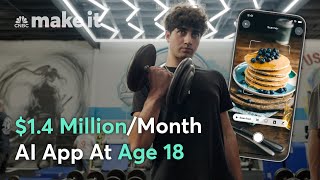

18-Year-Old CEO Makes $1.4M/Month
45sThe shocking contrast of extreme youth and massive revenue instantly grabs attention.
▶ Play Clip"Title promises an 18-year-old's $1.4M app story, and the transcript delivers exactly that—though some fluff around personal purchases and college plans dilutes the density."
Zach Yadigari, an 18-year-old entrepreneur, shares his journey of building Cal AI, a calorie-counting app that generates $1.4 million monthly. He discusses his early start in coding, the challenges of balancing high school and business, and his strategies for scaling and marketing.
Zach rejects age as a limitation, emphasizing his drive to learn coding and start businesses early.
Cal AI is an app that calculates calories and macros from a photo, generating $1.4M monthly after app store cuts.
Zach reinvests most revenue, pays himself $100K dividends, and bought a Lamborghini, viewing it as a diminishing-returns purchase.
Frustrated with manual food tracking apps, Zach and co-founders used AI to create a photo-based solution.
A month in a hacker house led to first hires and a productive rhythm, marking a pivotal moment.
Zach prioritized Cal AI over school, working 40 hours weekly and skipping his AT test, deciding against college initially.
Influencer marketing is the main spend; users misunderstand AI capabilities and refunds are handled by Apple.
Started coding at 7, built an unblocked gaming site in high school, and saw entrepreneurship as a way to bypass traditional career paths.
Apple's 45-day payout lag caused cash flow issues for six months until revenue outpaced expenses.
Zach plans to attend college for the social experience, living in an 'App Mafia' house with other founders.
Aims to become the biggest calorie tracker, then build a generational company, believing age doesn't determine success.
Zach's story highlights the power of early action, strategic reinvestment, and resilience in overcoming financial and educational hurdles, with a clear vision for future growth.
Age is not a barrier
Challenges common self-limiting beliefs about age in entrepreneurship.
Reinvestment strategy
Shows how reinvesting profits fuels growth, with dividends as a secondary reward.
01:05Prioritization over school
Illustrates a non-traditional path where business takes precedence over formal education.
03:42Cash flow management
Highlights the challenge of scaling with delayed payouts and the importance of bridging gaps.
06:24Long-term vision
Emphasizes building a generational company beyond the initial app success.
08:28[00:00] I think a lot of people will use age as something that is a self-limiting belief, but I didn't
[00:15] buy into any of that. When I've wanted to do something, I will just go and do it. This has helped me with learning to code at such an early age, getting into entrepreneurship at such an early age, and then anything else along the way.
[00:28] My name is Zach Yadigari. I'm 18 years old and the co-founder and CEO of Cali-O, an app where you can just take a picture of your food and then it will automatically calculate the calories and macros for you.
[00:41] My app brings in about $1.4 million a month after the app stores cut. We reinvest most of the money back into the app from Kali.ai.
[01:05] But whenever there's enough cash left over, we will pay out dividends to ourselves. Most recently, I personally was paid $100,000 in dividends. most of the money I've made from the app so far I've actually spent I recently bought a Lamborghini
[01:25] which you know some will say it's an irresponsible thing to buy at my age but I think that it's always something I've dreamed of getting and it's only gonna have
[01:39] diminishing returns as I get older I'm not that materialistic I don't have many things that I plan to bypass that and therefore I'm probably going to just start saving.
[01:52] A few years ago I started working out. I was a really skinny kid growing up and I wanted to put on muscle. Honestly they're impressed girls at my school. So I started going to the gym, weightlifting and didn't really see many results. And so after getting some advice from someone at the gym I
[02:07] downloaded one of the most popular apps at the time. I started using it and three days in, I quit And that because the app required me to weigh my food on a scale to type in everything I was eating It was unsustainable for my lifestyle Fast forward about a year or two
[02:25] and scratchy-ditty, all these other AI technologies started releasing. And so along with my co-founders, we hypothesized that we could build an app. We could just take a picture, and AI will do all
[02:37] the work for you. And we launched it. The response immediately was very positive. That's when we knew we had something good on our hands and we decided to go all in.
[02:52] And so along with Henry, our CTO, we decided let's spend the summer doing everything we can to make this app actually succeed. And so we moved to San Francisco for the month of July.
[03:06] We stayed there for a month, lived in a hacker house, basically slept in the office. And I think that month was the real turning point. That's when we started making our first real hires, started building up a team,
[03:19] and got into a really good rhythm that would carry us to next year. That's the RecoFounders with Cal AI.
[03:42] It was a lot juggling high school and running Cal AI at the same time. In the past, all of the projects I had been working on were always side projects to me. I would put school first. If I had a test to study for, I would study for the test, and then I would work on that.
[03:57] But Cal AI, for the first time, I would prioritize. I would put in, on average, 40 hours a week into Cal AI on top of school, often working while in school. Took my ATs this week, AT test.
[04:10] Sat for 12 hours total doing nothing. I don't care. There are more important things to discuss. Basically, I didn't even take my AT test. I didn't think I was going to go to college at this point.
[04:22] So I just sat there and didn't take a single one. Our special stock at Cali Eye, what we really do right, is influencer marketing. And that where a far majority of our spending goes to We have many competitors These apps are the reason that we started CalAI because they suck There are many misconceptions about CalAI and what AI can do Some of our users expect it to
[04:45] have x-ray vision where if you take a picture of a bowl of food and you hid things at the bottom of the bowl, it's going to pick it up. It won't. You have to make sure every ingredient is clearly in frame. And we try to teach the users early on in the apps tutorial how to use the scanner the most
[05:02] effectively. All refunds are handled by Apple directly. We don't process payments ourselves within the app and that's a common misconception of many users is they think the app actually
[05:18] handles payments and takes in credit card info. They don't Apple though so you have to directly request a refund with them. I started learning to code when I was 7 years old. I was obsessed with video games like
[05:31] Minecraft and Roblox. And so I begged my mom to put me in a summer camp to teach me how to make my own. There were many different factors that drove me to be an entrepreneur at such a young age.
[05:43] The biggest was that I always felt like I was pushed down a very narrow path in the school system. So I want to get a good grade on this test, that I could get into a good college, that I could get a good job, that I could make money. And then I decided if I could skip all
[05:59] those steps and just make money. Then I wouldn't be stressed anymore. My freshman year of high school, I built an unblocked gaming website that lets students play games in school, bypassing the internet blocking protocols. Building CalAI was very inexpensive because
[06:24] I programmed it along with Henry. It was only when we launched to the public that we really spent money. Scaling the business took everything I made from Totally Signs and then Blake doubled
[06:40] that on top of it Because of Apple payout calendar they pay you about 45 days after you make a sale And so because of that we were scaling faster than Apple was paying us which meant that for months we were putting money in and weren seeing a proportional
[07:02] amount of money out. It took about six months before we were finally ahead of Apple's payout schedule and we were making more than we were paying. And this sounds a little confusing. It sounds like maybe we weren't softball. We were very softball during that time.
[07:21] I decided to go to college because I care to just go into the business world, start working full time, get an in-person office with the team.
[07:33] And that could be cool. And that is something I do want to do. However, before that, I want to hold on to a little bit of this childhood experience of going to college, making new friends, having a good social life with peers that are also 18 years old.
[07:48] I'm getting a house with a bunch of other app founders that's right next to campus. And we're going to call this house the App Mafia. We're going to be recording a ton of content, throwing parties, educating people, teaching them how they can build their own apps.
[08:01] I'm going to be living the school life between entrepreneurship and the student life. And balancing that, it's going to be probably fun, but also pretty difficult. My only concern is that I'm not going to want to do any college work whatsoever.
[08:16] and if that becomes something where I never do anything I don't know how long I'll last there before they kick me out.
[08:28] It's something I thought a lot about is the end goal for Kalyon. For the longest time it's always been become the biggest calorie tracker app. When we are helping
[08:41] people on autopilot is one I would consider the job really complete. After CalAI, I plan to build a generational company. Not sure entirely what yet, but while the company is helping many people,
[08:55] I want to build something that can push that even further. I think entrepreneurship is really cool because at the end of the day, age doesn't really matter much. You're either good or not good at
[09:07] what you do and then the market will decide the rest.
⚡ Saved you 0h 09m reading this? Transcribe any YouTube video for free — no signup needed.
