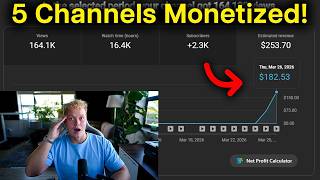

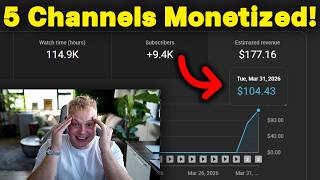
I Monetized 5 Faceless Channels in 15 Days
56sThe hook of achieving rapid monetization across multiple channels is highly aspirational and curiosity-driven, perfect for grabbing attention.
▶ Play Clip"Title promises weekly monetization of 5 channels, but the video only explains a generic framework for starting one channel at a time, with no real proof of weekly output."
Stefan, 23, claims to make $30-40k/month and has monetized 5 faceless channels quickly; example channels took 15 days to monetize.
Trust score is how much YouTube trusts your channel; warming up the account by watching 1-2 hours/day, liking, and commenting for a week helps increase it.
LinkedIn-style resume: Stefan has helped students like Martin make $31k/month and others achieve $24k, with average monetization in 3-6 weeks.
Criteria: under 5 competitors, no 100k+ subscriber channels, no failing small channels, niche younger than 6 months, and ability to create better content.
Use a dummy account to train YouTube's algorithm to show faceless niches by searching and clicking on faceless videos for about 2 minutes.
Use Next Level (€13/month) and VidIQ (free) to analyze RPM and channel performance; calculate potential earnings from views.
Speed is key; you need a team that can quickly implement content. Options: do it yourself (no cost, time-consuming), hybrid (low cost, scalable), or outsource (scalable, requires capital).
Framework: niche research, choose account, get 10-15 topics, test by posting, and repeat. Find demand via outliers, avoid copying top videos, check supply on YouTube.
Use ChatGPT for scripts, 11 Labs or Genny AI Pro for voiceover (million credits for $22), freelancers for editing ($15-25/video), and proven thumbnail/title concepts.
Video length should be 1.5x longer than competitors to keep viewers on YouTube longer, as YouTube promotes videos that retain audience.
Post inconsistently to show a human is behind the account; if one video blows up, double down on that topic (80% existing, 20% new); if flatlining, re-evaluate niche/topics.
What are the score ranges for the clickbait reality check rubric?
0-15: outright lie, 16-30: pure clickbait, 31-45: mostly fluff, 46-60: average, 61-75: solid, 76-89: excellent, 90-100: exceptional.
Which type of YouTube account is best for new faceless channels?
Personal accounts are the best, brand new accounts are also very good, but pre-monetized accounts are not recommended because they cost money.
02:41
How do you warm up a YouTube account to increase trust score?
Watch 1-2 hours of content per day, subscribe, like, and comment on videos, without acting bot-like, for at least one week.
03:20
What are the key criteria for choosing a niche?
Under 5 competitors, no channels over 100k subscribers, no small channels failing, niche not older than 6 months, can create better content, interest, and monetizable.
04:06
Which tools are recommended for niche research?
Next Level (€13/month) and VidIQ (free plan is enough).
05:53
How do you set up a dummy account for niche research?
Create a new account, search for any topic, click on faceless videos, let them play, and repeat for about 2 minutes to train the algorithm to show faceless niches.
07:15
If a channel has an RPM of $6 and 2 million views a month, how much does it earn monthly?
It is only $6 RPM, so 2 million views a month yields $2,000; you should calculate if that is enough money for you.
08:51
What are the main trade-offs between doing it yourself, hybrid, and full outsourcing?
Doing it yourself has no costs but is time-consuming; hybrid has low cost but is partially scalable; full outsourcing is extremely scalable but requires income.
10:12
What is the niche testing framework?
Niche research, choose an account, get 10-15 video topics, test by posting, and repeat until success.
11:51
How do you find demand and supply for video topics?
Look for recent outlier videos, recent trending formats, and do not copy the most popular videos; check supply by searching the topic on YouTube.
12:33
What is the topic transfer method?
Find winning video topics in other niches and move them over to your niche.
14:35
Why should you post inconsistently?
Post inconsistently to show a human is behind the account, not an AI bot.
17:25
Account warm-up to raise trust score
Explains a concrete method (watching content, liking, commenting) to build YouTube trust, which is crucial for avoiding shadow bans.
03:20Niche selection criteria
Provides specific, actionable filters (competitor count, channel size, niche age) that directly impact a new channel's success probability.
04:06Dummy account to train algorithm
Shows how to exploit YouTube's recommendation system to find endless faceless niche ideas, a clever and non-obvious approach.
06:23Demand and supply for topics
Teaches how to select video topics based on market saturation, which is a core reason why many creators fail.
12:33Topic transfer method
Presents a powerful cross-niche strategy for finding winning video ideas, backed by examples of high-performing transfers.
14:35[00:02] one, but not just two, but not just three, but not just four, but five faceless YouTube channels within a very very short period of time. And in this video, I'll show you guys exactly how I did it. For this channel here, just as
[00:17] an example, it took us literally 15 days to get this channel monetized. And this video, I'll show you guys exactly what I did and how you can monetize this many channels as well. If you, you know, want
[00:31] to. Now, for the people who don't know who I am, I'm Stefan, currently 23 years old. And, you know, I currently make between 30 and 40 thousand dollars a month and constantly building new faceless YouTube channels, as we can see
[00:43] right here. Then, you know, I've just made I've Oh, I made 42 thousand dollars with just two faceless YouTube channels, as we can just see here, 30 thousand dollars. And then here, I've scaled the channel from zero to 48 thousand dollars
[00:58] in just 30 days, as we can see right here. Then, I've also helped hundreds of other people do the exact same thing. For example, here Martin. Martin's with helped to make 31 thousand dollars in one single month. Here, a different
[01:10] channel. Here, a different student, 24 thousand different student blowing up. Here, a different student monetizing 20 days. So, it's not just me who's monetizing channels that fast. On average, like our
[01:23] in like literally three to six weeks, which is very fast. Now, if you're interested in working close with me, check out the first link in the video description. Book a call with me and we will have a look how we can scale up
[01:36] your channel as well. And, you know, how I can help you actually, you know, reach your goals and stop failing on YouTube, all right? So, check the first link in the video description, book your call. And with that being said, I planned out
[01:48] this whole video, quite valuable. So, make sure to watch this whole video. So, first thing we always need to do, and I like to do this here first before we even do niche research, before we do any of these kind of things, I like to get
[02:00] our channel ready, you know? You have to understand that shadow bans are for sure understand that shadow bans are for sure 100% real on YouTube, right? Now, we can avoid shadow bans by kind of having a good trust score. Now, what is a trust
[02:13] score? Trust score is just basically how much does the platform actually trust your YouTube channel, all right? Now, there are different kind of accounts and actually go ahead and increase your trust score for YouTube to trust your
[02:27] account more and with that actually push your channel more. Now, there are different kind of YouTube accounts. They are, just as an example, aged account, there's a pre-monetized account, and then there is, for example,
[02:41] also a personal account. A personal account is a YouTube channel like the one you most probably currently use to watch this exact video. Now, personal accounts are the best accounts you can go with. Brand new accounts are also
[02:55] very good. I would not recommend you to use a a pre-monetized account just because they cost a bunch of money and if you channel, all right? So, just use one of
[03:07] these accounts and you will be good to go. Now, how do you actually go ahead going to be very important because we obviously want to try to increase our trust score. Now, this is not always 100%, all right? So, it does not always
[03:20] work, but it does work, all right? Now, how do we actually go ahead and warm up our account? We use the account as a normal user, all right? We watch 1 to 2 hours of content per day. We subscribe, like, and comment to different kind of
[03:34] YouTube videos. Now, very important is that we do not spam this. So, we do not we do not want to act bot-like when we are actually, you know, subscribing to YouTube videos. And we do this for 1 week plus to lower the risk
[03:50] of a low trust score, all right? Now, as I've said, this is not going to be 100% safe. Now, it's not going to work every single time, but this for sure does work increase the chance of actually, you know, getting a good account. Next thing
[04:06] we want to do is we want to actually go ahead and, you know, do niche research. specific criteria we're always looking for. For example, there are under five this niche that are constantly getting more views than they have subscribers.
[04:21] This means there's high demand and low supply, which is one of the most important things or metric or kind of terms when it comes to YouTube automation. Most people fail with YouTube because they do not understand
[04:33] like demand and supply, okay? Then, there are under there are no channels with over 100,000 subscribers. We don't want any huge compen- competitors life extremely difficult when we actually want to go ahead and, you know,
[04:48] start our channel because YouTube trusts these accounts so much. So, you have to ask yourself, why why would YouTube kind of push out our channel if they already have this channel with 100,000 subscribers, which they already trust,
[05:00] there are no smaller channels failing, super important because otherwise, why should we win? The niche is not older than six months. This is just as important because we don't want to go into super old niches, otherwise there
[05:13] be channels with over 100,000 subscribers. Then, I can create better content than my competitors. Also super, super important. This can also just be longer content. We'll go into that a bit deeper in a second. Or and then, am I am
[05:27] I actually interested in this niche? Not a must as long as you build a team that actually has interest in that niche. Then, is the niche monetizable? Super make any money. Huge bonus if you can actually go ahead and post long videos
[05:41] in that niche. All right? Now, very important, give yourself enough time to do niche research and do not rush the process because if you are going to rush the process, you are going to do it twice. All right, promise me. Now,
[05:53] recommend for doing niche research. That is, for example, Next Level, which is €13 a month. I'll show you in a second how Next Level actually works. Let me just open it here on the side and then, you know, VidIQ, the free plan is more
[06:08] than enough, okay? Now, how do we actually do niche research? We actually do niche research by using a dummy account. A dummy account is basically a YouTube account that we only use for niche research. The YouTube homepage has
[06:23] changed for advantage during the last few years and, you know, YouTube got extremely good at predicting what we actually want to watch on YouTube. And we can actually use this to our advantage to train the YouTube algorithm
[06:36] to only show us faceless niches on our YouTube home tab. Now, instead of me explaining this, let me actually show you how this works because once your dummy account is set up, you can literally find endless niches with it,
[06:48] all right? So, this right here is my own dummy account. As we can see right here, it's mainly faceless niches on on here. You know, sometimes I click on on you don't want to do that. But faceless, faceless, then we have here faceless,
[07:02] faceless, faceless, everything is just faceless and that is the power of a account is set up the correct way, you thousands and thousands of niches on one single account, all right? Now, how do
[07:15] you set accounts up like this? So, you basically go ahead and you create a brand new brand new account exactly like here, just as an example, and, you know, just imagine I'm signed in and then you can literally go to your YouTube search
[07:28] bar and look, for example, top 10, you know, cats, just as an example. Like, no joke, anything you are interested in and then you just click on a faceless video. So, here we can, just as an example, see this is a faceless video as far as I can
[07:42] see right here, it is a faceless video. So, now we go ahead, we click on this video, and you know, we let it play. Now, while this video is playing, we can here on the side, and always just look for faceless videos on the side. So,
[07:55] here, you can already see a smaller channel doing very well. Here's another faceless video. Here's another faceless video. And this is what we can do like over and over and over and over again until, you know, you know, after after a
[08:08] while, you will see if you go to your YouTube homepage now, you will see that on the YouTube homepage. So, faceless, faceless, then we have here not faceless, but here just as an example, faceless content, faceless
[08:23] for very long now. I've literally done it for like no joke, like 2 minutes or something. So, this works very well. So, here just already a bit bigger, but it's, you know, as far as I know, it's a faceless
[08:37] channel. Now, where are you actually going to use 11 la- not 11 Labs, but here next lab. You can actually use next lab, you know, to check the back-ends of these channels. So, you can actually see like, "Hey, what is the RPM of a channel
[08:51] for you to actually try to calculate if it would even make sense for you to go into a specific channel." So, you can see $6 RPM channel gets 2 million views a month, and this channel is making $2,000 a month. Probably not at $4,000.
[09:04] Like, this might be a little bit wrong. Rather, look at the RPM and then the still a new channel. I'm actually not completely sure. Not a new channel. So, I'm not completely sure what's going on there. Or maybe it's doing a bunch of
[09:17] shorts, and that's why it is only, you know, making that much money. But its long-form RPM is $6. So, then you can now decide like, "Hey, is that enough money for you?" or not. And if yes, then you go for the niche, right? All right.
[09:30] So, now we know how to do niche research. Now, something that is lot of people mess up. And that is that most people don't understand that speed is key on YouTube. You must have a team that can very
[09:43] quickly implement whatever you want to do. Okay? You have to understand that player, and the player who's going to play the game the fastest is always going to win over the other player. All right? And this is something very
[09:58] important to understand. Now, when we kind of go towards content, we have three different options. We can either do it ourselves, we can do the hybrid method, or we can fully outsource it. If we do it ourselves, or if you do it
[10:12] yourself, there are advantages and disadvantages. So, the advantages are there basically no costs. You have 100% profit margin. You learn new skills. And you have full control over the channel. The disadvantages are it is not very
[10:26] time-consuming. The learning takes a no money because then nobody creates the videos. Then we have the hybrid method where you do some and the freelancers do some. So, the advantage are advantages
[10:40] are it's low cost. You do what you enjoy. You have more control over the channel. And the disadvantages are it's only partially scalable, very time-consuming, and some capital is required. And without you, you know,
[10:53] Okay? Now, many of our students actually start out with this and then move over we actually give you guys if you're working one-on-one with me, I'm giving everything you need. All right? So, if you fully outsource, this is not very
[11:09] time-consuming, extremely scalable, still over 80% profit margin if done correctly, not very time-consuming like because you have you have time freedom. You know, you can do whatever you want as long as the videos still get created.
[11:22] And without you, there's still an income. Now, the disadvantages are just that this does require some income. That's why, you know, mo- or some students start with the hybrid method and then move over to fully outsourcing.
[11:37] day, it doesn't matter how the content gets created as long as it actually gets created and actually gets posted to YouTube, all right? Then, next up we actually move to the niche testing framework. So, this is the exact process
[11:51] I follow with every single niche I go into to avoid spending spending money on videos that will never ever work. So, what we do first is we do niche research, right? Then we choose an account. You guys already know how what
[12:04] don't, let me know in the video description and I'll in the video comments and I'll help you guys out. Then we need actually 10 10 to 15 video topics. And we need good video topics. We do not need any random video topics.
[12:19] Now, how do we actually choose good video topics? So, how does a good video You guys have to understand that supply and demand is not just important in your niche, but also in the video topics you choose, all right? Now, how do you find
[12:33] demand? You look for recent outlier videos on competitor channels. Look for recent trending formats. And most importantly, do not copy the most popular videos from your competitor channels. This is what everyone does and
[12:47] I can promise you your channel's going to fail, all right? If you go ahead and here, you're going to go ahead and you just copy this video one on one, like your video your video's going to fail. Let's have a look at how many people
[13:00] actually created a video on this exact same topic. Probably a bunch of people. here we have it, here we have it. Like all of these videos, same topic, right? Obviously, like see these guys don't get any views anymore. That's completely
[13:14] normal, right? Because of supply and demand, right? Now, how do you actually go ahead and find supply? Use your YouTube search bar and look for how many people have actually created a video on the exact same video topic,
[13:27] right? Now, if it's been done more than three times and you do not have a completely different angle, you know, to that specific video, I a different topic. Now, YouTube will always show these videos to the hardcore
[13:40] fans of that niche first, and if they have already seen the video multiple times, you know, they don't have any single zero reasons to click on your video, all right? Except if it follows a different angle. Now, how does a perfect
[13:54] video topic actually look like? The A perfect video topic resonates with your audience. So, do they even want to watch the specific video? Some of the topics sound super interesting, but are actually super boring. Then, make sure,
[14:08] you know, that your topic is actually interesting. Your topic has to be posted on time, especially if it is a trend. Repeat what has done well in the past, later. Leverage negativity,
[14:21] because, you know, humans will always respond better to negative things. something is negative, we humans have to act, right? And that's going to happen if something is negative. Now, something you can also use is the topic transfer
[14:35] method. This is one of the most powerful ways to choose video topics. So, this is by far the most powerful way to choose video topics. What you essentially do is you find winning video topics in other niches and move them over to your niche.
[14:48] This can work insanely well if this is done correctly. If you look at here just as an example, this video here was posted 11 months ago, 2.7 million views here, three 350,000 views in 9 months, and it's basically the same topic. Same
[15:01] thing for this exact topic right here. Same exact concept, all right? Now, this is what we've done for with Scott, went from literally getting 50 to 100 views a video and almost giving up on his channel to $5,000 a month, as we can
[15:14] see right here. He even had a this is the highest days of $450, all right? In the the month of starting his channel. Now, the next thing we want to do is we already working. So let's say for for example, we posted five videos and we
[15:28] have one specific video that does very well. You know, once we find something that works and gets views, why do we want to reinvent the wheel? Double down on that topic until it does not work anymore. If you have something that
[15:40] works, do 80% of what works and 20% test new stuff. Now this has worked extremely well for Andre, went from, you know, just being monetized to $31,000 a month in just four months. All right?
[15:53] As we can just see in February, he hit $30,000 in gross revenue, which is extremely strong. Okay? So now you guys know how to pick good video topics. Now how do you actually go ahead and create them? So you can use ChatGPT or any kind
[16:06] of AI to write the script. For the voiceover, you can use 11 Labs or even here, let me just show you Genny AI Pro, which is basically a very cheap 11 Labs, which is super super awesome. So a million
[16:18] credits for only $22. Super cheap. Would recommend it, like we use it too. Then description. Just wanted you to know that. Then for the editor, we use a freelancer. Like have a look that you can get kind of cheaper videos for 15 to
[16:33] like $25 or something per video because we don't want to overspend in the beginning when we are just testing our channels. Then for the thumbnail, we use a freelancer or we just go ahead and we do the thumbnail ourselves. Um now make
[16:46] make sure to actually learn a little bit how to do it. Then for the video length, we want our video to be 1.5 times longer than our competitor video. Simple reason for that is very very simple because we obviously just want to make sure that,
[17:00] you know, our video actually has the potential to keep a viewer longer on because YouTube is always going to push the video that keeps someone on YouTube for the longest period of time. Then for the thumbnail
[17:13] and also the title, we always want to work with, you know, proven to work concepts. We do not want to reinvent the wheel because why do Why would we want to do that? We just want to do what is working, all right? Then
[17:25] then after we have all of that ready, once we go into the posting phase, so we post, skip, post, skip, post, post, skip, post. Now, we want to be inconsistent, which sounds very weird, but we also want to be consistent. We
[17:37] want to show YouTube that, you know, there's actually a human behind the account and not just like any kind of AI bot, all right? Now, one of two things is going to blow up like this, then we
[17:49] are actually going to continue to post videos on the channel. Now, if this does not happen and it's actually flatlining right here, we do not go ahead and we videos on the channel. Then we actually
[18:02] did the channel fail. So, there are a few reasons why a channel might fail. So, firstly, it might be the niche, the video topics, the packaging, the video length, or it's maybe just a bad channel, right? So, always go back and
[18:15] try to understand why a video is failing, okay? Now, once you why a understand that, you actually go back to niche research and you repeat this exact for a while, you know, you will 100% get something
[18:30] that works. Now, if you want to skip the whole trial and error, you know, and you know, do the same thing as, for example, Andre did or just as an example here, the student that did $25,000 or even here, you know, the student who went
[18:42] from $200 to $400 a day, or even here to $1,000 in the first month or here, $4,000, then check out the first link in the video description, book a completely look if it makes sense to work together and if I can scale you up. If I can,
[18:56] not. And with that being said, I'll see you guys in the next video.
⚡ Saved you 0h 19m reading this? Transcribe any YouTube video for free — no signup needed.