
AI Trading Pods: My Secret Strategy
45sReveals a unique, tech-forward trading strategy using AI agents, sparking curiosity and debate.
▶ Play Clip"Title promises AI trading setup and delivers a concrete pod strategy with real examples."
The video discusses a personal strategy for using AI agents (Claude, Fable, Codex) to set up multiple autonomous trading 'pods' that run in the background, with the goal of achieving overall profitability through diversification rather than focusing on a single trade. The creator demonstrates a mean-reversion pair trade example using Coca-Cola and PepsiCo, then pivots to a more promising V/MA pair, and emphasizes the importance of understanding the underlying logic before deploying a pod.
Instead of focusing on one trade, the creator sets up multiple autonomous trading 'pods' (e.g., Polymarket 5-min maker, mean reversion pairs, SpaceX short). Each pod runs independently; some lose money, but the combined portfolio aims to be green.
Codex suggests using yfinance Python package to fetch 5 years of closing prices for Coca-Cola and PepsiCo stocks.
Fable analyzes the data for mean-reversion opportunities. It finds that Coca-Cola/PepsiCo correlation has weakened recently due to GLP-1 headwinds for PepsiCo, making the pair less suitable.
Codex generates a list of highly correlated pairs. The V/MA pair shows strong correlation over the last year. Fable confirms 15 winners out of 21 trades historically, with a best return of 4%.
The creator uses Fable to explain the mean-reversion signal via an analogy: two twins (stocks) connected by a rubber band. When one runs ahead, the band stretches; history suggests it snaps back. The trade is to short the fast twin and go long on the slow twin.
The creator uses cron jobs to check on pods every two hours, ensuring they run autonomously without emotional interference.
The pod strategy leverages AI agents to run multiple uncorrelated trading strategies in the background, reducing emotional attachment and increasing the chance of overall profitability. Understanding the logic behind each pod is crucial for generating new ideas and avoiding blind reliance on AI.
What is the core idea behind the 'pod strategy' for AI trading?
Running multiple autonomous trading pods (strategies) in the background so that combined they are profitable, reducing emotional interference on any single pod.
Which Python package did Codex suggest for fetching stock closing prices?
yfinance
01:30
Why did the Coca-Cola/PepsiCo pair become less suitable for mean reversion?
GLP-1 headwinds for PepsiCo weakened the correlation.
02:30
What was the win/loss ratio for the V/MA pair over the last 21 trades?
15 winners, 6 losers.
04:00
What is the rubber band analogy used to explain?
The mean-reversion signal: two correlated stocks (twins) connected by a rubber band; when one runs ahead, the band stretches, and history suggests it snaps back.
06:00
How does the creator monitor the pods autonomously?
Using cron jobs that check every two hours if everything is running fine.
08:30
Pod Strategy Diversification
Introduces a novel approach to AI trading by running multiple independent strategies to reduce emotional bias and increase overall profitability.
Correlation Breakdown Example
Demonstrates how external factors (GLP-1 headwinds) can break historical correlations, making a pair unsuitable for mean reversion.
02:30Rubber Band Analogy
Provides a clear, intuitive explanation of the mean-reversion signal using a relatable analogy.
06:00Autonomous Monitoring with Cron Jobs
Shows a practical implementation for hands-off monitoring of trading pods.
08:30[00:00] Hello, hope you are doing well. So, in this video, we're not going to do anything like revolutionary, but I just wanted to talk a bit about how I personally have been using kind of AI to set up my trading and I'm kind of I'm thinking about doing this in the future because uh I get a lot of questions about this on Discord kind of how I think about this. So, I just wanted to talk a bit
[00:26] about kind of my strategy and how I've been kind of building up my portfolio or like pods I call it here of these different setups I have. So, um today we're just going to use the new Claude Fable 5 a bit. We're going to use codeex a bit. Uh not too much. Uh we're going to use some data, of course. This is kind of the the gold, right? This leads to everything. We need good data if
[00:53] we're going to use AI to do anything in this space, right? Because without it, we can't really do anything. So, uh I just wanted to talk a bit about what you see on the screen here. So, basically what I usually do is uh I have an ID, something I want to check out, right? And the first thing I do is uh usually I just get codecs or something to help me figure out the best source for
[01:19] the data we need. This could be either like in both direction. I can either start with the data I think we need or we kind of build like the model first and then we look for the data. This could kind of go both ways, right? Uh if you think like that but uh usually I just start with one of those. So let's say we use fable to analyze the data we collected for a specific type of
[01:45] thing we want to do, right? And from there we just uh do the analysis and if it looks good the numbers we build it and we run it. So these pods here are kind of what I think about this instead of just focusing on one thing. What I can kind of do with uh this agentic AI trading as you can set up what I call a lot of these different pods here. Right. So one pod could
[02:12] be running uh that could be my polyarket 5 minute maker setup. Uh I'm going to show you that after. Uh the other one could for example be like uh what we're going to go through this video like a mean reverse setup that just looks at a pair of stocks something like that. It could be like a SpaceX for example short setup or something like that. But they are not kind of related. They are kind of running
[02:38] in their own instance. And you can have loads of these. And of course some of them will kind of lose money. Right? Let's say we lose here. here. We kind of gain some. We gain some here. But the goal is like when we combine everything, we are kind of in the green, right? That's what we want to be. So, this is what I'm going to do uh for the rest of the year, trying to set up
[03:04] as many of these pods that uh combined with Claude, Fable, Codeex, uh looks profitable. And we're just going to see how when we combine all of them if we can actually turn this into a green number. So that is basically my idea. So I just thought I can go through kind of one setup I have looked at today and one I created yesterday. So why don't we just start with uh the pod I created yesterday. This
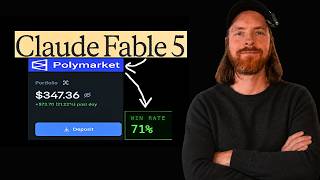
[03:30] was my another attempt at the poly market 5 minute uh makaker side with the claude fable 5. We set this up. So uh this is the pod I'm running for this right. Uh it's not a very active prod. is like very low frequency, but uh when we actually do something, we seem to do pretty well so far. So, I think I've been running this for like 24 hours now or something. You can see we have only
[03:57] made like 18 fills. Uh we are like $76 in the green so far. And yeah, it's been really slow today, right? We haven't really seen any moves almost like six, seven hours. But that is the point, right? You don't want to get like emotionally invested in these different pods here. You just want to do the do their own thing, right? You don't want to interfere because if you get kind of emotional attached to one of those,
[04:23] you can kind of get uh trying to adjust too much. you're trying to force something instead of just let it run in the background like you do with an index fund don't kind of try to force something through like uh if the numbers look kind of good this way just give it time so that is what I kind of like instead of just focusing on one thing you kind of get impatient so let's say this was
[04:49] the only thing I was running now I could get very impatient and try to adjust things to make it be more active and I could kind of hurt my uh uh uh expected value, right? So, basically that is the idea behind these pods. The more you have, the more you will interfere or intervene, I guess you call it, with each one of them instead of having just one thing. So, rather just have the agent look at
[05:16] the numbers. If everything still looks good, just let it run. Right? So, this is the maker desk for the poly market. Five minute up and down. And like you say, like you see, it's very quiet for being such an active market. And that is what I like about this. Okay, so uh this morning I guess today I kind of looked at some other things I wanted to check out. I guess we can just go through it.
[05:42] So I started on um codeex 5.5 medium like I said and I said just uh I want to find the data on the Coca-Cola PepsiCo stock for the last years. Uh what is the best way to find the closing price for the last 5 years for example? So uh Codex suggested we should use Y fin Finance and that is a great Python pack Python package for that. So we went ahead we grabbed all the data. So
[06:08] now we have kind of five years of closing prices for cola Coca-Cola and Pepsi. You kind of think these are related stocks, right? Because they are kind of in the same uh branch like what you call it like leverage beverage not leverage beverage branch. So they're are kind of related stock, right? And that was what I was looking for. And when I had the data, I went over to Fable and I just said to Fable, read
[06:35] the data we have on Coca-Cola and PepsiCo. We are looking for uh reverse to the mean opportunities on correlations on these two stocks. And I just say analyze the data to find examples in the last 5 years. So basically, this is a super well-known strategy, right? because you're kind of looking uh for two kind of related or correlated stocks and you want to see if they have like a history of kind of coming apart and always
[07:01] coming back together again. Right? So you can see here there are different ranges that Claude uh that Fable looked at here and we have some good uh setups here but uh lately it kind of said that um doesn't look too good anymore. They are not really that correlated anymore. So the results from this the best clean mean reverse trades happened in 21 to 23 when copep ratio was stable and correlations were high. Uh but now after
[07:27] some kind of GLP headwinds for PepsiCo uh it's not that relatable or like correlated anymore. So maybe it's not the best ch um pair for this at the moment. So I just followed up with Fable. how do you look for pairs that can run this trade? And it gave me like a good instructions here. And instead of running this on Fable, I went back to Codeex. And I just gave it all the prompts here. I said,
[07:53] "Look for pairs. Uh we can test more." And it came up with a list for me here. So we have the VMA pair. This has very strong correlations in the last year, right? And we have some other things. And I just said again just grabbed the data went back to fable and I just uh tagged this uh VMA pair here 5 years let's run the numbers on this pair right okay uh claude setup kind of fable
[08:20] setup kind of analysis uh script here looked at all the data and this is a completely different animal from copeep here's the full read and it's much more positive to this setting up this trade All right. Why this pair is a structural sound? And you can see all the numbers here are much better. So for the last 21 trades or the 21 trades we are looking at here, all right, we have 15 winners, six losers. And
[08:46] you can see if we did short V here and long MA at this point, we could do 4%. This was the best one. And yeah, this is something we could set up, right? So that is what's nice about this. So we can have like a signal here. So you can see that when this is uh met, we can just do this trade autonomously. So now I just want to say something like let's say I follow up
[09:12] to Fable here. Just for the video sake, I'm not going to do this at the moment. Uh but uh let's say I said I want to build this trade as an autonomous setup when the signal is right. What would be the signals we need to occur to trigger this trade? And here you can kind of see we get like a setup here from Fable. Uh, of course this model knows everything about trading, how we should set
[09:39] this up, everything about how coding this. But uh, what is nice about this is yeah, you kind of want to understand a bit what is going on here. You just want to you don't really want to just roll it without uh understanding quite 100% uh what is happening here. So I would kind of read through this, try to understand it. Maybe say something like uh let's say I just say uh explain the signal we need in
[10:05] a simple array. Maybe use an analogy or something. And here we get like a nice analogy. Uh I guess I can read this if you want to hear it. If not, just skip I guess. So imagine V and MA are identical twins who go to the gym together every single day. They do the same workout, eat the same food, live the same life. Over 5 years they have always stayed within a few steps of each other.
[10:31] This is kind of our two stocks. Right. Now, picture a rubber band connecting them uh as they walk side by side. On normal days, the band is relaxed. They are walking in the lock step. No trades. Okay. So, we're not going to do anything there. Something happens. This could be like an market event. One twin gets distracted, starts walking faster than the other. The rubber band starts to stretch, right? And we have some value here. The
[10:58] band is uh a little top. Nothing yet. Just watch. uh at this value the band is really stretched. This is your signal. History said always uh it almost always kind of snaps back and here the the band is dangerously tight. Either it snaps back hard or something has actually changed and the band is about to break. You exit either way. So we kind of want to see kind of this signal but if it it's really tight
[11:24] it might actually break and this pair is no longer useful. Right? The trade is simply betting that the rubber band snaps back. If we ran ahead, you sell the fast twin, you buy the slow twin and you do the opposite if MA run ahead. So basically, we are betting that something happens and they kind of drift apart a bit. But usually in history has shown that they will come back together. So we can kind of short
[11:50] the one that is uh far ahead and we can go long on the one that is kind of lagging behind because they will come back together again. This is kind of the trade. So if you don't really understand, I think it's really nice. I just talk a lot to the models trying to explain things I don't really understand before I actually build out the let's say the pod for this, right? Because then I kind of know
[12:16] more what to look for uh if I want to double check anything. And I'm not going to say I'm an expert on this, but I try to learn something every day uh when I'm doing this. And that is kind of why uh I I really like using these models to teach me about this because when you learn something here, maybe I can test that on some other thing and stuff like that, right? So this is I
[12:43] think it's a really good thing to not just go with the LLM without even trying to understand what's really happening because if you don't do that you will not really get some new ideas of things you want to test because maybe now okay maybe I can see something like this uh on poly market maybe I can find some kind of mean uh reversal strategy on poly market I can check that out or something like that right
[13:09] So, I think that's really important. And let's say uh okay, we went ahead, we built this pod now. Now, I have this pod, I have this pod, I have the SpaceX short pod, uh and I have 10 others. And like I said, that means that I'm not going to focus too much on one of those. Let's say again, we only had um this one. I would kind of stare at these numbers, right? and see, okay, are
[13:35] we closing in soon? Are we too tight? Right? But, uh, like with an index fund, I don't really look at it because it's not that much happening and I'm just going to trust that if the economy goes up, I'm going to be there. Okay. So, yeah. Uh, I think that's what I wanted to talk about today. instead of like only focusing on one type of trade. I think this pod strategy now that we have all these
[14:02] models could be really interesting, right? And let's say you have 20 of this and you kind of hand over the monitoring to these different agents like I do. I use chron jobs to kind of check on them. So, for example, for my um for my maker setup here, I have you can see I have this chron job here that every two hours go in and check everything is running fine. So, this is fully autonomous and it
[14:28] kind of checks everything uh looking healthy and stuff like that. So, yeah, not the most exciting video today, but uh I'm leaving for the World Cup, so I'm not going to be able to make any videos in a few days. So, I'm going to the US tomorrow. And hopefully uh I'm going to be doing some more videos when I get back.
⚡ Saved you 0h 14m reading this? Transcribe any YouTube video for free — no signup needed.