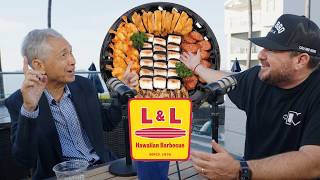

I learned to keep my mouth shut
45sThe hilarious and relatable moment of a founder realizing his daughter runs the company better than he did, with a funny 'emotional damage' punchline.
▶ Play Clip"Title accurately reflects the interview content about building a franchise brand."
Eddie Flores Jr., founder of L&L Hawaiian Barbecue, shares his journey from buying a restaurant for his mother to building a 235-store franchise. He emphasizes the power of branding with 'Hawaiian,' impact marketing, and the importance of treating customers and employees like family. Now led by his daughter, the company continues to grow with a focus on quality and legacy.
Eddie learned to keep his mouth shut after his daughter became CEO; the company has been profitable and growing every year.
Eddie discovered the magic of the word 'Hawaiian' when he was in the army; it attracted people and became the core of his brand.
Eddie bought a restaurant for his mother for $22,000, borrowing $10,000 from a bank that initially turned him down.
Eddie partnered with Johnson Cam, a generous man who opened many restaurants and sold them to immigrants, making them millionaires.
After 40 stores in Hawaii, they expanded to California, opening corporate stores that were later sold to employees as franchises.
Eddie created newsworthy events like spam musubi eating contests and the Hawaiian Atkins plate to get free media coverage.
Despite flunking English in college, Eddie wrote his fifth book, 'Franchising the American Dream,' with help from his daughter.
Expansion to Japan, China, and the Philippines failed due to cultural differences and pricing; Eddie learned to adapt pricing to local markets.
Treat customers like kings and queens with the aloha spirit; treat employees and franchisees as 'ohana' (family).
L&L created the Hawaiian food segment in the US, leading to thousands of copycats and the rise of poke restaurants.
Using Hellman's or Best Foods mayonnaise for macaroni salad ensures a distinct taste that customers love.
Good locations near freeways are crucial; they used a single radio station in Hawaii to announce a new store in Texas, drawing 100 people on opening day.
Eddie's daughter, a USC grad and former GE auditor, became CEO at 35 and plans to open 30 restaurants per year, aiming for 500 total.
Restaurant business is 24/7/365; hard work is key, but location is critical. L&L offers low franchise fees (4% total) and a low failure rate.
Eddie Flores Jr.'s story illustrates that a strong brand, innovative marketing, and a family-oriented culture can build a successful franchise. His legacy continues through his daughter, who is driving L&L toward 500 stores.
What did Eddie Flores learn after his daughter became CEO?
He learned to keep his mouth shut because the company continued to be profitable and grow.
How much did Eddie pay for the restaurant he bought for his mother?
$22,000.
03:00
What is the total franchise fee for L&L on the West Coast?
4% (3% royalty + 1% marketing).
24:00
What marketing strategy did Eddie use to get free media coverage?
He created newsworthy events like spam musubi eating contests and the Hawaiian Atkins plate.
08:00
Why did L&L's international expansions fail?
Due to different culture, taste, and pricing; they were targeting the wrong market segment.
12:00
What brand of mayonnaise does L&L use for their macaroni salad?
Hellman's or Best Foods mayonnaise.
18:00
How many stores does L&L have and what is the goal?
235 stores; goal is 500.
22:00
What is the 'aloha spirit' in the context of L&L?
Treating customers like kings and queens with aloha, and treating employees and franchisees as 'ohana' (family).
14:00
How did Eddie attract customers to the first store in Plano, Texas?
He called a single radio station in Hawaii to announce the opening, resulting in 100 people in line.
20:00
What was Eddie's college grade in English?
He flunked English as a freshman.
10:00
Letting Go of Control
Shows the challenge of succession and the importance of trusting the next generation.
The Magic of 'Hawaiian'
Demonstrates the power of branding and perception in marketing.
01:30Impact Marketing
Illustrates a low-cost, high-impact marketing strategy that generated free media coverage.
08:00Aloha Spirit and Ohana
Highlights the importance of company culture and treating stakeholders as family.
14:00Succession Success
Shows how a well-prepared successor can drive growth and innovation.
22:00[00:00] What have you learned in this process now that your daughter is the CEO running the company for the last five years? Well, I learned to keep my mouth shut. Damn! Every year we're making money. Every year the sales went up. So I have no choice but shut my mouth and walk away. Emotional damage. Welcome to Restaurant Influencers presented by Entrepreneur. I'm your host, Sean Walcheff. This is a Cali BBQ Media production. We are coming to you
[00:28] live from the Coronado Lowe's Resort in San Diego. We are at the Restaurant Franchising and Innovation Summit, and I have the keynote speaker. He just published his book. It is Franchising the American Dream, the story of Eddie Flores Jr. and L&L Barbecue. Eddie, welcome to the show. Thanks a lot, Sean. Hello now, Hawaiian barbecue. That's the key, Hawaiian. That is the key. Hawaiian, let's start there. Branding matters to the show. We have an audience of entrepreneurs,
[00:57] restaurant owners from all over the globe. You just gave a phenomenal keynote about branding. Can you bring us to the Hawaiian story of barbecue? Well, it's very simple. If you're from Hawaii, you have to sell Hawaii. And Hawaii is a big draw. And I did mention during my presentation, you know, when I was in the army, I went down to the USO club in New York and being the only Asian in 1968, nobody wanted to dance
[01:25] with me. Why not? Well, I don't know. You know, maybe my skin is too yellow. But my friend told one of the girl, that I am from Hawaii. I'm a Hawaiian. I don't look like Hawaiian. He said, he's a Hawaiian. Before I know, I got about 20 girls jumping over me. So that was it. I'm telling you, from then on, I said, Hawaiian is the draw. Hawaiian is the draw. You got to know the word Hawaiian
[01:54] because it's a magic word. Everybody wanted to be in Hawaii. Aloha to you. Aloha to you. Well, we have something in common because I have a barbecue brand and I called it Kali. for California barbecue. Oh, Calif, not too many people would understand that. Not too many people. But I should go with the whole California. We were California. I actually shortened it. Yeah, I know. Because it was too long. I know, maybe C-L-I-F, Calif. Calif? Calif
[02:22] barbecue. Yeah, because look at Calif. I don't know what that is. You don't know what that is? Yeah, so Hawaiian barbecue. And then, like I said, When I have to pick another word, not Hawaiian what, Hawaiian restaurant, fast food. And I thought, well, Hawaiian barbecue would be great. Barbecued is great. It's so common in the United States. I was going to pick grill. Grill is too healthy. Grill is too healthy. You know, barbecue. Everybody loves barbecue.
[02:51] So you have 235 stores. You started with one store. Yes, I started. And you didn't even want to be in the restaurant business. I didn't want to be in a restaurant. And I did mention that I bought the restaurant for my mother as a gift. How much did you spend for that restaurant? $22,000. $22,000. In fact, I went to the bank to borrow $10,000 and it turned me down. I couldn't believe that. Was your mother happy
[03:19] with this gift? Oh, she was so happy. She was so thankful. She told everyone, my son bought me a restaurant. I have a great son. But as soon as she started to make money, I got rid of her. Why did you get rid of her? No, she didn't want to run it, actually. I don't do things like that. But, you know, I got a partner whose name is Johnson Cam, one of the most generous men I
[03:48] have ever met. You know, I sold it to him, everything. But 10 years later, because he kept giving away his recipe, his restaurant to help everyone. And I said, let me franchise for you. But let me warn you, I don't know anything about franchising. So we became partners. How did you find him? Well, I was a coach in a soccer team. And he came down and I met him. And mind you, we became friends for over
[04:16] 50 years. Wow. You know, all our business arrangement is basically a handshake. We don't do anything, just handshake. What has he taught you about friendship? Oh, friendship is very important. And he knows exactly what he should and shouldn't do. And I know exactly what I should and shouldn't do. I run the whole operation. He doesn't tell me what to do. And he opened up a lot of restaurants. In fact, I think he must have opened at
[04:44] least 100 restaurants. In turn, he would give it or sell it to a lot of Chinese immigrants. And all these people all became millionaires because of him. amazing. He's amazing man you know I mean he doesn't like to say a lot of words you know but he would help a lot of people. In the beginning before you came stateside to the mainland you were Hawaii how many stores before you actually came? Well we got about 40
[05:13] stores in Hawaii. 40 stores. And we decided to come to California because you know my partner Johnson told me that one of the former employees opened up a Hawaiian drive-in down at Mission Street in San Francisco. And he said, he's doing well. So we came down, did some research, and I said, hey, with our name, we'll do better. About six months later, and opened another one. I opened a new one in West Covina in LA. Before
[05:41] you know, he opened another one, another one, and another one. He opened over 100. Corporate stores or franchise or both? No, no. You see, it's funny the way we operate. Every store he opened is individual store. He own it. Okay. 100%. And eventually he would sell it to the employees. And it became a franchisee. That's how we grow. That's amazing. What have you learned in this process now that your daughter is the CEO running the company
[06:10] for the last five years? Well, I learned to keep my mouth shut. Oh, yeah. Every time I tell her something, you tell me that that's not the right way of doing it. How many kids do you have? I have two girls. Two girls. Are they both in the business? She's the oldest one now. The youngest one used to be, but she has babies now. She stays home. But my daughter is doing a really great job. She
[06:38] knows what she's doing. She came from General Electric as a corporate auditor. She knows the corporate world. Me, I'm just an entrepreneur. I do anything I want. I throw the dots, and that's it. You know, and she tried to build up the system and I want to say she's doing great. And I have told you the story because I complained to her. I said, when I ran the business, I only got two, three people. Now we
[07:07] got 25. And she said, Dad, I want you to look at the profit and loss statement for the past five years. And she showed to me every year we're making money. Every year the sales went up. So I have no choice but shut my mouth and walk away. From then on, I never challenged her. Did you know that Toast powers over 140,000 restaurants across the United States, Canada and UK? It's an incredible company. I'm on the
[07:35] Toast customer advisory board. They are proud sponsors of this show, Restaurant Influencers. We couldn't do it without their support. They power our barbecue restaurants in San Diego. If you have questions about Toast, if you're thinking about bringing Toast on to be your primary technology partner at your restaurants, please reach out to me. I'm happy to get a local Toast representative to take care of you. You can reach me at Sean P. Welch on Instagram. Once again,
[08:04] thank you to Toast for believing in the power of technology, the power of storytelling, the power of hospitality. Back to the show. I remember you talking on stage about impact marketing, that you didn't have any money in the beginning when you were lean and mean operating your stores. What is impact marketing? People have to understand impact marketing. You know, I've been explaining to people the news media is interested in story that's interesting. You know, something that's
[08:32] different. So we create things that are different all the time. You know, like we have a spam musubi eating contest, not a plate lunch, spam musubi because the media from the States will cover that too. What the hell is spam musubi? You know, and we draw so many people, the news media will show up. One of the, promotion with it almost like 20, 30 years ago was the Atkins diet. As you know, when you eat a
[09:00] lot of meat, you will actually lose weight. And it's unbelievable you would do that. So we created a Hawaiian Atkins plate with about, I think, four or five pieces of meat, eggs, a lot of stuff. And we call that Atkins. And I tell them, look at me, how skinny I am. People didn't know that I'm always skinny. I never gained weight. So every TV station came down and gave the interviewers in the press or on the
[09:29] national news. And what was really funny too, we say impact, look for the opportunity. I was in New York City opening a store and I saw Spamalot. I said, Spamalot? I called up New York Times. And they sent someone down to actually wrote an article about L&L Hawaii barbecue selling spam mustard beans. Come on. I couldn't believe that. We were in New York Times. Can you imagine how much it cost to be a New York Times?
[09:57] That's what we call impact. Look for the opportunity. If you don't have it, you create it. Tell me about the process of writing a book. Oh, writing a book is... Actually, it's pretty difficult for me because I flung English in college. Honest to God, I got an F as a freshman. And this is my fifth book, by the way. Okay. I wrote several books, including a cookbook that I can cook. Don't tell people that now. I
[10:26] won't tell anyone. I wrote a book on Chinese history, travel. I'm not really Chinese. But this book is really interesting because my daughter actually reviewed it many times. Okay. And make sure it's accurate and up to date. It's about the story of L&L, how we started, and a story about myself. You say, you got to talk about yourself too, where you came from. And I did that. So it's really a fun book to read. I can't
[10:54] wait to read it. I spent three years with my grandfather researching his life, going to writers conferences. And I remember doing the work helped him start telling stories in a different way. It starts to force you to be uncomfortable, to remember the things that as an entrepreneur and a business owner, we forget. Yes. Because we have to move forward. We have to persist. There's no way you get to 235 stores without falling down. Can you share
[11:23] a little bit about the process of going through some of those uncomfortable memories? Well, the most difficult part was opening in foreign countries. I was so excited, you know, when Japan called. Yeah. And we went there. Japan was okay. Then we opened up in China. Yeah. That didn't last long. Yeah. We opened the Philippines. It didn't last. Malaysia, Indonesia, you name it. Why do you think that was? It's just a different culture, different taste, and I
[11:51] think the pricing too. And I finally figured out the pricing. Because like in the Philippines, they're selling a mule for about $1.50. And we're selling at $3. And we're hitting maybe the 5% of the market, not the 95% of market. If I have to go back to the Philippines today, I'll be selling it at $1.50. Interesting. So instead of three pieces of chicken, a lot of rice, it will be just half a piece of chicken, a
[12:20] lot of gravy, some vegetable, and I'll sell it for $1.50, and we'll make it. What have you learned about hospitality being in the restaurant business for as long as you have been? Well, you have to be nice to people. Your customer, they are kings and queens. Be nice to them. You have to treat them like human beings. bend over and take care of them. If you take care of them, they'll come back. That's why we preach
[12:48] aloha spirit. We say aloha to all customers. They're supposed to. They don't tell me, okay? Aloha, because Hawaii is aloha. It's very important for us. And for our employees, we call it ohana, part of the family. All the franchisees are ohana. We take care of them. What does it mean to you knowing that a part of Hawaii is now all over the United States in your food, in your stores, in the culture. It's unbelievable. I'm telling
[13:16] you, I never expected that. When I did my research, I came over and I look at a lot of restaurants. In fact, I saw one that's called Hawaiian barbecue, but actually it's not Hawaiian barbecue. It's a Korean food. Oh, really? Yeah. You know, they call it Hawaiian barbecue. Look, well, it's not Hawaiian. There's no Hawaiian food in there. But what we did is really amazing. If you look back about 30, 40 years ago, there is really
[13:45] no Hawaiian food segment, you know, per se. You know, you got Chinese, you got Korean, you got Asian, but no Hawaiian food. Today, we must have, what, 235 restaurants, and there must be about 5,000 to 1,000 copycats. Restaurants that call Hawaiian barbecue, or Hawaiian, or whatever. And then what's amazing is, we also see poke. Back in the old days, there's no pokey restaurant. Because we started to sell pokey in Ellendale and people saw that and they
[14:13] opened pokey restaurants. Because it's easy to open, you don't need a kitchen. You don't need grease trap, you don't need anything. So you can see a privilege, you see a lot of pokey restaurants spread out all over the United States, including the Midwest, anywhere you go, it's pokey restaurant. It's almost like the bubble tea, you know, easy because you don't need a kitchen. How important are quality ingredients? You talked about the mayonnaise. Oh yeah. Spend extra
[14:42] money on the mayonnaise. I'm telling you, the ingredients are so important. We use the best, especially our macaroni salad. We are known for our macaroni salad. And we use a Hellman or Best Food mayonnaise because they really taste good. And I have many comments, oh, why it tastes so good? And the other competition tastes different. Well, it's not Best Food or Hellman's. And that's why we've been using that. We pay more for it. We want to
[15:10] deliver quality. By the way, our food is cooked to order. It is very important for people to know that because we don't have a central kitchen. We cut the kitchen chicken every morning, and then we cook it and fry it right there. Can you tell me, with your real estate background, what did you learn about site selection? Well, site selection is very important. And we found out that if you have a good location, you'll make more
[15:39] money. Your sales are going to be much higher. If you pick a terrible location, it's not going to work. For us, this has got to be close by the freeway. Not freeway, but central people can get to, especially in places like Dallas, Idaho, Indiana, in the places way past the other side because people... would drive, the Hawaiian would drive two, three hours just to eat our food. I don't know if you believe that. I do believe
[16:07] it. 100%. I'm telling you, we opened the first one in Plano, Texas. Yeah. And I told them not to do any advertising because they're brand new, right? Yeah. I mean, you don't want people to come in. You don't know how to cook. So what I did was I called up the radio station in Hawaii, just one radio station. And I mentioned, hey, we're going to open up tomorrow in Dallas. Tell your friends. The next day, there
[16:36] were 100 people standing in line. Wow. Because the radio station make the announcement and the family called their family back in Texas. In fact, I got one from Oklahoma City, five-hour drive. What have you learned about partnerships and vendors? Oh, partnerships is very important. Like I said, my partner, Johnson & Cam, is one of the best partners I have. We've been together for 50 years, all in handshake. I mean handshake. He knows his strong point and
[17:04] his weak point, and I know myself too. So I never interfere what he's doing. His is operation. He's doing his own restaurant, getting more franchises for us, and mine is running the company, and he knows that. It's very difficult for entrepreneurs to pass on their legacy to the next generation. Can you share a little bit about what it means to have your daughter working? Do you think that she's working because she went to General Dynamics and
[17:32] she wasn't, you know, working with L&L her entire life? Well, you know, she graduated from USC. Yep. And then went to UCLA MBA and worked with General Electric for almost like eight years as a corporate auditor. She flew all over the world. But I told her, hey, look, you're a woman. You see a glass ceiling one day. And one day it happened. Yeah. And she said, Dad, I'm coming home. I said, yeah, come home. I'll give
[18:01] you five years. If you do good, you'll be the president and CEO in three years. She did better than I expected. And she became the CEO when she was 35 years old. It's amazing. And right now she tells me that she's going to open 30 restaurants every year. It's amazing. It's amazing because we don't have a big staff. We'll have less than 25 people, maybe not even 25, 20 people working in the office. What's your hope
[18:29] for the legacy moving on? Well, the legacy is she wanted to open 500. Yeah. I think there'll be a real legacy for someone from Hawaii because if you're from Hawaii, there's no company from Hawaii ever franchised successfully. L&L is the only company from Hawaii to franchise successfully. And if we can open 500, I'll be so proud of her because we are promoting Hawaii. Hawaii is our state, is our, you know, our family. And we want to
[18:58] make sure we spread the name and make sure people know that we are the real Hawaiian barbecue. We are the original. We started it. We are still in Hawaii. A lot of people ask me, why don't you come to California? Have your operation in California? We can. because I have to stay close to the culture in Hawaii. I have to know what's happening there. If there's any changes in the food, I would know immediately. And I
[19:26] do have the support of the community in Hawaii. I may be joking around. Anywhere I go, they will stop me for my autograph. We have a lot of entrepreneurs, business owners that watch this program. They listen to this podcast, and we're grateful. If they're considering becoming an L&L franchisee, why should they consider becoming an L&L franchisee? Well, you know, I've been telling people, you got to work hard. You know, you don't need to be in a
[19:55] restaurant business, but you got to work hard and you got to work in the kitchen. And why you should be at L&L? Because we have a brand name. Yeah. OK. L&L. You wear an L&L T-shirt, everyone will stop by and say hi to you. I'm telling you, in the airport, anywhere you go, We have one of the lowest franchise fee in California. The West Coast is 3% and then 1% marketing, 4%. It's unheard of. And we
[20:23] have one of the lowest failure rate in the United States. One of the lowest. So very few restaurants would fail and we treat everyone what we call Ohana, family. When you join us, you are part of the family. You gotta call me anytime you want. You can call my daughter, Alicia, anytime you want, we will answer your phone call. If there's a restaurant, if there's an entrepreneur that's listening to this, what advice would you have for
[20:51] them about getting into the business of restaurants? Well, the most important thing you have to remember is, is 24 seven. 365. You gotta work hard. If you work hard, you know, because when I look at in Hawaii, We got about 60 restaurants and 57 are owned by immigrants. The whole family worked there and every one of them, they became, to me, they became millionaire. They all become very rich. I don't know if they are or not.
[21:20] They all dress like, they still have rags and so on. The clothes are not designers, but you know, I know I can see that because all the kids went to a private school. That's 30, 40,000 per person. You know, they all went to private school. So if you work hard, the whole key is, are you willing to work hard? Yeah. And there's no guarantee. In any restaurant business, there is no guarantee. Because if you pick the
[21:48] wrong location, hey, you're not going to make money. Oh, we appreciate you guys watching. We appreciate you listening. You can always reach out to me. I'm available at Sean P. Walchef. Instagram is the fastest. You can email me Sean at Cali BBQ.media. We tell the best stories in the restaurant business. This has been a true honor for me, Eddie. I have so much respect for what you've built. I'm grateful that you put it into a book
[22:17] so that you can share it with future generations. Grateful that you took the time and thank you to the Restaurant Franchising and Innovation Summit. This is a phenomenal conference. We have lots of restaurateurs. My grandfather taught me to always stay curious, to get involved, and to ask for help. If you're watching this, if you're listening to this, you've got to get outside of your restaurant and come to conferences like this so that you can sit down
[22:45] and learn from people like Eddie and all the amazing people that are here at this show. Eddie, thank you so much for taking the time. Hey, thank you very much. If you want more information about LNL, just look at our website, hawaiianbarbecue.com. Amazing. hawaiianbarbecue.com. Very simple. For the book, if you want to buy it, well, Amazon.com. Just type my name in there. Amazon.com. Eddie Flores. You'll find the book. There it is. Eddie, it's been a true
[23:14] honor. Thank you so much. Hey, thanks a lot, Don. It was fun, man. It's fun. We love it. It's been fun. Beautiful San Diego. Beautiful San Diego. Hawaii's better. Hawaii's better. California's better. Hawaii's better. Forget about the storms. There's no storms there. Come on, Juan. Thank you for watching. Thank you for listening. If you've made it this long, you are part of the community. You're part of the tribe. We can't do this alone. We started, no
[23:42] one was listening. Now we have a community of digital hospitality leaders all over the globe. Please check out our new series called Restaurant Technology Substack. It's a Substack newsletter. It's free. It's some of our deep work on the best technology for restaurants. Also go to YouTube and subscribe to Kali BBQ Media. Kali BBQ Media on YouTube. We've been putting out a lot of new original content. Hopefully you guys like that content. If you want to work
[24:11] with us, go to BeTheShow.media. We show up all over the United States, some international countries. We would love to work with you and your growing brand on digital storytelling. You can reach out to me anytime at Sean P. Welchef on Instagram. I'm weirdly available available. Stay curious, get involved. Don't be afraid to ask for help. We'll catch you next episode.

⚡ Saved you 0h 24m reading this? Transcribe any YouTube video for free — no signup needed.