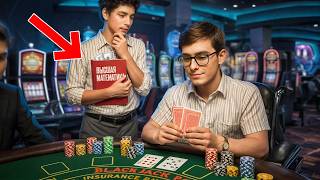

MIT Nerds Rob Casino with Math
45sThe contrast between nerdy university students and a high-stakes casino heist using mathematics creates an intriguing and surprising hook.
▶ Play Clip"The title accurately describes the story of MIT students winning $30 million from casinos using math."
This video tells the true story of how a group of MIT students used mathematical card counting to legally win millions of dollars from casinos over a decade. It details their strategies, team structure, and the eventual downfall due to casino countermeasures.
A group of MIT students developed a complex card counting system to beat blackjack, winning up to $500,000 in a single weekend.
In 1979, JP Massar attended a lecture at MIT on the mathematics of gambling, which sparked his interest in card counting.
Casinos have a statistical advantage; on average, only 80-95% of money is returned to players (RTP). Blackjack is unique because players can gain a mathematical advantage.
Players track high and low cards to determine when the deck is favorable. Low cards add +1, high cards subtract -1. A positive count means more high cards remain, increasing player advantage.
In 1962, mathematics professor Edward Thorp published a book proving that card counting in blackjack can systematically beat the casino.
JP Massar and his MIT classmates went to Atlantic City but lost almost all their money due to lack of organization.
JP started a blackjack course at MIT to recruit like-minded players. Professional poker player Dave invested $5,000 for a test in Atlantic City.
JP met Bill Kaplan, a Harvard Business School student who had turned $2,000 into $40,000 playing blackjack. They combined JP's math skills with Bill's business acumen.
On August 1, 1980, the MIT Blackjack team was officially created with 10 players and $89,000 in capital. Profits were split 45% to management, 45% to investors, 10% to players.
In 4 years, the team grew to 35 players with $350,000 capital. They doubled their investment in the first 3 months, with annual returns over 250% for investors.
Casinos began suspecting card counting. Bill Kaplan was threatened by a casino owner, leading to his retirement. Leadership passed to JP, John Chang, and Bill Rubin.
In 1992, Foxwoods Casino opened in Connecticut, just two hours from MIT. This prompted JP and John to restart the team with Bill Kaplan, forming Strategic Investments with $1 million capital.
New recruits underwent daily training for weeks, learning basic strategy, the Hi-Lo card counting method, and team roles: observer, controller, and major player.
The team set up a practice casino on campus with noise and distractions to simulate real conditions. Candidates had to pass a test at Foxwoods to become official members.
A student once left $125,000 under a chair, leading to a federal investigation. The team learned to always keep money on hand.
Semyon Dukach, a Russian-born MIT student, played with a female partner. He would leave the table while she signaled favorable counts, then return to place large bets. They won $150,000 in one weekend.
Despite occasional losses (e.g., losing $100,000 in a weekend), the math always worked. By June 1993, the team had won $439,000 total.
At its peak, up to 15 players visited casinos worldwide every weekend. The largest single trip win was $520,000.
Casinos hired detective Andy Anderson from the Griffin Agency to identify card counters. He noticed many players used Cambridge, Massachusetts addresses.
The team's written strategy guide was found in a casino bathroom. Griffin compiled photos and names of team members, including from MIT yearbooks, into a book shared with casinos.
Team members used disguises (e.g., John Chang dressed as a woman, a nurse, or a man in a wheelchair). But they were increasingly banned. One member was banned from Monaco and got a criminal record.
Players felt underpaid (only 10% of profits) and burned out. JP left, and Bill Kaplan tried to replace him with Semyon, who refused. Strategic Investments dissolved in December 1995.
Semyon founded Amphibia Investments with fairer profit sharing, winning over $5 million. Mike founded the Reptile Team. Combined, MIT teams caused casino losses over $30 million.
Most team members succeeded in their careers. Semyon sold his first IT company for $35 million in 2000 and became a wealthy entrepreneur.
The MIT blackjack team demonstrated that disciplined mathematical strategy can overcome casino odds, but their success was ultimately limited by casino countermeasures and internal conflicts. The story highlights the power of teamwork and the importance of fair profit distribution.
What is RTP in gambling?
RTP stands for Return to Player, the percentage of money returned to players over the long term. In casinos, it's typically 80-95%.
01:31
How are cards valued in blackjack?
Cards 2-10 are face value, Jack/Queen/King are 10, Ace is 1 or 11.
01:59
What is the best hand in blackjack?
An Ace and a 10-value card (21 points) is called Blackjack.
02:13
How does the Hi-Lo card counting method work?
Low cards (2-6) add +1, high cards (10-Ace) subtract -1. A positive count means more high cards remain, favoring the player.
02:39
Who proved that card counting can beat blackjack?
Mathematics professor Edward Thorp in 1962 with his book using computer calculations.
03:20
What was the profit split for the MIT Blackjack team?
45% to management, 45% to investors, 10% to players. Players also got $80 per hour.
08:21
What was the starting capital of the MIT Blackjack team in 1980?
$89,000.
08:07
What was the largest single trip win for the MIT team?
$520,000.
17:50
What was the Griffin Book?
A book shared among casinos containing photos and names of known card counters, compiled by the Griffin detective agency.
19:09
Why did the MIT team eventually dissolve?
Players felt underpaid (only 10% of profits), burnout, and increased casino countermeasures like the Griffin Book and bans.
21:34
How much did Semyon Dukach's new team, Amphibia Investments, win?
Over $5 million.
23:04
What was the total casino loss caused by MIT-bred teams?
Over $30 million.
23:17
MIT Students Beat Casinos
Reveals that a group of students used mathematics to legally win millions from casinos.
00:01Edward Thorp's Proof
First mathematical proof that card counting can beat blackjack, foundational to the team's strategy.
03:20Team Formation
The official founding of the MIT Blackjack team with structured profit sharing.
08:07Semyon's $150,000 Weekend
Illustrates the team's success and the use of signals and disguises.
14:04Griffin Book Exposure
Shows how casinos identified and blacklisted card counters, leading to the team's downfall.
19:09[00:01] nerds from one of the world's most prestigious universities are playing BlackD. At the end of the hall, a security guard notices one of them. He could swear he'd seen this guy before. Then he walked, but now he sits in a wheelchair. But what was even
[00:13] making big bets and winning. The truth was that these botanists didn't rely on luck. They used mathematics. They developed a complex system, came up with secret signals, disguises and roles. All
[00:26] they needed was to beat the casino and walk away with a fortune. They could make $500,000 in one weekend. While the security guards were trying to figure out what was going on, these quiet students were already boarding the overnight flight to Cambridge,
[00:38] . This is a true story spent a decade beating casinos for millions of dollars, and did it completely legally, using mathematics. In 1979, JP Massar and
[00:52] several of his friends attended a lecture entitled "How to lecture is to show the truth about casinos from the point of view of mathematics and analysis. The numbers than on gambling. The lecture took place at the prestigious Massachusetts
[01:07] Institute of Technology. One of the most prestigious universities on the planet, consistently ranked among the top five universities in the world and repeatedly taking first place in international rankings. Only those
[01:19] who truly stand out for their intelligence, perseverance and talent are admitted to this university. JP and his friends were only interested in one thing: how to beat the casino. The teacher immediately made it clear that gambling was a dubious idea. Statistics are always on the casino's side. On
[01:31] average, only 80 to 95% of players' money is returned to them. That means for every dollar you invest, the maximum you'll get back is 95 cents. And the rest is the establishment’s guaranteed profit. This is called RTP, a metric that
[01:45] back to players over the long term . But the professor added that among all the gambling games, there is one special one: BlackD. Unlike roulette or slot machines, the player can gain a mathematical advantage. The
[01:59] to get a total of cards as close to twenty as possible, beating the dealer, but not getting more than 21. Cards from two to ten are counted at face value. Jack, queen and king are worth 10 points. An ace can
[02:13] be worth one or 11 points, depending on which is more advantageous for the player. The best combination of cards is an Ace and any picture. Two cards that add up to 21 points. This combination is called BlackJack.
[02:25] From one to seven people sit at the table to play. In this case, everyone plays against the dealer, not six decks of cards into a special device called a shoe and begins dealing. The most interesting thing is that the dealer deals the cards to all players
[02:39] face up. This is where the card counting begins . For example, you are playing and see that a six have appeared. For each such low card you add one, which makes it plus three. There was also a king and an ace on the table.
[02:51] Subtract one from the high cards, and you get -2. 3 - 2 = +1. If the count for example +5, it is a good time to raise the bet because there are a lot of good cards left. And if the score is zero or
[03:05] minus, then it’s better not to risk it. And this is not just a misconception. This theory was proven by American mathematics professor Edward Thorp. In 1962, he published a book used real computer calculations to prove for the first time that card counting in
[03:20] Blackjack allows one to systematically beat the casino. JP was skeptical of the professor's claims, as they sounded too good to be evidence. To test this
[03:32] to a real casino and play with his own money. So JP Massar convinced his MIT classmates to pack up and head to Atlantic City. But, unfortunately, everything did not go as planned. An unorganized
[03:45] group of students lost almost all their money. After the trip, many of them gave up, graduated from MIT, and moved on with their lives. But not JP. He came to a shocking conclusion. If enough games are played
[03:58] willing to signal their cards to other players, then a player can win more games than he loses. In other words, there is a chance to make a lot of money. He knew he had something special in his hands, but now he had
[04:11] so he decided to open his own BKJack course. He posted posters all over campus in hopes of finding like-minded people. What he didn't expect was to professional poker player named Dave. Dave offered JP
[04:26] $5,000 to go to Atlantic City again and test the strategy again . I also found him a team of four people. And in December 1979, JP and a team of students set out again . The moment was very opportune. The
[04:40] New Jersey Gaming Commission just banned casinos from kicking out players who counted cards. This meant that even if JP and his team started winning too much, the casino would do nothing to them. This
[04:52] The team returned home with a more confident attitude and began actively recruiting new participants for the BJ course taught by JP. They continued $5,000 they started with into $ 20,000. At that point, the group wasn't really a
[05:08] team, but rather a gathering of random BlackD players who helped each other out and shared their winnings. But everything changed when JP met a man named Bill Kaplan. Sometimes one acquaintance can
[05:20] completely change your life. For JP, meeting Bill Kaplan was his ticket into the world of big money. On the Internet, everything works according to the same rules. If you want next move. After all, it’s becoming more and more difficult to remain anonymous. If you
[05:33] security, you should definitely try GREW VPN. It offers speeds up to 300 Mbps. No freezing or lag, even when watching videos or playing online games. A
[05:45] to connect to servers around the world and bypass any blocking. With is encrypted to the latest standards to ensure no one can intercept it. The coolest thing is that up to 10 devices can work with one subscription
[05:59] . It doesn't matter if it's an Android, iPhone or TV, the whole family can be connected. And the description now, you can try it offers the best price- quality ratio, providing reliable protection.
[06:13] Bill Kaplan also played in Black Jet. When he read a book about card counting, Harvard Business School. To test this mathematical strategy in practice, I went to Las Vegas. He went there with only
[06:26] $2,000 in hand. And when he returned 9 months later, he had 40,000. However, Harvard Business School refused to accept him back. Upon learning of the administration decided to revoke his enrollment. But Bill wasn't about to
[06:40] position, proving that Blackjack is not a game of chance at all, but an intellectual analysis based on logic, probability theory and precise mathematical calculations. I have studied the game so deeply that if you follow the
[06:53] strategy, the risk is practically reduced to zero. The player gains a mathematical advantage. And in this sense, Blackjack is no different from solving a professor's complex math problem. Luck smiled on him, and Harvard
[07:05] heard him. He managed to prove that his passion for gambling was not just a risky pastime, but a subject of scientific interest. He graduated from this time he continued to pursue his hobby of BKJack. One evening, JP was at a
[07:19] Chinese restaurant and he overheard Bill Kaplan talking about his trip to Sin City. JP immediately approached Bill to talk about their shared interest in card counting. Both realized that they could help each
[07:31] other well. Bill was a business person and a people manager, and JP was a computer scientist. He knew mathematics, was able to create algorithms and build statistical models. Soon JP asked Bill to help him manage his
[07:43] own team of MIT students. He invited Bill to one of the games in Atlantic City to see how the team worked. Bill realized that this agreed to help them, but on one
[07:55] condition. The team had to become more cohesive and work according to common rules without making independent decisions. Many of the team members were not too happy with the new system, but they still decided to give Bill a chance and try a more rigorous
[08:07] Bill a chance and try a more rigorous approach. Thus, on August 1, 1980, the MIT BlackDam blackjack team was officially created . The team had 10 players and $89,000 in starting capital. This money was raised by both the participants themselves and
[08:21] external investors. Within the first 3 months they managed to double this investment agreement, profits were divided equally between the two principal were divided equally between the two principal parties. 45% went to management, and the other
[08:34] 45% went to investors. The remaining 10% was taken by the players. Players also received wages based on how many hours they played. Basically it was $80 an hour. Investors also came out ahead. Taking into account the
[08:46] annual returns, they received more than 250% profit on their investments. never been properly documented publicly, but they were clearly very high, especially considering this was the 1980s,
[09:00] when the average price of a Big Mac was $1.50. Clearly, the team was moving towards something big. In 4 years, the team grew to 35 players, and the total capital reached $350,000. But soon the casino began to suspect what was
[09:14] Bily Kaplan was being followed in all the casinos. The most terrifying moment happened in Las Vegas in the late eighties. I quite a lot. Then the owner came up to me , patted me on the shoulder and said,
[09:28] "You know, if you didn't have any fingers, you'd have a pretty hard time playing soon as I heard this, I immediately knew it was time to retire. Leadership was handed over to JP along with John Chang and Bill Rubin. From 1980
[09:42] to 1990, more than 80 students passed through the MIT BlackD team. Everything changed on February 15, 1992, when the
[09:54] legal casino in the state and was located a two-hour drive from the MIT campus. Previously, trips took up to 7 hours and sometimes required flights across the country. It was an ideal opportunity for the team . Upon learning of the discovery, JP Masar
[10:07] and team veteran John Czanck again turned to Bill Kaplan to get things started again . In April 1992, they formed a formal limited partnership called Strategic Investments. Bill built
[10:19] it on the investment fund model. 40 shares at $25,000 each. The total investment volume is 1 million dollars. Former investors, who had already made good profits, immediately invested in the new project. There was one problem left: we had to
[10:32] look for new players again. Despite their success in the 1980s, the team suffered from burnout. Many left to start families or use their MIT degrees outside the casino, such as in science. JP, Bill and John quickly began recruiting new
[10:46] advertising the team as a great summer job. Unlike the put up their own money, so it was a great opportunity extra money. But getting into the team this time was much more
[11:02] difficult. Each candidate had to undergo serious training. Daily training for several hours for several weeks. At first, beginners learned the basic strategy of the game, described in Edward Thorp's book. It all came down to a
[11:14] act depending on the dealer's card. This was the first thing that had to be learned by heart. The players then learned the High Low card counting method . Surprisingly, memorizing the tables and learning to count
[11:27] cards was the easiest thing. The hardest part is learning to act as a team. Everyone was divided into three roles: observer, controller, and major player. The count the cards in the deck and wait until the count became favorable for a
[11:40] bet. After which he would make some kind of signal, for example, comb his hair in a certain way, which was only understood by someone from the team. Then to confirm the count. And finally, after the score was confirmed, they would call on a
[11:53] high roller to place a large bet. One of them was Mike Ponto's student, who was then 22 years old. He practiced in empty classrooms right after a lecture, and was then shocked when he
[12:05] won $40,000 the first time, and then lost $10,000 in 5 minutes. By the end of the weekend, he returned to university with a net income of about $30,000. But let's not get ahead of ourselves grueling training, the final stage awaited the future players. Examination. Counting
[12:20] cards in the silence of a classroom is one thing, but a casino is another matter entirely. Noise, smoke, drunk people, the tension of high stakes and strangers at the table. All this makes it very difficult to concentrate. To prepare for real-world conditions,
[12:33] the team set up a practice casino right on campus. They turned on loud customers and annoying security guards. In such a setting, candidates had to read the cards accurately. If a person succeeded, he was allowed to play a
[12:46] It was here, at the newly opened Fox Woods Casino, that future players underwent the final test of their skills. This was the final step towards the team. If they played Fox Woods well enough, they became
[12:59] official members of the MIT BlackJ team. In September 1992, the MIT BlackJ team playing Blackjack, their actions resembled a legally organized casino robbery every weekend. One of the team's main rules is to always keep
[13:14] money with you and never let it out of your hands. This rule came about after a student went on a gambling trip and arrived at a lecture, leaving a paper bag of money under his chair . $125,000 ended up in
[13:26] the hands of a janitor who cleaned the classrooms after lectures. He put the bag in the closet and called the police. Federal authorities have launched an investigation to determine ensure that it is not connected to theft, money laundering or other
[13:39] illegal activities. The process took several months, but eventually funds were legitimate and get their money back. Another important rule was not to drink, but that wasn't a problem. They were mature, responsible, and had prepared for a long time to
[13:52] get this opportunity, and therefore wanted to show off their skills. One of these students was Semyon Dukach, originally from Moscow. He first went to Vegas, where he was supposed to meet Kate at the entrance to the Mirage casino around 10:00
[14:04] pm. Her role was to pretend to be his girlfriend during this It was in Vegas. I remember I was wearing a heavy leather jacket and there was about $150,000 in cash in her pocket. After they
[14:17] met, they quickly got down to business, sitting down at the Blackjack table as a couple. Semyon soon found an excuse to leave the table, citing the need to go to the toilet. Meanwhile, Kate was making minimum bets of $25 at a time, waiting for the
[14:29] right moment. As soon as the count became positive, she gave a pre- arranged signal, placing her chin on her left hand. Semyon, who had been expecting this gesture, returned to the table and immediately began placing bets of $5,000. As
[14:41] earned $30,000. One of the casino administrators, noticing their success, soon approached them and said: "What are your plans for the evening? We would luxury rooms." High rollers are treated like guests of honor in Vegas. They
[14:56] stay in the casino, especially if they win significant sums, so that they come back the next day and, possibly, lose everything. By the end of the weekend, Semyon and Kate were in seventh heaven. Their winnings exceeded $150,000. On the
[15:10] believe they had actually managed to beat the casino with all its cameras and security. Two young men in their 20s became rich like bandits, amassing a ton of stuff and freebies. And the casino never figured it out.
[15:24] Like JP, Semyon was confident that it would work thanks to the law of large well. Due to the expected mathematical deviation, sometimes they lost, and lost big. One night, when the balance was unusually
[15:37] high, Semyon placed bets of $10,000 and over the weekend he was able to lose $ 100,000. Despite such losses, the math always worked. By June 1, 1993, the team was on a roll, having won a total of $439,000.
[15:52] strategy that allows you to earn money not through luck, but through knowledge. This is exactly how the guys from MIT worked. They had no magic, only mathematics, discipline and a clear strategy. A friend told me
[16:04] about the Telegram channel Obuzishche. A project that has been publishing only proven methods of earning money for 5 years. It has tens of thousands of members and more than 2,000 real reviews. Right now they are recruiting for internal part-time positions for
[16:16] admins. Everything is simple, no investment, no experience, completely online. You need to complete registering with Revka, opening an account, or ordering a product. You get paid for this on the same day. Usually it comes out to 5 dash 7,000 in an evening or 20 dash 25,000 over
[16:30] quickly raising starting capital of 15-20,000 and then investing it in other topics. A detailed guide was recently released on how to earn 30,000 or more in free bets from officially licensed bookmakers. They also discuss the topic of
[16:44] tenders. This is already a serious market, where billions are circulating, especially after the departure of Western companies. Auzishche is even developing its own software that will automatically you. To get a part-time job and access all the content,
[16:57] the promo code "Mask" in their bot. He will send all the description, QR code on the screen. Come in and subscribe. The team's typical schedule was to fly in on Friday, play
[17:11] 4800 games of chance, and then catch a red-eye flight on Sunday evening to attend university classes on Monday morning . After each trip, they handed over the money they had won to the person responsible for collecting it, and in between trips they had to fill out
[17:24] forget that strategic investments were registered as a fully-fledged legal company. Eventually, after more than 10 years of changes in the team's composition, MIT Black reached its peak. Up to fifteen players
[17:37] visited casinos around the world at the same time every weekend. Things went so participants tried to appear in the same establishments as rarely as possible. They constantly changed their clothes and image, sometimes even going to Europe or the
[17:50] MIT suspected that these students were leading double lives. earned in one trip was $520,000. Finally, the team achieved success. But in the coming months, as the team began to win more and
[18:05] more attention. Casinos don't like losing money, so they do everything more than they should. Hundreds of cameras are installed in gaming halls to track every move of players. And when a casino notices that it is losing
[18:19] serious money, but does not understand why, private detectives get involved. This is Andy Anderson. He was a detective with the Griffin agency. In the nineties they were the most famous private detectives in the mining industry. They made
[18:31] every effort to identify those who were illegally cheating the casinos. But the point is, what the MIT guys did wasn't fraudulent or illegal. They counted cards using their brains. They were simply smart players and
[18:43] took advantage, but for the casino, legality didn't matter. so they can deny entry to anyone for any reason. And with Andy's help, they hoped to find out who exactly had robbed them of hundreds of thousands of dollars. He
[18:57] went from casino to casino, finding the big players and finding out who they were, and then trying to figure out who they worked for. But the worst thing was that their photographs and fictitious names could be included in the so-called Griffin book. A
[19:09] special book that was released exclusively for all casinos to ensure that all Essentially, if someone was caught cheating multiple times , their name and photo would be entered into the Griffin book. Andy noticed that many players had similar
[19:22] addresses. They indicated them themselves in order to receive increased cashback. And what's interesting is that almost all of these addresses were from Cambridge, Massachusetts. If several different players are using the same or similar addresses, it may
[19:34] group is colluding. But the team's biggest mistake was writing a written guide to their strategies in case any students needed a refresher. Eventually, Andy
[19:47] One of the students accidentally forgot it in the toilet. After piecing together all the clues, Andy realized that the largest card counting team in the world was made up of students from the Institute of Technology. One day, Griffin's book fell into our hands
[20:01] . We read it almost in its entirety, 140 pages, which in itself was a bit much. We took over almost their entire book and they made a lot of money from us . As I was leafing through this book, I saw a photograph of Mike. I called him over and
[20:15] said, "Hey, Mike, this is a great photo of you. It looks like you posed for it." And he looks and replies: “This is a photo from my graduation album.” Griffin had someone pose as an MIT student
[20:28] someone pose as an MIT student scanned photographs of not only all the team members, but also other MFA students. This data ended up in the casino's database of unwanted clients. In response, the
[20:41] team began to come up with increasingly unusual methods of camouflage. John Chunk once dressed up as a woman, another time as a nurse, and a third time as a man in a wheelchair. But all this did not help. They continued to be
[20:53] got to the point where as soon as one of them arrived at the airport, the casinos would receive a fact warning of their arrival. Moreover, this happened not only in Once I went to Europe, to a casino in
[21:06] hour. Security personnel escorted me away from the table and led me behind a glass door. They could have sent our photos to the Griffin Detective Agency identify us, but they just called the police and now I have a criminal record. I am
[21:20] officially banned from entering the Principality of Monaco. Because of this, they as almost everyone on the team was either not allowed in or was blacklisted by Griffin, making it much more difficult for the team to make money. JP was very
[21:34] worked so hard for. The situation worsened further because the team members began to get tired and gradually leave. Since players received a fixed salary of only 10% of the profits, they felt like they were doing
[21:47] all the hard work while investors took a significant portion of the profits. Eventually, JP informed Bill Kaplan of his desire to leave the team, risks. Bill met with John and suggested replacing JP with Semyon. They
[22:00] proposed this idea to Semyon, but he immediately refused. Firstly, he felt that it would be a betrayal of JP, whom he still considered his mentor and to whom he was very grateful. Team members
[22:12] unfair distribution of profits. Semyon understood that if he accepted the offer, he risked losing the trust of the others. It was obvious that taking situation was not the best idea, so it would be wiser to start from scratch and
[22:25] create a new team under Semyon’s leadership. However, out of respect for JP, he decided to do nothing until the company finally collapsed on its own. And in December 1995, the strategic investments company paid everyone their
[22:38] money and declared bankruptcy. But the story didn't end there. Semyon Dukach no intention of stopping. He concluded that the main reason for their students' feeling that they were not receiving a fair percentage of their winnings, which
[22:52] negatively impacted their motivation and commitment to their work. He founded a new team called Amfibia Investments, which operated according to a proven scheme. However, this time it was the students who acted as
[23:04] feasible contribution, and their share of the profit was calculated proportionally to the volume of investment, regardless of its scale. The team included more than 60 players spread across five cities, and their combined winnings exceeded
[23:17] $5 million. The completion of the strategic investment also led to the emergence of the Reptile Team, which Mike founded. In total, these MIT-bred teams caused casino losses of over $30 million
[23:29] . However, like all great teams, they had a limited time and after a few years, everything fell apart. After this, most of the students found continued their education and
[23:41] Most of the team members have achieved significant heights in their professional and personal lives. Semyon also took the entrepreneurial path, and in 1997 he founded his first IT company, Fast Engines, and in 2000 he successfully
[23:55] sold it for $35 million. He went on to launch several other technology companies and became an extremely wealthy man, but that's subscribe to the channel, like it, and leave your opinion in the comments. Bye.
⚡ Saved you 0h 24m reading this? Transcribe any YouTube video for free — no signup needed.