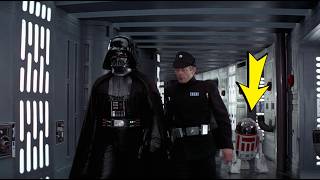

Star Wars' Junkyard Aesthetic Saved It
56sReveals how the iconic 'used universe' look came from scrapped parts, a shocking behind-the-scenes fact that redefines the film's design.
▶ Play Clip""
[00:00] In May of 1977, a movie opened in 32 theaters across the United States.
[00:22] The studio had no faith in it. The director was so certain it would fail that he left the country to avoid watching the reviews come in. His own editor had a heart attack during the final cut, and the replacement team reportedly burst into tears when they screened the rough footage, convinced it was unwatchable.
[00:38] That movie was Star Wars, and almost nothing about getting it made went according to plan. Today we are counting down 16 production facts about the film that nearly destroyed itself before anyone could see it.
[00:50] These are not trivia questions, these are survival stories, and by the end, you will understand why the mess behind the camera is exactly the reason the magic in front of it hit so hard. 1. The first problem George Lucas faced was not a technical one.
[01:04] It was a philosophical one. Every science fiction film before Star Wars looked clean, spotless spaceships, gleaming corridors, perfect uniforms. It looked like the future as designed by an architect who had never left the building.
[01:17] Lucas wanted the opposite. He wanted a universe that had been used, broken, repaired badly, and used again. He called it the used universe, and pulling it off meant the props and design team had to completely abandon how movie sets were supposed to look.
[01:30] The solution was almost embarrassingly practical. They went to junkyards, they raided aircraft graveyards, and military surplus depots collecting jet engine housings, hydraulic components, and old plumbing pipes. They glued the salvage pieces onto every surface in sight, a technique called griebling, essentially
[01:47] burying the models and sets under layers of unidentifiable mechanical clutter. The Millennium Falcon, one of the most iconic spacecraft in film history, is covered almost entirely in recycled scrap metal. There is no elegant design logic underneath it.
[02:00] It looks like something that has been crashed, rebuilt by three different owners, and is currently held together by optimism. That one decision made the entire world feel inhabited rather than invented. 2. While the art department was solving what things should look like, the effects team was facing
[02:15] a more urgent crisis. They had no idea how to actually shoot any of it. The space battle sequences Lucas envisioned had never been done before. Previous science fiction films either avoided large scale dog fights entirely, or used static
[02:27] camera positions with simple model swaps. Lucas wanted dynamic camera movement around the ships, with vehicles banking and diving through three-dimensional space. The technology to achieve this did not exist, so they built it.
[02:39] A young effects supervisor named John Dykstra led the effort to construct a motion-controlled camera system that could execute precise, repeatable movements around a stationary model. The camera could track, pan, tilt, and roll on command with every movement recorded so
[02:53] it could be duplicated exactly on a second or third pass. That allowed the team to composite multiple elements together frame-by-frame without the seams showing. They called it the Dykstra Flex, and it changed the entire industry.
[03:06] Here is the detail most people overlook. The moment Star Wars wrapped, Dykstra walked directly from that production to lead the visual effects team on a competing project, the original Battlestar Galactica. One camera system, same movement philosophy, same sense of ships moving with real physical
[03:22] weight. Those two productions are visually linked at the source, not because one copied the other, but because the same brain built both of them. Number three. The Dykstra Flex solved the camera problem and immediately created a new one.
[03:34] Building and operating the system, plus photographing hundreds of individual model shots, required time and money the production consistently could not afford. The effects house Lucas established, which would eventually become industrial light and magic,
[03:47] started from nothing, no pipeline, no precedent, no certainty that any of it would work. Deadlines were missed constantly. At one point, the situation was serious enough that Lucas reportedly considered scrapping entire sequences. The Battle of Yavin, the climactic assault on the Death Star, exists in its current form
[04:03] not because the team had everything they needed, but because they improvised their way through a triage process that lasted until almost the final weeks before release. The pressure produced some genuinely strange workarounds. At least one asteroid visible in a background shot has been identified as a spray painted
[04:19] potato. When you are inventing motion control photography and managing 100 simultaneous model builds on a budget that keeps shrinking, the grocery store is as valid a resource as anywhere else. Number four.
[04:31] The chaos was not limited to the effects facility. On location in Tunisia, where the desert sequences were filmed, the production encountered conditions that would have shut down a less stubborn crew. The Tunisian Desert in 1976 had just experienced its heaviest rainfall in 50 years.
[04:47] Sets constructed in advance were partially destroyed before filming began. Equipment malfunctioned in the heat, and the production's most technically ambitious practical asset, the radio-controlled R2D2 unit, almost never worked correctly.
[05:01] The problem was frequency interference. Local radio broadcasts in Tunisia operated on channels that conflicted with the remote signals controlling the droid. On any given take, R2D2 might respond perfectly, veer off course into the sand, or simply stop
[05:16] moving entirely. The crew could not predict it. The footage required an extraordinary number of setups and retakes to collect enough usable material. And yet in the finished film, the droid moves with a personality that seems completely intentional,
[05:29] which is honestly remarkable when you consider how much of it was accidental. Number five. The human cast was not faring much better. Darth Vader's helmet was essentially unwarrable during active filming. The interior fogged almost immediately under studio lights, reducing David Proust's visibility
[05:45] to near zero. The ventilation was inadequate, and Proust has described operating largely by feel, listening for directional cues from crew members positioned around him. The lightsaber props added a separate layer of risk.
[05:57] The original blades were aluminum rods coated in retro-reflective material designed to catch light for the optical effect added in post-production. The rods were fragile, snapping regularly under moderate contact.
[06:09] The handles contained small rotating motors prone to overheating, and multiple actors reported burns from prolonged use. The props that became synonymous with elegant combat were, in practice, instruments nobody
[06:21] entirely trusted. Number six. The trash compactor sequence required Mark Hamill, Carrie Fisher, Harrison Ford, and Peter Mayhew to stand in stagnant water for extended periods. The smell, by multiple cast accounts, was severe enough to be a recurring complaint throughout
[06:37] the shoot. Hamill held his breath and submerged himself repeatedly to sell the chaos of the scene. He held it too long at least once, long enough that a blood vessel in his face burst from the pressure.
[06:49] In certain shots from the sequence, there is a visible red mark near his eye that makeup could not fully conceal. It is the kind of detail that disappears inside the larger spectacle, but it is there. Number seven.
[07:01] Peter Mayhew's situation in the Chewbacca suit deserves its own entry, because it is genuinely remarkable that no serious injury occurred. The suit was constructed from real animal hair, specifically a combination of mohair and yak
[07:14] hair layered over a foam underlayer. It was heavy, it did not breathe, and it generated intense heat against the body. In Tunisia, where exterior temperatures were already extreme, the suit became a serious physical
[07:27] hazard. It required cooling breaks between most takes and came close to heat-related collapse on multiple occasions. Crew members were reportedly assigned specifically to watch for signs of distress. The character of Chewbacca communicates entirely through posture and gesture.
[07:43] Every frame of that performance was extracted under conditions that would have ended most actors willingness to continue. Number eight. The cantina scene, one of the most visually memorable sequences in the film, almost did not
[07:55] exist in its current form. Animal photography was completed with a limited number of alien performers and was considered inadequate. A second round of filming was scheduled, but by then the budget for custom creature fabrication
[08:07] was exhausted. The solution was to buy whatever alien and monster masks were commercially available. Outfit performers with matching costumes assembled quickly and shoot the additional crowd footage as fast as possible.
[08:19] Several of the aliens visible in the finished sequence were available for purchase at retail drug and novelty stores in the United States at the time of release. Strategic lighting and camera angles obscured the difference between genuine creature shop
[08:32] craftsmanship and Halloween supply store inventory. In the finished film, you largely cannot tell which is which. Number nine. Alex Guinness accepted the role of Obi-Wan Kenobi and spent much of production openly skeptical
[08:45] of the dialogue he had been given. He described the script privately as rubbish on more than one occasion. He was a classically trained stage actor of considerable reputation and the language of the film sat awkwardly against his instincts.
[08:57] His commitment to the project was real, but contingent on negotiated terms that turned out to be unexpectedly consequential. Guinness agreed to a salary plus two and a quarter percent of the gross profits. At the time, both sides considered the percentage a reasonable hedge.
[09:12] Nobody on either side of the deal understood what finding an audience was about to mean. Four wars became the highest grossing film in history at the time of its release. Guinness received residual checks for the rest of his life, accumulating earnings that by
[09:25] some estimates exceeded everything he had made from all his other work combined. He reportedly found this both gratifying and faintly absurd. Number ten. There's a scene in the finished film that was originally cut entirely.
[09:38] During principal photography, a brief exchange between Han Solo and Jabba the Hut was filmed using a human actor in a fur costume as a stand-in for the creature. Lucas looked at the footage and decided it did not work.
[09:50] The visual credibility of Jabba could not be established with what they had. He cut the scene. It sat in an archive for decades. When the special edition releases were prepared in 1997, Lucas finally had the digital tools
[10:02] to replace the human actor with a computer-generated Jabba. And repositioned Harrison Ford's movement so he no longer appeared to walk through the creature. The practical failure from 1976 became a digital showcase 20 years later.
[10:16] Before that fix existed, the scene simply did not. Which version do you consider the real one? The special edition changes have been debated for nearly 30 years and the argument still runs hot.
[10:28] Leave your take in the comments. Number eleven. The Death Star in many of its wide-angle establishing shots is not a physical model. Building a model large enough to fill the frame convincingly at those scales was beyond what the production could achieve.
[10:41] The solution was matte painting. Detailed photo-realistic artwork on glass panels composited with model and live-action photography. The challenge with matte painting has always been lighting consistency. A physical model is lit by real sources.
[10:55] A painted glass surface is illuminated differently, and the human eye is sensitive to the discrepancy even without consciously analyzing the image. The matte painters spent enormous effort matching the precise angle, quality, and color temperature
[11:08] of light across every composited element. In those shots, the boundary between the physical and the painted is essentially invisible. The most ominous views of the Death Star are, in technical terms, glass.
[11:20] Number twelve. George Lucas finished the film in poor health. By the time he was deep in the editing process in Los Angeles, he was operating under sustained stress with inadequate sleep and it became clear an undiagnosed cardiovascular problem.
[11:34] He was hospitalized. He was identified hypertension and exhaustion serious enough to require medical attention. The first rough cuts screened during this period did not work. People who saw early footage described it as incoherent.
[11:47] The pacing was wrong. The climactic battle sequence at the end of the film did not build properly, and the entire emotional arc of the story collapsed at exactly the moment it should have peaked. Number thirteen.
[11:59] The person who fixed it was Marsha Lucas. She was George's wife, and she was also a working editor with serious credits. She and a small team went into the Battle of Yavin footage and rebuilt the sequence from the raw material available, restructuring the intercutting, reordering shots, and adjusting
[12:15] the rhythm of the attack runs until tension accumulated instead of dispersing. The version of the Battle of Yavin that audiences saw in May of 1977 is substantially the result of her editorial work.
[12:27] The sequence that made people stand up in theaters, the one that sold the world on a franchise that still exists today, was rescued from a rough cut that insiders had described as unwatchable. Marsha Lucas won the Academy Award for film editing that year.
[12:41] It is one of the most important creative contributions in blockbuster cinema history, and it is consistently under-ignolaged. Number fourteen. Ben Burt was responsible for building the film's entire sonic vocabulary from scratch.
[12:54] Every creature, every environment, every piece of technology needed a sound that had never existed before, and audiences had to decode each one instinctively without explanation. The solution in most cases was physical experimentation.
[13:07] To create the sound of a blaster bolt, Burt struck a high-tension wire supporting a radio tower with a hammer and recorded the resonant ping that followed. The result was a sound with the right physical quality, a crack of energy that felt fast
[13:19] and dangerous. R2D2's voice combined Burt's own vocalizations processed through analog electronics to shift the pitch and texture. The Bach's voice blended recordings from multiple animals, including a walrus and a bear
[13:32] until something emerged that felt emotionally readable without being any specific creature. Every sound in the film was built from physical reality, then processed into something new. Number fifteen. The legal aftermath of Star Wars reached further than most audiences ever knew.
[13:47] By 1978, the visual and mechanical similarities between Battlestar Galactica and Star Wars had become a formal dispute. Burt's voice acting on behalf of Lucasfilm filed a lawsuit against Universal Studios claiming
[13:59] Battlestar Galactica had copied thirty-four distinct elements from the film, covering ship designs, plot structures, character archetypes, and specific visual sequences. Universal countersuit. The litigation ran for years and was ultimately settled without a final ruling, meaning neither
[14:15] side claimed a clear legal victory. But the lawsuit accelerated an internal review at Universal that concluded Battlestar Galactica had borrowed two heavily from Star Wars, and the series was significantly affected by the ongoing legal pressure.
[14:28] The two franchises already connected at their technical origins through John Dykstra's camera system were now connected through the courts as well. Number sixteen. When the film finally opened, the studio was not prepared for what happened.
[14:40] Foxx had so little confidence in Star Wars that theater owners were reportedly required to book it as a condition of receiving the other side of midnight, which the studio considered their real commercial release of the season. Many theaters accepted reluctantly.
[14:54] The audiences that showed up did not leave. They came back the next day and brought other people. Lines formed around city blocks. Theaters that had booked it for a short run found themselves unable to schedule anything else because audiences would not stop returning.
[15:08] The film that had been hospitalized into existence, edited back from disaster, built from salvaged scrap metal and Halloween masks, and a spray-painted potato became the defining entertainment event of its decade.
[15:20] It did not succeed because everything went right. It succeeded because the people making it refused to stop solving problems even when the problems had no obvious solutions. That is the part that tends to get left out. Not the magic, the stubbornness.
[15:33] From Tunisian rainstorms to a potato in orbit around a painted death star, the making of Star Wars 1977 was less a film shoot than a sustained emergency. And at every point where it should have collapsed, somebody found a way forward.
[15:48] But there is a production detail, a practical effect, or something you noticed in the film that nobody ever explained, drop it in the comments. We read everything. And if you want to keep going deeper into the history behind science fiction cinema, subscribe.
[16:00] There is a lot more to cover.
⚡ Saved you 0h 16m reading this? Transcribe any YouTube video for free — no signup needed.