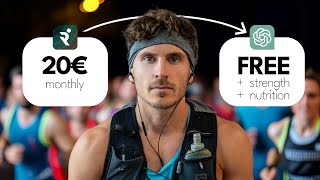

Build a Free AI Training Plan
45sSaves money by offering a free alternative to expensive apps, which is highly appealing and shareable.
▶ Play Clip"Title accurately promises a free AI training plan using ChatGPT, and the video delivers exactly that with step-by-step instructions."
This video demonstrates how to build a personalized AI training plan for running, including strength and nutrition, using ChatGPT for free, instead of paying for expensive apps. The creator walks through setting up a project, inputting personal data, and generating a structured plan with phases, CSV export, and PDF visualization.
Most running apps charge €20/month for AI training plans. This video shows how to build your own for free using ChatGPT.
Take screenshots of your running app (e.g., Strava, Garmin, Apple Watch) showing weekly mileage and other stats to provide context to ChatGPT.
Open a new project in ChatGPT (e.g., 'Ultra Morocco 2025') to keep running, strength, and nutrition plans in one place.
Prompt ChatGPT to act as an expert running coach and nutritionist. Provide age, weight, height, body fat, current PBs, running history, past injuries, and lifestyle details.
Upload screenshots of past training data and ask ChatGPT to confirm understanding. This step is crucial for accuracy.
Ask ChatGPT to ask 10 questions about race specifics, injury recovery, training preferences, nutrition, and lifestyle to tailor the plan.
ChatGPT creates a baseline weekly training plan based on all provided information.
Prompt ChatGPT to structure the plan into four phases: initial (aerobic endurance), progression (intervals, tempo, hills), taper (reduce mileage), and recovery (post-race).
Add strength sessions (2-4 per week, 30-60 min) and mobility (2-6 per week, 10-20 min) with guidelines to avoid overtraining.
Ask ChatGPT to create a CSV file for import into Google Sheets, allowing easy editing and visualization of the plan.
Request a 16:9 PDF document to see all sessions leading up to the race.
After the training plan is ready, ask ChatGPT to ask 10 questions about eating habits and preferences to create a personalized nutrition plan.
By following these steps, you can generate a comprehensive, free training plan with ChatGPT that rivals paid apps, including a structured running plan, strength and mobility integration, and a nutrition plan, all exportable to spreadsheet and PDF.
What is the first step in building a free AI training plan with ChatGPT?
Take screenshots of your past running data from your running app.
00:17
Why is it important to create a new project in ChatGPT for your training plan?
To keep running, strength, and nutrition plans in one place so they can communicate with each other.
00:47
What personal information should you provide in the first prompt to ChatGPT?
Age, weight, height, body fat, current PBs, running history, past injuries, and lifestyle.
01:16
After uploading screenshots of past training data, what should you ask ChatGPT?
Ask it to confirm that it understands the data or if it needs clarification.
03:24
What is the purpose of asking ChatGPT to ask you 10 questions?
To tailor the training plan to your specific race, injury recovery, training preferences, nutrition, and lifestyle.
04:05
What are the four phases of a training plan according to the video?
Initial phase (aerobic endurance), progression phase (intervals, tempo, hills), taper phase (reduce mileage), and recovery phase (post-race).
05:27
What guidelines are given for integrating strength sessions?
Add 2-4 strength sessions per week, 30-60 minutes each, not the day before hard interval workouts or long runs.
06:52
How can you export the training plan from ChatGPT for editing?
Ask ChatGPT to create a CSV file and import it into Google Sheets.
07:22
What format does the video suggest for visualizing the training plan?
A 16:9 PDF document.
08:34
When should you create the nutrition plan?
After the training plan is ready, so the AI can base the nutrition plan on the training schedule.
08:48
Free Alternative to Paid Apps
Highlights a cost-saving method for personalized training plans using ChatGPT.
Comprehensive Personal Data Input
Emphasizes the importance of providing detailed background for accurate plan generation.
01:16Data Confirmation Step
Ensures AI correctly interprets uploaded data, preventing misunderstandings.
03:08Four-Phase Training Structure
Breaks down training into logical phases for optimal performance and recovery.
05:27CSV Export for Flexibility
Allows users to edit and visualize the plan in a spreadsheet, adding practicality.
07:22[00:00] Most running apps charge €20 a month for an AI training plan. Today I'll show you how to build your own training plan for free using ChatBT. Let's get right in. important running data from the past few months. This step is really important
[00:17] we're not going to overtrain and get injured. So go into your running app. Mine is a Sundto, but you maybe have a Garmin, an Apple Watch, or a Chorus. Honestly, they're all doing the same. And literally just take screenshots of
[00:32] really good one. Your weekly mileage is really important. Maybe even your going to airdrop that to our MacBook or whatever you're using. And let's open
[00:47] Chat GBT. So once we're in ChatBT, first step is we're going to open a new project. Name it whatever. I'll go with Ultra Morocco 2025. Now, technically, you could split your running plan, your strength plan, and your nutritionist
[01:01] communicate with one another. Each chat kind of has its own brain. And so, if kind of depend on your running week, then it's really important to keep it
[01:16] first prompt. Dear coach, now obviously I'm going to write this prompt with my information, but put your relevant information where it fits. And if you want all the prompts with blanks just to fill it in, you can download it for free
[01:32] in the first link of the video description down below. So, dear coach, I'm Rafa and I want you to act as my expert running coach and nutritionist. Your mission is to get me in the best shape possible to achieve my next goal,
[01:44] the ultramarathon 2-day stage race in Morocco on the 15th of November, 2025. understand my background, habits, and context. Base info here, insert your
[01:56] age, your weight, your height, and your body fat if you have it. Sports sporty? Are you just starting out? All that information is important. And then your last current PB. If that's a 5K, if that's a marathon, doesn't matter. Just
[02:11] input your most current personal best in there. Then your running history. When did you start running? What are the major races you did and your time really helpful. Then your past injuries. Okay, so I have multiple ankle sprains. I had
[02:24] shin splints in 2022, IT band syndrome, runner's knee. All your injuries should be here. And of course, the most important are the injuries that are the from a miniscus tear, and that's going to be really, really important um for my
[02:39] for my mobility and strength sessions. Last but not least, your lifestyle. How much you sleep? Uh where do you work? Do you work from home? When do you usually go to the gym? Do you have a gym near you? Um, how many days a week do you
[02:52] run? Okay, if you run with a run club or something like that on certain days, of information are going to be really useful later on. So, before we click enter, just make sure that the AI is up for the challenge. So, then Chachi will
[03:08] give you an answer saying that he's very motivated to take on this challenge and first prompt. There's two more before we actually start building our plan. The second prompt will actually include the screenshots that we took earlier. So,
[03:24] data. Screenshots of my past training from my Sunundto app. Can you confirm you understand that data or do you need me to clarify anything? Just drag and drop your pictures here. I do think that this is also available for the free
[03:39] version of ChatBT, but honestly, I'm not sure anymore. If not, you can also transcribe the screenshots into actual text. All right, so it tells me it fully understands that data, so I don't need to clarify anything. Sometimes there can
[03:53] be misunderstandings. So that's why it's important to ask and confirm. already. So now we can get into the first big task that you're going to have
[04:05] building my plans, please ask me 10 questions that will help you perform going to have the same questions as me, okay? That's because I am training for a
[04:18] completely different race than you might be training for. Okay? That's why this video is a followalong. And the best way to do it is to just take it and adapt it to your situation. What did it made different categories, one for race
[04:32] specific, one for injury recovery, okay, because of my miniscus tier, one for my training preferences, nutrition and lifestyle, and life context. So, this is really awesome. It even asks me if I have any big life events coming coming
[04:44] up before the race. So, it can make my training plan according to those events. The apps that I tried like runner and urun, they are AI based uh training coaches. They don't even ask you these questions. So, so this is awesome. So,
[04:59] take time to respond to these questions. Okay. sentence at the end. Please create a baseline training plan based on all my
[05:11] answers. All right. So, already chatbt created a really solid baseline structure for my weekly training plan. Okay, I can see it. It included the running history. It's based on my current goal. So this is super
[05:27] take that baseline and structure it into four phases because each training plan in the world works in four phases. You first have the initial phase. It's kind of to get started. Then the progression phase. That's the biggest block. Okay?
[05:42] It's like progressive overloading until like two weeks before the race. Then you have the taper phase which serves to get your volume down, keep the intensity high to get you into peak athletic performance on race day. And then the
[05:57] recovery phase which is like 2 weeks after the race. So now the next prompt will be based on that. So great, thanks for the baseline running plan. Now please organize this running plan into four clear phases leading up to my race.
[06:09] One, initial phase, build aerobic endurance, consistency, and injury prevention. Two, progression phase. at intervals, tempo runs, hill workouts, and gradually increase long run distance. Taper phase, reduce mileage
[06:21] and intensity to arrive fresh while maintaining sharpness. And lastly, recovery phase, post- race recovery plan with reduced load, mobility, and gentle each phase and explain the main purpose of the phase. All right. So, now that we
[06:37] according to our goals and our lifestyle, we can now sprinkle in some strength and mobility sessions. Now, please integrate strength and mobility sessions on top of it. Guidelines. Okay, these are my guidelines. You obviously
[06:52] have different ones, so just act accordingly. Add two to four strength availability and preference. Make sure strength sessions don't fall the day before hard interval workouts or long runs. Each strength session should last
[07:06] 30 to 60 minutes depending on time available. Add mobility sessions two to six times per week. Length can vary from 10 to 20 minutes. Focus on common weak existing running schedule without creating overload and explain why you
[07:22] placed them where you did. All right, so now comes the best part of do a CSV export so we can import it into Google spreadsheets and actually have
[07:35] our plan in a spreadsheet and you know move things around, take off sessions, etc. So the prompt we're going to use is great. Now please create a CSV file that I can import into Google spreadsheets to visualize all of this.
[07:50] plan and gave me a CSV file right here that I can download. I'm going to do that and import it into a new spreadsheet.
[08:04] So, I open this here. Import. Yes. And there we go. It doesn't look that great yet. We can still do some formatting, but this is a full training
[08:17] plan including everything we want with focus and notes at the end all the way until race day. That's amazing. But we can go even further than that. Let's go back to chatbt and actually ask it to visualize something into a PDF. Amazing.
[08:34] Now, please visualize this in a 16x9 document so I can see all my sessions leading up to the race. And here we go. This is it. So, we have a full training plan
[08:48] exported into a PDF from ChatBT. That's amazing. All right, it's time for training plan because otherwise the AI won't know what to base your nutrition
[09:01] plan on. And so because this is again a case-by case thing, I asked ChachiBC again to ask me 10 questions about my eating habits and preferences to perform its job as a nutritionist as good as possible. So here's the prompt. Now
[09:16] before you create my nutrition plan, I want you to ask me 10 questions about my your abilities. Again, take as much time as you need to answer these questions and it will give you a full nutrition plan that's based on your training plan.
[09:32] If you want to download all the prompts uh with a blank so you can fill it in, for free into your mailbox. Thanks a lot for watching. Stay wingy. Peace.
⚡ Saved you 0h 09m reading this? Transcribe any YouTube video for free — no signup needed.