
From $24K to $100M: The Power of Vulnerability
60sDavid's raw story of posting despite fear, then seeing explosive growth, is highly relatable and inspiring for entrepreneurs.
▶ Play Clip"The title accurately reflects the webinar's focus on using personal branding to grow a business, with concrete examples and actionable advice."
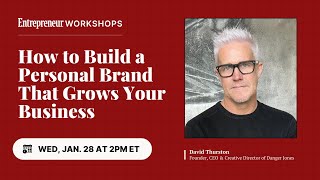
In this webinar, David Thurston, founder of Pulp Riot and Danger Jones, shares his journey from running a hair salon to building two multi-million dollar hair color brands by leveraging personal branding. He emphasizes that putting your face and beliefs at the center of your marketing can transform your business, and he provides actionable advice on overcoming fear, building community, and staying authentic.
David Thurston, founder of Pulp Riot and Danger Jones, discusses how personal branding can grow a business. He shares his story of posting a vulnerable message on Instagram that led to hundreds of comments and changed his career.
David describes the fear he felt after posting his first personal brand content, including lying face down on his bed for seven minutes. He emphasizes that fear is the number one reason people don't build brands, but it's necessary for growth.
By becoming a voice in his industry, David gained credibility and could connect with influencers who wouldn't have taken his call otherwise. This led to partnerships and amplified his reach.
David explains that entrepreneurs can compete with large companies by moving faster, knowing customers better, and building a community. A personal brand with clear beliefs and values attracts followers who amplify the message.
When launching Danger Jones, David didn't start from zero because his personal brand carried over. Customers followed him, not the logo, because they believed in his values.
David sold Pulp Riot for nearly $100 million but returned to entrepreneurship because fulfillment comes from climbing, not reaching the top. He compares building Danger Jones to building a cathedral for the long term.
On his personal page, David shares messy, behind-the-scenes content. On the brand page, he provides context for campaigns, explaining why they do things differently from competitors.
David uses AI as a brainstorming tool to bounce off ideas, but he never posts AI-generated content verbatim. He stresses that authenticity is key; people can sniff out a bot.
To define your brand, ask 'why' repeatedly until you reach the core purpose. Connect that purpose to your customers' hearts to build a movement, not just a marketing plan.
As a founder, David has credibility and freedom to speak authentically, unlike salespeople who follow scripts. This makes him a more effective evangelist for his brand.
David believes in work-life fusion rather than balance, as building a brand is a creative endeavor. He emphasizes unplugging with his wife and co-founder to maintain staying power.
David advises new brands to differentiate from corporate competitors by being disruptive and authentic. He also stresses surrounding yourself with people smarter than you in operations, marketing, and sales.
David keeps his team motivated through transparency, full team meetings, and sharing a compelling vision. He involves them in decision-making and celebrates wins together.
David admits he becomes a bottleneck when people wait for his approval on tasks like Instagram captions. He commits to hiring talented people to take over so he can focus on being an evangelist.
David encourages entrepreneurs to build in public, showing the messy reality. Authenticity and vulnerability are what people follow.
Building a personal brand is essential for entrepreneurs to grow their business, create community, and compete with larger players. Authenticity, vulnerability, and a clear sense of purpose are the keys to connecting with customers and building a lasting movement.
What was David Thurston's first successful personal brand post about?
He posted a picture of himself in a black t-shirt with a long caption about something in the hair industry that everyone was thinking but nobody was talking about.
03:45
How did David Thurston's personal brand help him connect with influencers?
Influencers picked up the phone because they recognized him as the voice of the beauty industry, not as an anonymous caller.
06:30
What are the three ways entrepreneurs can compete with Goliaths according to David?
Move faster, know your customer better, and build a community.
09:15
Why did David Thurston start Danger Jones after selling Pulp Riot?
He felt unfulfilled and realized that fulfillment comes from climbing, not reaching the top. He needed a bigger dragon to slay.
15:30
What type of content does David post on his personal Instagram page?
Messy, behind-the-scenes content showing struggles and outtakes, building in public.
18:45
How does David use AI for content creation?
He uses it as a brainstorming tool to bounce off ideas, but never posts AI-generated content verbatim.
22:00
What method does David recommend for defining your brand?
Ask 'why' repeatedly until you reach the core purpose, then connect that to your customers' hearts.
25:30
Why does David believe founders have an advantage over salespeople in presentations?
Founders have built-in credibility and can speak authentically without following a script, making them more effective.
28:00
What is David's view on work-life balance?
He prefers work-life fusion because building a brand is a creative endeavor, but he emphasizes unplugging with his wife to maintain staying power.
31:00
What advice does David give for new beauty brands?
Differentiate from corporate competitors by being disruptive and authentic, and surround yourself with people smarter than you in key areas.
34:00
How does David keep his team motivated?
Through transparency, full team meetings, sharing a compelling vision, and involving them in decision-making.
36:30
What is a sign that a founder has become a bottleneck?
When people are waiting for the founder's approval on tasks like Instagram captions.
39:00
Overcoming Fear
David's raw description of his fear after posting his first personal brand content is relatable and shows that vulnerability can lead to breakthrough.
03:45Community vs. Goliath
The three ways to compete with large companies are actionable and applicable across industries.
09:15Fulfillment from Climbing
David's realization that fulfillment comes from the journey, not the destination, is a powerful principle for entrepreneurs.
15:30Finding Your Why
The 'why' exercise is a practical method for defining a brand's core purpose.
25:30Recognizing Bottlenecks
David's honest admission of being a bottleneck and his commitment to hiring help is a valuable lesson for scaling.
39:00[00:00] Hey everyone, I'm Dan Bova, host of Entrepreneur Magazine's podcast, How Success Happens. And welcome to today's webinar, How to Build a Personal Brand That Grows Your Business. Our guest today is David Thurston, who is the founder, CEO, and creative director of Hair Color Brand Inc. Danger Jones. Now, David has had incredible success building two huge hair color brands by putting his own face and voice at the center of the company's marketing. He turned Pulp Riot into
[00:28] a near $100 million acquisition in just 23 months. And he launched Danger Jones straight into over 1,400 stores with a national distribution deal. He's also the author of the book, The Spiral Staircase. Now, I have a bunch of questions for David, but we want to hear from you. So please pop any questions you have into the chat and we will answer as many as we can. All right, let's get to it. Welcome, David. So excited to
[00:57] be here. I put this on my calendar a couple of months ago, and the reason I'm excited is not only do I get to talk about something I'm passionate about, but I'm in a room full of my people. fellow entrepreneurs. So it's great to be here. Thank you, Dan. Great, great. And just to give you all a window into how passionate he's cutting into his ski vacation to talk to us all today. So we really, really
[01:25] appreciate it. So, yeah, it looks like the people are jumping into the chat already. So that's fantastic. Now, I want to start with something that's maybe a fear of a lot of people when we talk about personal branding. I mean, sometimes I have this fear too, which is I'm going to be the face of something or I have some things to say, but like, does anyone care what I have to say? Like what, what makes me
[01:53] so important that I think other people could benefit from me. But you say that staying in the background is hurting a huge potential for growth for your business. So can you talk a little bit about that? Yeah. You're holding back your company if you're not putting your face out there and more importantly, your beliefs and values. the i struggled with the same thing in fact my career really took off when i started to give my brand
[02:21] a voice a soul a purpose and it started when i was running a hair salon and we were growing our instagram page and one day i thought i'm going to post something about our industry something that everybody's thinking but nobody's talking about so i posted a picture of myself in a black t-shirt. I wrote a long caption about something about the industry. I hit post and the fear kicked in, the imposter syndrome kicked in. And I
[02:50] literally walked to my bedroom, laid face down on my bed, head in my hands and moaned for seven minutes straight. That's how uncomfortable it was for me. So after that, I said, that's it, I'm not doing this. I'm getting back up, I'm deleting that post. I'm mortified, hopefully not too many people see it. But then a wild thing happened, Dan. I opened it up and hundreds of comments. People loved it. They loved that I put myself
[03:18] out there, that I was vulnerable, and I was saying something kind of disruptive, something that might not have been said before. And that moment is when my career changed. And as you said in the opener, I, at age 40, was running a hair salon for $24,000 a year. And by the time I hit 50, I'd already exited a company for close to a hundred million as a hair color company. So to the people listening, I absolutely
[03:46] know what it's like to be stoked about being an entrepreneur and running your own thing and going to a dinner party. When people ask you, what do you do? You say, I'm an entrepreneur. They say, what do you do? And I run this company. And then being really fearful of that follow-up question about how great is your company doing? And you're like, I wish they didn't ask that. So hopefully I unlock some things today that help
[04:14] so that when you go to that dinner party and they talk about how your company's doing, you're able to, with pride, say, I'm doing this. So that's what we're here for today. That's fantastic. I love that. And I think, I think no matter who you are, you can relate to the post that you're like, Oh God, why did I do that? But I'm glad it worked out for you. That's great. That's fantastic. The fear is the
[04:43] number one reason people don't build brands. And like, if you want the big prize, you've got to, you've, it's part of the price of admission is you've got to break through that fear. And anybody who wasn't born during the social media revolution, like myself, I was came into it a little bit later. It's very awkward and uncomfortable to put yourself out there. But even when I'm talking right now, I'll bet you there's people in the audience
[05:11] who wish they were in my chair on this webinar. And then there's people who would say to themselves, say, I'm so glad I'm not there. Either way, like in order to get there, you've got to go through fear to get there. So let's talk about that post and other posts. So you put yourself out there as I'm the person running this company. People obviously liked what you had to say. They reacted to what you had to
[05:39] say. But how did that translate to business? How did that translate to your business growing? So by saying things, I started to act like a voice of our industry. And anybody, it doesn't matter what industry you're in, if you start talking about your industry in a way that makes people feel like, oh, he gets us, and that's your customer. Oh, he really does get us. That's where you want to be. And for me, it started to
[06:07] give me credibility in the industry. It made me the voice of the industry. How does that translate to business? It unlocked worlds to me I wouldn't have had otherwise because This is around the time when social media influencing started to become a thing. And as I'm trying to grow my personal brand and awareness for my hair salon in an education team I was creating, by having a personal brand that allowed me to pick up the phone
[06:36] and call influential hairstylists across the country who are influencers, and they picked up the phone. They would not have picked up the phone if I was some anonymous guy giving them a call. It was David Thurston, the voice of the beauty industry, the person who's saying why the beauty school curriculum is outdated, why I would be happy if my daughters were hairstylists, why you should be saying no to certain clients. Like, here's how to rethink pricing.
[07:04] I was doing these kind of posts and they're like, oh, I know that guy. I'll pick up the phone. And that just kind of started to make it so that I could connect my circle to their circles. And that's how you could build a personal brand. Like you could create one, but you also have to make it go far and travel. It's by connecting yourself and your personal brand to other people and their personal brands and
[07:32] their audiences that could really rocket you to the top. And aside from connecting with other influencers, what do you think about the connection it forms with your customers? They're not just buying a box of something on the shelf. They know the person behind it and what your beliefs are. Can you talk a little bit about that, how that grows your own community? It's the most important thing. I'm guessing that most of the people on this meeting
[08:00] are entrepreneurs that are trying to defeat or compete with a Goliath in your industry. And you could only do that in three ways. in my experience. One is, is you can move a lot faster than they can. Number two is you can know your customer better than they do. But number three is that you have the power to build a community. And with the community, you can amplify your message faster and further than the Goliath ever
[08:29] can. So you cannot build a community unless you have a leader. And you cannot be a leader unless people understand what you believe and what your values are, because that's what they're linking themselves to. They're not following a little. They're not following you because you're creating a really great product. They're going to follow you and buy from you because your beliefs and values align with theirs. And more importantly, that has to happen for them to bother
[08:57] to amplify your message to their following. They have to feel passionate about what you believe in. So how do you start with a personal brand? You start focusing on what do you believe in? What markets do you want to leave on the world? What values do you want to share with others? What is your why? Start there and you're going to find a lot of people. You're going to find your group of people that share that
[09:25] belief and you will amplify your message. And, you know, as I, talked about in the intro to you, you know, you didn't just do one company, you're you, you launch a second one. And you didn't have to start from scratch. The second time around, can you talk a little bit about that, that continuity that comes with the strong personal brand? Because a lot of entrepreneurs, you know, some of them may have one company for the rest
[09:53] of their life. But you know, the nature of entrepreneurship, too, is You know, start this, sell it, move on to this, doing everyone's doing a million different things. So can you talk about that connectivity that comes with having a sort of central personal brand? Yeah. So I talked about owning the hair salon and putting my face out there to give the brand a voice and a soul and then connecting myself with other influencers who have their
[10:22] own personal brands to find a broader market. Well, when I was able to create the product line called Pulp Riot, I didn't start from zero. People already knew who they were buying from and what they stood for. A person who believes that people are more important than profits. A person believes that building a community should be the reason why we exist. Somebody who believes that products are better when they're made inside of a hair salon. And
[10:50] somebody who says women, because they dominate the beauty industry, should be front and center on stage. Those are some of my beliefs. And it... People already knew that. So we didn't start from zero. So when we created Pulp Riot, we created it with this thing in Instagram posts and we have product now available. In 23 months after we actually did that post saying we now have products available, we sold the brand to L'Oreal for almost a
[11:18] hundred million dollars because of the personal brand. Well, after that, I took some time off and came back to create another brand in the beauty industry. And here's what's important. I didn't start from zero. In fact, I started from 100 because the community that I built with Paul Bryant, so many of them followed me to my next brand called Danger Jones. They didn't follow a logo. They didn't follow the name of a brand. They follow people
[11:47] they believe in because belief is the most important currency. Your employees should have belief in what you're doing. They should be missionaries. Your customers should believe what you're doing so much that they become amplifiers. I love that. That's awesome. And I mean, it's an easy thing to equate. If you think about a favorite musician, they have a new album out. You think about an actor in a totally different movie, a director, a writer. The parallel is
[12:15] so great. I want to ask you one question that doesn't have that much to do with personal branding, but you sell a company for close to a hundred million dollars. Why aren't you just skiing for the rest of your life? Great question. Um, it's because I don't think that brings meaning to your life. And I know a lot of people who do that and they're miserable. Um, to be honest with you, when we sold our company,
[12:43] I have been climbing the spiral staircase one by one, elevating my career. And a scary thing happens when you feel like you've reached the top step. Your foot goes out for the next step and there's nothing there. It sounds like a great problem to have. And if you're a young entrepreneur, you're probably saying, I hope I have that problem one day. But it's actually quite scary. And I had to work with a coach and a therapist
[13:11] to kind of find out what's missing from my life. If I have everything I ever wanted, I sold my company for close to a hundred million dollars, shouldn't I feel full? But I didn't feel fulfilled. And so we started to realize that it's the act of climbing that brings fulfillment into your life. And so I needed to come up with a bigger dragon to slay, a bigger mountain to climb. With Danger Jones, the brand that I'm
[13:40] building now, there's a different purpose. I consider my first brand, Pulp Riot, to be the rocket ship. But Danger Jones is a cathedral built to last, stone by stone, stained glass. It's going after a bigger part of the market, not a niche product line, but playing in the biggest arena of all. Now I've got purpose and I'm running a company with just different stakes where it's more of a long-term play and I don't have to think
[14:08] about, oh, I'm building this to exit. And so it's rewarding and fulfilling to do what I do. In fact, I will say this and I bet you all the entrepreneurs will back me up. Being an entrepreneur and creating a brand is the most creative thing a human being can do. More so than playing music or painting a picture. because you're making a thousand choices a day in those thousands of choices come together. And you're working with
[14:36] all these different people to create one single thing called a brand. It's such a creative endeavor. So I could be sitting here doing some kind of creative artistic thing. And that's exactly what I'm doing and what I choose to wake up and do every day. That's I love that. That's fantastic. So let's get a little into. And by the way, you mentioned the spiral staircase. name of your book, which dives into all of this. So people
[15:04] should definitely pick that up and learn about your, your ascent. And that, as you said, that's such a great metaphor that there's no step to put your foot on. I love that. Yeah. Like the spiral circuit is just really quickly. I would like to say, you know, I think of life as being like a spiral staircase. You could only see one or two steps up, but you can't exactly see where it's going. Right. People don't, Ryan
[15:33] Duffy, Line because they have this fear of leaving the unknown are leaving the known for the unknown and getting out of their comfort zone. Ryan Duffy, And so the story of the spiral staircase is really me climbing up my spiral staircase and all the lessons I learned along the way, especially about building personal brand, but what really makes it unique is it's not a memoir. And it's not some business book you would typically read. In fact,
[16:01] I dropped the F-bomb at least seven times in the book. It's told more in a rock and roll style voice. And it's very easy to read. And it's kind of in the voice of what Anthony Bourdain used to talk like in short sentences that just make it fun and impactful and easy to read. It's not a memoir. It's a manifesto for a better way to live a bold life. All right, let's do it. I want to
[16:29] talk, get a little nitty gritty about, cause I think, you know, people understand what you're saying about the personal brand. And I think everyone has a same similar experience is like, okay, I'm going to, I'm going to get on social media. I'm going to start doing this. And then like a week into it, you're like, oh man, I'm exhausted. I don't know what else to say. So how do you manage that? How do you keep it
[16:57] fresh? How do you not burn yourself out? So, There's your own personal page. Let's call it social media page. I live in the Instagram world, so I'm going to talk in those terms. I have my own personal Instagram page where I could be building a personal brand, but I also have my company page where I'm also building my personal brand. The two kind of go together. They amplify each other, which is really important. On my personal
[17:26] page, I like to show messy things. And it's just an easy thing for founders to do if they just let go of their ego a little bit and you build in public. So you're showing the behind the scenes of building. You're especially showing them when things are going wrong. Oftentimes we're trying to create this really polished video that we're going to post on our main brand page and On my personal page, I'll post all the outtakes
[17:54] showing that I'm a normal person that struggles with public speaking when a microphone shoved in front of my face. When we have a problem building a hair color and it doesn't pass stability testing and we have to discontinue it, we don't do it in quiet. We do it in public, almost prideful saying we're not going to launch this crappy podcast. formulation, we need to continue to work on it and people feel really great that you're taking
[18:22] them for the ride. So that's kind of on your personal page, but on your brand page, you should have endless things to talk about. What you're doing as the founder is giving context to everything that you're launching or releasing. Just as an example, just the other day, we were posting this video of four artists. And they were the face of a campaign that we were doing for hairstylists. And so I went on before we even launched
[18:50] the videos to our audience to say, and this is why we're doing this because our competitors, Goliath, are focused so much on the end consumer that they're hiring influencers like pop stars and actresses. But at Danger Jones, we're going to put on front of the screen, you, the hairstylist. So I gave it context so now people know what they're believing in, what our values are, and showing how disruptive we are and different from Goliath. So this
[19:19] should be an endless amount of content. But here's, we live in a great time. And I will say that if you're an introvert or you're struggling for ideas for content, there's something that you might have heard of called AI. And if you're having conversations with ChatGPT or whatever you're using, explaining who you are, what your brand is, who your customers are, and what essentially you're trying to get through to them or communicate with them, it's a
[19:47] great brainstorming tool to be able to provide you with some of the words. And if you're an introvert and you don't feel comfortable in front of the camera, The truth is, is writing is also another way of communicating and a really well written caption could also move people. So that's my answer to that. That's great. And, you know, full disclosure, I am completely AI generated. You've been talking to a bot this whole time. You know, I
[20:15] love what you said about when you were talking about your book and likening it to Anthony Bourdain. And it made me think as you're talking about social media, I think a great way to if you don't really know where to start is to think like, who do I like on social media? Why do I like them? And not you're not going to copy them, but just sort of use them as a little bit of a template.
[20:43] Oh, they do these kinds of videos or they do those kinds of videos. Yeah, totally. There's inspiration everywhere. And, you know, I hopefully somebody on here starts to follow me and see what I'm doing and start emulating some of the things that I'm doing. Borrow from people. And it's a great way to kind of use a template. Somebody who's disruptive to an industry, if they figured it out and they're in a different industry than you, I
[21:12] guarantee you it's going to translate over to your industry as well. Because what are we trying to do? We're trying to come up with a solution to a problem that exists in your industry. And most likely an incumbent solved that a long time ago but you're trying to come in and say there's a better way and that's what you need to represent as a young entrepreneur who's trying to be disruptive you're the person who's saying i
[21:40] know there's a better way and it's not necessarily an innovative new product or a lovely fragrance or some kind of interesting packaging although those things could all be really important it's a better way perhaps to communicate and work with the community that you're there to serve or a better way to build or a better way to think about people and employees, et cetera. All the things that are in your playbook as a disruptor. We got a
[22:08] question in earlier and from someone who was saying, asking about having trouble defining for themselves, what is my brand? I don't, I don't know. I know, In my head, I kind of know what it is, but I don't know how to put it succinctly. Do you have any advice for that? Do you have any questions someone could ask themselves or any method to sort of like hash out like this is what my brand is? I think
[22:36] the best way to uncover a meaning is to ask the question why. And then when you give an answer, ask the question why again. And keep doing that until you really figure out why you're doing what you're doing. Why are you building what you're building? Why are you waking up every day? And ideally, hopefully, it's not all about money. It's bringing some kind of purpose to other people yourself, whether it be making an impact or some
[23:05] kind of legacy that you're leaving behind. And it could even be ego driven because you want to be a podcast guest. You want to write a book, whatever it might be. You need to get to the essence of why. And ideally, you're going to now say, I know why I'm doing this. And then you need to connect it to your customers because what's in your heart. I think of why not in the head. I think of
[23:33] in your heart. If your heart could connect to a lot of people's hearts. Now you've got a business. Now you've got a brand that's going to travel. So ask the question why over and over again, until you get to the core essence of why you are doing what you're doing. And that is your brand. And I love what you said there. It's about being, when you ask yourself why, give yourself an honest answer. If it is,
[24:01] as you said, I want to be famous, okay. That's what you want to do. Go for it. So I think that's such great, like don't lie to yourself why you're doing this, which I think is great. And you just touched on there at the end there, something that I've read that you've talked about, which is you're encouraging people to build a movement not a marketing plan. You've talked a little bit about that over the course of
[24:30] this, but can you kind of hone in on that, what you mean by that? Yeah. We talked about two successful hair color companies that I've had. The truth is we could talk about the first one I ever built, and it was a total failure. Well, I guess it depends how you measure because it gave me all the tools, skills, lessons that I needed in order to have success later. But The difference between the failure and the
[24:58] ones that are successful is because I stopped trying to do it alone. It's possible to be a solopreneur and just build in quiet and have some great success. If you can, it means you're more innovative than I am. I have to rely on other people to build with me and to create a in order to really be disruptive. And again, you could only do that as a leader. The power of a founder, I think people don't
[25:26] realize it when you are a founder, how powerful it is compared to some of the other people that might be in your industry. As an example, I have a lot of opportunity to go up on stage at various distributor events where you've got a room full of salespeople. And some of the competing brands, other color lines in my industry, will send a salesperson up there to give a presentation of what their brand's up to. Now, the
[25:54] salesperson goes up there and the audience doesn't trust them at all because they don't know them. There's no credibility built. And the salesperson goes up there and they have to follow a script that was written for them and a PowerPoint slides and can't say what they really want to say because they might get fired. And then at the end, they say, now please welcome to the stage founder of Danger Jones, David Thurston. It's a game changer.
[26:23] I don't have to take time to build credibility with them. In fact, the other day I taught six back to back to back presentations in Las Vegas. And every time I didn't have to start from ground zero. Hi, I'm David Thurston. This is why I'm building it. This is what I believe in. This is my track record. It was done. the second I walk in a room and that's really the power of the founder. And it
[26:51] also, I could go up there and I could be unhinged. I could be walking in a tightrope. I could say things that are irreverent. I could do whatever I want. And that makes the audience love me more. It makes them engage me more. It makes them feel like I'm speaking from the heart and not following a script. So I, as a founder, I, creating a movement. I'm creating movement with distributors, with sales reps, with stylists everywhere
[27:19] I go. And it's just people that are latching on to the message. I said it at the beginning, if you aren't building your message, your brand, your community, you're really getting in the way of some significant growth that you can't have because belief travels faster than anything. And like it or not, that's your job. That's That's fantastic. I wonder as we wrap this up, you're doing so much. You're putting so much out there. How do you
[27:47] keep so energized? What do you do to sort of take a break? We heard you were skiing, but like more on a day-to-day thing. Is there anything, habits that you have in the morning or night that sort of keeps yourself grounded and not going in a million directions at once? Dan, I think it's important to have some balance, but I'm going to go against the grain here and say that as an entrepreneur, if you really want
[28:16] to have success, at least in my experience, you're not going to have the balance that some like to talk about on social media that you should aspire to. The truth is I told you that building a brand is the reason why I wake up in the morning. It's the most creative endeavor you can do. And so I'm not looking for work-life balance. It's a little bit more work-life fusion. I'm creating a world with my brand. and
[28:44] maybe some of you are as well, a world that I want to live in, a world that I want to invite those that I love into. And so it's it's that's what I'm creating. So I don't feel a real need to break out of this world that I'm creating. And this is something that any of us can do. And it might be your why. If anybody was looking for what is the reason I'm doing it? Maybe
[29:12] it's to create this world that you want to live in and invite those people in. As far as like things that I do. Yeah. You need to unplug. You need to. My wife is my co-founder and business partner. And, you know, we need to be husband and wife from time to time and try travel and get away. These are all really important things in order to be successful and to be able to have some staying power,
[29:40] to be honest with you. That's fantastic. So we've got some questions that have been rolling in. Apologies, I had the chat window not in the right spot, so I didn't see these coming in, but lots of love here, David. Let's do it. Great. Great to hear from everyone on here. Here's a question from Carly. What do you think brands should prioritize more to truly understand and connect with their consumer? What advice would you give someone just
[30:09] starting a beauty brand? So if you're starting a beauty brand, here's what you need to know. And I'm guessing this is the way in a lot of different industries, especially mature industries. The world's gone through a period of consolidation and generally just a few brands own everything. They've bought up everything. That makes it really hard to break through. it's also your superpower because now you get to stand different than them. You get to show people how
[30:37] you're not corporate, how you care about people, how they're the man and they're soulless. And that gives you an opportunity to be disruptive with your language. And I'd say that's the best way to really break through any industry. And it's been one of my big secrets other than building community and personal brand in order to be able to build something in the beauty industry. That's another thing I would say is you better surround yourself with people
[31:05] who are smarter than you are, a lot of them. Because it takes a lot of knowledge and skill set to really break through a really challenging industry. And so you need to rely on people who are really good at operations and supply chain, for example, or somebody who's an expert marketer, somebody who wakes up in the morning and loves sales. Add them to your team in order to really break through any industry and particularly the beauty
[31:33] industry. Fantastic. I want to get to as many as you can before we have to go. This is from Nyack. How do you keep your team motivated to build your vision with you? NAYAK, THAT'S A FANTASTIC QUESTION. AND THE TRUTH IS, IS YOU HAVE TO HAVE A LOT OF PEOPLE IN YOUR BOAT, ROWING IN THE SAME DIRECTION AND NOT ROWING IN DIFFERENT DIRECTIONS. AND THEY BETTER WAKE UP AND HAVE A REASON, THEIR OWN WHY AND WHAT'S
[32:02] CONNECTING TO THEM. WE, EVEN AT OUR SCALE THAT WE'RE AT NOW, STILL HAVE FULL TEAM MEETINGS. AND THEY'RE NOT JUST ME DIRECTING THE MEETING, BUT IT'S PEOPLE CONTRIBUTING TO IT. THAT MOTIVATES THEM, MAKES THEM FEEL LIKE THEY'RE PART OF THE BUILDING PROCESS BECAUSE THEY ARE. At those team meetings, I'm super transparent with them. I think transparency is part of building a personal brand. So when you're really transparent with them and they know your why and you
[32:30] know you're struggling or they know that you're actually having a really hard time making a decision because it's complex and nuanced sometimes and you're bouncing it off of them. Now they're invested in what's going on and they get excited about a about building and they should celebrating your wins. They should feel just as disruptive as you are. If they're doing a good job, they hate the man too. They want to take down the man also. And
[32:58] they, they take pride in being able to do that. So those are ways to keep them motivated. I also always talk about a vision of what the future is going to be. That's much bigger than now. And if we're all working together, that we're going to reach that vision and that vision better be a, what's an them and um so that's a way to keep the team motivated excellent great advice as uh ms will just wrote
[33:26] this is all great advice david you're getting a lot of love here in the chat uh and thanks to everyone who's who's writing in uh we did have one question i'm sorry i'm trying to find it again but um there's a question you mentioned using ai um and uh the question had to do with using AI, but staying authentic and not just like having some bot write stuff that you would never have said, or it doesn't
[33:55] sound like you. So how do you sort of balance that as with your approach? Yeah, the early days of AI are already over and I can sniff out something written by AI like that. And so early days, there's a few people who caught on early and they were looking like geniuses in their language that they used. And they probably got way ahead because of that and more power to them. But now it's clear when something is
[34:23] written in AI. And so I don't use it to write things for me. I use it to bounce ideas off of. It knows everything about me so that when I start to say tonight, I'll give you an example. Another brand in our industry just named a giant team of artists who are their ambassadors. And unfortunately, almost every one of them is a man. And tonight we actually have a video that's coming on that we're going to
[34:51] be posting if you want to follow our page that features four women. And in it, I want to show how we are putting women front and center and that the industry is really not in an industry that's more full of women. And so I might go to AI and say, this is what I'm trying to accomplish. What are some of the points we can make here? How do we say this? How do I say this without
[35:20] looking like I'm mad? And, And so that's what it is. It's really a great brainstorming tool for me. And if you're going to have it write anything for you, don't post it. Make it your own voice. That's your brand. You can't have a bot be your voice. No one's going to follow a bot. They will for a moment. But there'll be a moment when you're on stage and you better be just as eloquent as what AI
[35:48] wrote you or they're going to sniff it out. That's great. I think we'll do one more question and then we'll wrap this up. But this is from Jennifer Taylor. When you were building early on, what were the signs that you personally had become the bottleneck and that it was time to add a new role to the organization? That's the question of the day, because I struggle with that every single day. And on the car ride over
[36:16] here, that's exactly what I was thinking. You get to a certain point in a brand where you are getting to where you really need to scale. You've got proof of concepts, you've shown it works, and now you need to just put the gas pedal down and bring in the right people. And the founder has such a hard time of letting go of the early days. So I'll share with you with my brand Danger Jones. Just yesterday,
[36:44] I kind of started thinking we are now entering Danger Jones 2.0 era, which means bringing in some really talented people who could take over giant swaths of the business without me being focused on it because my job shouldn't be behind a computer. It should be being an evangelist for my brand and building believers across the world. And so now's the time. What's the sign? The sign is that when I get off this webinar, I will open
[37:13] Slack and there'll be messages waiting for my approval for various things. And so I'm not perfect because I'm telling you, I'm showing you the messiness. The truth is I'm a bottleneck and I need to do better at it. And I committed to doing better at it starting now. And that's why we're hiring some really great people. That's the sign is, is when you have people waiting for you to say, I approve of this caption on this
[37:41] Instagram post. That's a classic sign. You are a bottleneck and it's time to add a new role. So thank you, Jennifer, for calling me out. I need it. Thank you. That's fantastic. And I think that's to wrap it up though, Dan, what you heard there is my honest feeling. That's how you build a personal brand. I could have given you a polished voice that I'm perfect and here's what it is. And you should do that on
[38:09] social media. You should show. I don't got it all figured out. I'm building. It's messy, but I'm going to build in public and take you along for the ride. That's what people follow up. Ah, that's fantastic and such a great way to end. I think that's the name of your next book. You know you're a bottleneck when. I love it. Great idea. But thank you so much. First of all, to you, David, to everyone who asked
[38:37] all these fantastic questions. David, we've been putting up your handles, but remind everyone how they can follow you and keep up with what you're up to. Follow me on Instagram at David Thurston Official. That's my personal page where I talk about, you see all the behind the scenes. And if you want to follow me, my brand and watch me from time to time, show my face there to give it a face and a soul. And my
[39:06] wife who does it even better than I do, then go to Danger Jones Balayage. That's probably the best place to see what we're up to. And then of course the book, The Spiral Staircase, you can read the entire journey. You can get it at Amazon or wherever books are sold. It's The Spiral Staircase by David Thurston. Thank you so much. Excellent. Awesome. Well, we'll let you get back to the slopes if you can squeeze another run
[39:34] in, but we really appreciate it. And again, I love that all these great questions came in. Love this community, Abound Entrepreneur. So thank you all for joining us and success. And let's go build our personal brands. Let's do it, Dan. Thank you for the opportunity and thank you for the entire team at Entrepreneur. This has been just a real joy. So thank you and good luck to everybody building your brands. Feel free to send me a
[40:02] DM. I'll respond. Awesome. All right. See you all soon. Bye-bye.


⚡ Saved you 0h 40m reading this? Transcribe any YouTube video for free — no signup needed.