
We Won $1.5M Counting Cards
45sHigh earning claims and professional credibility grab attention immediately.
▶ Play Clip"Title accurately promises a card counting tutorial, and the video delivers exactly that with clear steps."
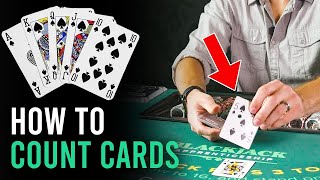
Professional card counters Colin and David (Loud and Often) teach the fundamentals of counting cards in blackjack, a skill they've used to win over $1.5 million combined. They explain that card counting doesn't require a great memory or genius-level intellect, but rather a simple system called High-Low that assigns values to cards.
Colin and David, professional card counters for 15 years, have won over $1.5 million individually and close to $4 million as teams. They now run Blackjack Apprenticeship.
Card counting is simpler than expected; it doesn't need a photographic memory or being a rocket scientist. It does take time to become perfect.
Before counting cards, one must master basic strategy. David learned it in a few weeks with a couple hours a day. No winning card counter lacks basic strategy.
Assign values: low cards (2-6) = +1, high cards (10-Ace) = -1, neutral cards (7-9) = 0. This balanced count starts and ends at zero.
David counts through a quarter deck, ending at -1. The last card is a low card (4), confirming accuracy. The running count is kept for every card from the shoe.
Wait until the second card is dealt to each player. High and low cards cancel each other. Example: a hand with a high and low card cancels out.
A high running count (many low cards out) means more high cards remain, which is good for the player. A low running count means more low cards remain, bad for the player.
Divide running count by number of decks remaining. Example: running 15 with 5 decks left = true count 3. This determines bets and playing decisions.
True count dictates bet size and when to deviate from basic strategy. This gives the player an edge over the casino.
Card counting is a learnable skill that, combined with basic strategy and true count conversion, can give players an edge. For more in-depth training, visit Blackjack Apprenticeship.
What is the first step to becoming a card counter?
Perfect basic strategy.
01:12
In the High-Low system, what value is assigned to cards 2 through 6?
+1
01:40
In the High-Low system, what value is assigned to 10, Jack, Queen, King, and Ace?
-1
02:07
What is the value of neutral cards (7, 8, 9) in the High-Low system?
0
02:22
Why does the running count always start and end at zero?
Because High-Low is a balanced count.
03:37
When should you start counting cards in a round?
Wait until the second card is dealt to each player.
04:08
What does a high running count indicate about the remaining cards?
More high cards (tens and aces) remain in the shoe.
07:08
How do you convert running count to true count?
Divide the running count by the number of decks remaining.
08:44
If running count is 15 and 5 decks remain, what is the true count?
3 (15/5 = 3)
09:10
What does the true count determine?
Bet size and playing deviations from basic strategy.
10:35
Card Counting Doesn't Require Great Memory
Dispels a common myth that card counting requires a photographic memory or genius intellect.
00:45Basic Strategy is Essential
Emphasizes that no winning card counter lacks basic strategy; it's the foundation.
01:12Why Card Counting Works
Explains the fundamental difference from other casino games: blackjack has dependent events.
07:08True Count Conversion
Key technique that adjusts running count for number of decks remaining, crucial for accurate advantage calculation.
08:17[00:01] Apprentichip and I'm here with my good friend David, also known as Loud and often, and we're going to teach you how to count cards at Blackjack and bring to count cards at Blackjack and bring down the house.
[00:17] for roughly 15 years, we've been professional card counters. We've played on our own. We've played as parts of teams. Between the two of us, we've won over $1.5 million. and our teams have won close to $4 million and we now help
[00:31] Blackjack Apprenticeship. If you want to find out more, you can subscribe to this channel where we put out weekly trainings and updates and stories and all that stuff. But let's show you how to count cards. First thing you need to
[00:45] know about card counting is it doesn't involve having a great memory. Do you Are you Rainman? No. No. Are you a rocket scientist? I am not.
[00:58] that you have incredible photographic memory. You don't need any of those you, it's going to be a lot simpler than you expect. Though, it does take quite a bit of time to become perfect at. First step is perfect basic strategy. Do you
[01:12] Yes. How long would you say it took you to Few weeks. A couple hours a day. Do you know a winning card counter that doesn't know basic strategy? No. It's really important that you don't
[01:26] counting and go beat the casinos." You have to first know basic strategy. But is going to be learning what's called the running count. First step to card counting is going to be assigning a value to every card. So this card
[01:40] called high low. It's what we have always used and what basically every major card team has used to beat casinos. And what we're going to do here is I have a fourth of a deck, a two through ace of spades. So four of these,
[01:55] one of these in every suit would be one deck of cards. And what we're going to do is separate these into different values. So we're going to have two through six, which are going to be our low cards, and those are going to be
[02:07] given a value of plus one. So every time you see a 2, 3, 4, 5, or six, you're Over here, we have 10 through ace. So every time you see a 10, jack, queen, king, or ace, we're going to subtract one. These are our high cards. And then
[02:22] neutral cards. They're going to be assigned the value of zero. Or you can basically ignore them with your running count. So I've got our quarter of a deck these over and David's just going to count through them as we go. Negative 1
[02:38] zero. Still zero one zero. Still zero. Still zero. One
[02:52] zero negative 1 -21. So at this point, David's saying we have a negative one running count. There's a negative one running count. There's one card left. And so because high low
[03:06] always ends at a zero, we know that this is going to be what kind of a card? A low card, which is a two through six. And all right, so it's a four. So we accurately. This is called the running count. And we just do this for every
[03:21] card as it comes out of the shoe from the very beginning of the shoe until the step. So this is keeping the running count. We're going to be doing what David just did for every card as it's played. And the nice thing about high
[03:37] low is because it always starts and ends at zero because it's a balance count and because it's a pretty good uh stable versatile count, you can use this exact same system whether you're playing one deck, two decks, six decks, eight decks.
[03:52] high low. So you're going to be counting every card, whether it's the other dealers cards, you're going to be counting everything until that cut card examples of what this is going to look like, keeping the rank count as it's
[04:08] dealt. Here's our our first example round. And I actually don't recommend counting until the second card is being dealt to each player. So then right dealt to each player. So then right here, we would say 1, two,
[04:31] And so we have a two because this is a neutral. This is a zero. And one thing that's really nice, a shortcut is if you have a high and a low card like this hand or this hand, these actually just cancel each other out. So the other way
[04:44] you would count it is one, two, cancel, cancel. Still a running two. And then at this point, you would count each card as it comes out with splits and all that running two. And now you're going to count as every card comes out of the
[04:59] count as every card comes out of the shoe. So we have plus two and then one 3 2
[05:16] 1 zero 2 2 and a running two. Now, we're going to
[05:28] keep that running count into the second round. So, we have a running two. And round. So, we have a running two. And again, wait for the second card to come out. So, we have two 1 zero.
[05:43] Those are both zeros. 1 -2 and 1. This player's going to stay. This player's going to stay. He's got a blackjack. So we have -1,
[05:58] So we have -1, -2, negative, we say D for down, like D3. It's just a little bit faster to say, a little bit easier to do. And we're going to keep that running count. Thatg -3
[06:13] to keep that running count. Thatg -3 into the third round. Again, waiting for the second card cancel. So, we're still at D3G -3 -21
[06:28] cancel. So, we're still at D3G -3 -21 -21. He's going to stay. He's going to double. So, now we're at zero
[06:42] what we're going to continue to do round after round as the count fluctuates it goes more positive, that's going to give us the information we're going to need to know when we have the advantage and how to play accordingly. As it goes
[06:56] further to the casino, and we're going to use that information to our advantage been doing so far with the running count? Let's say we're seeing the cards
[07:08] go into the discard tray and the running count is changing. What does that even coming out, it means there's more high cards in the shoe yet to come, which That's right. So, this is how blackjack is fundamentally different than every
[07:23] other game in a casino. Every other game is based on independent events, like a throw of the dice or a spin of the roulette wheel, those are independent events. But if a bunch of small cards have come out of the shoe, those aren't
[07:36] going to be in play again until the dealer shuffles. What we know is that what's in here correlates to what remains in the shoe. So like David said, if the count is going high because lots of small cards have come out, that means
[07:50] High cards. Yeah. Tens and aces are going to be coming out of the shoe, which is good for the player. It's not enough yet, but that tells you where we're going. Conversely, if lots of high cards have
[08:03] does that mean for the player? Uh, bad news. advantage is going higher and higher, which is not good for us. So, at this point, we're keeping our running count, but that's not going to be enough for us
[08:17] but that's not going to be enough for us because that only tells us in the entire shoe how the composition of the shoe is changing. But there's a big difference if, let's say, we have a running 10, and if you look at this SIS card tray,
[08:30] there's five decks left. So if there's a rank 10 with five decks left, that's going to be very different than if we have a running 10 with only one deck left to be dealt. So what we have to do at this point is convert to our count
[08:44] per deck or what we call the true count. And you might be getting overwhelmed saying, "What else do I have to do?" But it's really some fourth grade division. And what we're going to do is take that running count that David's been keeping
[08:56] this entire shoe and divide it by how many decks remain to be dealt. So this is a six deck discard tray. Here we have one deck in there. That means there are five decks that remain to be dealt. Let's give you a few examples of
[09:10] converting to the true count. So David, let's say we've got a running 15 right terms of the true count? Well, I've got five decks left. 15 / 5 So our true count in this situation, if we had a running count of 15, would be a
[09:26] true three. And that will dictate how we bet and even playing decisions, which I'll get to in a minute. And as soon as you make that calculation, it's going to decisions, and then you just go right back to that running count of
[09:41] That's right. Here's another example. There's about three decks in the discard three decks left. Three decks left. So, let's say we have a running -7. -7 / 3 is -2. So, in this situation, we
[09:57] would be saying, "I'm going to go make a phone call." from the table because this is a bad situation for a card counter. Let's do one more example. So, in this situation, we've got about four decks that have
[10:11] tray. Let's say we have a running nine. So, 9 / two decks left is four. Even though it's technically four and a half, we would just round it down to a
[10:23] true four. And that is going to be a pretty good count for us. And so that's going to determine our bets here. The fourth step as a card counter is to use this information to determine both our bets and our playing deviations, which
[10:35] are going to be times where we actually don't follow basic strategy based on the running count or true count. So perfect basic strategy, perfect running count, perfect true count conversion gives us enough information to actually gain the
[10:51] edge over the casino. It's not easy, but it can be done. So, this gives you an be honest, there is a lot more you need to learn. That's what we're here for. If our weekly updates. You can check out the channel where we've got tons of
[11:05] blackjack. Also at blackjackapprenip.com, we have a free card counting miniourse where you can learn more and I get into some more examples of how to count cards to how to make it easier, how to be faster at it,
[11:19] counter and all the common mistakes to avoid as a new card counter. Check that avoid as a new card counter. Check that out at blackjack apprentichip.com.



⚡ Saved you 0h 11m reading this? Transcribe any YouTube video for free — no signup needed.